


 |
BIO521S OR IBC521S - BIOCHEMISTRY - 1ST OPP -NOV 2025 |
|
|
1 Page 1 |
▲back to top |
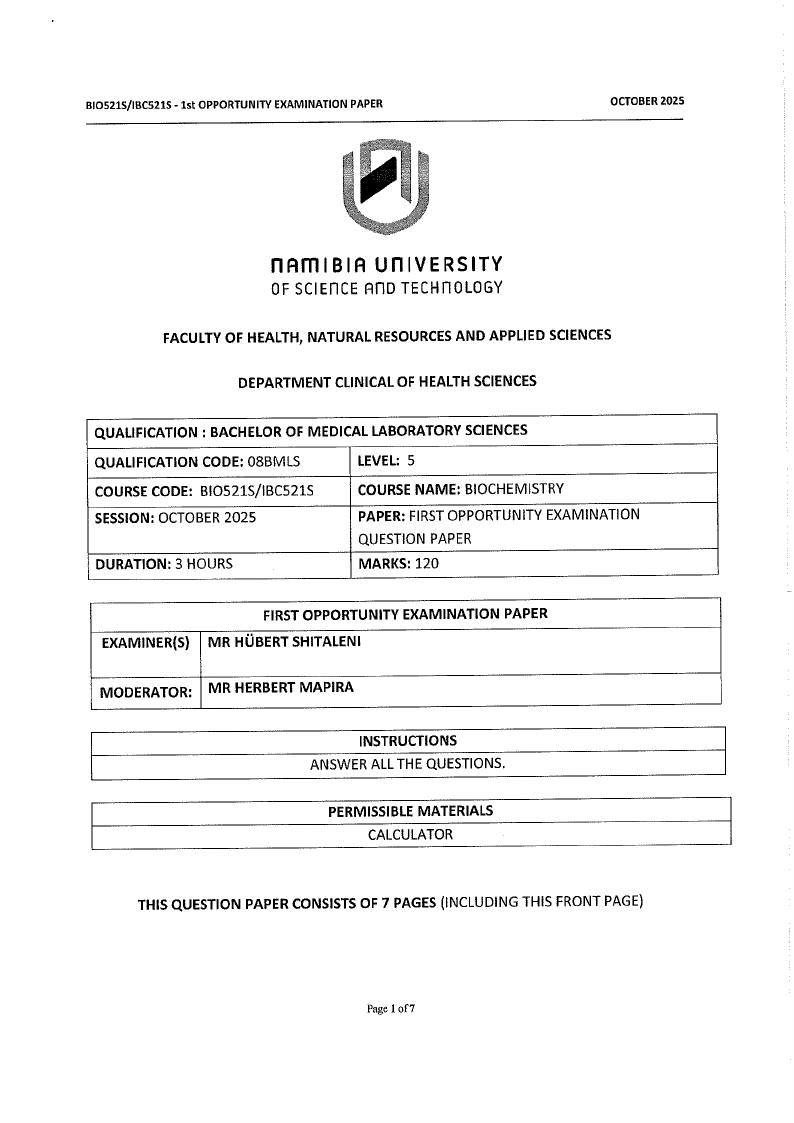
BIO521S/IBCS21S-1st OPPORTUNITY EXAMINATION PAPER
OCTOBER 2025
nArTIIBIA unlVERSITY
OF SCIEnCE Ano TECHnOLOGY
FACULTY OF HEALTH, NATURAL RESOURCES AND APPLIED SCIENCES
DEPARTMENT CLINICAL OF HEALTH SCIENCES
QUALIFICATION : BACHELOR OF MEDICAL LABORATORY SCIENCES
QUALIFICATION CODE: 08BMLS
LEVEL: 5
COURSE CODE: BIO521S/IBC521S
SESSION: OCTOBER 2025
DURATION: 3 HOURS
COURSE NAME: BIOCHEMISTRY
PAPER: FIRST OPPORTUNITY EXAMINATION
QUESTION PAPER
MARKS: 120
FIRST OPPORTUNITY EXAMINATION PAPER
EXAMINER(S} MR HUBERT SHITALENI
MODERATOR: MR HERBERT MAPIRA
INSTRUCTIONS
I
1-------------A-N_S_W_ER_A_L_L_T_H_E_Q_U_E-ST_I_O_N_S_.- - - - - - - - - - -
PERMISSIBLE MATERIALS
CALCULATOR
THIS QUESTION PAPER CONSISTS OF 7 PAGES (INCLUDING THIS FRONT PAGE}
Page 1 of7
|
|
2 Page 2 |
▲back to top |
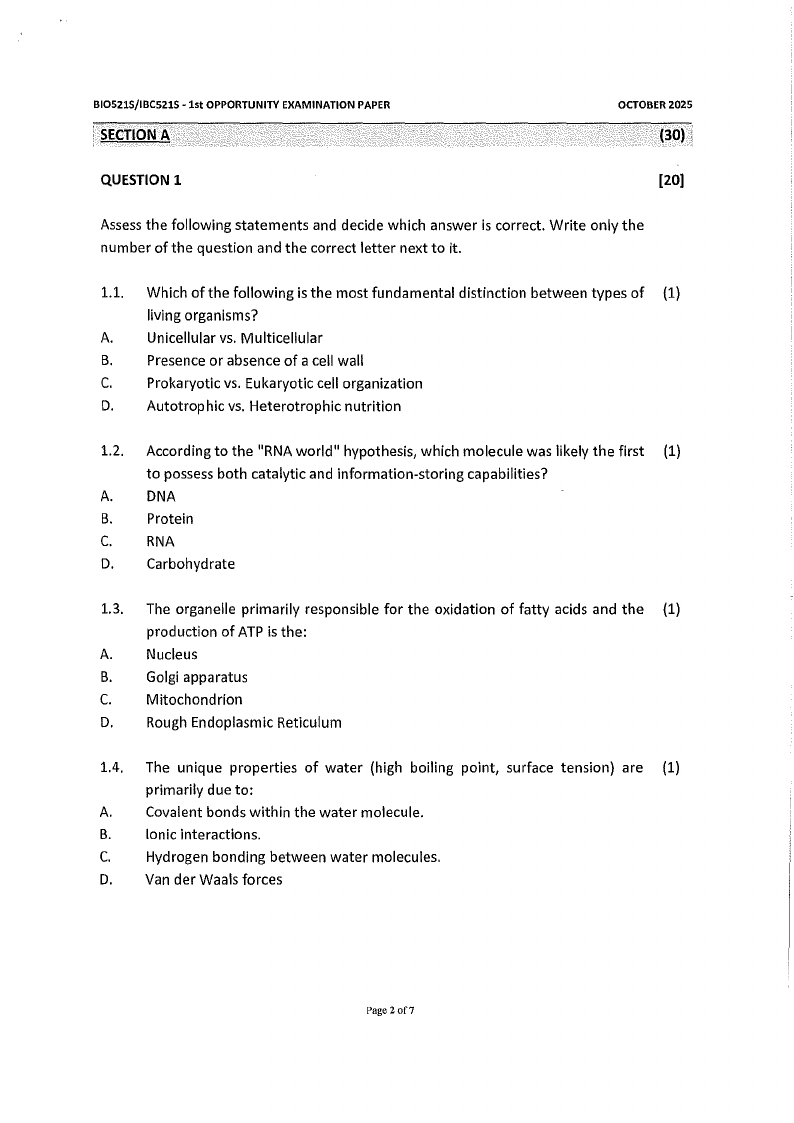
BIO5215/IBC5215 -1st OPPORTUNITY EXAMINATION PAPER
;SECTION A
OCTOBER 2025
• (30) j
QUESTION 1
[20]
Assess the following statements and decide which answer is correct. Write only the
number of the question and the correct letter next to it.
1.1. Which of the following is the most fundamental distinction between types of {1)
living organisms?
A. Unicellular vs. Multicellular
B. Presence or absence of a cell wall
C. Prokaryotic vs. Eukaryotic cell organization
D. Autotrophic vs. Heterotrophic nutrition
1.2. According to the "RNA world" hypothesis, which molecule was likely the first (1)
to possess both catalytic and information-storing capabilities?
A. DNA
B. Protein
C. RNA
D. Carbohydrate
1.3. The organelle primarily responsible for the oxidation of fatty acids and the {1)
production of ATP is the:
A. Nucleus
B. Golgi apparatus
C. Mitochondrion
D. Rough Endoplasmic Reticulum
1.4. The unique properties of water (high boiling point, surface tension) are {1)
primarily due to:
A. Covalent bonds within the water molecule.
B. Ionic interactions.
C. Hydrogen bonding between water molecules.
D. Van der Waals forces
Page 2 of7
|
|
3 Page 3 |
▲back to top |
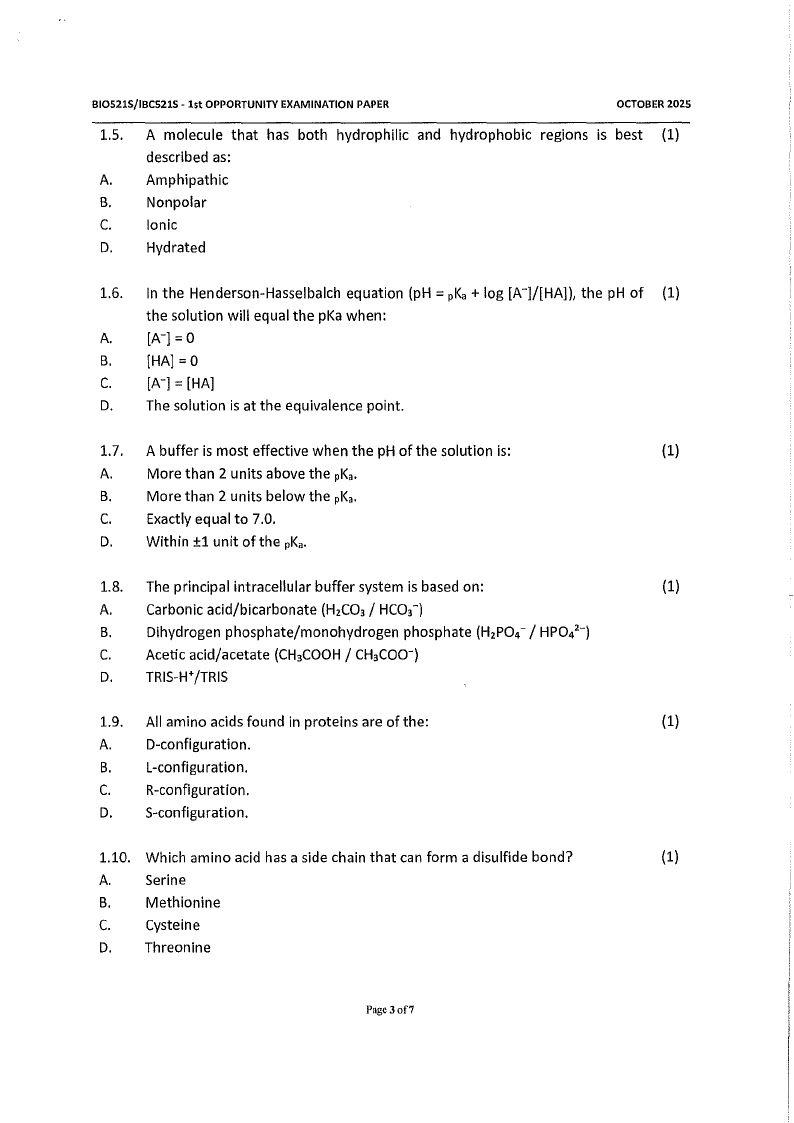
BIO5215/IBC5215 - 1st OPPORTUNITY EXAMINATION PAPER
OCTOBER 2025
1.5. A molecule that has both hydrophilic and hydrophobic regions is best (1)
described as:
A. Amphipathic
B. Nonpolar
C. Ionic
D. Hydrated
1.6. In the Henderson-Hasselbalch equation (pH= pl<a + log [A-J/[HA]), the pH of (1)
the solution will equal the pl<a when:
A. [A-] = 0
B. [HA]= 0
C. [A-] = [HA]
D. The solution is at the equivalence point.
1.7. A buffer is most effective when the pH of the solution is:
(1)
A. More than 2 units above the pl<a,
B. More than 2 units below the pl<a,
C. Exactly equal to 7.0.
D. Within ±1 unit of the pl<a,
1.8. The principal intracellular buffer system is based on:
(1)
A. Carbonic acid/bicarbonate (H2CO3/ HCO3-)
B.
Dihydrogen phosphate/monohydrogen phosphate (H2Po.- / HPO/-)
C. Acetic acid/acetate (CH3COOH / CH3Coo-)
D. TRIS-W /TRIS
1.9. All amino acids found in proteins are of the:
(1)
A. D-configuration.
B. L-configuration.
C. R-configuration.
D. $-configuration.
1.10. Which amino acid has a side chain that can form a disulfide bond?
(1)
A. Serine
B. Methionine
C. Cysteine
D. Threonine
Page 3 of7
|
|
4 Page 4 |
▲back to top |
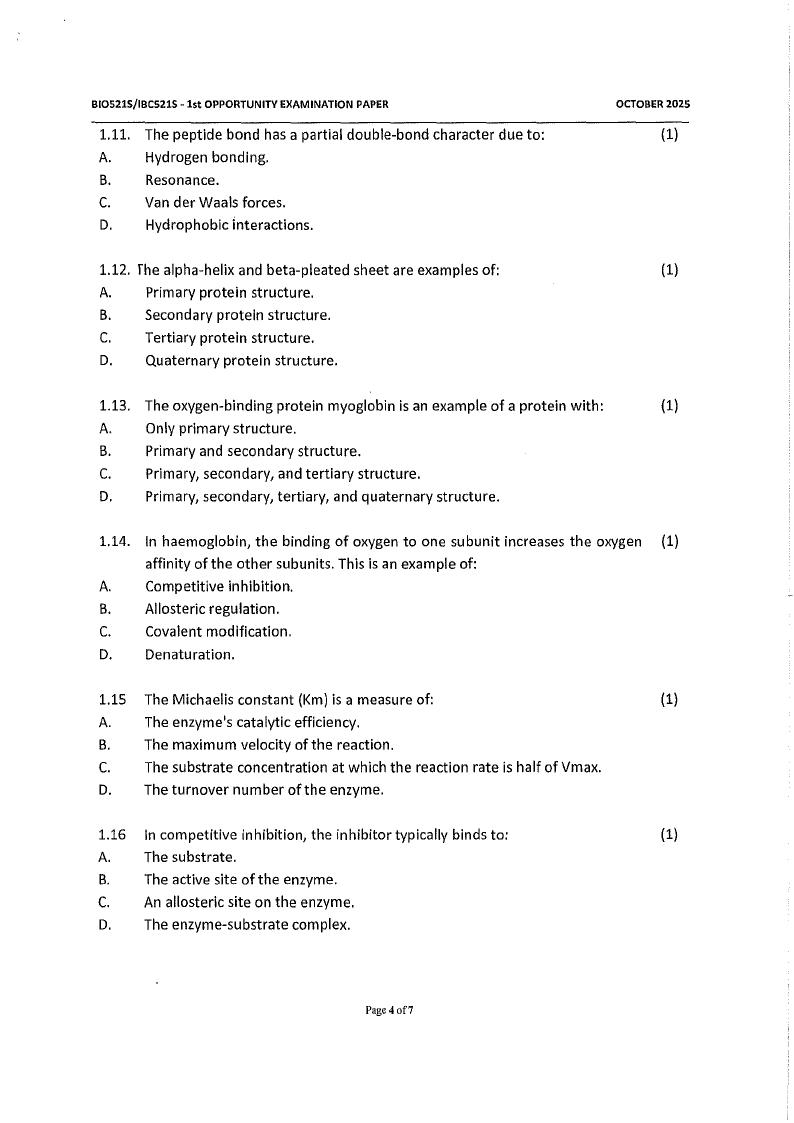
B1O521S/IBCS21S- lst OPPORTUNITY EXAMINATION PAPER
1.11.
A.
8.
C.
D.
The peptide bond has a partial double-bond character due to:
Hydrogen bonding.
Resonance.
Van der Waals forces.
Hydrophobic interactions.
OCTOBER 2025
(1)
1.12. fhe alpha-helix and beta-pleated sheet are examples of:
(1)
A. Primary protein structure.
8. Secondary protein structure.
C. Tertiary protein structure.
D. Quaternary protein structure.
1.13. The oxygen-binding protein myoglobin is an example of a protein with:
(1)
A. Only primary structure.
8. Primary and secondary structure.
C. Primary, secondary, and tertiary structure.
D. Primary, secondary, tertiary, and quaternary structure.
1.14. In haemoglobin, the binding of oxygen to one subunit increases the oxygen (1)
affinity of the other subunits. This is an example of:
A. Competitive inhibition.
8. Allosteric regulation.
C. Covalent modification.
D. Denaturation.
1.15 The Michaelis constant (Km) is a measure of:
(1)
A. The enzyme's catalytic efficiency.
8. The maximum velocity of the reaction.
C. The substrate concentration at which the reaction rate is half of Vmax.
D. The turnover number of the enzyme.
1.16 In competitive inhibition, the inhibitor typically binds to:
(1)
A. The substrate.
8. The active site of the enzyme.
C. An allosteric site on the enzyme.
D. The enzyme-substrate complex.
Page 4 of7
|
|
5 Page 5 |
▲back to top |
B1O521S/IBC521S • 1st OPPORTUNITY EXAMINATION PAPER
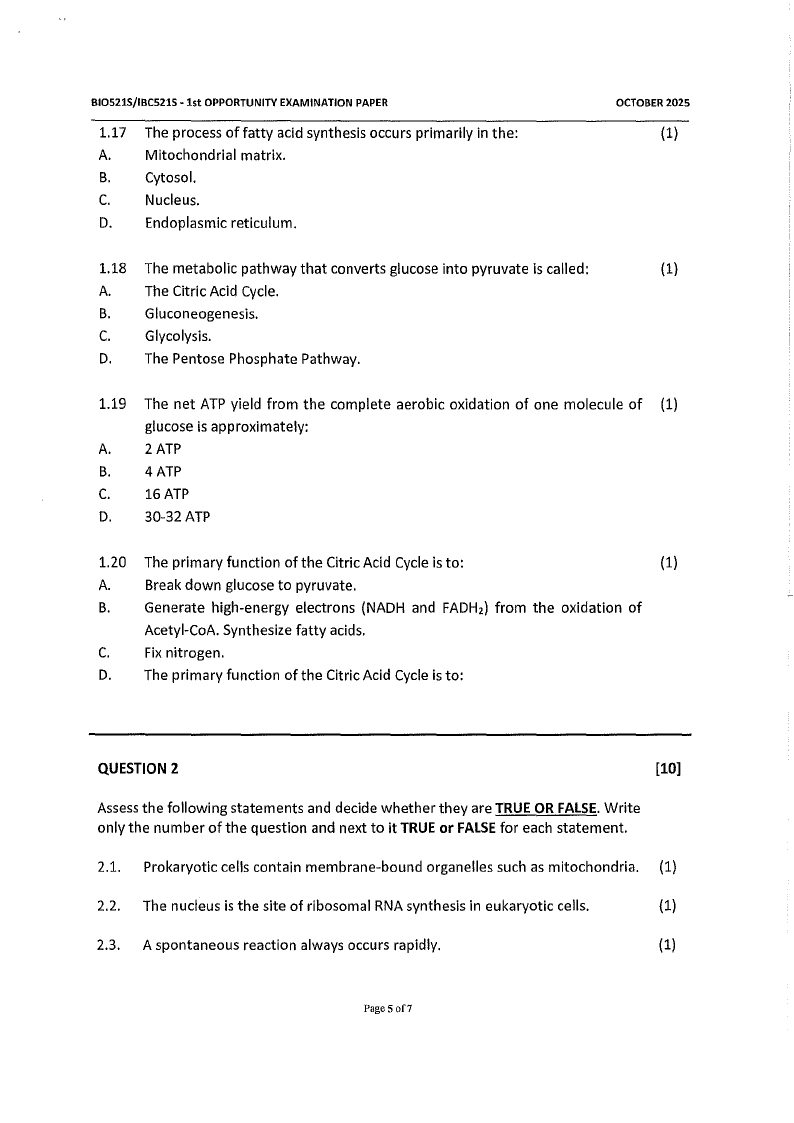
1.17 The process of fatty acid synthesis occurs primarily in the:
A. Mitochondrial matrix.
B. Cytosol.
C. Nucleus.
D. Endoplasmic reticulum.
OCTOBER 2025
(1)
1.18 The metabolic pathway that converts glucose into pyruvate is called:
(1)
A. The Citric Acid Cycle.
B. Gluconeogenesis.
C. Glycolysis.
D. The Pentose Phosphate Pathway.
1.19 The net ATP yield from the complete aerobic oxidation of one molecule of (1)
glucose is approximately:
A. 2ATP
B. 4ATP
C. 16 ATP
D. 30-32 ATP
1.20 The primary function of the Citric Acid Cycle is to:
(1)
A. Break down glucose to pyruvate.
B. Generate high-energy electrons (NADH and FADH 2) from the oxidation of
Acetyl-CoA. Synthesize fatty acids.
C. Fix nitrogen.
D. The primary function of the Citric Acid Cycle is to:
QUESTION 2
[10]
Assess the following statements and decide whether they are TRUE OR FALSE. Write
only the number of the question and next to it TRUE or FALSE for each statement.
2.1. Prokaryotic cells contain membrane-bound organelles such as mitochondria. (1)
2.2. The nucleus is the site of ribosomal RNA synthesis in eukaryotic cells.
(1)
2.3. A spontaneous reaction always occurs rapidly,
(1)
Page 5 of7
|
|
6 Page 6 |
▲back to top |
BIO521S/IBC521S-1st OPPORTUNITY EXAMINATION PAPER
OCTOBER 2025
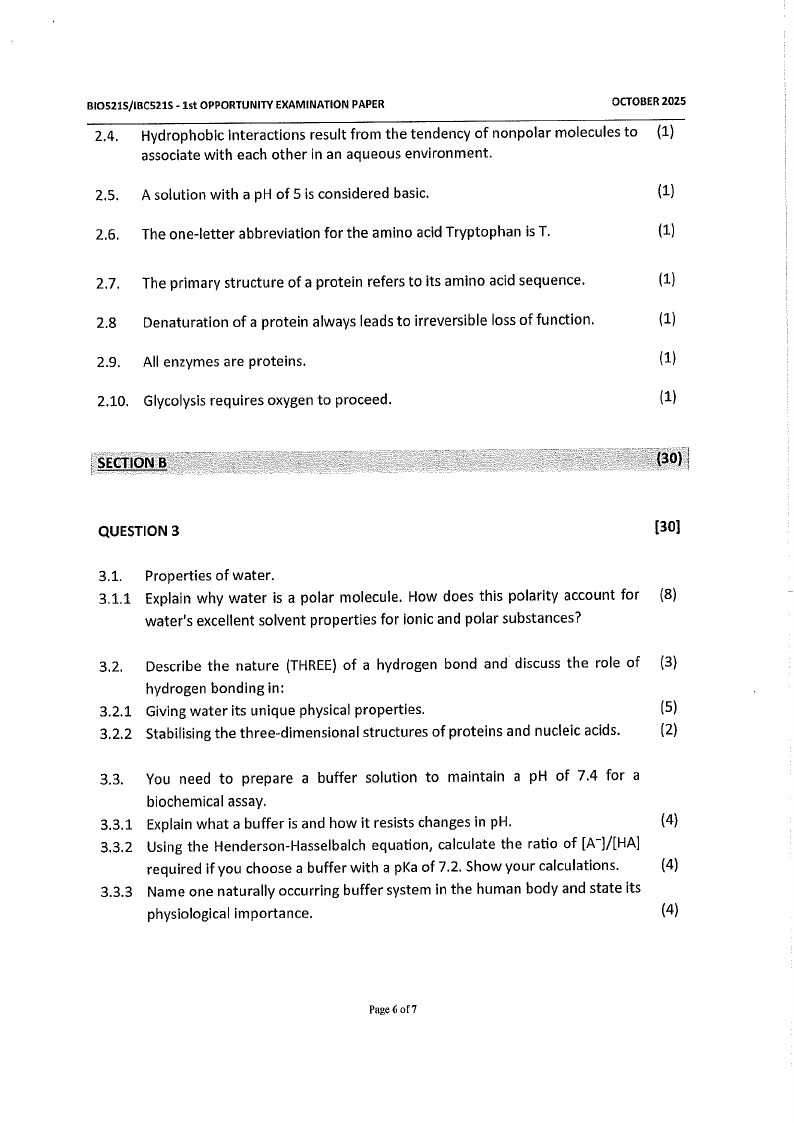
2.4. Hydrophobic interactions result from the tendency of non polar molecules to (1)
associate with each other in an aqueous environment.
2.5. A solution with a pH of 5 is considered basic.
(1)
2.6. The one-letter abbreviation for the amino acid Tryptophan is T.
(1)
2.7. The primary structure of a protein refers to its amino acid sequence.
(1)
2.8 Denaturation of a protein always leads to irreversible loss of function.
(1)
2.9, All enzymes are proteins.
(1)
2.10. Glycolysis requires oxygen to proceed.
(1)
QUESTION 3
[30]
3.1. Properties of water.
3.1.1 Explain why water is a polar molecule. How does this polarity account for (8)
water's excellent solvent properties for ionic and polar substances?
3.2. Describe the nature (THREE) of a hydrogen bond and discuss the role of (3)
hydrogen bonding in:
3.2.1 Giving water its unique physical properties.
(5)
3.2.2 Stabilising the three-dimensional structures of proteins and nucleic acids.
(2)
3.3. You need to prepare a buffer solution to maintain a pH of 7.4 for a
biochemical assay.
3.3.1 Explain what a buffer is and how it resists changes in pH.
(4)
3.3.2 Using the Henderson-Hasselbalch equation, calculate the ratio of [A-J/[HA]
required if you choose a buffer with a pKa of 7.2. Show your calculations.
(4)
3.3.3 Name one naturally occurring buffer system in the human body and state its
physiological importance.
(4)
Page 6 of7
|
|
7 Page 7 |
▲back to top |
BIO521S/IBCS21S -1st OPPORTUNITY EXAMINATION PAPER
i SECTION C
OCTOBER 2025
.. l6<>fl
QUESTION 4
[60)
4.1. Amino Acids.
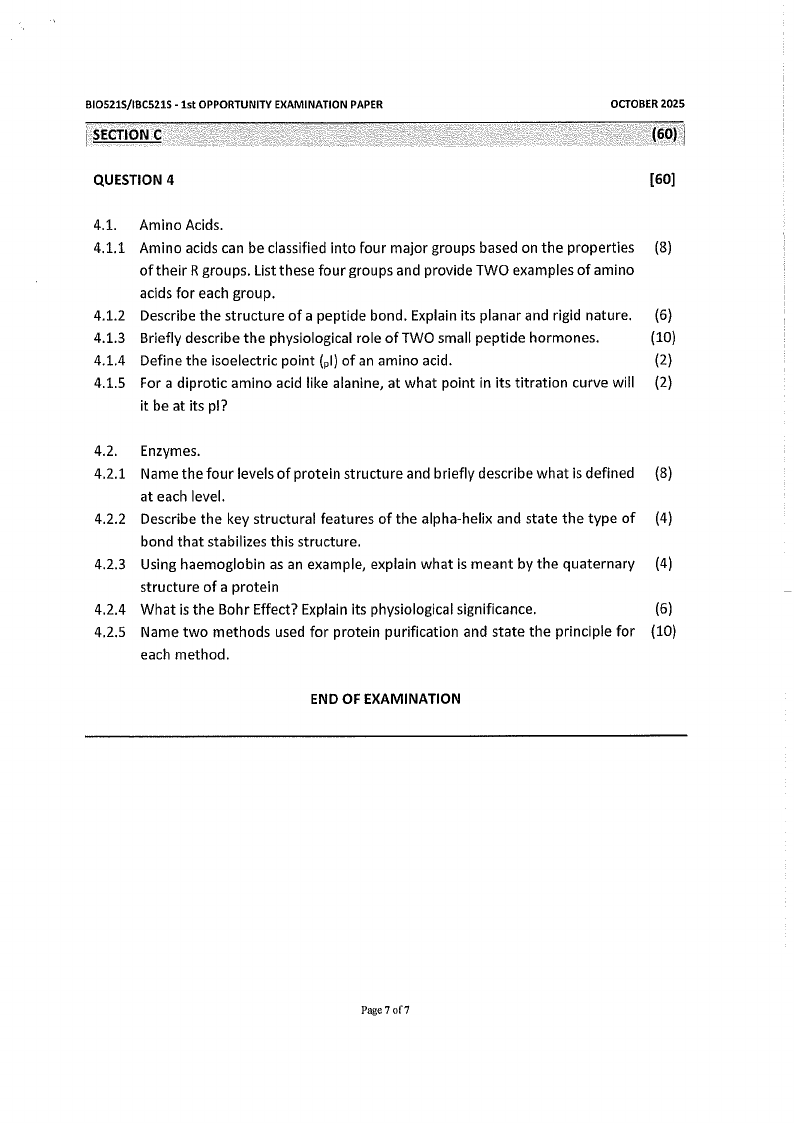
4.1.1 Amino acids can be classified into four major groups based on the properties (8)
of their Rgroups. List these four groups and provide TWO examples of amino
acids for each group.
4.1.2 Describe the structure of a peptide bond. Explain its planar and rigid nature. (6)
4.1.3 Briefly describe the physiological role of TWO small peptide hormones.
(10)
4.1.4 Define the isoelectric point (pl) of an amino acid.
(2)
4.1.5 For a diprotic amino acid like alanine, at what point in its titration curve will (2)
it be at its pl?
4.2. Enzymes.
4.2.1 Name the four levels of protein structure and briefly describe what is defined (8)
at each level.
4.2.2 Describe the key structural features of the alpha-helix and state the type of (4)
bond that stabilizes this structure.
4.2.3 Using haemoglobin as an example, explain what is meant by the quaternary (4)
structure of a protein
4.2.4 What is the Bohr Effect? Explain its physiological significance.
(6)
4.2.5 Name two methods used for protein purification and state the principle for (10)
each method.
END OF EXAMINATION
Page 7 of7