


 |
MOD621S -MOLECULAR DIAGNOSTIC - 2ND OPP - DEC 2025 |
|
|
1 Page 1 |
▲back to top |
nAmlBIA unlVERSITY
OF SCIEnCE AnDTECHnOLOGY
Faculty of Health, Natural
Resources and Applied
Sciences
School of Health Sciences
Department of Clinical
Health Sciences
13 Ja ckson Kaujeua Street T: +264 61 207 2970
Private Bag 13388
F: +264 61 207 9 97□
Windhoek
E: dchs@nust .na
NAMIBIA
W: www.nust.na
QUALIFICATION: BACHELOR of MEDICAL LABORATORY SCIENCES
QUALIFICATION CODE: 08BMLS
LEVEL: 6
COURSE: MOLECULAR DIAGNOSTICS
COURSE CODE: MOD621S
DATE: DECEMBER 2025
SESSION: 1
DURATION: 3 HOURS
MARKS: 100
SECOND OPPORTUNITY/ SUPPLEMENTARY: EXAMINATION QUESTION PAPER
EXAMINER:
MODERATOR:
Ms Vanessa Tjijenda
Dr Taime Sylvester
INSTRUCTIONS:
1. Answer all questions on the separate answer sheet.
2. Please write neatly and legibly.
3 . Do not use the left side margin of the exam paper. This must be allowed for the
examiner.
4. No books, notes and other additional aids are allowed.
5 . Mark all answers clearly with their respective question numbers.
PERMISSIBLE MATERIALS:
1. Non-Programm able Calculator
ATTACHEMENTS
1. None
This question paper consists of 5 pages including this front page.
|
|
2 Page 2 |
▲back to top |
ECTION A:
QUESTION 1:
Differentiate between the following:
1.1 Primers melting and annealing temperature.
1.2 Northern and Southern Blotting techniques.
1.3 0.8 % agarose gel and 2% agarose gel in relation to DNA movement.
1.4 Multiplex PCR and Microarray.
1.5 T4 Polynucleatide Kinase and Sl Nuclease.
1.6 Annealing and Extension processes in PCR.
1.7 RFLP and VNTR.
1.8 Palindrome and PCR target sequence.
1.9 lsopropyl alcohol and sodium acetate during DNA extraction.
1.10 PCR copies in cycle 3 and 14.
20 MARKS
(20 MARKS]
(2)
(2)
(2)
(2)
(2)
(2)
(2)
(2)
(2)
(2)
ECTION B: SHORT ANSWER UESTIONS
Please answer ALL of the questions in this section.
QUESTION 2
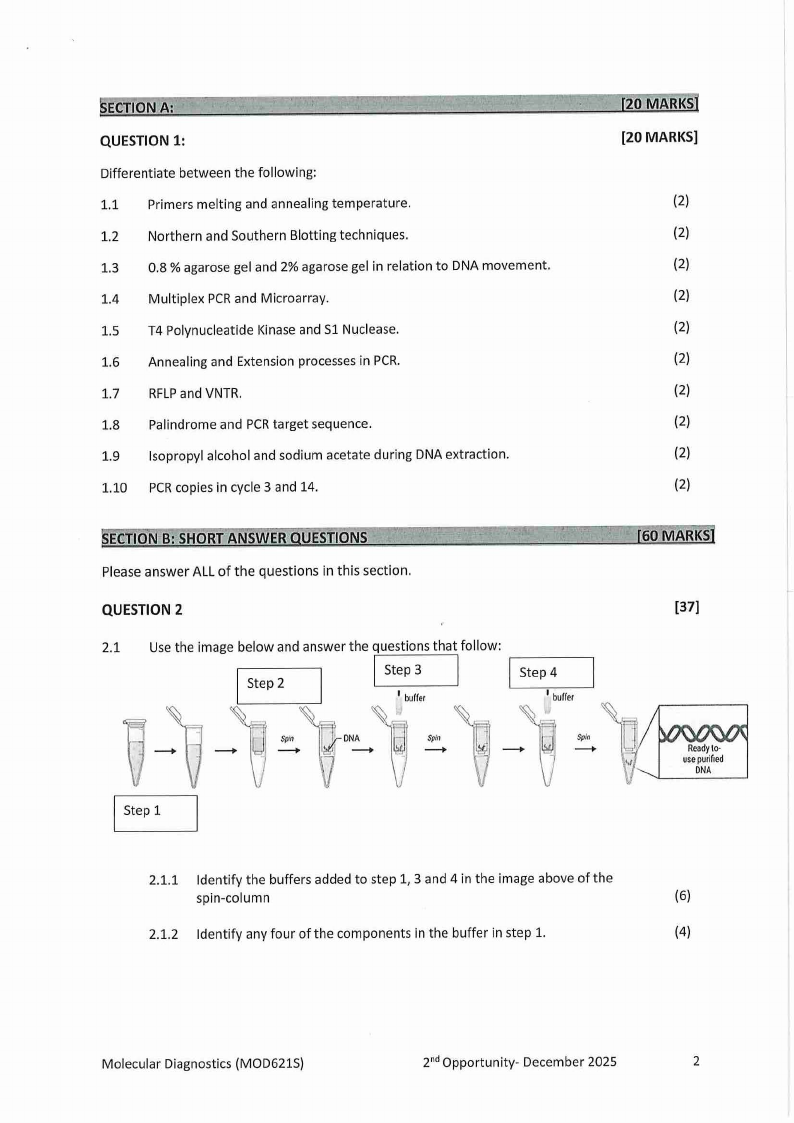
2.1 Use the image below and answer the questions that follow:
I S~p3 I
- ~-e-p-4- ~
9-
-Spin
1 buffer
I buffer
~) -1 -Spin
1 Step 1
GO MARKS
[37)
2.1.1 Identify the buffers added to step 1, 3 and 4 in the image above of the
spin-column
(6)
2.1.2 Identify any four of the components in the buffer in step 1.
(4)
Molecular Diagnostics (MOD621S)
2nd Opportunity- December 2025
2
|
|
3 Page 3 |
▲back to top |
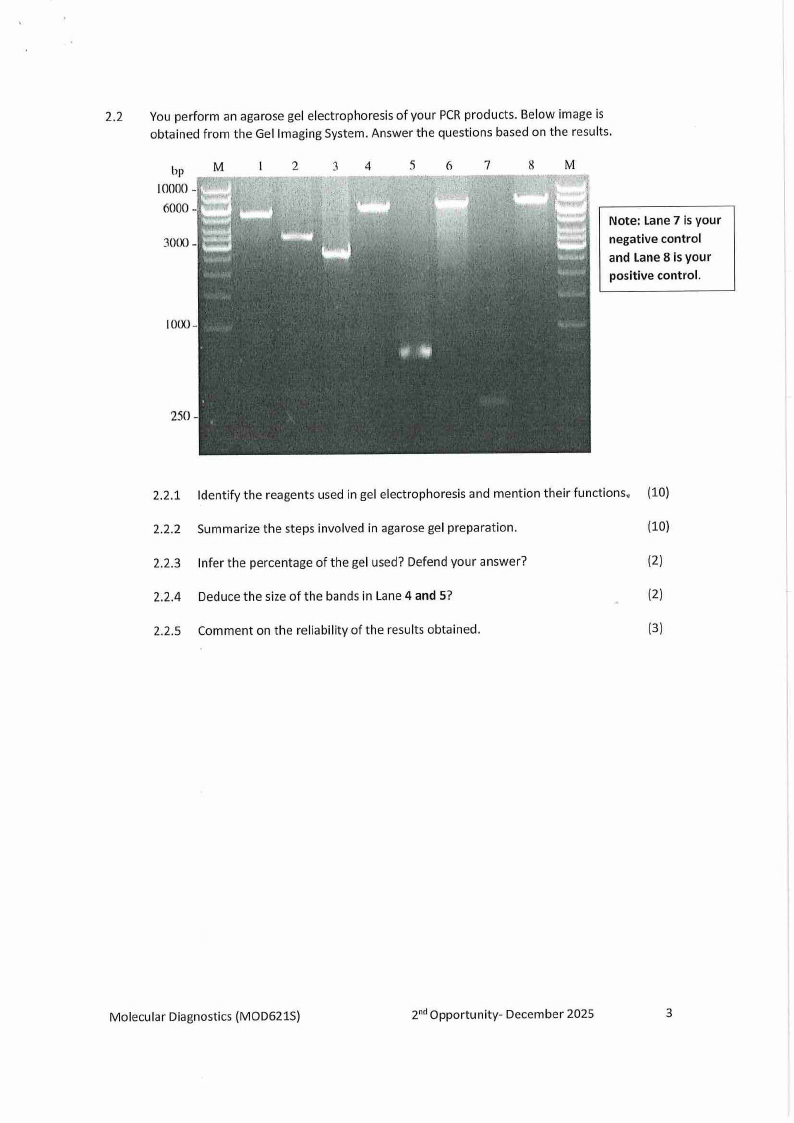
2.2 You perform an agarose gel electrophoresis of your PCR products. Below image is
obtained from the Gel Imaging System. Answer the questions based on the results.
bp M
10000 -
6000-
30(Xl -
2
34
56 7
8M
Note: Lane 7 ls your
negative control
and Lane 8 is your
positive control.
2.2.1 Identify the reagents used in gel electrophoresis and mention their functions. (10)
2.2.2 Summarize the steps involved in agarose gel preparation.
(10)
2.2.3 Infer the percentage of the gel used? Defend you r answer?
(2)
2.2.4 Deduce the size of the bands in Lane 4 and S?
(2)
2.2.5 Comment on the reliability of the results obtained.
(3)
Molecular Diagnostics (MOD621S)
2nd Opportunity- December 2025
3
|
|
4 Page 4 |
▲back to top |
QUESTION 3
(11]
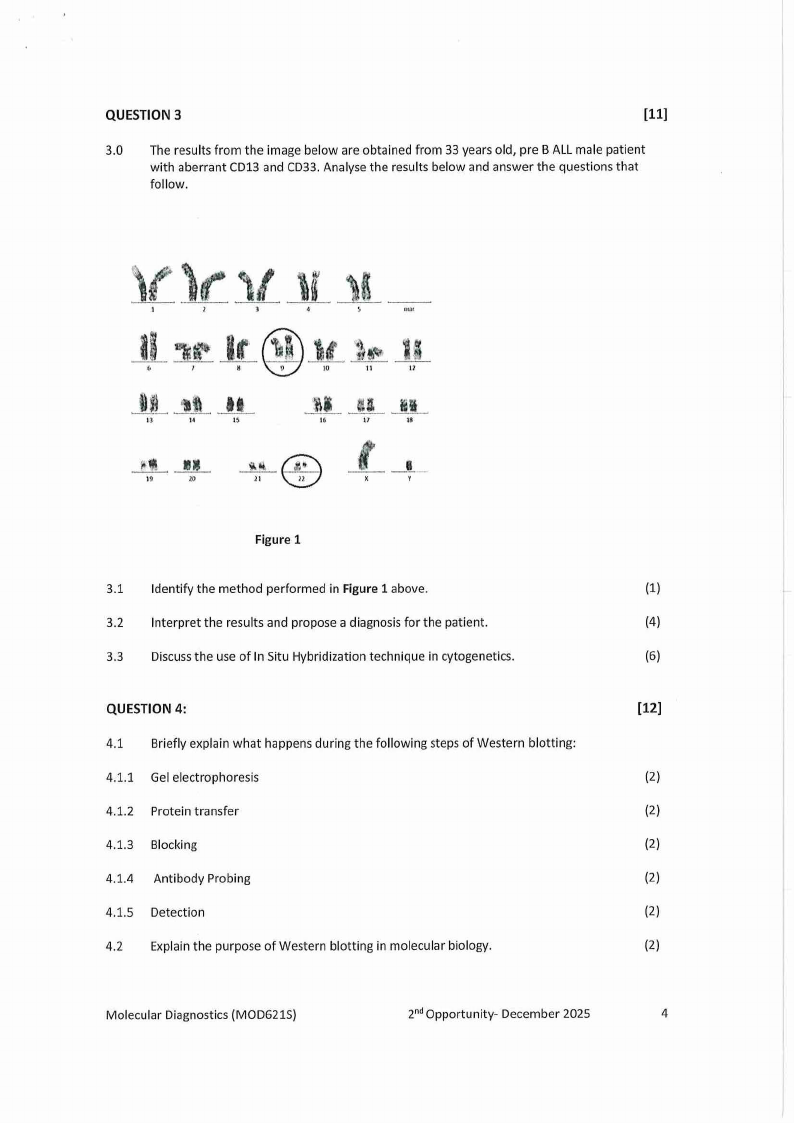
3.0 The results from the image below are obtained from 33 years old, pre BALL male patient
with aberrant CD13 and CD33. Analyse the results below and answer the questions that
follow.
Ill.If
__tl__H_
19
lO
__:n!__Jtj_ __!L
16
17
13
_J_ _j_
X
V
Figure 1
3.1 Identify the method performed in Figure 1 above.
(1)
3.2 Interpret the results and propose a diagnosis for the patient.
(4)
3.3 Discuss the use of In Situ Hybridization technique in cytogenetics.
(6)
QUESTION 4:
[12]
4.1 Briefly explain what happens during the following steps of Western blotting:
4.1.1 Gel electrophoresis
(2)
4.1.2 Protein transfer
(2)
4.1.3 Blocking
(2)
4.1.4 Antibody Probing
(2)
4.1.5 Detection
(2)
4.2 Explain the purpose of Western blotting in molecular biology.
(2)
Molecular Diagnostics (MOD6215)
2nd Opportunity- December 2025
4
|
|
5 Page 5 |
▲back to top |
NSWER QUESTIONS
Please answer ALL of the questions in this section.
[20 MARKSJj
QUESTION 5:
5.1 You are interested in doing Cross-species studies for your Masters degree. You are
particularly interested in studying gene expression in a closely related species. Using
hybridization techniques, explain step by step how you will achieve this.
(10)
5.2 The Conventional PCR method can be modified to increase specificity. One such
technique is Hot Start PCR, explain in detail how specificity is achieved in this method (10)
END OF QUESTION PAPER
Molecular Diagnostics (MOD621S)
2nd Opportunity- December 2025
5