


 |
MOD621S -MOLECULAR DIAGNOSTIC - 1ST OPP - NOV 2025 |
|
|
1 Page 1 |
▲back to top |
nAm I BI A un IVE RS ITY
OF SCIEnCE Ano TECH no LOGY
Faculty of Health, Natural
Resources and Applied
Sciences
School of Health Sciences
Department of Clinical
Health Sciences
13 Jackson Kauj eua Street T: +264 61 207 2970
Private Bag 13388
F: +264 61 207 9970
Windhoek
E: dchs@nust.na
NAMIBIA
W: www.nust .na
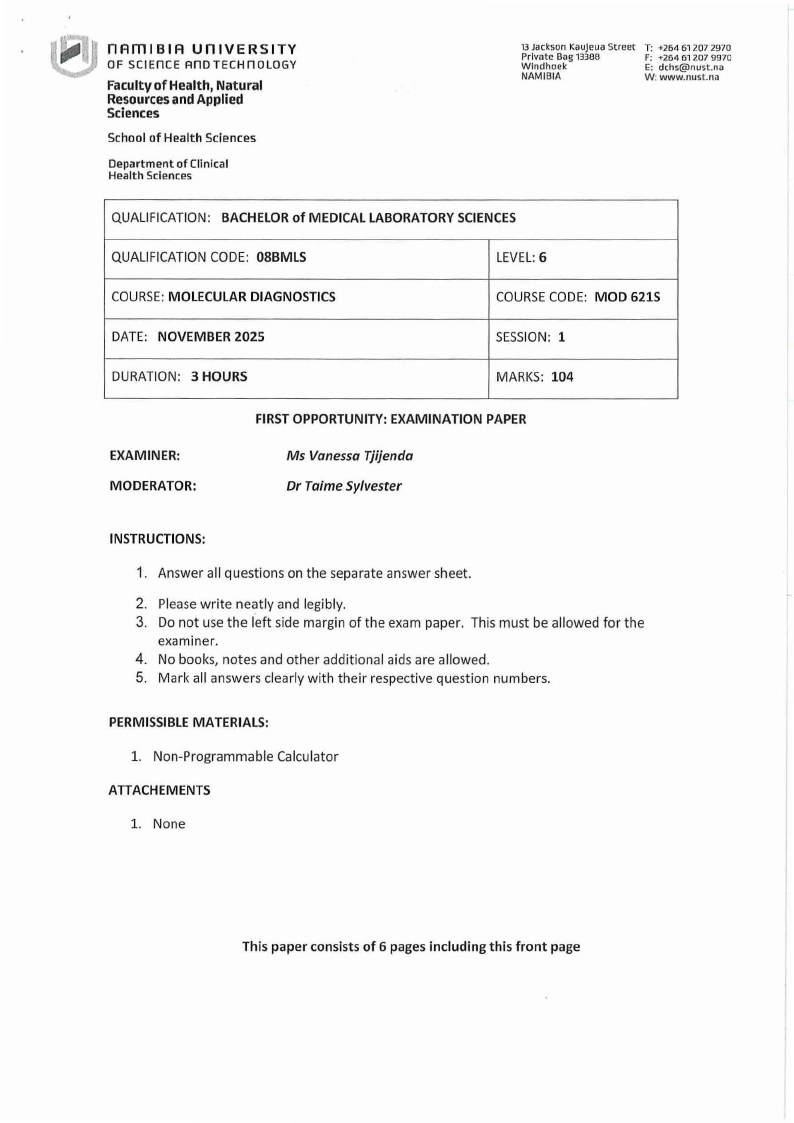
QUALIFICATION: BACHELOR of MEDICAL LABORATORY SCIENCES
QUALIFICATION CODE: 08BMLS
LEVEL: 6
COURSE: MOLECULAR DIAGNOSTICS
CO URSE CODE: MOD 621S
DATE: NOVEMBER 2025
SESSION: 1
DURATION: 3 HOURS
MARKS: 104
EXAMINER:
MODERATOR:
FIRST OPPORTUNITY: EXAMINATION PAPER
Ms Vanessa Tjijenda
Dr Taime Sylvester
INSTRUCTIONS:
1. Answer al l questions on the separate answer sheet.
2. Please write neatly and legibly.
3. Do not use the left side margin of the exam paper. This must be allowed for the
exa miner.
4. No books, notes and other additional aids are allowed.
5. Mark all answers clearly w ith their respective question numbers.
PERMISSIBLE MATERIALS:
1. Non-Programmable Calculator
ATTACHEMENTS
1. None
This paper consists of 6 pages including this front page
|
|
2 Page 2 |
▲back to top |
ECTION A: Ml!JLTIPLE ClitO.IOE
10 MARKS
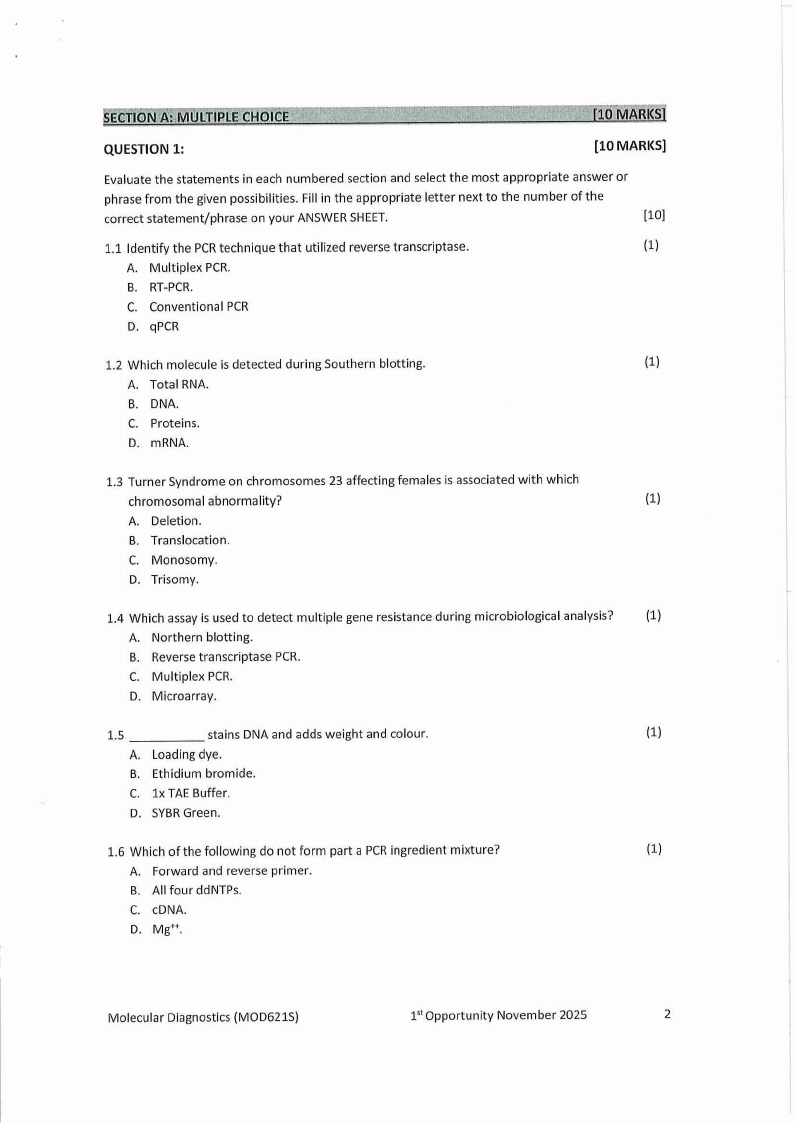
QUESTION 1:
[lOMARKS]
Evaluate the statements in each numbered section and select the most appropriate answer or
phrase from the given possibilities. Fill in the appropriate letter next to the number of the
correct statement/phrase on your ANSWER SHEET.
(10]
1.1 Identify the PCR technique that utilized reverse transcriptase.
(1)
A. Multiplex PCR.
B. RT-PCR.
C. Conventional PCR
D. qPCR
1.2 Which molecule is detected during Southern blotting.
(1)
A. Total RNA.
B. DNA.
C. Proteins.
D. mRNA.
1.3 Turner Syndrome on chromosomes 23 affecting females is associated with which
chromosomal abnormality?
(1)
A. Deletion.
B. Translocation.
C. Monosomy.
D. Trisomy.
1.4 Which assay is used to detect multiple gene resistance during microbiological analysis?
(1)
A. Northern blotting.
B. Reverse transcriptase PCR.
C. Multiplex PCR.
D. Microarray.
1.5 _ __ __ stains DNA and adds weight and colour.
(1)
A. Loading dye.
B. Ethidium bromide.
C. lx TAE Buffer.
D. SYBR Green.
1.6 Which of the following do not form part a PCR ingredient mixture?
(1)
A. Forward and reverse primer.
B. All four ddNTPs.
C. cDNA.
D. Mg<'.
Molecular Diagnostics (MOD621S)
1st Opportunity November 2025
2
|
|
3 Page 3 |
▲back to top |
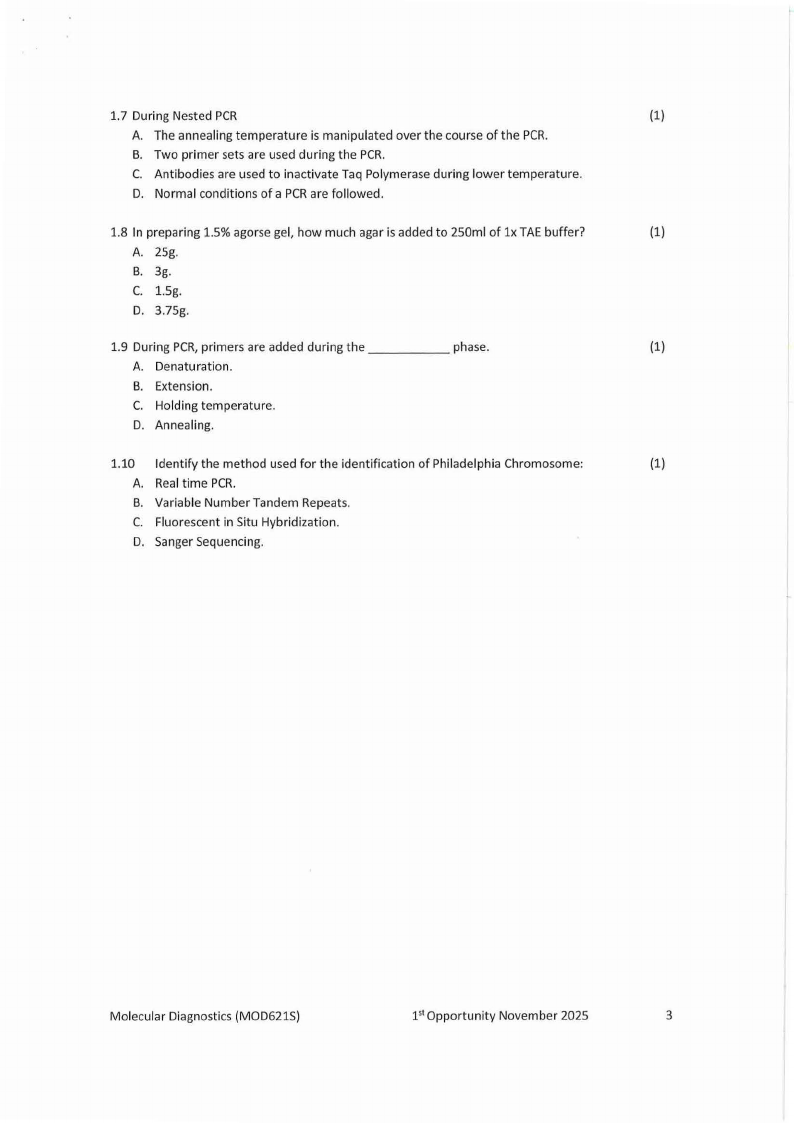
1.7 During Nested PCR
(1)
A. The annealing temperature is manipulated over the course of the PCR.
B. Two primer sets are used during the PCR.
C. Antibodies are used to inactivate Taq Polymerase during lower temperature.
D. Normal conditions of a PCR are followed.
1.8 In preparing 1.5% agorse gel, how much agar is added to 250ml of 1x TAE buffer?
(1)
A. 25g.
B. 3g.
C. 1.Sg.
D. 3.75g.
1.9 During PCR, primers are added during the _ _ _ _ _ phase.
(1)
A. Denaturation.
B. Extension.
C. Holding temperature.
D. Annealing.
1.10 Identify the method used for the identification of Philadelphia Chromosome:
(1)
A. Real time PCR.
B. Variable Number Tandem Repeats.
C. Fluorescent in Situ Hybridization.
D. Sanger Sequencing.
Molecular Diagnostics (MOD621S)
1' 1Opportunity November 2025
3
|
|
4 Page 4 |
▲back to top |
6ECTION B: SHORT Q_UESTIONS
Please answer ALL of the questions in this section.
QUESTION 2:
[ 74 MARKS]
[10)
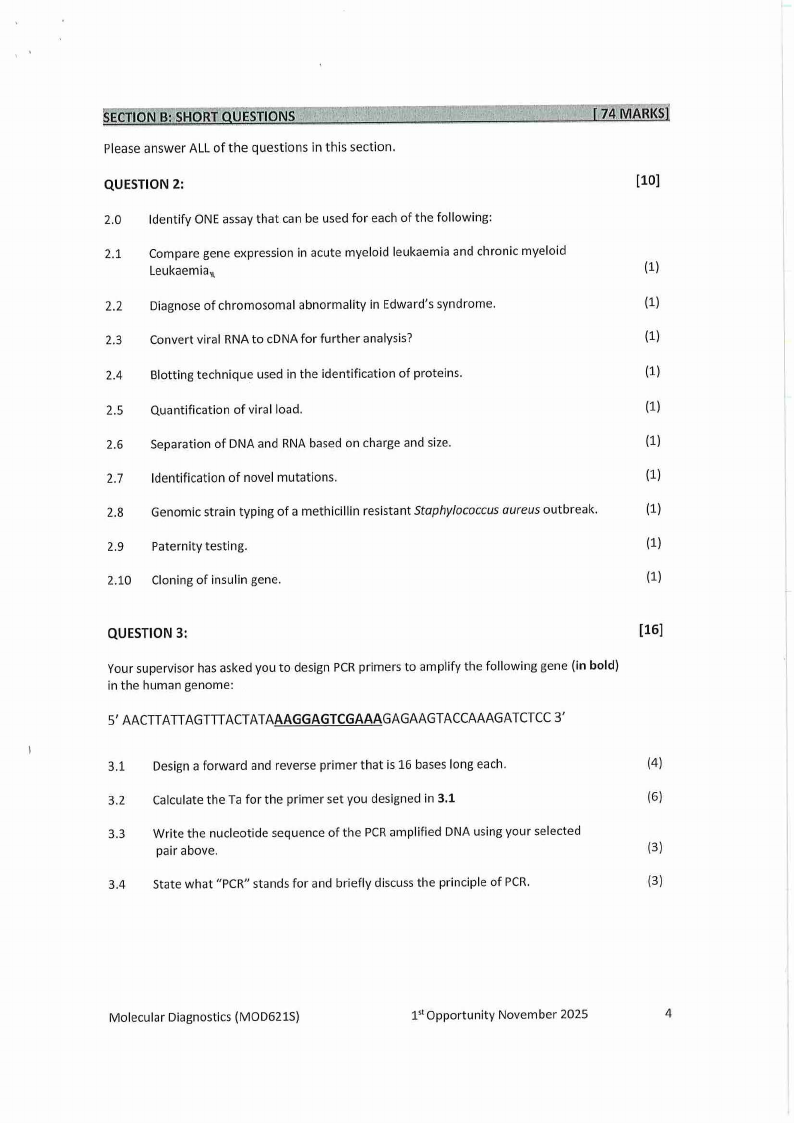
2.0 Identify ONE assay that can be used for each of the following:
2.1 Compare gene expression in acute myeloid leukaemia and chronic myeloid
Leukaemia,.
(1)
2.2 Diagnose of chromosomal abnormality in Edward's syndrome.
(1)
2.3 Convert viral RNA to cDNA for further ana lysis?
(1)
2.4 Blotting technique used in the identification of proteins.
(1)
2.5 Quantification of viral load.
(1)
2.6 Separation of DNA and RNA based on charge and size.
(1)
2.7 Identification of novel mutations.
(1)
2.8 Genomic strain typing of a methicillin resistant Staphylococcus aureus outbreak.
(1)
2.9 Paternity testing.
(1)
2.10 Cloning of insulin gene.
(1)
QUESTION 3:
[16)
Your supervisor has asked you to design PCR primers to amplify the following gene (in bold)
in the human genome:
S'AACTTATTAGTTTACTATAAAGGAGTCGAAAGAGAAGTACCAAAGATCTCC3'
3.1 Design a forward and reverse primer that is 16 bases long each.
(4)
3.2 Calculate the Ta for the primer set you designed in 3.1
(6)
3.3 Write the nucleotide sequence of the PCR amplified DNA using your selected
pair above.
(3)
3.4 State what "PCR" stands for and briefly discuss the principle of PCR.
(3)
Molecular Diagnostics (MOD621S)
1st Opportunity November 2025
4
|
|
5 Page 5 |
▲back to top |
QUESTION 4:
(22]
Using your knowledge of nucleic acid extraction and purification using the phenol
chemical method, answer the following questions.
4.1 Would your nucleic acid quality be affected if you were to perform each of the following
scenarios? Answer "Yes" or "No" and Justify your answer:
4.1.1 The procedure for DNA extraction requires that you elute the DNA twice with elution
buffer. You decide to elute it a third time, just for good measure.
(2)
4.1.2 You elute your DNA into a used collection tube.
(2)
4.1.3 When a fellow student signed for the DNA extraction kit, they did not check if
Proteinase K was present. You use RNase A instead.
(2)
4.1.4 You obtain a value of 1.8 for your 260/230 ratio.
(2)
4.1.5 You store your DNA in a buffer with no EDTA at room temperature
(2)
4.2 Discuss the four components of the lysis buffer.
(8)
4.3 Explain the importance of the chloroform/isomamylalcohol (24:1) step.
(2)
4.4 Explain the role of ice-cold isopropanol.
(2)
QUESTION 5:
(26]
Sanger sequencing, also known as the chain termination method, is a technique used to determine the
nucleotide sequence of DNA. Developed by Frederick Sanger and his colleagues in the 1970s, it was the
first widely used method for DNA sequencing and remains a foundational technique in molecular
biology.
5.1 Explain the principle of Sanger Sequencing.
(2)
5.2 Summarize the ingredients and function of Sanger Sequencing technique.
(14)
5.3 Tabulate the differences between Sanger sequencing and Next Generation Sequencing
under the following headings:
5.3.1 Read length/throughput
(2)
5.3.2 "generation" classification
(2)
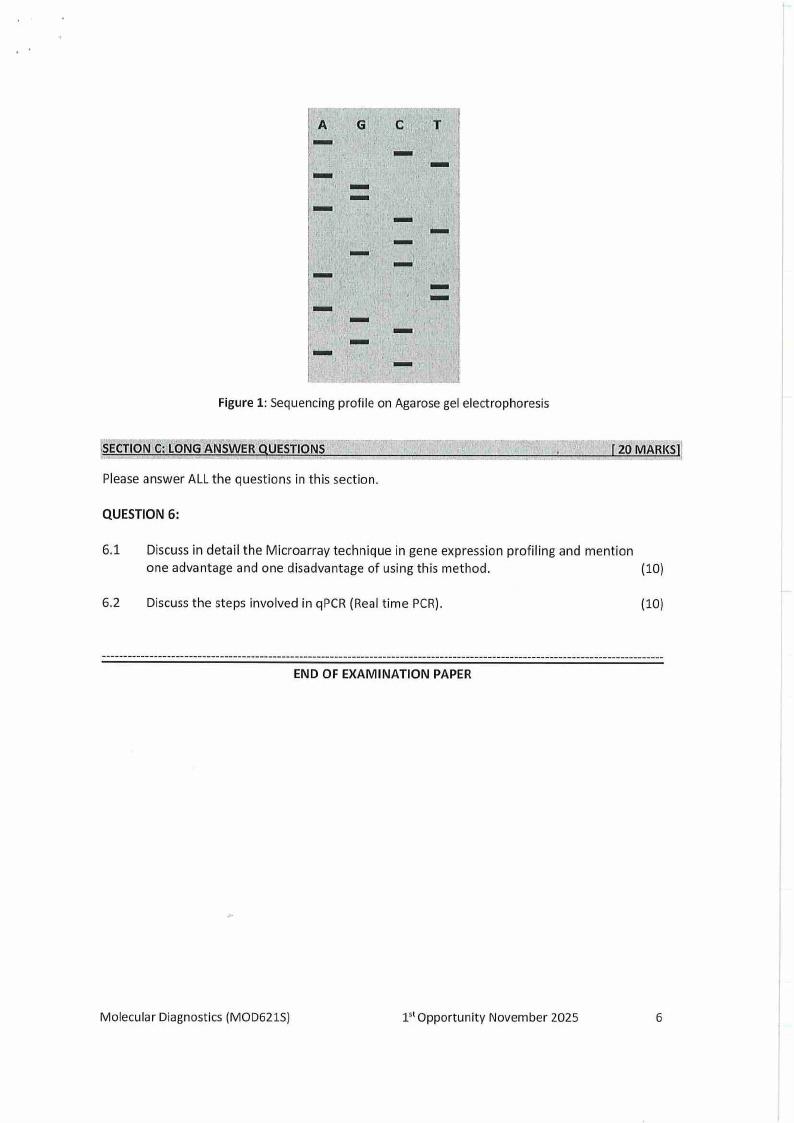
5.4 The below image (Figure 1) is obtained from Sanger Sequencing. Generate the
sequence of the Gene of interest.
(6)
Molecular Diagnostics (MOD621S)
1st Opportunity November 2025
5
|
|
6 Page 6 |
▲back to top |
-A G
--
.... -
Figure 1: Sequencing profile on Agarose gel electrophoresis
Please answer ALL the questions in this section.
QUESTION 6:
6.1 Discuss in detail the Microarray technique in gene expression profiling and mention
one advantage and one disadvantage of using this method.
(10)
6.2 Discuss the steps involved in qPCR (Real time PCR).
(10)
------------------------------------------------------------------------------------------------·--------------·-----------·-------
END OF EXAMINATION PAPER
Molecular Diagnostics (MOD6215)
1'1Opportunity November 2025
6