


 |
HAM621S - HAEMATOLOGY 2B - 1ST OPP - NOV 2025 |
|
|
1 Page 1 |
▲back to top |
nAmlBIA UnlVERSITY
OF sci ence Ano TECHnOLOGY
FACULTY OF HEALTH, APPLIED SCIENCES AND NATURAL RESOURCES
DEPARTMENT OF CLINICAL HEALTH SCIENCES
QUALIFICATION : BACHELOR OF MEDICAL LABORATORY SCIENCES
QUALIFICATION CODE: 08BMLS
LEVEL: 6
COURSE CODE: HAM621S
COURSE NAME: HAEMATOLOGY 28
SESSION: NOVEMBER 2025
PAPER:
THEORY
DURATION: 3 HOURS
MARKS:
100
EXAMINER(S}
MODERATOR:
FIRST OPPORTUNITY EXAMINATION PAPER
Ms EDWIG SHINGENGE
Ms BELINDA ROSELIN TSAUSES
INSTRUCTIONS
1. Answ er ALL the questions.
2. Write clearly and neatly.
3. Number the answers clearly.
4. Non-programmable calculators allowed.
THIS QUESTION PAPER CONSISTS OF 5 PAGES (Including this front page)
|
|
2 Page 2 |
▲back to top |
QUESTION 1
[10)
Evaluate the statements in each numbered section and select the most appropriate answer or phrase from the
given possibilities. Write the appropriate letter next to the number of the statement/phrase.
1.1 P53 is a.............?
(1)
A) Oncogene
B) Transcription factor
C) Tumour suppressor gene
D) Proto-Oncogene
(1)
1.2 Cytopenia's are a typical pentation in?
A) Polycythaemia vera
B) Myelodysplastic syndrome
C) Acute myeloid leukaemia
D) Giant platelets
(1)
1.3 DNA methylation is an example of:
A) A translocation
B) A point mutation
C) An epigenetic change
D) A mutation
(1)
1.4 Secondary granules start to appear at which stage of the neutrophil maturation?
A) Blast
B) Band Cell
C) Myelocyte
D) Metamyelocyte
(1)
1.5 Which of the following is closely associated with Acute Promyelocytic leukaemia?
A) Philadelphia Chromosome
B) Disseminated intravascular coagulation
C) Giant Platelets
D) Increased sphingomyelin
2
|
|
3 Page 3 |
▲back to top |
1.6 A 27-year-old woman presents with acute bleeding to the emergency department and is found to have a (1)
white count of 32.7 x 10⁹L with pancytopenia : haematocrit 25%, platelet count 30 x 109 /L, and absolute
neutrophil count 0.8 x 10⁹ /L. She has a combination of 93% blasts and abnormal promyelocytes in her
peripheral blood; some of these cells contain stacked Auer rods. What form of leukaemia does she most likely
have?
A) Acute myeloid with t(15;17)
B) Chronic myeloid leukaemia
C) Acute monoblastic leukaemia
D) Polycythaemia Vera
1.7 Identify the component of a flow cytometer responsible for delivering the sample:
(1)
A) Fluidics
B) Sample pipes
C) Optics
D) Electronics
1.8 In Polycythaemia vera, the erythropoietin level is......?
(1)
A) Normal
B) Increased
C) Low
D) Variable
1.9 The French American British (FAB) classification of Acute Myeloblastic Leukaemia (AML) is based on?
(1)
A) Cytogenetic abnormalities
B) Morphology and cytochemistry of blasts
C) lmmunophenotyping of blasts
D) Molecular genetic abnormalities
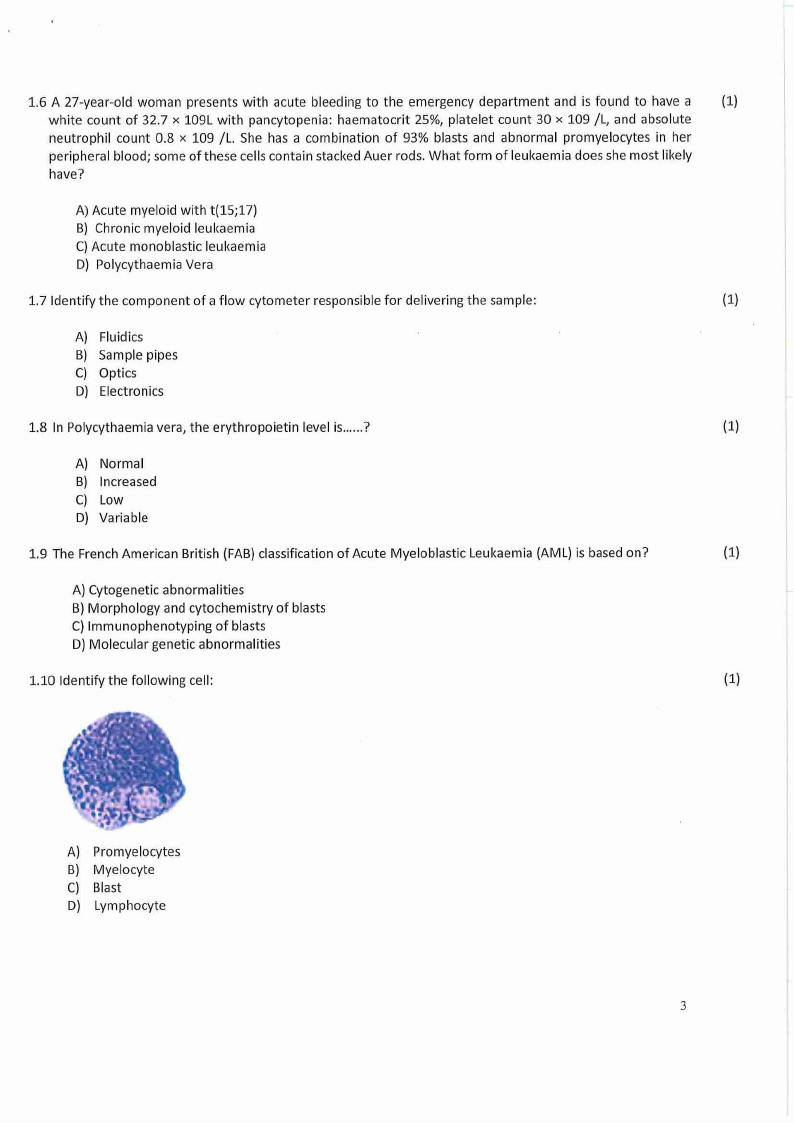
1.10 Identify the following cell:
(1)
A) Promyelocytes
B) Myelocyte
C) Blast
D) Lymphocyte
3
|
|
4 Page 4 |
▲back to top |
QUESTION 2
[15)
2.1 Complete the following table by determining the which component is sta ined, reagent used, appea rance of (15)
positive cells as well cells that are positive and negative with the following cytochemistry stains:
Stain
Myeloperoxidase
Sudan Black
Periodic Acid-Schiff
Component
Stained
Reagent
Appearance
Positivity
Negative
SECTION B:
( 45 MARKS]
QUESTION 3
[25)
3.1 Myeloblast and promyelocytes are stages of the neutrophil that are morphologically similar. Describe the (10)
morphologica l appearance of t hese two stages.
3.2 List the four developmental pools of the granulocyte including the cells found in each.
(9)
3.3 Describe the opsonization function of the neutrophil.
(4)
3.4 By means of the absolute count, define eosinophilia.
(2)
QUESTION 4
[20)
4.1 Describe the classification of benign disorders of the neutrophil.
(4)
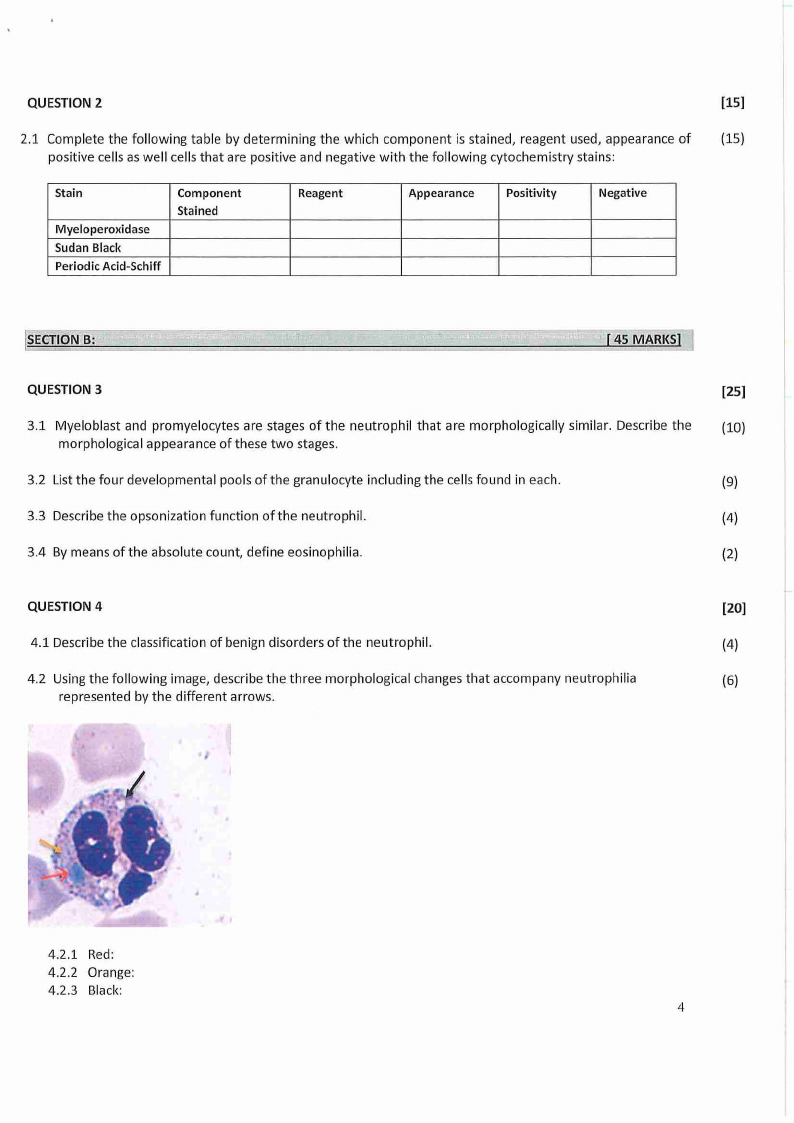
4.2 Using the following image, describe the three morphological changes that accompany neutrophilia
(6)
represented by the different arrows.
4.2.1 Red:
4.2 .2 Orange:
4.2.3 Black:
4
|
|
5 Page 5 |
▲back to top |
4.3 Why is it important to account for age when investigating lymphocytosis?
(5)
4.4 Describe t he haematological findings in Infectious Mononucleosis.
(5)
~ ECTION C: APPLICATION BASED
[ 30 MARKS]
QUESTION 5
[20]
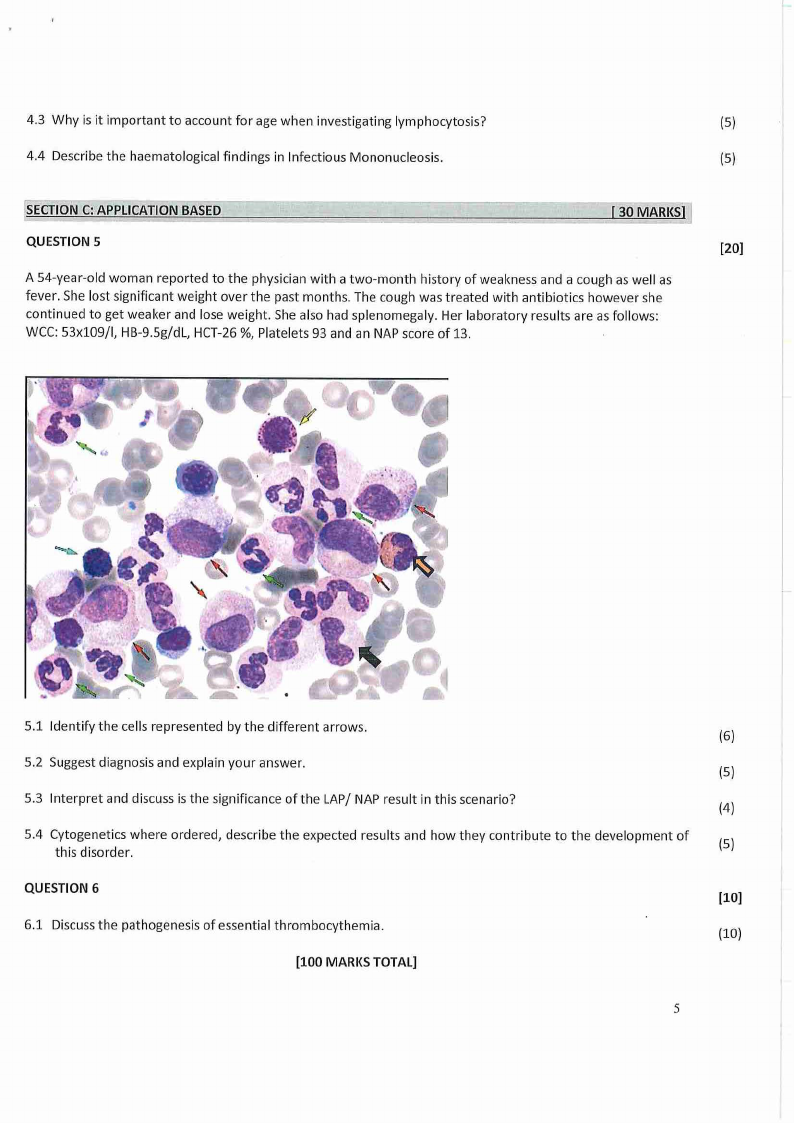
A 54-year-old woman reported to the physician with a two-month history of weakness and a cough as well as
fever. She lost significant weight over the past months. The cough was treated with antibiotics however she
continued to get weaker and lose weight. She also had splenomega ly. Her laboratory results are as follows:
wee: 53x109/I, HB-9.5g/d L, HeT-26 %, Platelets 93 and an NAP score of 13.
5.1 Identify the cells represented by the different arrows.
(6)
5.2 Suggest diagnosis and explain your answer.
(5)
5.3 Interpret and discuss is the significance of the LAP/ NAP result in this scenario?
(4)
5.4 Cytogenetics where ordered, describe the expected results and how they contribute to the development of
this disorder.
(5)
QUESTION 6
[10]
6.1 Discuss the pathogenesis of essential t hrombocythemia.
(10)
[100 MARl<S TOTAL]
5