


 |
MOD620S - MANAGEMENT OF ORGANISATIONAL DEVELOPMENT AND LEARNING - 1ST OPP - NOVEMBER 2025 |
|
|
1 Page 1 |
▲back to top |
nAmlBIA UnlVERSITY
OF SCIEnCE Ano TECHnOLOGY
FACULTY OF COMMERCE, HUMAN SCIENCES AND EDUCATION
DEPARTMENT OF TECHNICAL AND VOCATIONAL EDUCATION AND TRAINING
QUALIFICATION : DIPLOMA IN TECHNICAL AND VOCATIONAL EDUCATION AND TRAINING :
MANAGEMENT
QUALIFICATION CODE: 06DTVM LEVEL: 6
COURSE CODE: MOD620S
COURSE NAME: MANAGEMENT OF ORGANISATIONAL
DEVELOPMENT AND LEARNING
SESSION: NOVEMBER 2025
PAPER: PAPER 1
DURATION: 3 HOURS
MARKS: 100
FIRST OPPORTUNITY EXAMINATION PAPER
EXAMINER(S): Mr. Benhardt U Kauteza
MODERATOR: Dr. lndepentia de Waldt
INSTRUCTIONS
1. Answer all questions.
2. Read all the questions carefully before answering.
3. This paper consists of Sections A and B with a total of six questions.
4. Make sure your name and surname, question number and the date appear on
the answer script.
5. Number the answers clearly.
6. Please ensure that your writing is legible, neat and presentable
THIS MEMORANDUM CONSISTS OF _7_ PAGES (Including this front page)
|
|
2 Page 2 |
▲back to top |
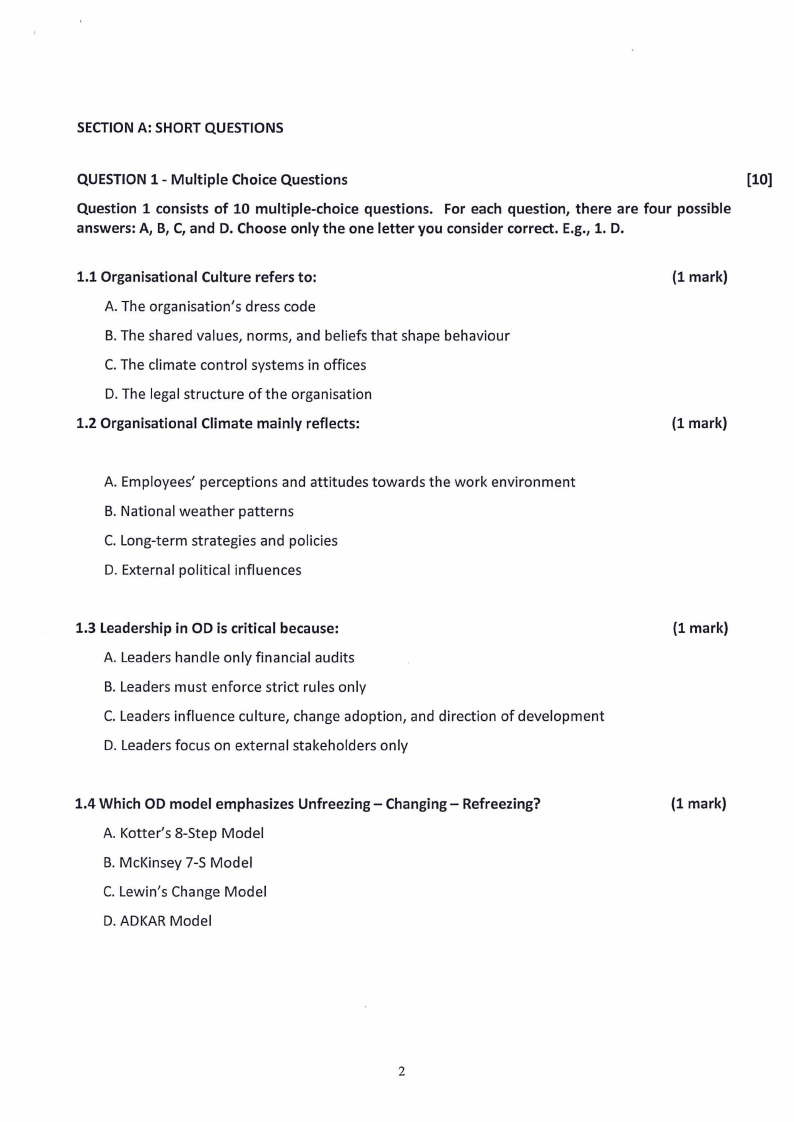
SECTION A: SHORT QUESTIONS
QUESTION 1 - Multiple Choice Questions
[10]
Question 1 consists of 10 multiple-choice questions. For each question, there are four possible
answers: A, B, C, and D. Choose only the one letter you consider correct. E.g., 1. D.
1.1 Organisational Culture refers to:
A. The organisation's dress code
B. The shared values, norms, and beliefs that shape behaviour
C. The climate control systems in offices
D. The legal structure of the organisation
1.2 Organisational Climate mainly reflects:
(1 mark)
(1 mark)
A. Employees' perceptions and attitudes towards the work environment
B. National weather patterns
C. Long-term strategies and policies
D. External political influences
1.3 Leadership in OD is critical because:
A. Leaders handle only financial audits
B. Leaders must enforce strict rules only
C. Leaders influence culture, change adoption, and direction of development
D. Leaders focus on external stakeholders only
(1 mark)
1.4 Which OD model emphasizes Unfreezing- Changing - Refreezing?
A. Kotter's 8-Step Model
B. McKinsey 7-S Model
C. Lewin's Change Model
D. ADKAR Model
(1 mark)
2
|
|
3 Page 3 |
▲back to top |
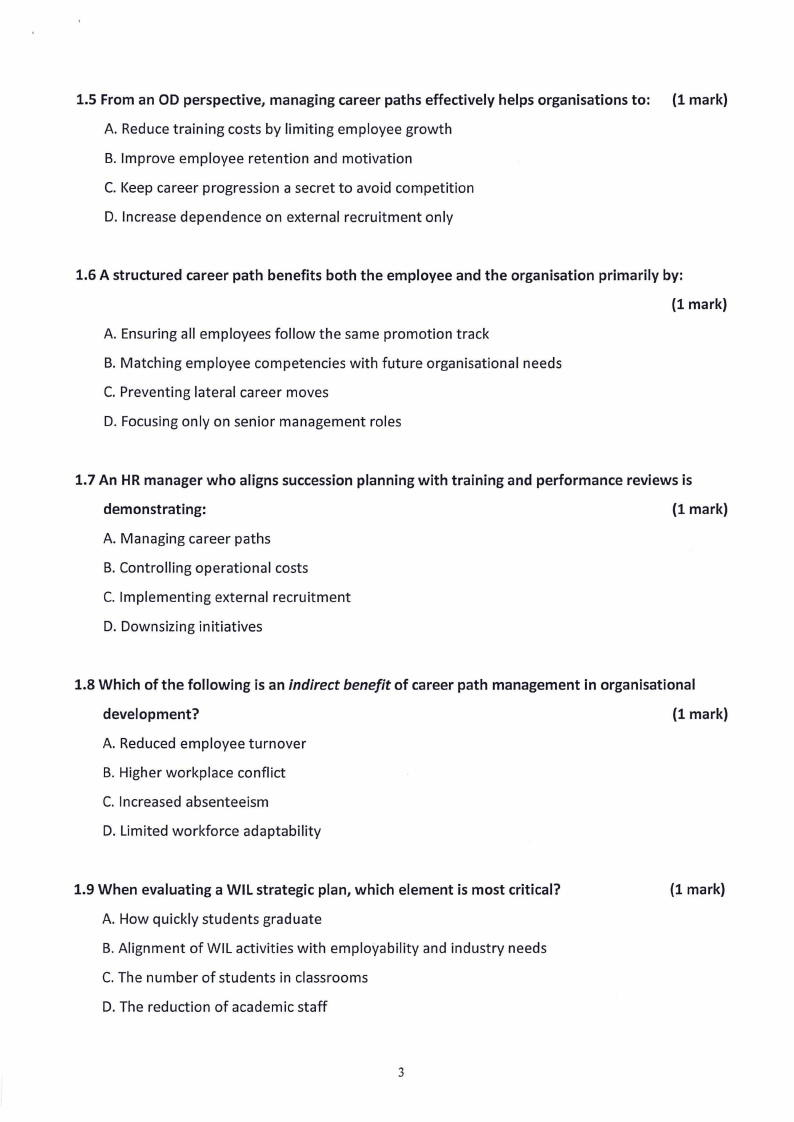
1.5 From an OD perspective, managing career paths effectively helps organisations to:
A. Reduce training costs by limiting employee growth
B. Improve employee retention and motivation
C. Keep career progression a secret to avoid competition
D. Increase dependence on external recruitment only
(1 mark)
1.6 A structured career path benefits both the employee and the organisation primarily by:
(1 mark)
A. Ensuring all employees follow the same promotion track
B. Matching employee competencies with future organisational needs
C. Preventing lateral career moves
D. Focusing only on senior management roles
1.7 An HR manager who aligns succession planning with training and performance reviews is
demonstrating:
(1 mark)
A. Managing career paths
B. Controlling operational costs
C. Implementing external recruitment
D. Downsizing initiatives
1.8 Which of the following is an indirect benefit of career path management in organisational
development?
(1 mark)
A. Reduced employee turnover
B. Higher workplace conflict
C. Increased absenteeism
D. Limited workforce adaptability
1.9 When evaluating a WIL strategic plan, which element is most critical?
A. How quickly students graduate
B. Alignment of WIL activities with employability and industry needs
C. The number of students in classrooms
D. The reduction of academic staff
(1 mark)
3
|
|
4 Page 4 |
▲back to top |
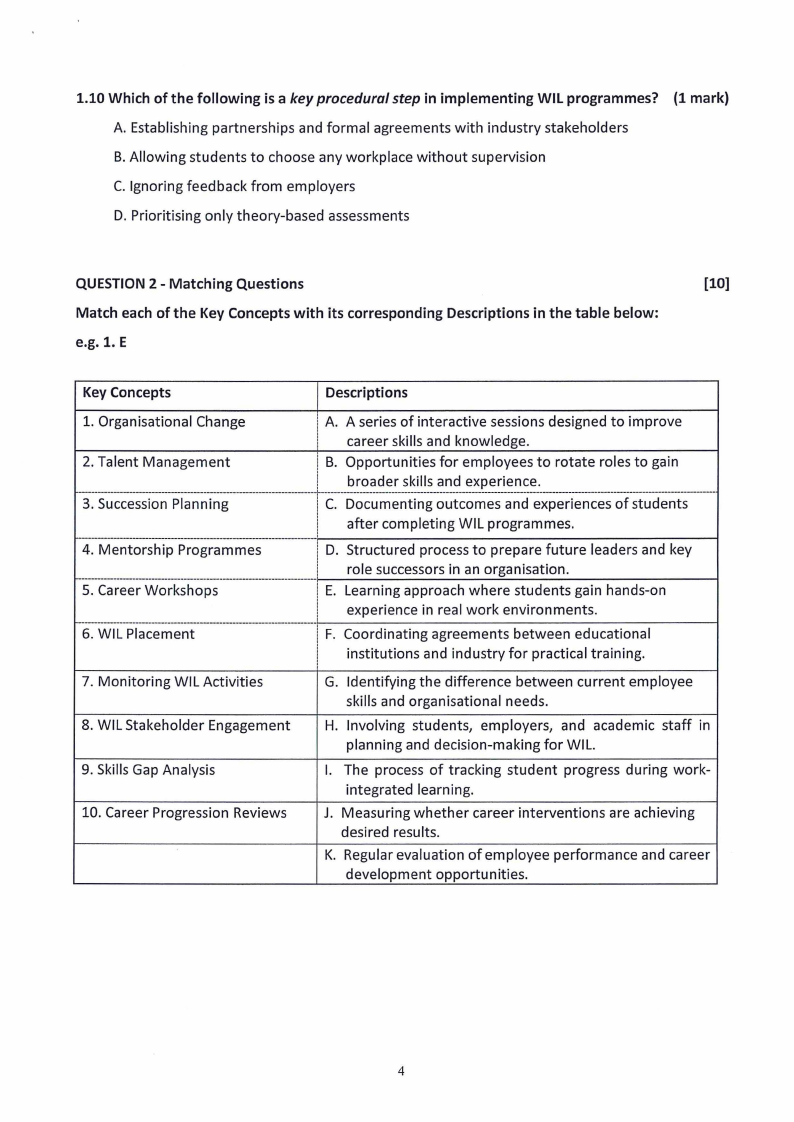
1.10 Which of the following is a key procedural step in implementing WIL programmes? (1 mark)
A. Establishing partnerships and formal agreements with industry stakeholders
B. Allowing students to choose any workplace without supervision
C. Ignoring feedback from employers
D. Prioritising only theory-based assessments
QUESTION 2 - Matching Questions
[10]
Match each of the Key Concepts with its corresponding Descriptions in the table below:
e.g. 1. E
Key Concepts
1. Organisational Change
2. Talent Management
3. Succession Planning
4. Mentorship Programmes
5. Career Workshops
6. WIL Placement
7. Monitoring WIL Activities
8. WIL Stakeholder Engagement
9. Skills Gap Analysis
10. Career Progression Reviews
Descriptions
A. A series of interactive sessions designed to improve
career skills and knowledge.
B. Opportunities for employees to rotate roles to gain
broader skills and experience.
C. Documenting outcomes and experiences of students
after completing WIL programmes.
D. Structured process to prepare future leaders and key
role successors in an organisation.
E. Learning approach where students gain hands-on
experience in real work environments.
F. Coordinating agreements between educational
institutions and industry for practical training.
G. Identifying the difference between current employee
skills and organisational needs.
H. Involving students, employers, and academic staff in
planning and decision-making for WIL.
I. The process of tracking student progress during work-
integrated learning.
J. Measuring whether career interventions are achieving
desired results.
K. Regular evaluation of employee performance and career
development opportunities.
4
|
|
5 Page 5 |
▲back to top |
SECTION B: STRUCTURED QUESTIONS
QUESTION 1- Key Concepts in Organisational Development (OD) and Career Management
[20]
1.1 Explain why planned change is considered a key concept in Organisational Development. (4)
1.2 Define career management and explain its relevance to a TVET graduate. (2 marks for definition
and 2 marks for explanation)
(4)
1.3 State briefly how networking can support career development for young professionals.
(2)
1.4 A final-year TVET student in your institution is preparing for workplace after graduation. As part
of career management, advise the student on five practical strategies they can apply to manage
their career path effectively in a dynamic labour market.
(10}
QUESTION 2 - Develop and Manage Career Path
[20]
You are a Human Resource Officer in a mid-sized company. The organisation is facing high
employee turnover because staff feel uncertain about their future growth opportunities.
2.1 As part of your duties, explain how you would develop career paths in the organisation to support
employee retention and professional growth.
(10)
2.2 After developing the career paths, outline how you would manage these career paths to ensure
employees continue progressing and remain motivated.
(10}
QUESTION 3 - Impact of WIL on Stakeholders and Implementation Procedures of WIL
[20]
3. A TVET college partners with a local manufacturing company to place students on a six-month job
attachment.
3.1 Discuss two benefits of Work Integrated Learning (WIL) for (a) the student and (b) the employer in
this case.
(8)
3.2 In a healthcare training programme, nursing students are placed in hospitals for practical
rotations. Analyse the impact of WIL on the community and the TVET institution in this
situation.
(6)
5
|
|
6 Page 6 |
▲back to top |
3.3 A TVET Centre is planning to roll out a new WIL programme in the hospitality sector.
Outline three key steps the college should follow to successfully implement this WIL
programme.
(6)
QUESTION 4 - Implementation Procedures and Evaluation of WIL Programmes
[20]
CASE STUDY
Read the Case Study below and answer the questions which follow.
Background
The Polytechnic of Southern Africa recently launched a Work Integrated Learning (WIL) programme for
final-year Diploma in Business Administration students. The programme was designed to bridge the gap
between classroom theory and workplace practice by placing students in partner companies for six
months.
The implementation procedures followed included:
• Signing formal agreements with host companies.
• Preparing students with pre-placement workshops on professional conduct and workplace
expectations.
• Assigning academic supervisors to monitor progress and conduct site visits.
• Requiring students to submit reflective journals and monthly reports.
After the first intake, the Polytechnic conducted an evaluation of the WIL programme. Key findings
included:
• Strengths: Students reported gaining valuable practical skills, improved confidence, and
professional networks. Employers noted that students contributed fresh ideas.
• Weaknesses: Some students lacked adequate preparation in workplace communication. Certain
companies did not provide structured mentorship. Academic supervisors found it challenging to
monitor all students effectively due to workload.
• Recommendations: Enhance pre-placement training on soft skills, allocate smaller supervisor-
student ratios, and establish clearer mentorship guidelines for companies.
6
|
|
7 Page 7 |
▲back to top |
Answer the following questions:
4.1 Explain the importance of implementation procedures in ensuring the success of WIL
programmes, using examples from the case study. (2 marks for explanation and 4 marks for
examples}
(6)
4.2 Identify and discuss two key challenges in the evaluation findings of the WIL programme and
suggest practical solutions. (2 marks for identification and 4 marks for challenges}
(6)
4.3 Based on the evaluation findings, propose a comprehensive revised implementation procedure
that addresses at least three weaknesses identified in the WIL programme. Provide detailed
strategies for how each weakness can be resolved effectively. (5 marks for the weaknesses and
3 marks for the strategies}
(8)
TOTAL [100 MARKS]
[End of Paper]
7