MPM512S - Marketing Principles - 1st Opp - Nov 2025


MPM512S - Marketing Principles - 1st Opp - Nov 2025


1 Page 1

▲back to top


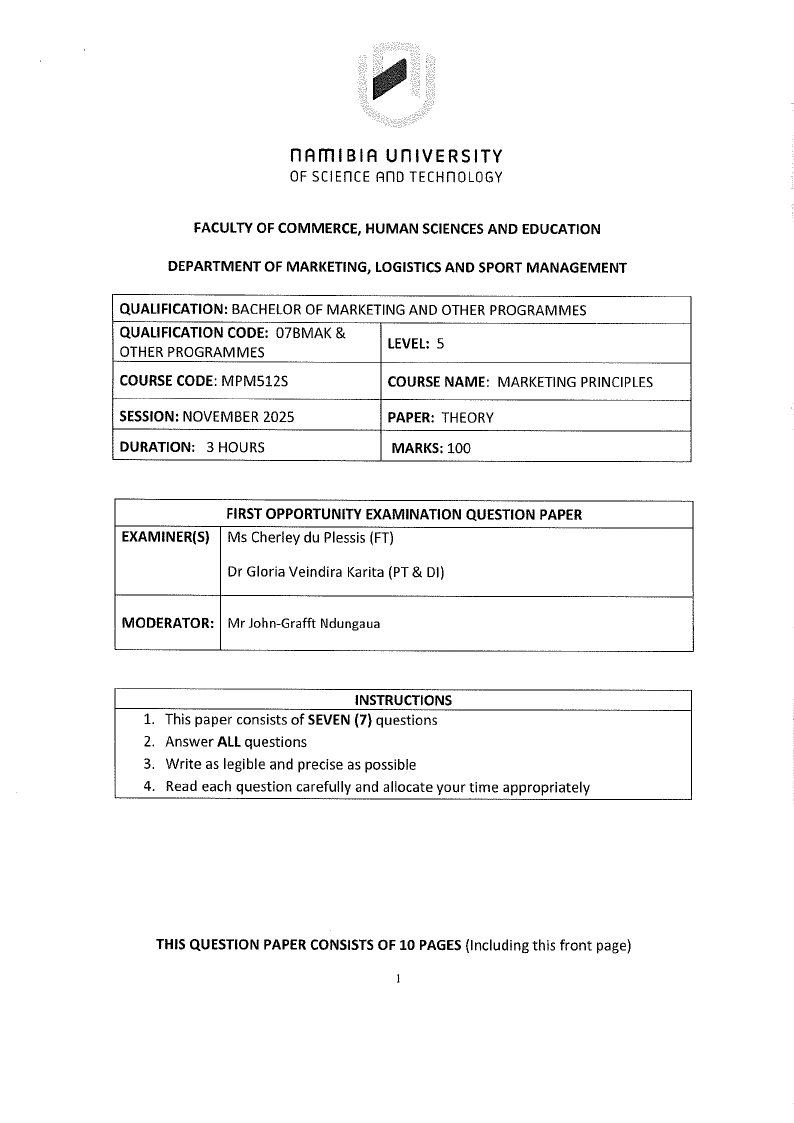
nAmlBIA unlVERSITY
OF SCIEnCE Ano TECHn0LDGY
FACULTY OF COMMERCE, HUMAN SCIENCES AND EDUCATION
DEPARTMENT OF MARKETING, LOGISTICS AND SPORT MANAGEMENT
QUALIFICATION: BACHELOR OF MARKETING AND OTHER PROGRAMMES
QUALIFICATION CODE: 07BMAK &
OTHER PROGRAMMES
LEVEL: 5
COURSE CODE: MPM512S
COURSE NAME: MARKETING PRINCIPLES
SESSION: NOVEMBER 2025
DURATION: 3 HOURS
PAPER: THEORY
MARKS: 100
FIRST OPPORTUNITY EXAMINATION QUESTION PAPER
EXAMINER(S) Ms Cherley du Plessis (FT)
Dr Gloria Veindira Karita (PT & DI)
MODERATOR: Mr John-Grafft Ndungaua
INSTRUCTIONS
1. This paper consists of SEVEN (7) questions
2. Answer ALL questions
3. Write as legible and precise as possible
4. Read each question carefully and allocate your time appropriately
THIS QUESTION PAPER CONSISTS OF 10 PAGES (Including this front page)

2 Page 2

▲back to top


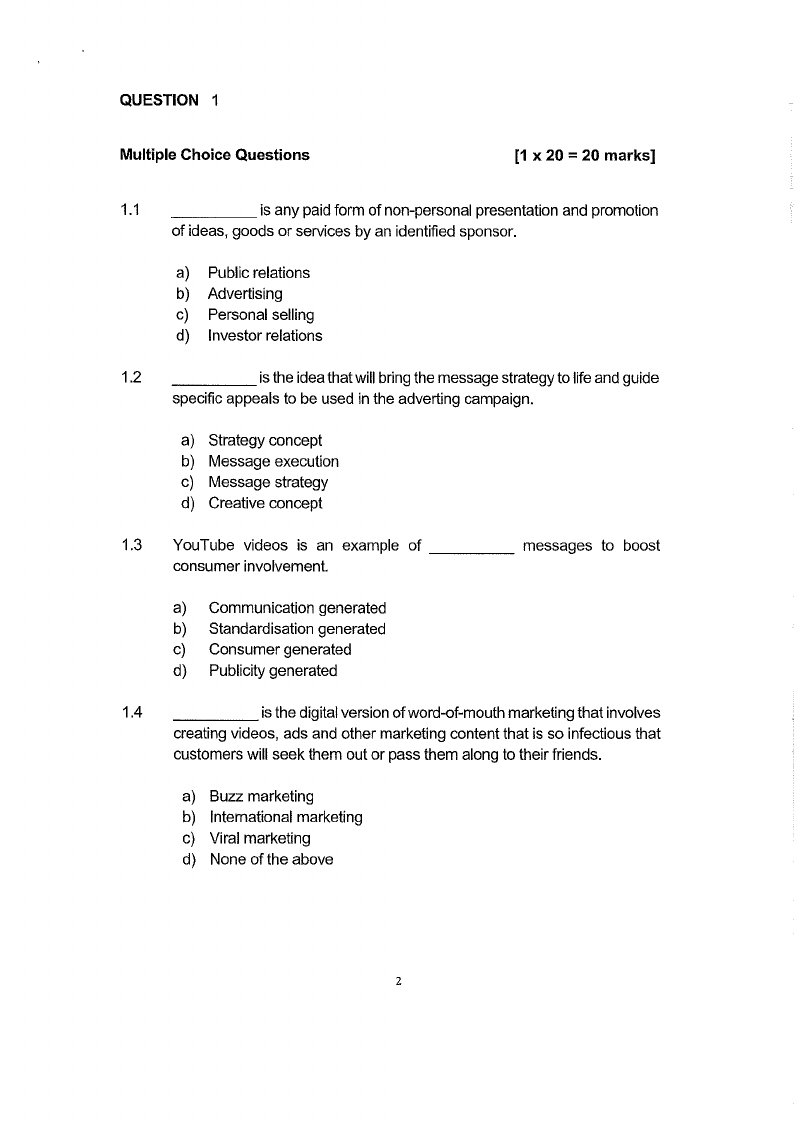
QUESTION 1
Multiple Choice Questions
[1 x 20 = 20 marks]
1.1 _____ is any paid form of non-personal presentation and promotion
of ideas, goods or services by an identified sponsor.
a) Public relations
b) Advertising
c) Personal selling
d) Investor relations
1.2 _____ is the idea that will bring the message strategy to life and guide
specific appeals to be used in the adverting campaign.
a) Strategy concept
b) Message execution
c) Message strategy
d) Creative concept
1.3 YouTube videos is an example of _ _ _ __ messages to boost
consumer involvement.
a) Communication generated
b) Standardisation generated
c) Consumer generated
d) Publicity generated
1.4 _____ is the digital version of word-of-mouth marketing that involves
creating videos, ads and other marketing content that is so infectious that
customers will seek them out or pass them along to their friends.
a) Buzz marketing
b) International marketing
c) Viral marketing
d) None of the above
2

3 Page 3

▲back to top


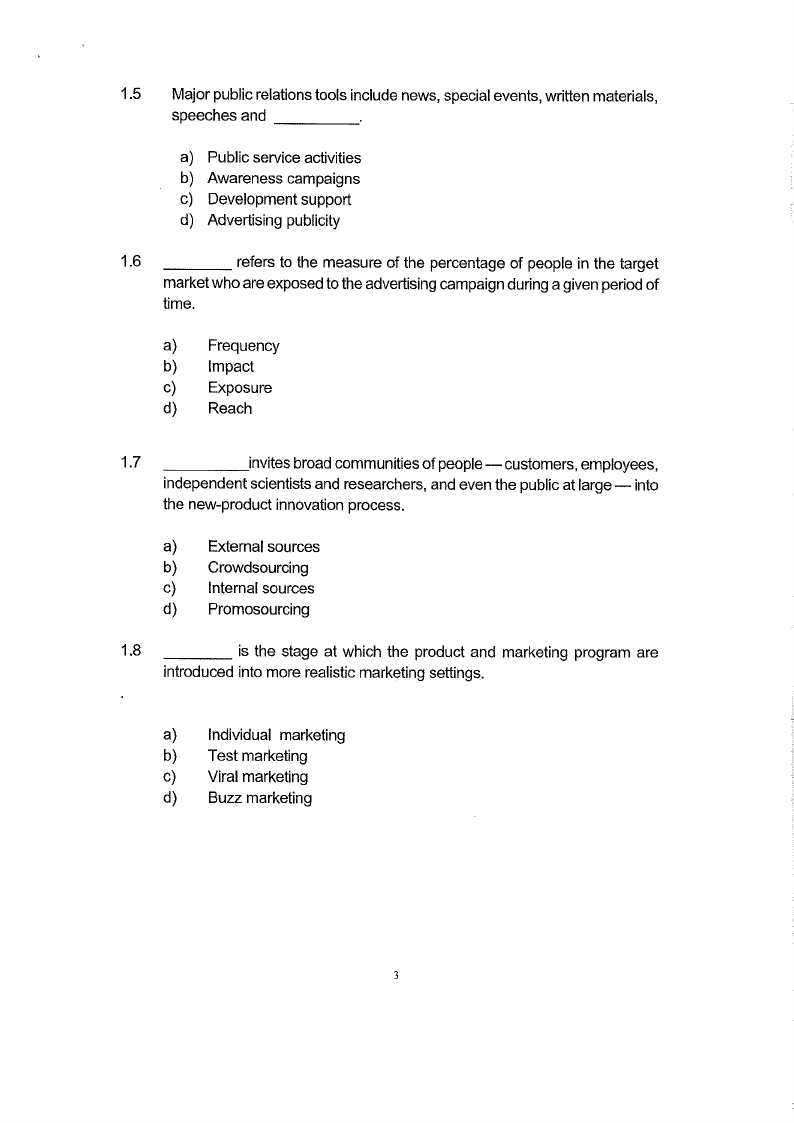
1.5 Major public relations tools include news, special events, written materials,
speeches and _ _ _ __
a) Public service activities
b) Awareness campaigns
c) Development support
d) Advertising publicity
1.6 ____ refers to the measure of the percentage of people in the target
market who are exposed to the advertising campaign during a given period of
time.
a) Frequency
b) Impact
c) Exposure
d) Reach
1.7 _____invites broad communities of people-customers, employees,
independent scientists and researchers, and even the public at large - into
the new-product innovation process.
a) External sources
b) Crowdsourcing
c) Internal sources
d) Promosourcing
1.8 ____ is the stage at which the product and marketing program are
introduced into more realistic marketing settings.
a) Individual marketing
b) Test marketing
c) Viral marketing
d) Buzz marketing
3

4 Page 4

▲back to top


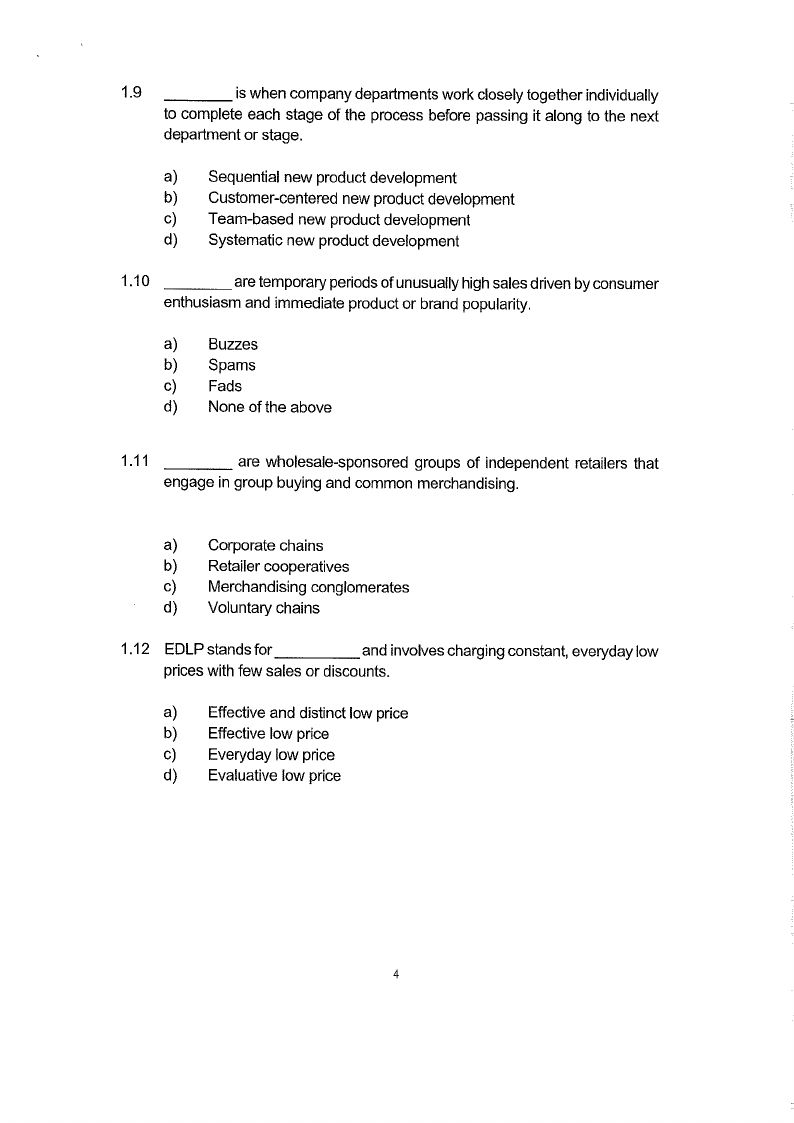
1.9 ____ is when company departments work closely together individually
to complete each stage of the process before passing it along to the next
department or stage.
a) Sequential new product development
b) Customer-centered new product development
c) Team-based new product development
d) Systematic new product development
1.10 ____ are temporary periods of unusually high sales driven by consumer
enthusiasm and immediate product or brand popularity.
a) Buzzes
b) Spams
c) Fads
d) None of the above
1.11 ____ are wholesale-sponsored groups of independent retailers that
engage in group buying and common merchandising.
a) Corporate chains
b) Retailer cooperatives
c) Merchandising conglomerates
d) Voluntary chains
1.12 EDLP stands for _____ and involves charging constant, everyday low
prices with few sales or discounts.
a) Effective and distinct low price
b) Effective low price
c) Everyday low price
d) Evaluative low price
4

5 Page 5

▲back to top


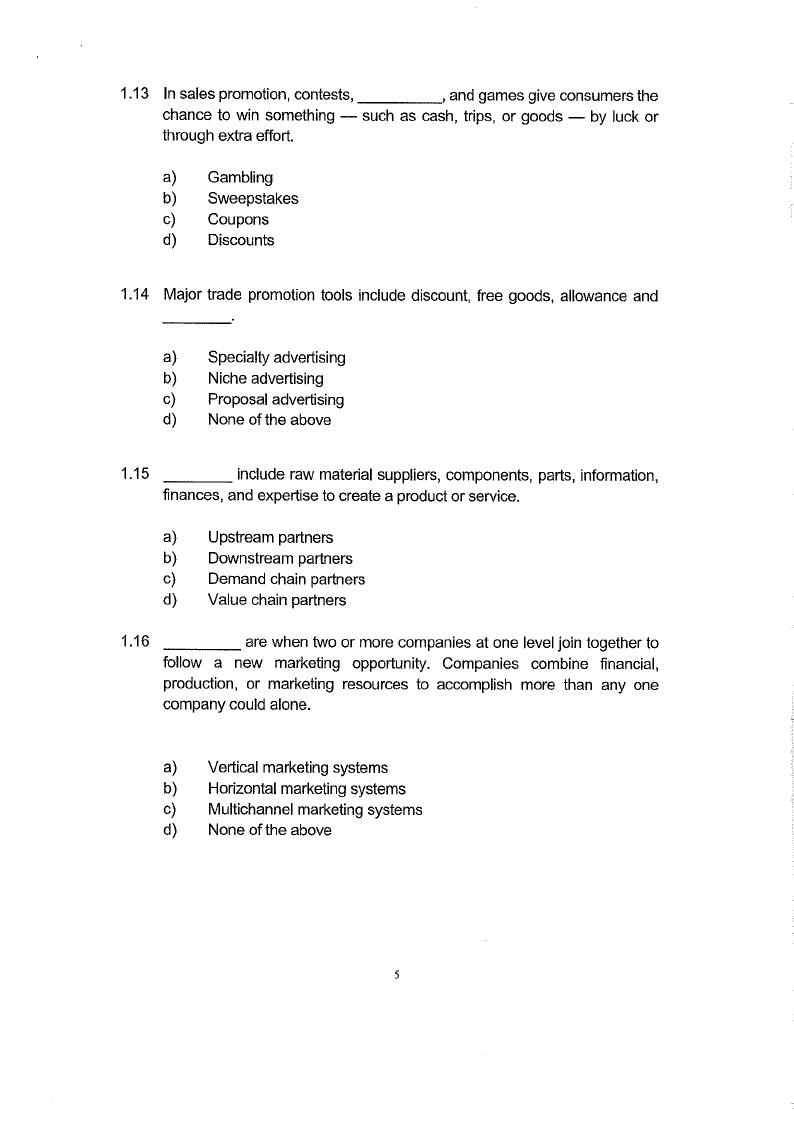
1.13 In sales promotion, contests,----~ and games give consumers the
chance to win something - such as cash, trips, or goods - by luck or
through extra effort.
a) Gambling
b) Sweepstakes
c) Coupons
d) Discounts
1.14 Major trade promotion tools include discount, free goods, allowance and
a) Specialty advertising
b) Niche advertising
c) Proposal advertising
d) None of the above
1.15 ____ include raw material suppliers, components, parts, information,
finances, and expertise to create a product or service.
a) Upstream partners
b) Downstream partners
c) Demand chain partners
d) Value chain partners
1.16 _ _ _ _ are when two or more companies at one level join together to
follow a new marketing opportunity. Companies combine financial,
production, or marketing resources to accomplish more than any one
company could alone.
a) Vertical marketing systems
b) Horizontal marketing systems
c) Multichannel marketing systems
d) None of the above
5

6 Page 6

▲back to top


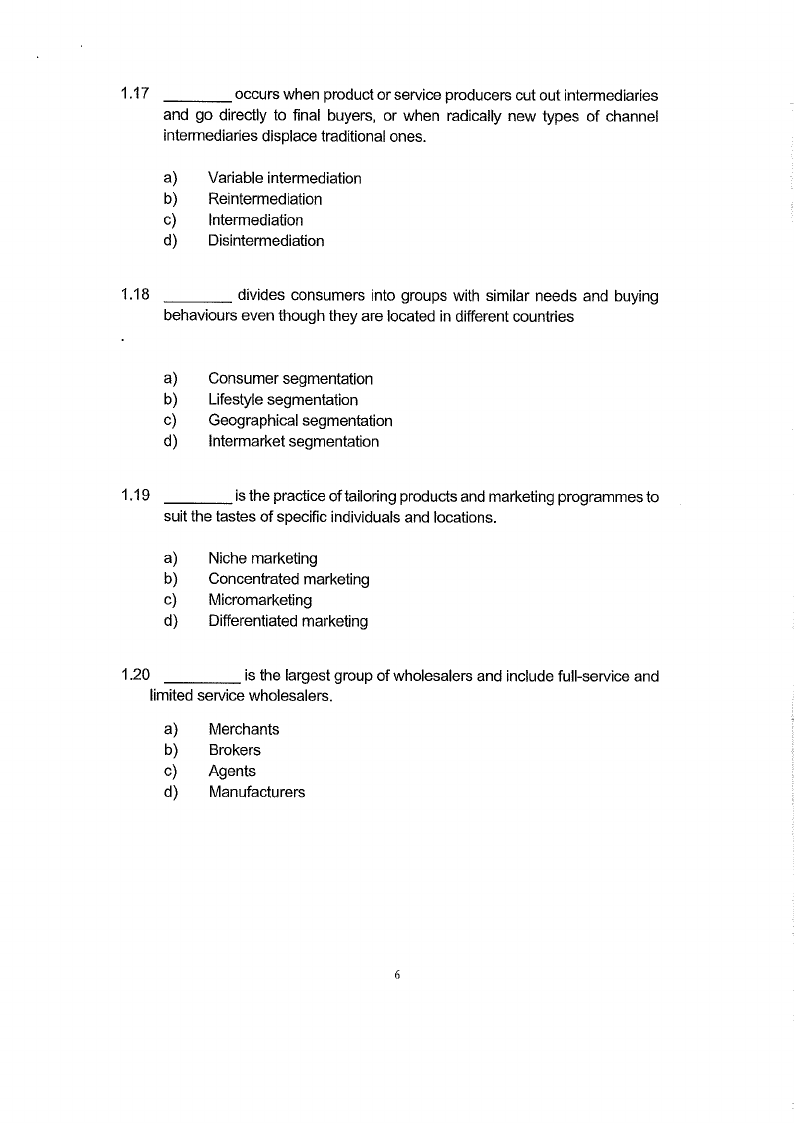
1.17 ____ occurs when product or service producers cut out intermediaries
and go directly to final buyers, or when radically new types of channel
intermediaries displace traditional ones.
a) Variable intermediation
b) Reintermediation
c) Intermediation
d) Disintermediation
1.18 ____ divides consumers into groups with similar needs and buying
behaviours even though they are located in different countries
a) Consumer segmentation
b) Lifestyle segmentation
c) Geographical segmentation
d) lntermarket segmentation
1.19 ____ is the practice of tailoring products and marketing programmes to
suit the tastes of specific individuals and locations.
a) Niche marketing
b) Concentrated marketing
c) Micromarketing
d) Differentiated marketing
1.20 _ _ _ _ is the largest group of wholesalers and include full-service and
limited service wholesalers.
a) Merchants
b) Brokers
c) Agents
d) Manufacturers
6

7 Page 7

▲back to top


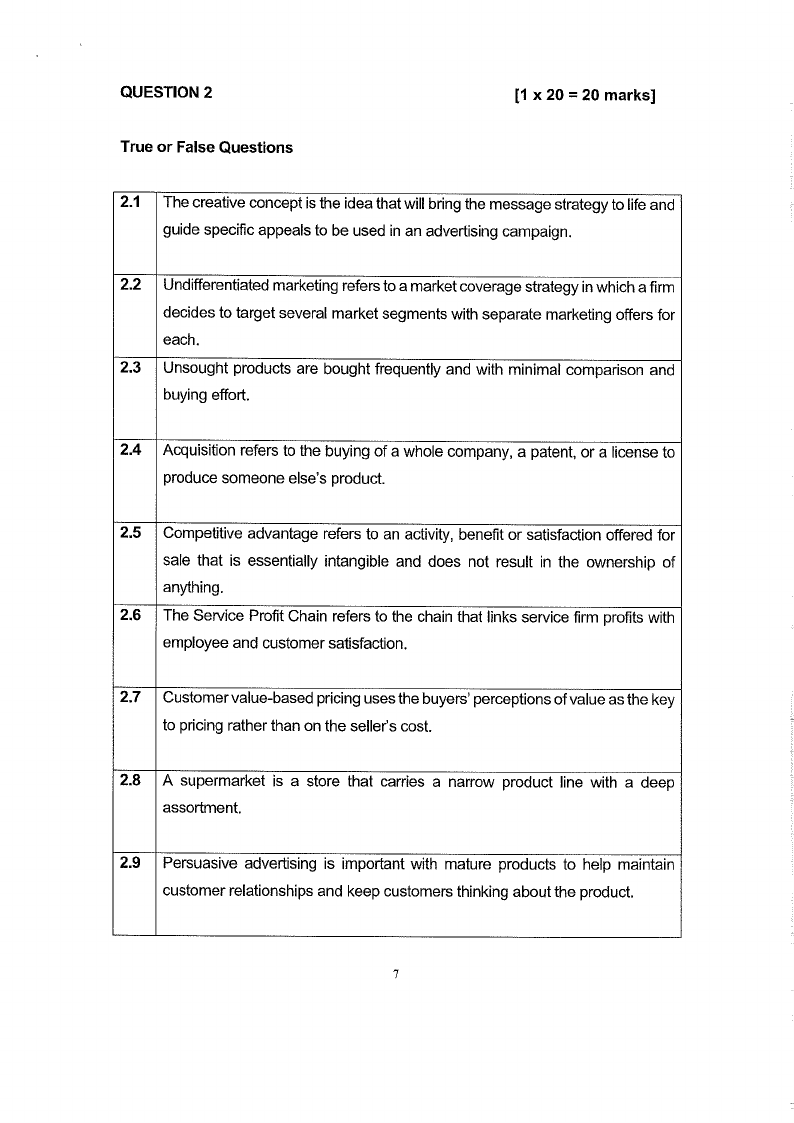
QUESTION 2
[1 x 20 = 20 marks]
True or False Questions
2.1 The creative concept is the idea that will bring the message strategy to life and
guide specific appeals to be used in an advertising campaign.
2.2 Undifferentiated marketing refers to a market coverage strategy in which a firm
decides to target several market segments with separate marketing offers for
each.
2.3 Unsought products are bought frequently and with minimal comparison and
buying effort.
2.4 Acquisition refers to the buying of a whole company, a patent, or a license to
produce someone else's product.
2.5 Competitive advantage refers to an activity, benefit or satisfaction offered for
sale that is essentially intangible and does not result in the ownership of
anything.
2.6 The Service Profit Chain refers to the chain that links service firm profits with
employee and customer satisfaction.
2.7 Customer value-based pricing uses the buyers' perceptions of value as the key
to pricing rather than on the seller's cost.
2.8 A supermarket is a store that carries a narrow product line with a deep
assortment.
2.9 Persuasive advertising is important with mature products to help maintain
customer relationships and keep customers thinking about the product.
7

8 Page 8

▲back to top


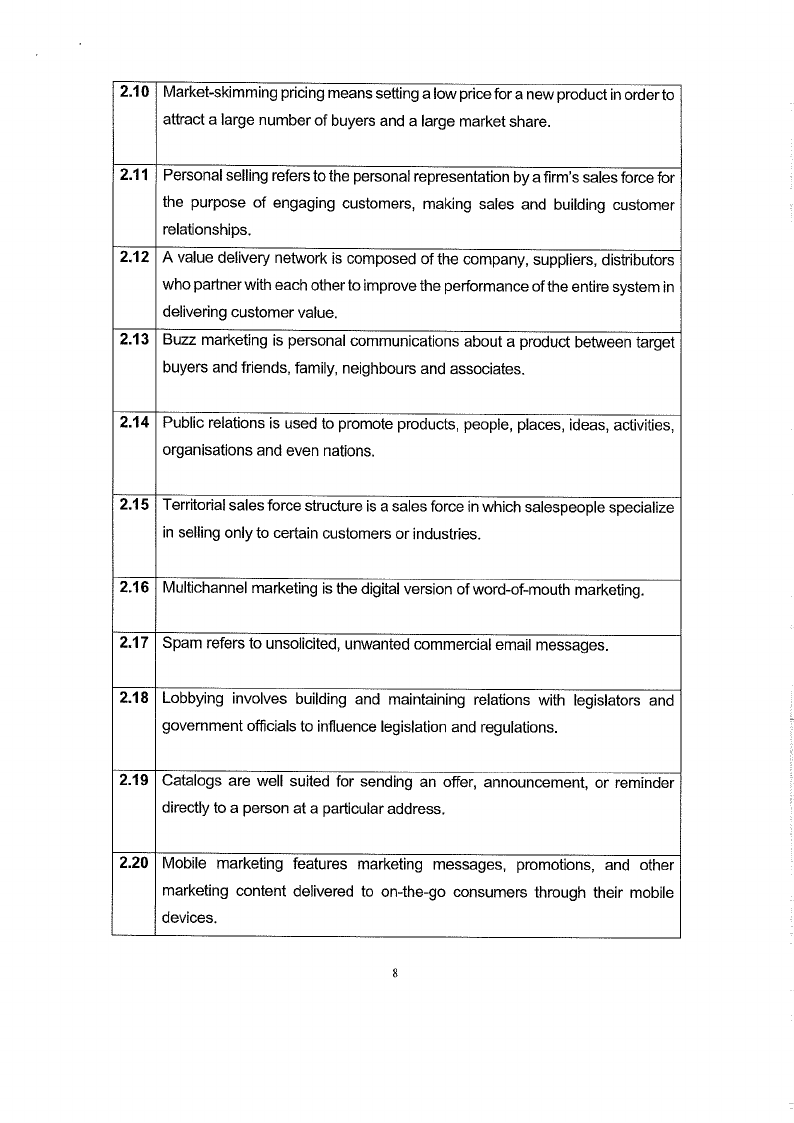
2.10 Market-skimming pricing means setting a low price for a new product in order to
attract a large number of buyers and a large market share.
2.11 Personal selling refers to the personal representation by a firm's sales force for
the purpose of engaging customers, making sales and building customer
relationships.
2.12 A value delivery network is composed of the company, suppliers, distributors
who partner with each other to improve the performance of the entire system in
delivering customer value.
2.13 Buzz marketing is personal communications about a product between target
buyers and friends, family, neighbours and associates.
2.14 Public relations is used to promote products, people, places, ideas, activities,
organisations and even nations.
2.15 Territorial sales force structure is a sales force in which salespeople specialize
in selling only to certain customers or industries.
2.16 Multichannel marketing is the digital version of word-of-mouth marketing.
2.17 Spam refers to unsolicited, unwanted commercial email messages.
2.18 Lobbying involves building and maintaining relations with legislators and
government officials to influence legislation and regulations.
2.19 Catalogs are well suited for sending an offer, announcement, or reminder
directly to a person at a particular address.
2.20 Mobile marketing features marketing messages, promotions, and other
marketing content delivered to on-the-go consumers through their mobile
devices.
8

9 Page 9

▲back to top


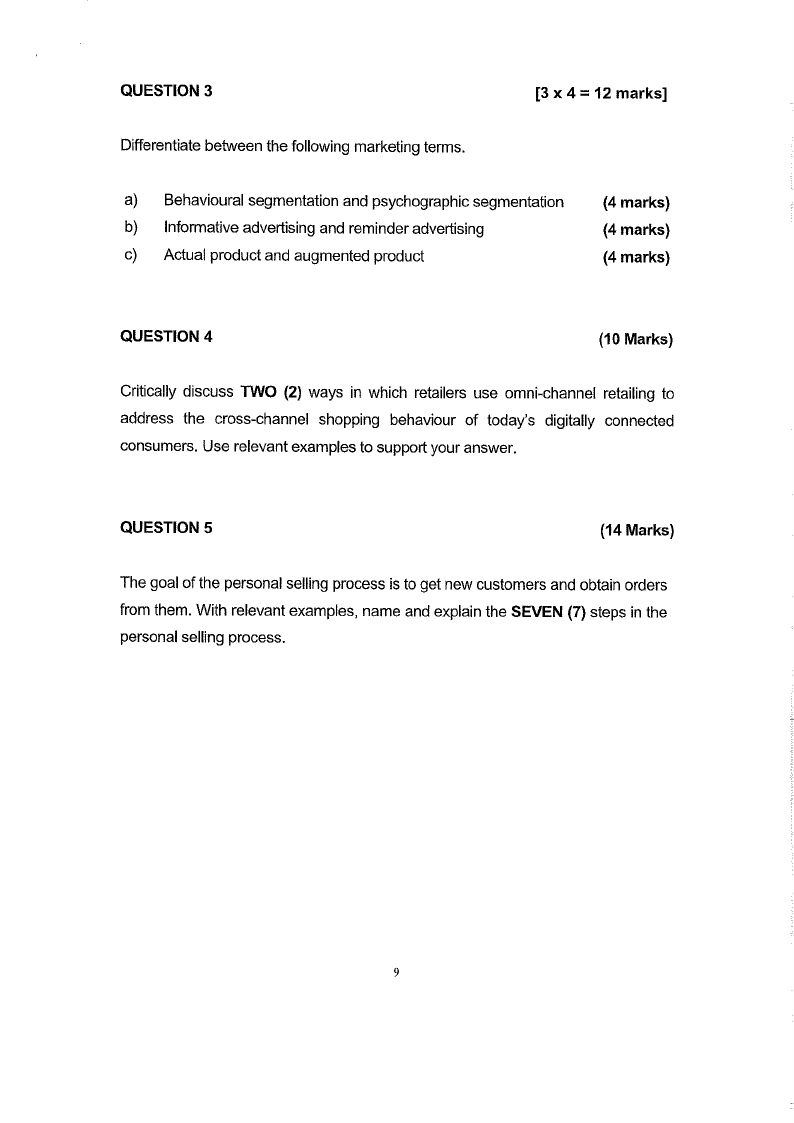
QUESTION 3
[3 x 4 = 12 marks]
Differentiate between the following marketing terms.
a) Behavioural segmentation and psychographic segmentation
b) Informative advertising and reminder advertising
c) Actual product and augmented product
(4 marks)
(4marks)
(4 marks)
QUESTION4
(10 Marks)
Critically discuss TWO (2) ways in which retailers use omni-channel retailing to
address the cross-channel shopping behaviour of today's digitally connected
consumers. Use relevant examples to support your answer.
QUESTION 5
(14 Marks)
The goal of the personal selling process is to get new customers and obtain orders
from them. With relevant examples, name and explain the SEVEN (7) steps in the
personal selling process.
9

10 Page 10

▲back to top


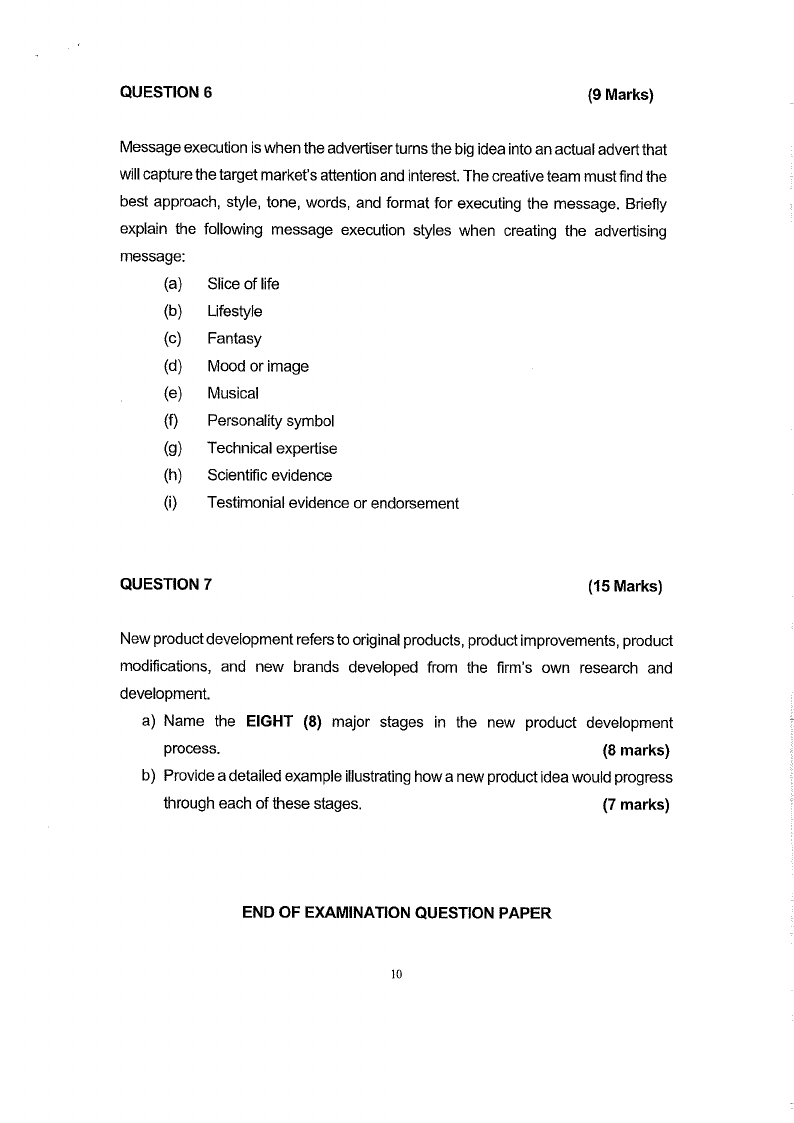
QUESTION 6
(9 Marks)
Message execution is when the advertiser turns the big idea into an actual advert that
will capture the target market's attention and interest. The creative team must find the
best approach, style, tone, words, and format for executing the message. Briefly
explain the following message execution styles when creating the advertising
message:
(a) Slice of life
(b) Lifestyle
(c) Fantasy
(d} Mood or image
(e) Musical
(f) Personality symbol
(g) Technical expertise
(h) Scientific evidence
(i) Testimonial evidence or endorsement
QUESTION 7
(15 Marks)
New product development refers to original products, product improvements, product
modifications, and new brands developed from the firm's own research and
development.
a) Name the EIGHT (8) major stages in the new product development
process.
(8 marks)
b) Provide a detailed example illustrating how a new product idea would progress
through each of these stages.
(7 marks)
END OF EXAMINATION QUESTION PAPER
10