


 |
MPM512S - Marketing Principles - 2nd Opp - Nov 2025 |
|
|
1 Page 1 |
▲back to top |
n Am I BI A u n IVE Rs ITY
OF SCIEnCE Ano TECHnOLOGY
FACULTY OF COMMERCE; HUMAN SCIENCES AND EDUCATION
DEPARTMENT OF MARKETING, LOGISTICS AND SPORT MANAGEMENT
QUALIFICATION: BACHELOR OF MARKETING AND OTHERS
QUALIFICATION CODE: 07BMAK AND
LEVEL: 5
OTHERS
COURSE CODE: MPM512S
SESSION: NOVEMBER 2025
DURATION: 3 HOURS
COURSE NAME: MARKEING PRINCIPLES
PAPER:THEORY
MARKS: 100
SECOND OPPORTUNITY EXAMINATION QUESTION PAPER
EXAMINER(S) Ms Cherley Du Plessis (FT)
Dr. Gloria Veindira Karita (PT & DI)
MODERATOR: Mr John-Grafft Ndungaua
INSTRUCTIONS
1. This paper consists of SEVEN (7) questions
2. Answer ALL questions
3. Use the table provided on page (7] to answer Question 1 and 2:
Detach and insert into your answer booklet
4. Write as legible as possible, and as prec;ise as possible
5. Read each question carefully
6. Allocate your time appropriately
PERMISSIBLE MATERIALS
1. Examination paper
2. Examination script
THIS QUESTION PAPER CONSISTS OF 7 PAGES (Including this front page)
1
|
|
2 Page 2 |
▲back to top |
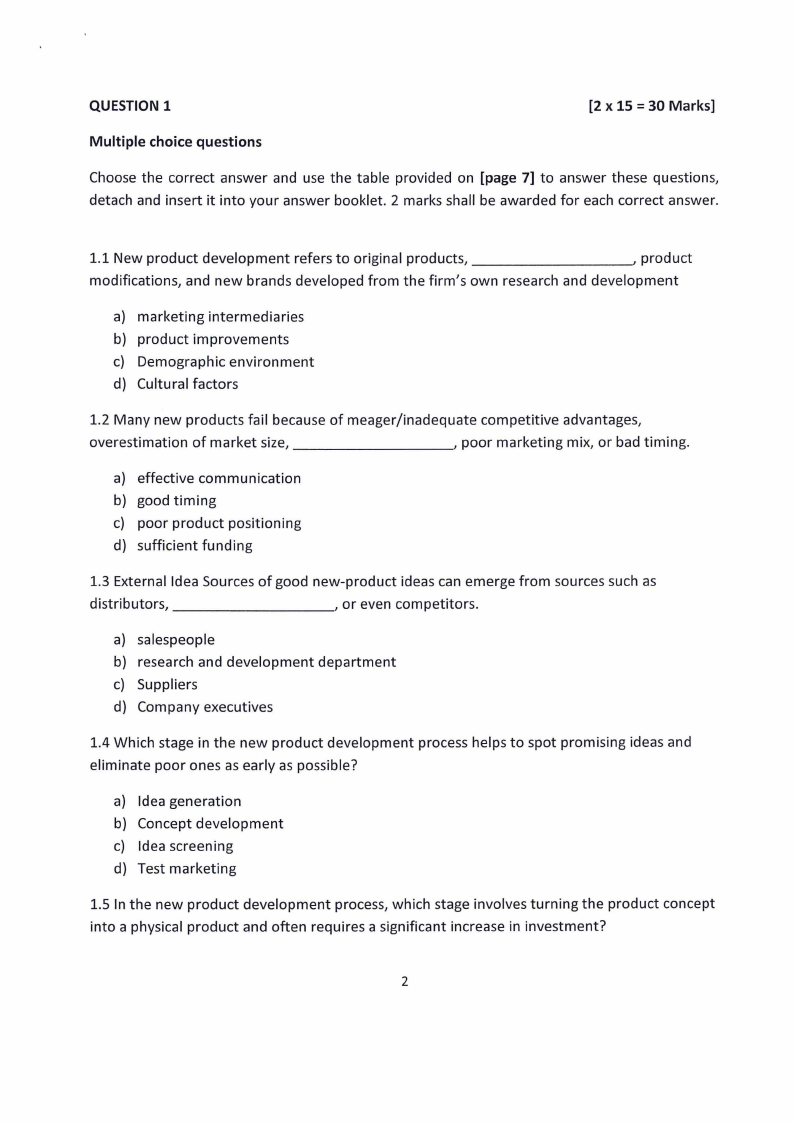
QUESTION 1
[2 x 15 = 30 Marks]
Multiple choice questions
Choose the correct answer and use the table provided on [page 7] to answer these questions,
detach and insert it into your answer booklet. 2 marks shall be awarded for each correct answer.
1.1 New product development refers to original products,--------~ product
modifications, and new brands developed from the firm's own research and development
a) marketing intermediaries
b) product improvements
c) Demographic environment
d) Cultural factors
1.2 Many new products fail because of meager/inadequate competitive advantages,
overestimation of market s i z e , - - - - - - - - ~ poor marketing mix, or bad timing.
a) effective communication
b) good timing
c) poor product positioning
d) sufficient funding
1.3 External Idea Sources of good new-product ideas can emerge from sources such as
distributors,---------~ or even competitors.
a) salespeople
b) research and development department
c) Suppliers
d) Company executives
1.4 Which stage in the new product development process helps to spot promising ideas and
eliminate poor ones as early as possible?
a) Idea generation
b) Concept development
c) Idea screening
d) Test marketing
1.5 In the new product development process, which stage involves turning the product concept
into a physical product and often requires a significant increase in investment?
2
|
|
3 Page 3 |
▲back to top |
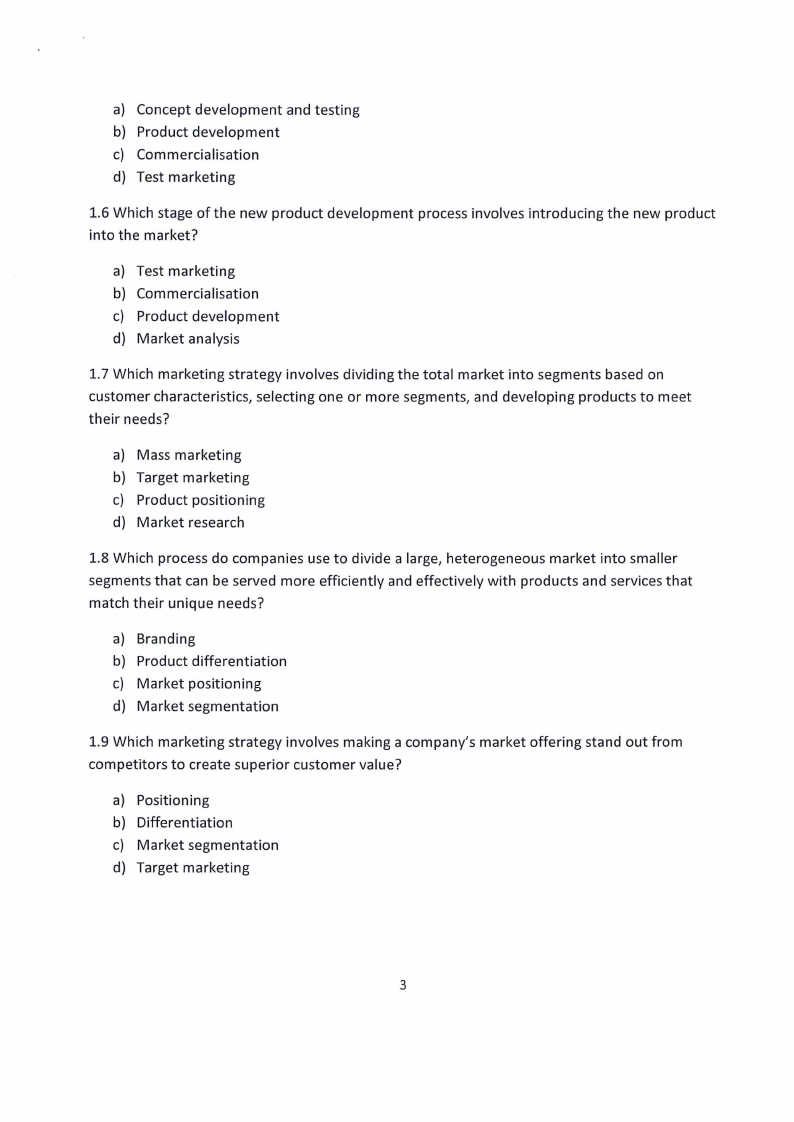
a) Concept development and testing
b) Product development
c) Commercialisation
d) Test marketing
1.6 Which stage of the new product development process involves introducing the new product
into the market?
a) Test marketing
b) Commercialisation
c) Product development
d) Market analysis
1.7 Which marketing strategy involves dividing the total market into segments based on
customer characteristics, selecting one or more segments, and developing products to meet
their needs?
a) Mass marketing
b) Target marketing
c) Product positioning
d) Market research
1.8 Which process do companies use to divide a large, heterogeneous market into smaller
segments that can be served more efficiently and effectively with products and services that
match their unique needs?
a) Branding
b) Product differentiation
c) Market positioning
d) Market segmentation
1.9 Which marketing strategy involves making a company's market offering stand out from
competitors to create superior customer value?
a) Positioning
b) Differentiation
c) Market segmentation
d) Target marketing
3
|
|
4 Page 4 |
▲back to top |
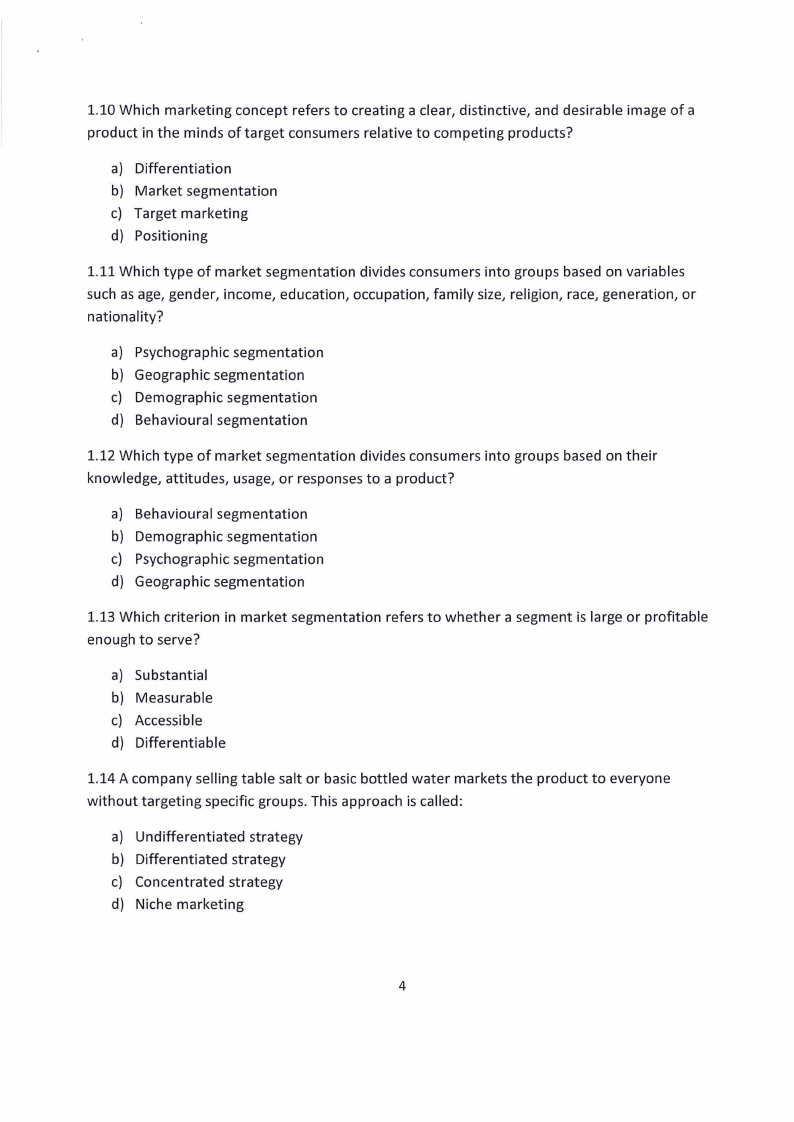
1.10 Which marketing concept refers to creating a clear, distinctive, and desirable image of a
product in the minds of target consumers relative to competing products?
a) Differentiation
b) Market segmentation
c) Target marketing
d) Positioning
1.11 Which type of market segmentation divides consumers into groups based on variables
such as age, gender, income, education, occupation, family size, religion, race, generation, or
nationality?
a) Psychographic segmentation
b) Geographic segmentation
c) Demographic segmentation
d) Behavioural segmentation
1.12 Which type of market segmentation divides consumers into groups based on their
knowledge, attitudes, usage, or responses to a product?
a) Behavioural segmentation
b) Demographic segmentation
c) Psychographic segmentation
d) Geographic segmentation
1.13 Which criterion in market segmentation refers to whether a segment is large or profitable
enough to serve?
a) Substantial
b) Measurable
c) Accessible
d) Differentiable
1.14 A company selling table salt or basic bottled water markets the product to everyone
without targeting specific groups. This approach is called:
a) Undifferentiated strategy
b) Differentiated strategy
c) Concentrated strategy
d) Niche marketing
4
|
|
5 Page 5 |
▲back to top |
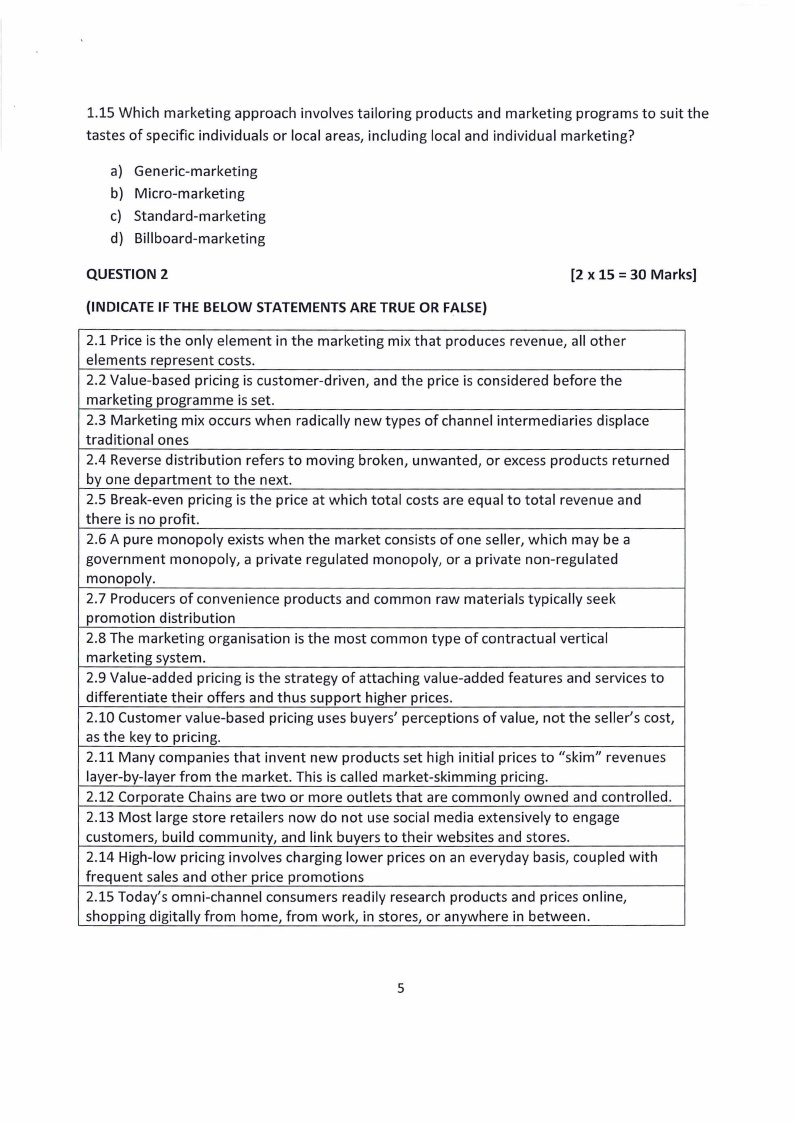
1.15 Which marketing approach involves tailoring products and marketing programs to suit the
tastes of specific individuals or local areas, including local and individual marketing?
a) Generic-marketing
b) Micro-marketing
c) Standard-marketing
d) Billboard-marketing
QUESTION 2
[2 x 15 = 30 Marks]
(INDICATE IF THE BELOW STATEMENTS ARE TRUE OR FALSE)
2.1 Price is the only element in the marketing mix that produces revenue, all other
elements represent costs.
2.2 Value-based pricing is customer-driven, and the price is considered before the
marketing programme is set.
2.3 Marketing mix occurs when radically new types of channel intermediaries displace
traditional ones
2.4 Reverse distribution refers to moving broken, unwanted, or excess products returned
by one department to the next.
2.5 Break-even pricing is the price at which total costs are equal to total revenue and
there is no profit.
2.6 A pure monopoly exists when the market consists of one seller, which may be a
government monopoly, a private regulated monopoly, or a private non-regulated
monopoly.
2.7 Producers of convenience products and common raw materials typically seek
promotion distribution
2.8 The marketing organisation is the most common type of contractual vertical
marketing system.
2.9 Value-added pricing is the strategy of attaching value-added features and services to
differentiate their offers and thus support higher prices.
2.10 Customer value-based pricing uses buyers' perceptions of value, not the seller's cost,
as the key to pricing.
2.11 Many companies that invent new products set high initial prices to "skim" revenues
layer-by-layer from the market. This is called market-skimming pricing.
2.12 Corporate Chains are two or more outlets that are commonly owned and controlled.
2.13 Most large store retailers now do not use social media extensively to engage
customers, build community, and link buyers to their websites and stores.
2.14 High-low pricing involves charging lower prices on an everyday basis, coupled with
frequent sales and other price promotions
2.15 Today's omni-channel consumers readily research products and prices online,
shopping digitally from home, from work, in stores, or anywhere in between.
5
|
|
6 Page 6 |
▲back to top |
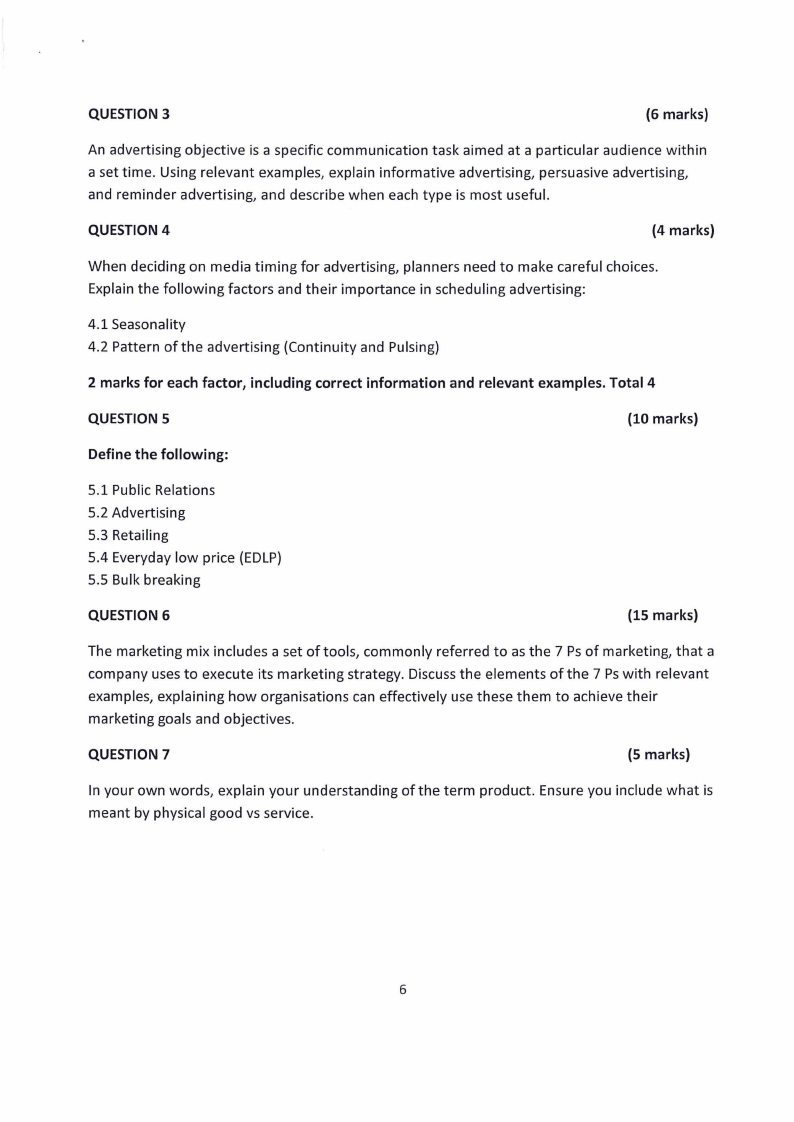
QUESTION 3
(6 marks)
An advertising objective is a specific communication task aimed at a particular audience within
a set time. Using relevant examples, explain informative advertising, persuasive advertising,
and reminder advertising, and describe when each type is most useful.
QUESTION 4
(4 marks)
When deciding on media timing for advertising, planners need to make careful choices.
Explain the following factors and their importance in scheduling advertising:
4.1 Seasonality
4.2 Pattern of the advertising (Continuity and Pulsing)
2 marks for each factor, including correct information and relevant examples. Total 4
QUESTION 5
(10 marks)
Define the following:
5.1 Public Relations
5.2 Advertising
5.3 Retailing
5.4 Everyday low price (EDLP)
5.5 Bulk breaking
QUESTION 6
(15 marks)
The marketing mix includes a set of tools, commonly referred to as the 7 Ps of marketing, that a
company uses to execute its marketing strategy. Discuss the elements of the 7 Ps with relevant
examples, explaining how organisations can effectively use these them to achieve their
marketing goals and objectives.
QUESTION 7
(5 marks)
In your own words, explain your understanding of the term product. Ensure you include what is
meant by physical good vs service.
6
|
|
7 Page 7 |
▲back to top |
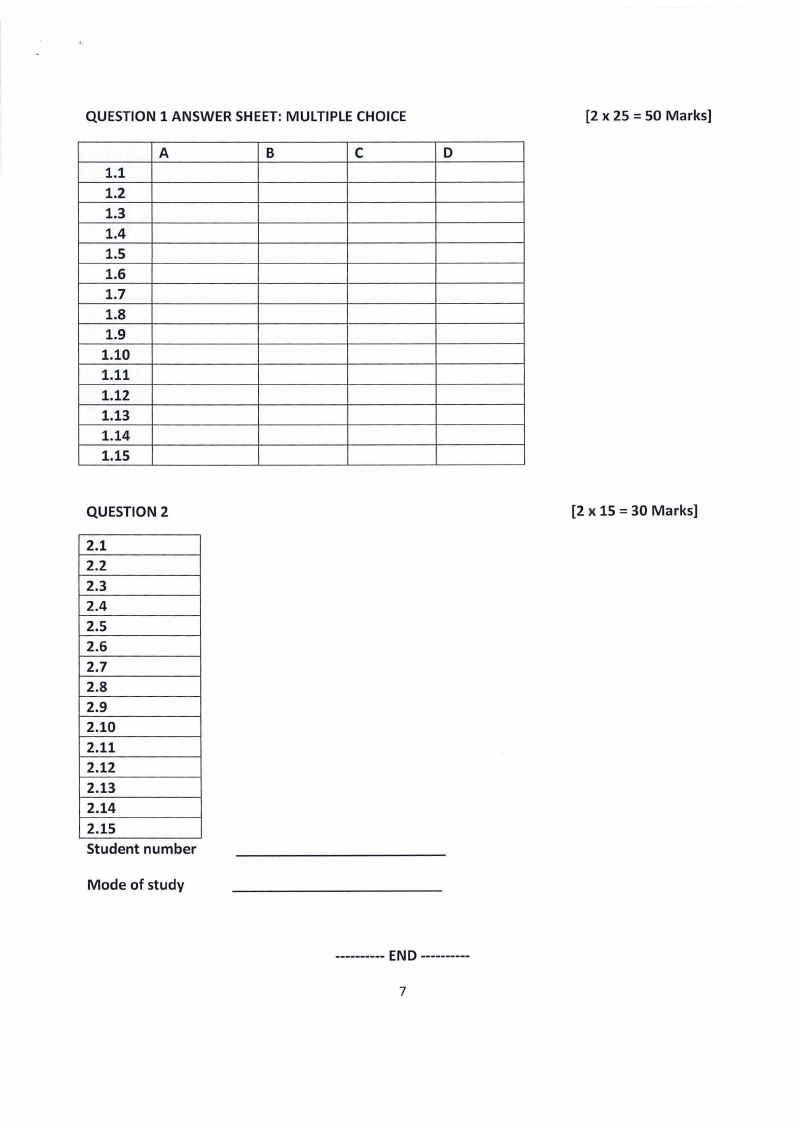
QUESTION 1 ANSWER SHEET: MULTIPLE CHOICE
A
1.1
1.2
1.3
1.4
1.5
1.6
1.7
1.8
1.9
1.10
1.11
1.12
1.13
1.14
1.15
B
C
D
QUESTION 2
2.1
2.2
2.3
2.4
2.5
2.6
2.7
2.8
2.9
2.10
2.11
2.12
2.13
2.14
2.15
Student number
Mode of study
---------- END----------
7
[2 x 25 = SO Marks]
[2 x 15 = 30 Marks]