


 |
IMH621S - IMMUNOHAEMATOLOGY - 2ND OPP - DEC 2025 |
|
|
1 Page 1 |
▲back to top |
nAmlBIA unlVERSITY
OF SCIEnCE Ano TECHnOLOGY
FACULTY OF HEALTH, NATURAL RESOURCES AND APPLIED SCIENCES
DEPARTMENT OF CLINICAL HEALTH SCIENCES
QUALIFICATION: BACHELOR OF MEDICAL LABORATORY SCIENCES
QUALIFICATION CODE: 08BMLS
LEVEL: 6
COURSE CODE: IMH621S
COURSE NAME: IMMUNOAEMATOLOGY
SESSION:
DECEMBER 2025
PAPER:
THEORY
DURATION: 3 HOURS
MARKS:
100
SUPPLEMENTARY/ SECOND OPPORTUNITY EXAMINATION
EXAMINER(S)
Dr Martin Gonzo
MODERATOR:
Mrs Edwig Shingenge
1. Answer ALL the questions.
2. Write clearly and neatly.
3. Number the answers clearly.
INSTRUCTIONS
PERMISSIBLE MATERIALS
1. Pen
2. Calculator
THIS QUESTION PAPER CONSISTS OF 6 PAGES (Including this front page)
Page J of6
|
|
2 Page 2 |
▲back to top |
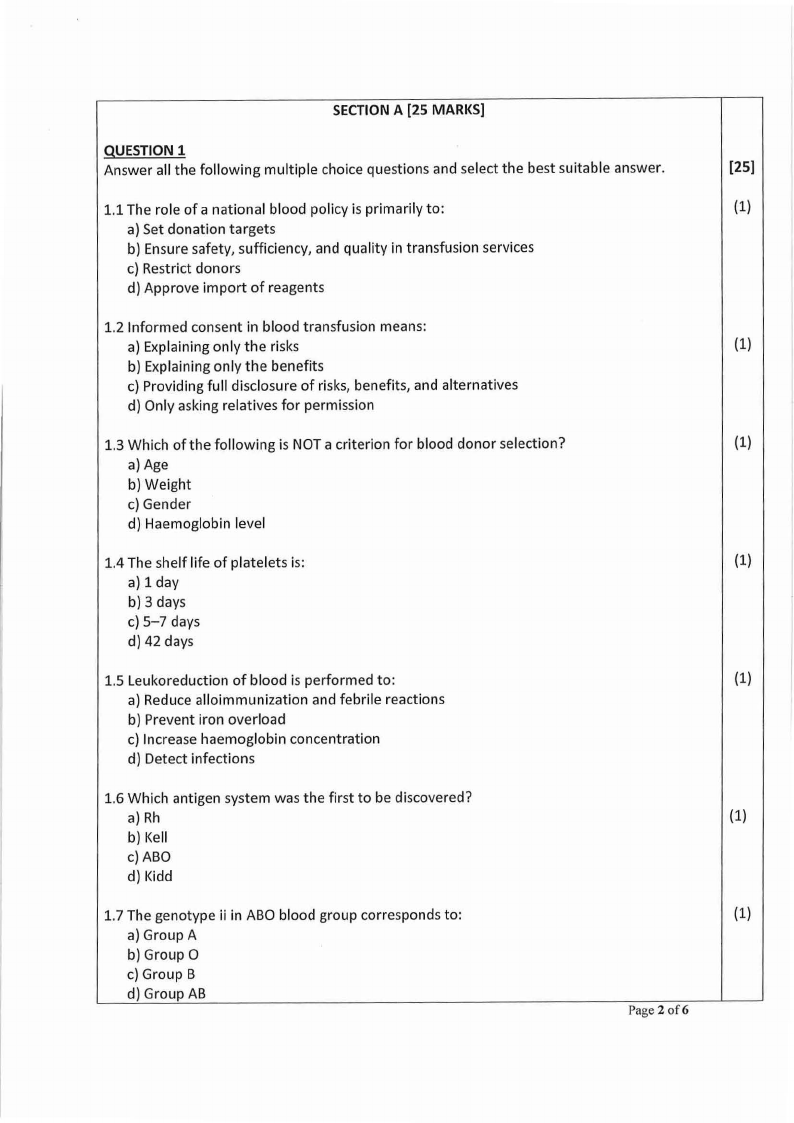
SECTION A (25 MARKS]
QUESTION 1
Answer all the following multiple choice questions and select the best suitable answer.
(25]
1.1 The role of a national blood policy is primarily to:
(1)
a) Set donation targets
b) Ensure safety, sufficiency, and quality in transfusion services
c) Restrict donors
d) Approve import of reagents
1.2 Informed consent in blood transfusion means:
a) Explaining only the risks
b) Explaining only the benefits
c) Providing full disclosure of risks, benefits, and alternatives
d) Only asking relatives for permission
1.3 Which of the following is NOT a criterion for blood donor selection?
a) Age
b) Weight
c) Gender
d) Haemoglobin level
1.4 The shelf life of platelets is:
a) 1 day
b) 3 days
c) 5-7 days
d) 42 days
1.5 Leukoreduction of blood is performed to:
a) Reduce alloimmunization and febrile reactions
b) Prevent iron overload
c) Increase haemoglobin concentration
d) Detect infections
1.6 Which antigen syst em was the first to be discovered?
a) Rh
b) Kell
c) ABO
d) Kidd
1.7 The genotype ii in ABO blood group corresponds to:
a) Group A
b) Group 0
c) Group B
d) Group AB
(1)
{1)
(1)
(1)
(1)
(1)
Page 2 of6
|
|
3 Page 3 |
▲back to top |
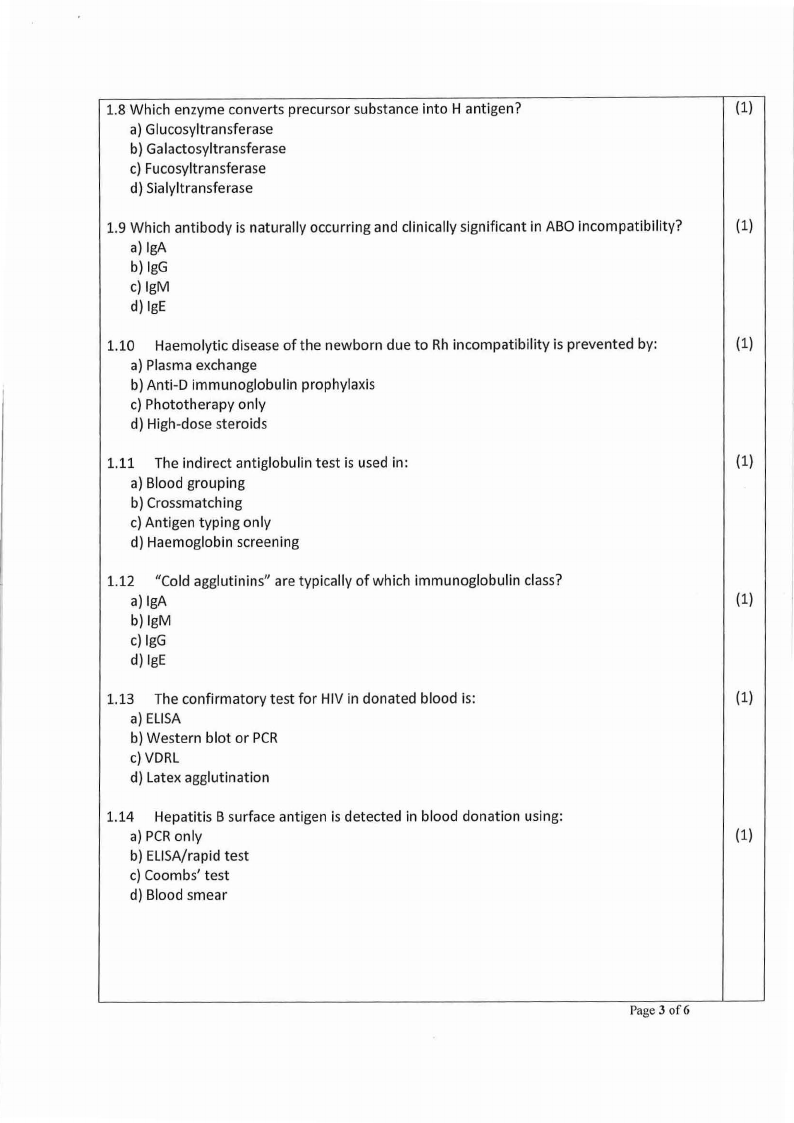
1.8 Which enzyme converts precursor substance into H antigen?
(1)
a) Glucosyltransferase
b) Galactosyltransferase
c) Fucosyltransferase
d) Sialyltransferase
1.9 Which antibody is naturally occurring and clinically significant in ABO incompatibility?
(1)
a) lgA
b) lgG
c) lgM
d) lgE
1.10 Haemolytic disease of the newborn due to Rh incompatibility is prevented by:
(1)
a) Plasma exchange
b) Anti-D immunoglobulin prophylaxis
c) Phototherapy only
d) High-dose steroids
1.11 The indirect antiglobulin test is used in:
(1)
a) Blood grouping
b) Crossmatching
c) Antigen typing only
d) Haemoglobin screening
1.12 "Cold agglutinins" are typically of which immunoglobulin class?
a) lgA
(1)
b) lgM
c) lgG
d) lgE
1.13 The confirmatory test for HIV in donated blood is:
(1)
a)ELISA
b) Western blot or PCR
c) VDRL
d) Latex agglutination
1.14 Hepatitis B surface antigen is detected in blood donation using:
a) PCR only
(1)
b) ELISA/rapid test
c) Coombs' test
d) Blood smear
Page 3 of6
|
|
4 Page 4 |
▲back to top |
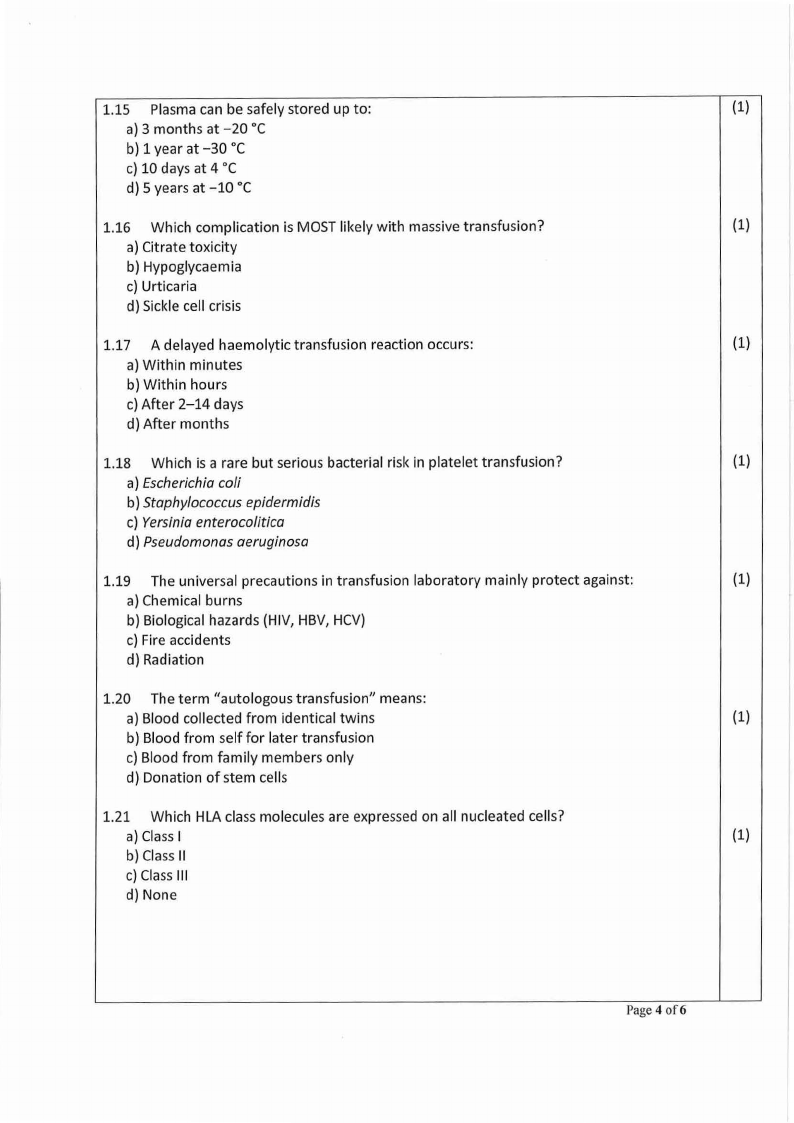
1.15 Plasma can be safely stored up to:
(1)
a) 3 months at -20 °C
b) 1 year at -30 °C
c) 10 days at 4 °C
d) 5 years at -10 °C
1.16 Which complication is MOST likely with massive transfusion?
(1)
a) Citrate toxicity
b) Hypoglycaemia
c) Urticaria
d) Sickle cell crisis
1.17 A delayed haemolytic transfusion reaction occurs:
(1)
a) Within minutes
b) Within hours
c) After 2-14 days
d) After months
1.18 Which is a rare but serious bacterial risk in platelet transfusion?
(1)
a) Escherichia coli
b) Staphylococcus epidermidis
c) Yersinia enterocolitica
d) Pseudomonas aeruginosa
1.19 The universal precautions in transfusion laboratory mainly protect against:
(1)
a) Chemical burns
b) Biological hazards (HIV, HBV, HCV)
c) Fire accidents
d) Radiation
1.20 The term "autologous transfusion" means:
a) Blood collected from identical twins
(1)
b) Blood from self for later transfusion
c) Blood from family members only
d) Donation of stem cells
1.21 Which HLA class molecules are expressed on all nucleated cells?
a) Class I
(1)
b) Class 11
c) Class Ill
d)None
Page 4 of6
|
|
5 Page 5 |
▲back to top |
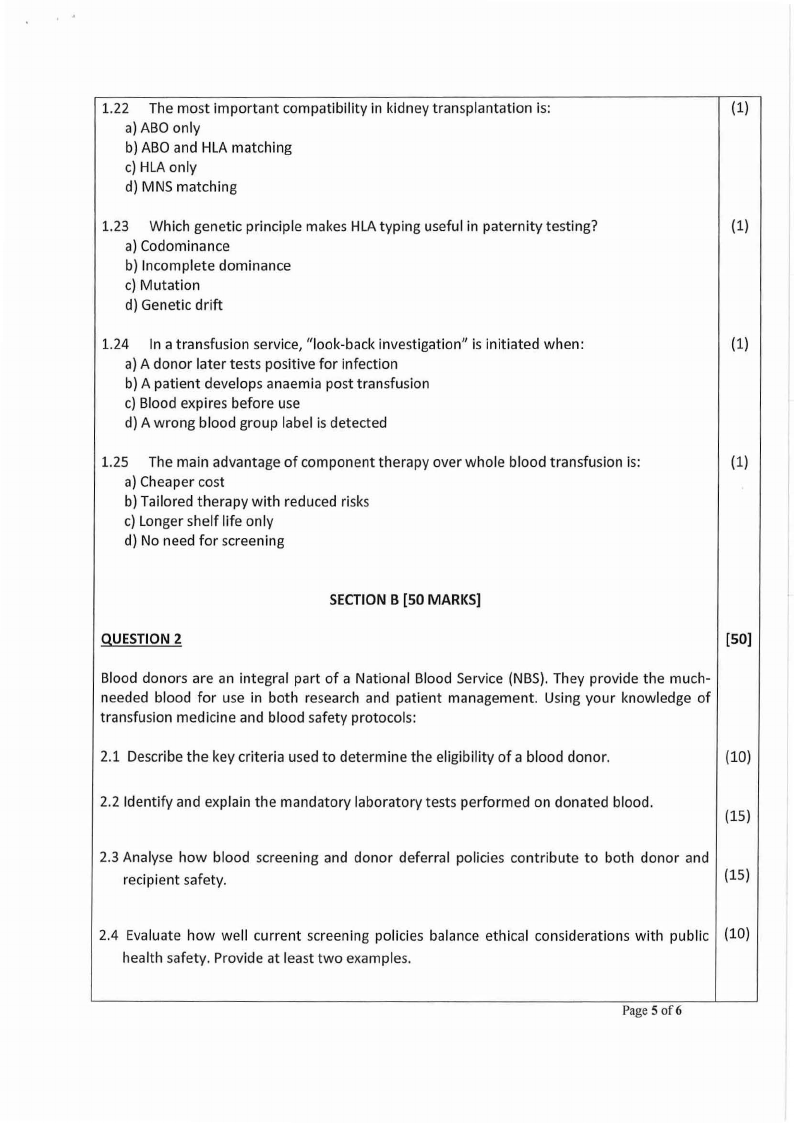
1.22 The most important compatibility in kidney transplantation is:
(1)
a) ABO only
b) ABO and HLA matching
c) HLA only
d) MNS matching
1.23 Which genetic principle makes HLA typing useful in paternity testing?
(1)
a) Codominance
b) Incomplete dominance
c) Mutation
d) Genetic drift
1.24 In a transfusion service, "look-back investigation" is initiated when:
(1)
a) A donor later tests positive for infection
b) A patient develops anaemia post transfusion
c) Blood expires before use
d) A wrong blood group label is detected
1.25 The main advantage of component therapy over whole blood transfusion is:
(1)
a) Cheaper cost
b) Tailored therapy with reduced risks
c) Longer shelf life only
d) No need for screening
SECTION B [SO MARKS]
QUESTION 2
[SO]
Blood donors are an integral part of a National Blood Service (NBS). They provide the much-
needed blood for use in both research and patient management. Using your knowledge of
transfu sion medicine and blood safety protocols:
2.1 Describe the key criteria used to determine the eligibility of a blood donor.
(10}
2.2 Identify and explain the mandatory laboratory tests performed on donated blood.
(15)
2.3 Analyse how blood screening and donor deferral policies contribute to both donor and
recipient safety.
(15)
2.4 Evaluate how well current screening policies balance ethical considerations with public (10)
health safety. Provide at least two examples.
Page5of6
|
|
6 Page 6 |
▲back to top |
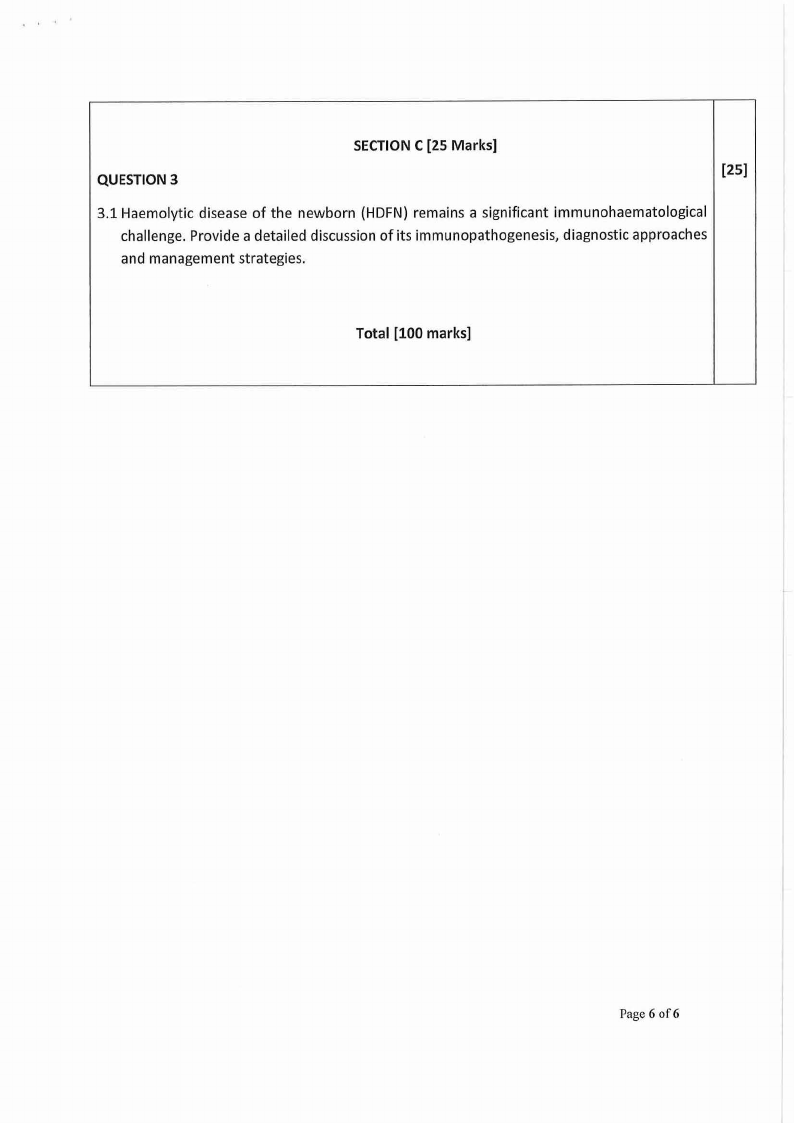
SECTION C [25 Marks]
[25]
QUESTION 3
3.1 Haemolytic disease of the newborn (HDFN) remains a significant immunohaematological
challenge. Provide a detailed discussion of its immunopathogenesis, diagnostic approaches
and management strategies.
Total [100 marks]
Page 6 of 6