


 |
IMH621S - IMMUNOHAEMATOLOGY - 1ST OPP - NOV 2025 |
|
|
1 Page 1 |
▲back to top |
nAmlBIA unlVERSITY
OF SCIEnCE Ano TECHnOLOGY
FACULTY OF HEALTH, NATURAL RESOURCES AND APPLIED SCIENCES
DEPARTMENT OF CLINICAL HEALTH SCIENCES
QUALIFICATION : BACHELOR OF MEDICAL LABORATORY SCIENCES
QUALIFICATION CODE: 08BM LS
LEVEL: 6
COURSE CODE: IMH 621S
COURSE NAME: IMMUNOHAEMATOLOGY
SESSION :
OCTOBER 2025
PAPER:
TH EORY
DURATION: 3 HOURS
MARKS:
100
EXAMINER(S)
MODERATOR:
FIRST OPPORTUNITY EXAMINATION
Dr Martin Gonzo
M rs Edw ig Shingenge
4.1 Answer ALL the qu estions.
4. 2 Write clearly and neatly.
4.3 Number the answers clearly.
INSTRUCTIONS
PERMISSIBLE MATERIALS
1. Pen
2. Calculator
THIS QUESTION PAPER CONSISTS OF 7 PAGES (Including this front page)
Page 1 of7
|
|
2 Page 2 |
▲back to top |
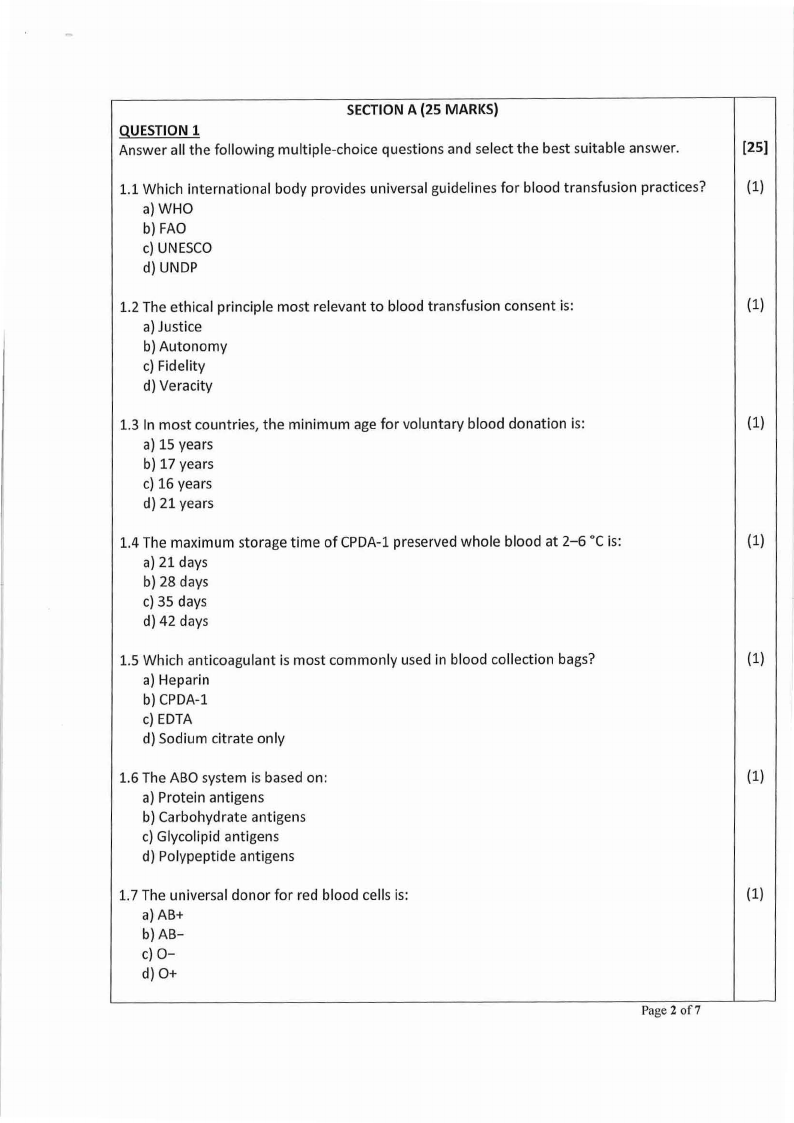
SECTION A (25 MARKS)
QUESTION 1
Answer all the following multiple-choice questions and select the best suitable answer.
[25)
1.1 Which international body provides universal guidelines for blood transfusion practices?
(1)
a}WHO
b) FAO
c) UNESCO
d) UNDP
1.2 The ethical principle most relevant to blood transfusion consent is:
(1)
a) Justice
b) Autonomy
c) Fidelity
d) Veracity
1.3 In most countries, the minimum age for voluntary blood donation is:
(1)
a) 15 years
b) 17 years
c) 16 years
d) 21 years
1.4 The maximum storage time of CPDA-1 preserved whole blood at 2-6 °C is:
(1)
a) 21 days
b) 28 days
c) 35 days
d) 42 days
1.5 Which anticoagulant is most commonly used in blood collection bags?
(1)
a) Heparin
b) CPDA-1
c)EDTA
d) Sodium citrate only
1.6 The ABO system is based on:
(1)
a) Protein antigens
b) Carbohydrate antigens
c) Glycolipid antigens
d) Polypeptide antigens
1.7 The universal donor for red blood cells is:
(1)
a) AB+
b) AB-
c) 0-
d) 0+
Page 2 of7
|
|
3 Page 3 |
▲back to top |
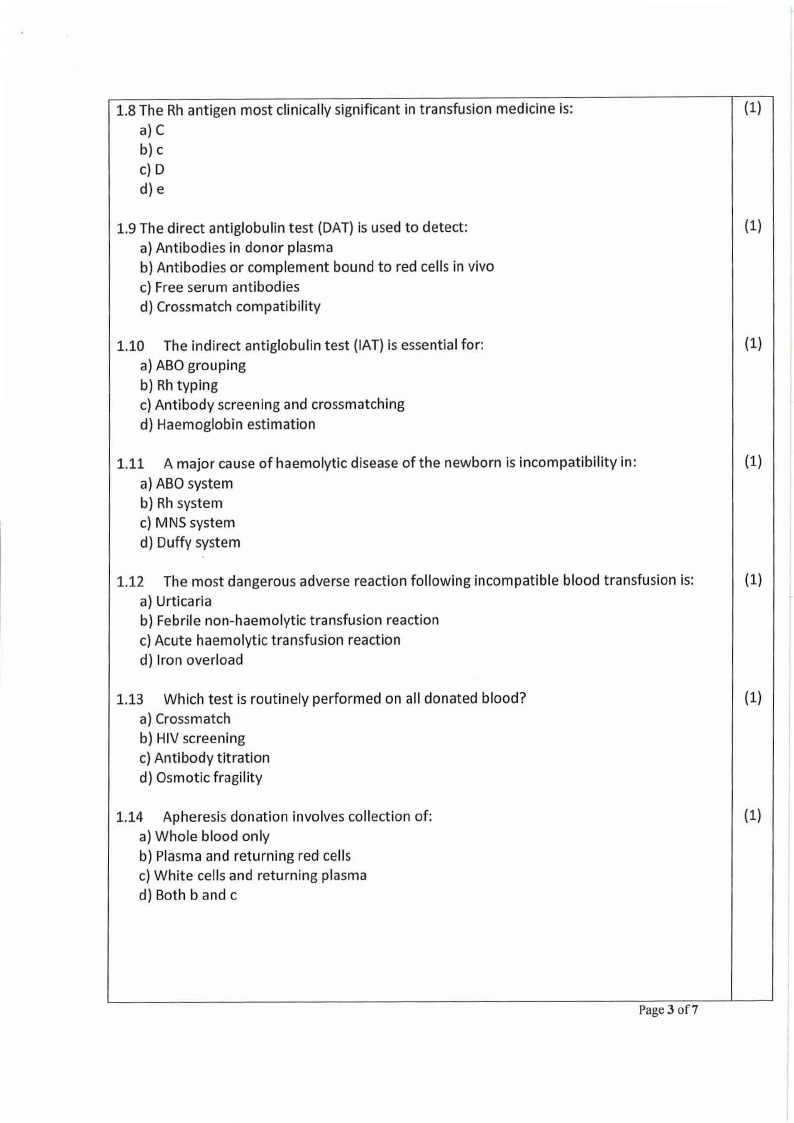
1.8 The Rh antigen most clinically significant in transfusion medicine is:
(1)
a) C
b) c
c) D
d)e
1.9 The direct antiglobulin test (DAT) is used to detect:
(1)
a) Antibodies in donor plasma
b) Antibodies or complement bound to red cells in vivo
c) Free serum antibodies
d) Crossmatch compatibility
1.10 The indirect antiglobulin test (IAT) is essential for:
(1)
a) ABO grouping
b) Rh typing
c) Antibody screening and crossmatching
d) Haemoglobin estimation
1.11 A major cause of haemolytic disease of the newborn is incompatibility in:
(1)
a) ABO system
b) Rh system
c) MNS system
d) Duffy system
1.12 The most dangerous adverse reaction following incompatible blood transfusion is:
(1)
a) Urticaria
b) Febrile non-haemolytic transfusion reaction
c) Acute haemolytic transfusion reaction
d) Iron overload
1.13 Which test is routinely performed on all donated blood?
(1)
a) Crossmatch
b) HIV screening
c) Antibody titration
d) Osmotic fragility
1.14 Apheresis donation involves collection of:
(1)
a) Whole blood only
b) Plasma and returning red cells
c) White cells and returning plasma
d) Both b and c
Page 3 of7
|
|
4 Page 4 |
▲back to top |
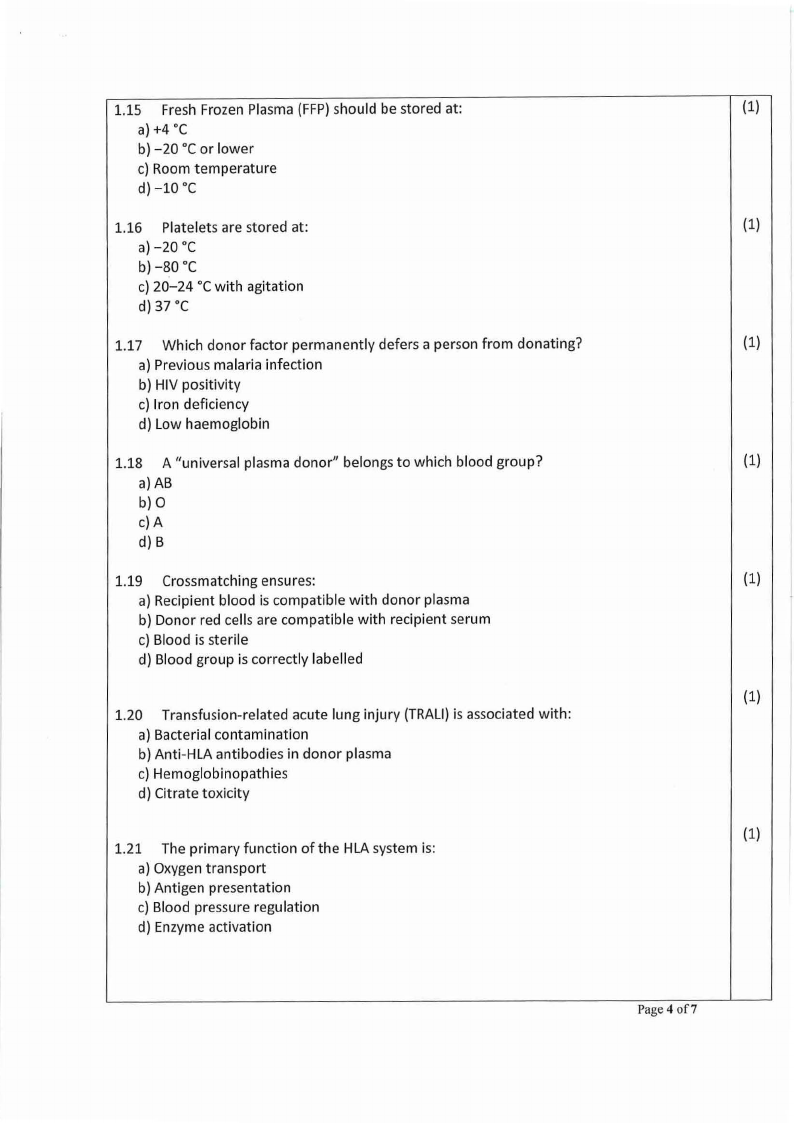
1.15 Fresh Frozen Plasma (FFP) should be stored at:
(1)
a) +4 °C
b) -20 °C or lower
c) Room temperature
d)-10°C
1.16 Platelets are stored at:
(1)
a) -20 °C
b)-80 °C
c) 20-24 °C with agitation
d) 37 °C
1.17 Which donor factor permanently defers a person from donating?
(1)
a) Previous malaria infection
b) HIV positivity
c) Iron deficiency
d) Low haemoglobin
1.18 A "universal plasma donor" belongs to which blood group?
(1)
a) AB
b)O
c) A
d) B
1.19 Crossmatching ensures:
(1)
a) Recipient blood is compatible with donor plasma
b) Donor red cells are compatible with recipient serum
c) Blood is sterile
d) Blood group is correctly labelled
(1)
1.20 Transfusion-related acute lung injury (TRALI) is associated with :
a) Bacterial contamination
b) Anti-HLA antibodies in donor plasma
c) Hemoglobinopathies
d) Citrate toxicity
(1)
1.21 The primary function of the HLA system is:
a) Oxygen transport
b) Antigen presentation
c) Blood pressure regulation
d) Enzyme activation
Page 4 of7
|
|
5 Page 5 |
▲back to top |
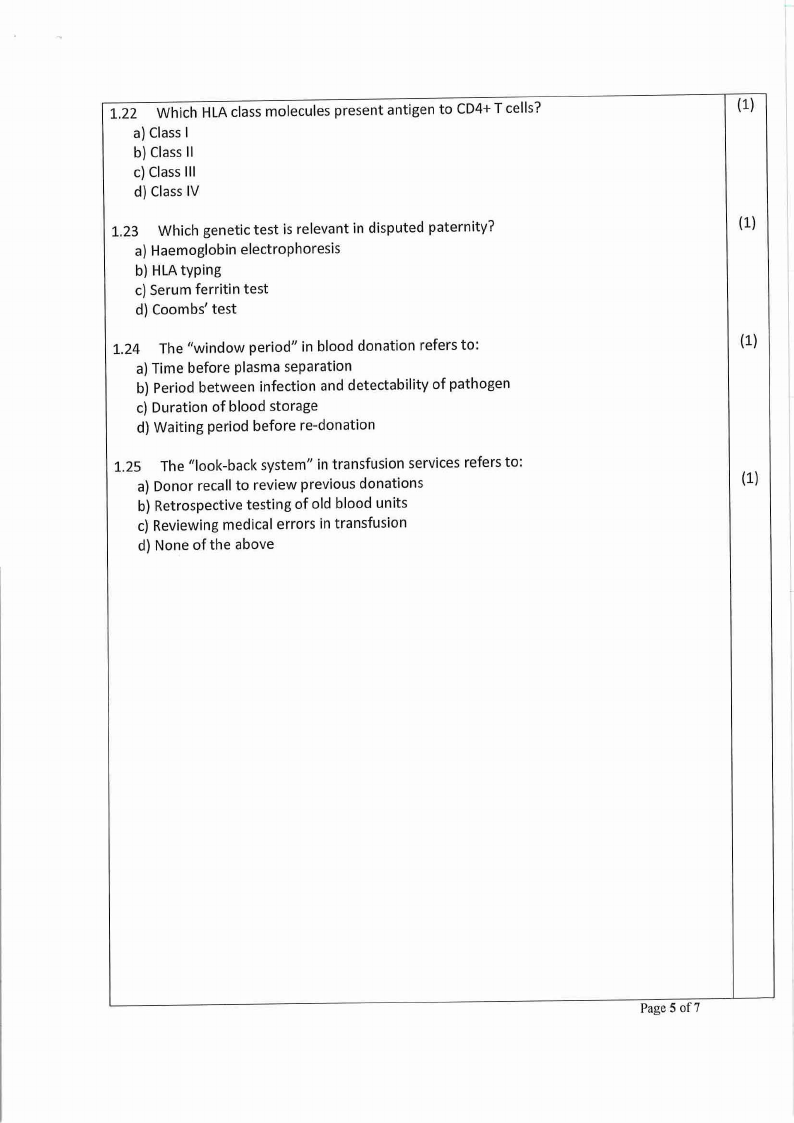
1.22 Which HLA class molecules present antigen to CD4+ T cells?
(1)
a} Class I
b} Class II
c} Class 111
d} Class IV
1.23 Which genetic test is relevant in disputed paternity?
(1)
a} Haemoglobin electrophoresis
b} HLA typing
c} Serum ferritin test
d} Coombs' test
1.24 The "window period" in blood donation refers to:
(1}
a} Time before plasma separation
b) Period between infection and detectability of pathogen
c) Duration of blood storage
d} Waiting period before re-donation
1.25 The "look-back system" in transfusion services refers to:
a} Donor recall to review previous donations
(1)
b} Retrospective testing of old blood units
c} Reviewing medical errors in transfusion
d} None of the above
Page 5of7
|
|
6 Page 6 |
▲back to top |
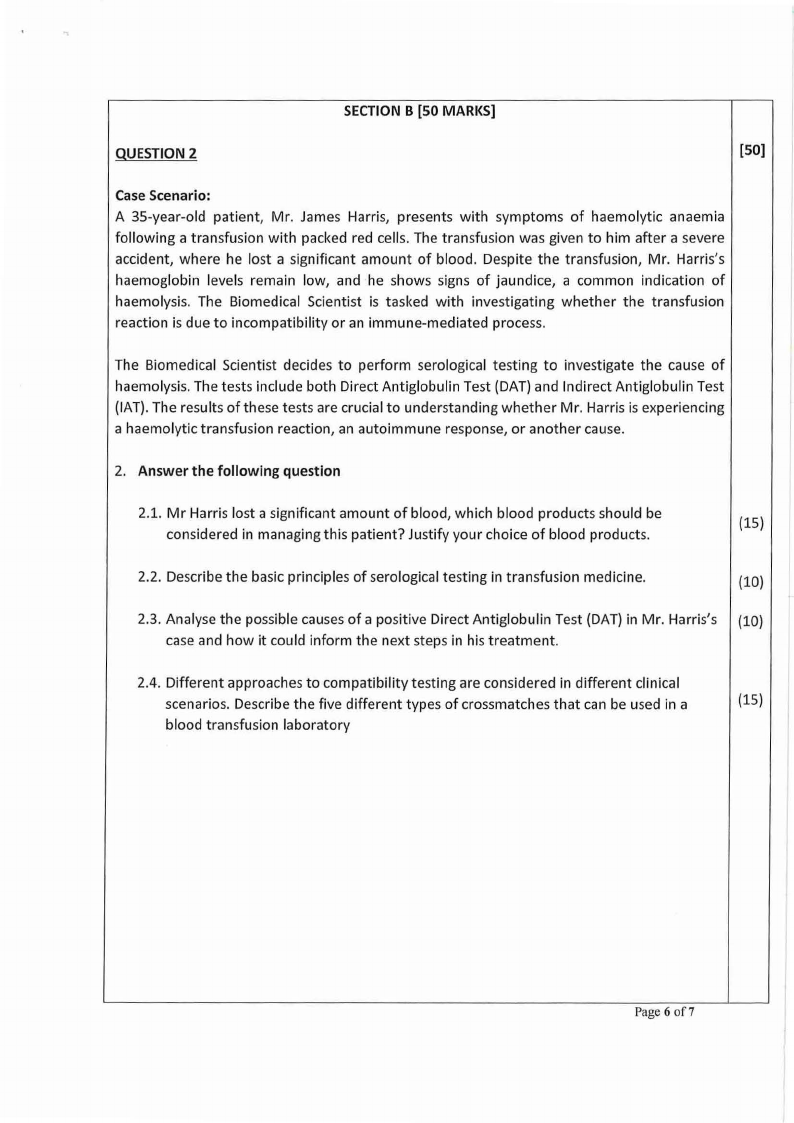
SECTION B [SO MARKS]
QUESTION 2
[SO]
Case Scenario:
A 35-year-old patient, Mr. James Harris, presents with symptoms of haemolytic anaemia
following a tran sfusion with packed red cells. The transfusion was given to him after a severe
accident, where he lost a significant amount of blood. Despite the transfusion, Mr. Harris's
haemoglobin levels remain low, and he shows signs of jaundice, a common indication of
haemolysis. The Biomedical Scientist is tasked with investigating whether the transfusion
reaction is due to incompatibility or an immune-mediated process.
The Biomedical Scientist decides to perform serological testing to investigate the cause of
haemolysis. The tests include both Direct Antiglobulin Test (DAT) and Indirect Antiglobulin Test
(IAT). The results of these tests are crucial to understanding whether Mr. Harris is experiencing
a haemolytic transfusion reaction, an autoimmune response, or another cause.
2. Answer the following question
2.1. Mr Harris lost a significant amount of blood, which blood products should be
(15)
consid ered in managing this patient? Justify your choice of blood products.
2.2. Describe the basic principles of serological testing in transfusion medicine.
(10)
2.3. Analyse the possible causes of a positive Direct Antiglobulin Test (DAT) in Mr. Harris's (10)
case and how it could inform the next steps in his treatment.
2.4. Different approaches to compatibility testing are considered in different clinical
scenarios. Describe the five different types of crossmatches that can be used in a
(15)
blood transfusion laboratory
Page 6 of7
|
|
7 Page 7 |
▲back to top |
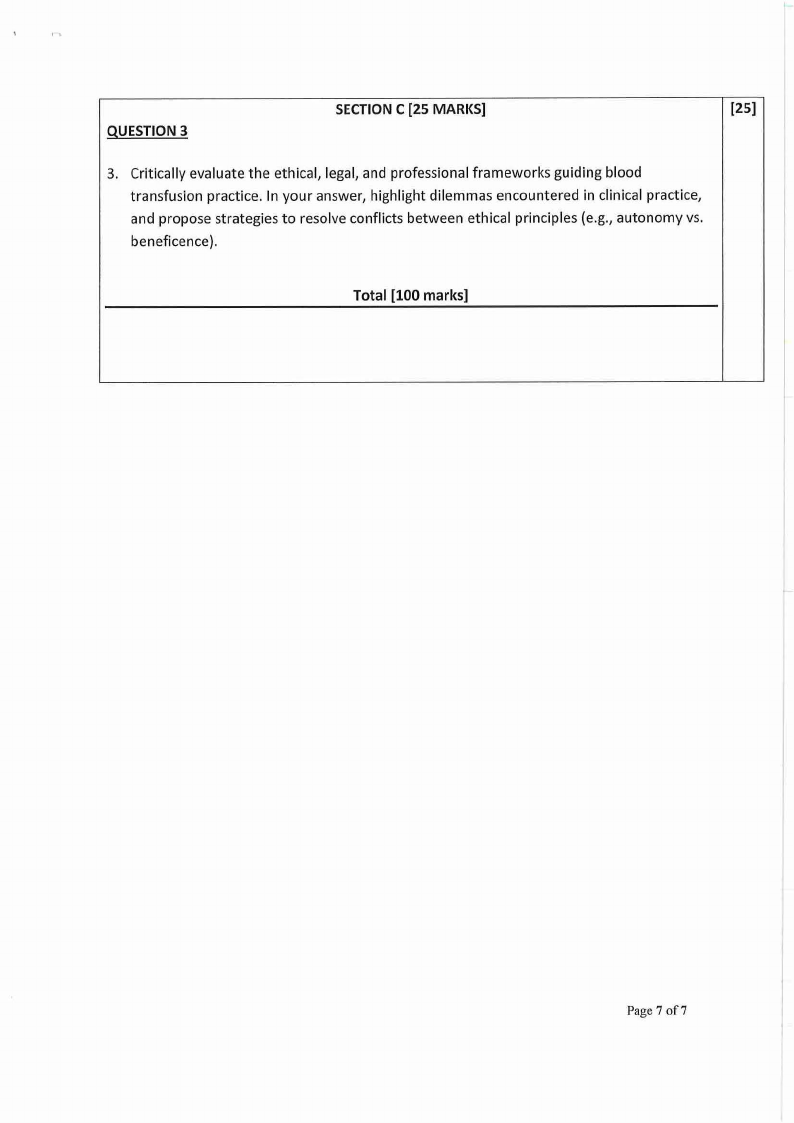
SECTION C [25 MARKS]
[25]
QUESTION 3
3. Critically evaluate the ethical, legal, and professional frameworks guiding blood
transfusion practice. In your answer, highlight dilemmas encountered in clinical practice,
and propose strategies to resolve conflicts between ethical principles (e.g., autonomy vs.
beneficence).
Total [100 marks]
Page 7 of7