


 |
MCF811S - MOBILE AND CLOUD FORENSICS - 2ND OPP - JULY 2025 |
|
|
1 Page 1 |
▲back to top |
n Am I BI A u n IVER s I TY
OF SCIEnCE Ano TECHnOLOGY
FACULTY OF COMPUTING AND INFORMATICS
DEPARTMENT OF CYBER SECURITY
QUALIFICATION: BACHELOR OF COMPUTER SCIENCE HONOURS IN DIGITAL FORENSICS
QUALIFICATION CODE: 08BHDF
COURSE: MOBILE AND CLOUD FORENSICS
DATE: JULY 2025
DURATION: 2H
LEVEL: 8
COURSE CODE: MCF811S
PAPER: THEORY
MARKS: 100
SECOND OPPORTUNITY /SUPPLEMENTARY EXAMINATION QUESTION PAPER
EXAMINER(S) MR. JULIUS SILAA
MODERATOR: DR. NKOSINATHI MPOFU
THIS QUESTION PAPER CONSISTS OF 4 PAGES
(Excluding this front page)
INSTRUCTIONS
1. Answer ALL the questions on the answer scripts.
2. Write clearly and neatly.
3. Number the answers clearly.
PERMISSIBLE MATERIALS
1. Calculator.
|
|
2 Page 2 |
▲back to top |
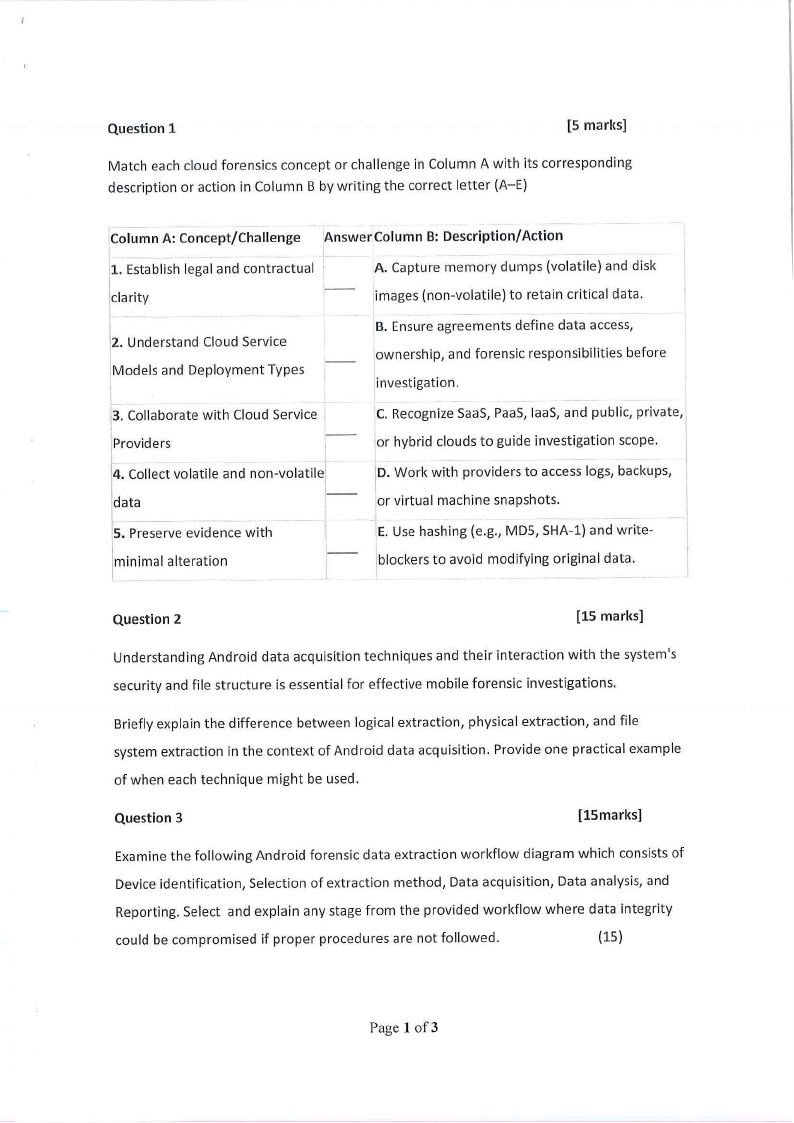
Question 1
[5 marks]
Match each cloud forensics concept or challenge in Column A with its corresponding
description or action in Column B by writing the correct letter (A-E)
,Column A: Concept/Challenge Answer Column B: Description/ Action
\\1.Establish legal and contractual
A. Capture memory dumps (volatile) and disk
lc1arity
images (non-volatile) to retain critical data.
\\2.Understand Cloud Service
,Models and Deployment Types
B. Ensure agreements define data access,
ownership, and forensic responsibilities before
investigation.
3. Collaborate with Cloud Service 1
Providers
4. Collect volatile and non-volatile!
data
'--
5. Preserve evidence with
minimal alteration
II-
C. Recognize Saas, PaaS,laaS, and public, private,
or hybrid clouds to guide investigation scope.
10.Work with providers to access logs, backups,
or virtual machine snapshots.
I1E. Use hashing (e.g., MOS, SHA-1) and write-
lblockers to avoid modifying original data.
Question 2
[15 marks]
Understanding Android data acquisition techniques and their interaction with the system's
security and file structure is essential for effective mobile forensic investigations.
Briefly explain the difference between logical extraction, physical extraction, and file
system extraction in the context of Android data acquisition. Provide one practical example
of when each technique might be used.
Question 3
[15marks]
Examine the following Android forensic data extraction workflow diagram which consists of
Device identification, Selection of extraction method, Data acquisition, Data analysis, and
Reporting. Select and explain any stage from the provided workflow where data integrity
could be compromised if proper procedures are not followed.
(15)
Page 1 of3
|
|
3 Page 3 |
▲back to top |
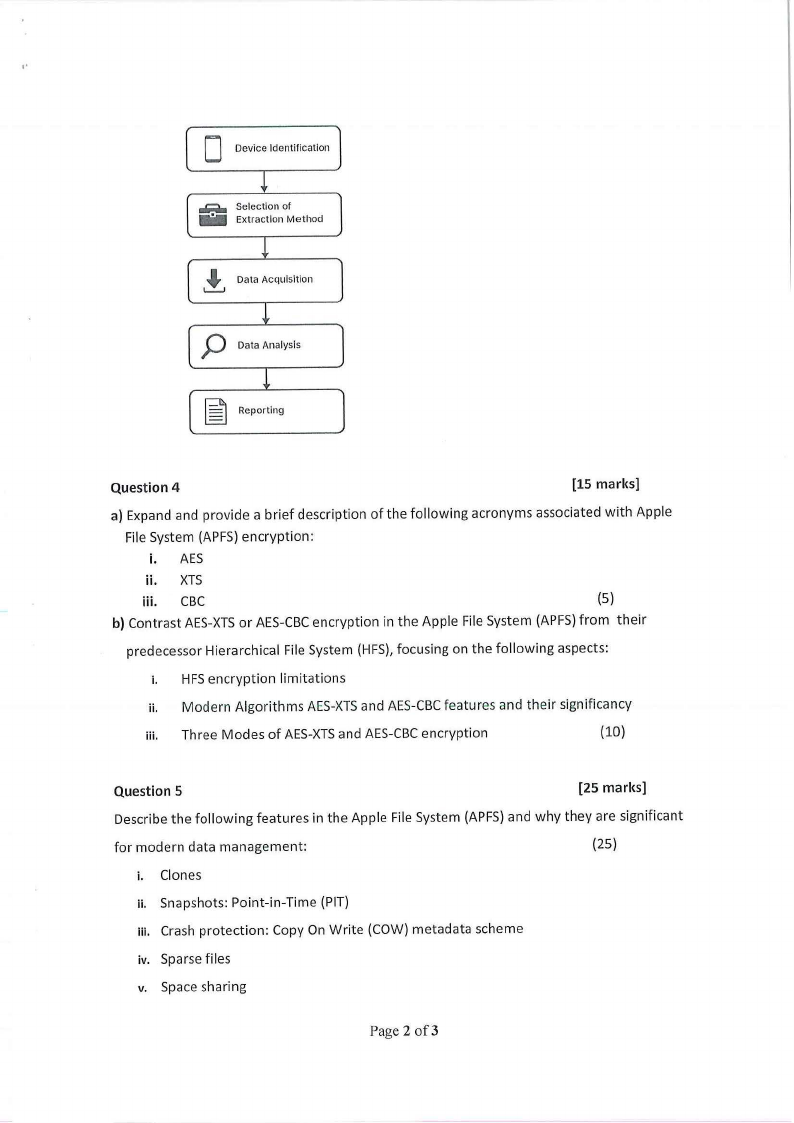
D Device Identification
!
Selection of
Extraction Method
L
± Data Acquisition
1
p Data Analysis
l
@JReporting
Question 4
(15 marks]
a) Expand and provide a brief description of the following acronyms associated with Apple
File System (APFS)encryption:
i. AES
ii. XTS
iii. CBC
(5)
b) Contrast AES-XTSor AES-CBCencryption in the Apple File System (APFS)from their
predecessor Hierarchical File System (HFS), focusing on the following aspects:
i. HFSencryption limitations
ii. Modern Algorithms AES-XTSand AES-CBCfeatures and their significancy
iii. Three Modes of AES-XTSand AES-CBCencryption
{10)
Question S
(25 marks)
Describe the following features in the Apple File System (APFS) and why they are significant
for modern data management:
(25)
i. Clones
ii. Snapshots: Point-in-Time (PIT)
iii. Crash protection: Copy On Write (COW) metadata scheme
iv. Sparse files
v. Space sharing
Page 2 of3
|
|
4 Page 4 |
▲back to top |
Question 6
[15 marks]
Understanding techniques for bypassing Android passcodes and rooting devices, along with
their prevention and risks, is essential for assessing mobile security and forensic
implications.
a) Besides rooting or using recovery mode, describe three methods to bypass passcodes
on Android devices.
(6)
b) Explain how each method identified in (a) can be prevented.
(3)
c) Describe three methods to root an Android device and list three potential
risks of rooting.
(6)
Question 7
[10 marks]
a) This semester, you completed a class group project focused on cloud forensics.
In your class group project, you worked with a cloud computing platform (such as AWS or
Google Cloud) and now need to preserve its data for future analysis. Identify one specific
step you could take to save a copy of the cloud instance and explain why this action would
be beneficial.
(3)
b) After doing activities on a cloud computer, the project asks you to bring files like memory
dumps or snapshots to your own computer for closer inspection-what is one reason you
might download files like a memory dump or snapshot to your own computer? (3)
c)The project involves making a pretend suspicious file called malware.txt on a cloud
computer to see how it behaves when you use it-describe one thing you could do with
a file like malware.txt to make sure it leaves a trail in the cloud instance.
(4)
*****END OF PAPER*****
Page 3 of3