


 |
MLY612S - Marketing Communicatios Strategy - 2nd Opp - Nov 2025 |
|
|
1 Page 1 |
▲back to top |
n Am I BI A u n IVER s ITY
OF SCIEnCE Ano TECHnDLOGY
FACULTY OF COMMERCE, HUMAN SCIENCES AND EDUCATION
DEPARTMENT OF MARKETING, LOGISTICS AND SPORT MANAGEMENT
QUALIFICATION : BACHELOR OF MARKETING
QUALIFICATION CODE: 07BMAR
LEVEL: NQF LEVEL 7
COURSE: MARKETING
COMMUNICATIONS STRATEGY
COURSE CODE: MLY612S
SESSION: DECEMBBER 2025
DURATION: THREE (3) HOURS
PAPER: THEORY
MARKS: 100
SECOND OPPORTUNITY EXAMINATION QUESTION PAPER
EXAMINER(S) MR. S TJITAMUNISA
MODERATOR: PROF. MAXWELL CHUFAMA
THIS QUESTION PAPER CONSISTS OF FIVE (5) PAGES
(Including this front page)
INSTRUCTIONS
• PLEASE ANSWERS AL THE QUESTIONS, WRITE NEAT AND TO THE POINT.
• SECTION A & B: USE TABLES PROVIDED ON PAGE OF THIS QUESTION
PAPER.
• MAKE SURE YOU INSERT THE TABLE INSIDE YOUR ANSWER BOOK
1
|
|
2 Page 2 |
▲back to top |
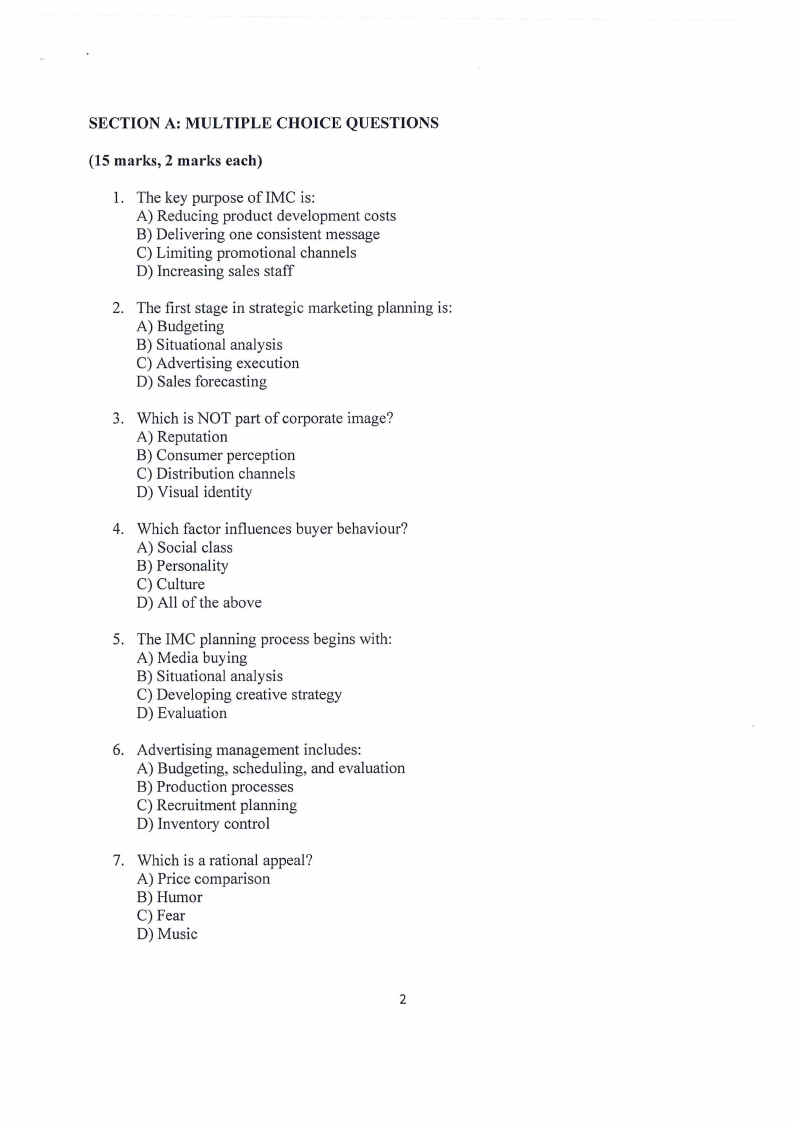
SECTION A: MULTIPLE CHOICE QUESTIONS
(15 marks, 2 marks each)
1. The key purpose of IMC is:
A) Reducing product development costs
B) Delivering one consistent message
C) Limiting promotional channels
D) Increasing sales staff
2. The first stage in strategic marketing planning is:
A) Budgeting
B) Situational analysis
C) Advertising execution
D) Sales forecasting
3. Which is NOT part of corporate image?
A) Reputation
B) Consumer perception
C) Distribution channels
D) Visual identity
4. Which factor influences buyer behaviour?
A) Social class
B) Personality
C) Culture
D) All of the above
5. The IMC planning process begins with:
A) Media buying
B) Situational analysis
C) Developing creative strategy
D) Evaluation
6. Advertising management includes:
A) Budgeting, scheduling, and evaluation
B) Production processes
C) Recruitment planning
D) Inventory control
7. Which is a rational appeal?
A) Price comparison
B) Humor
C) Fear
D) Music
2
|
|
3 Page 3 |
▲back to top |
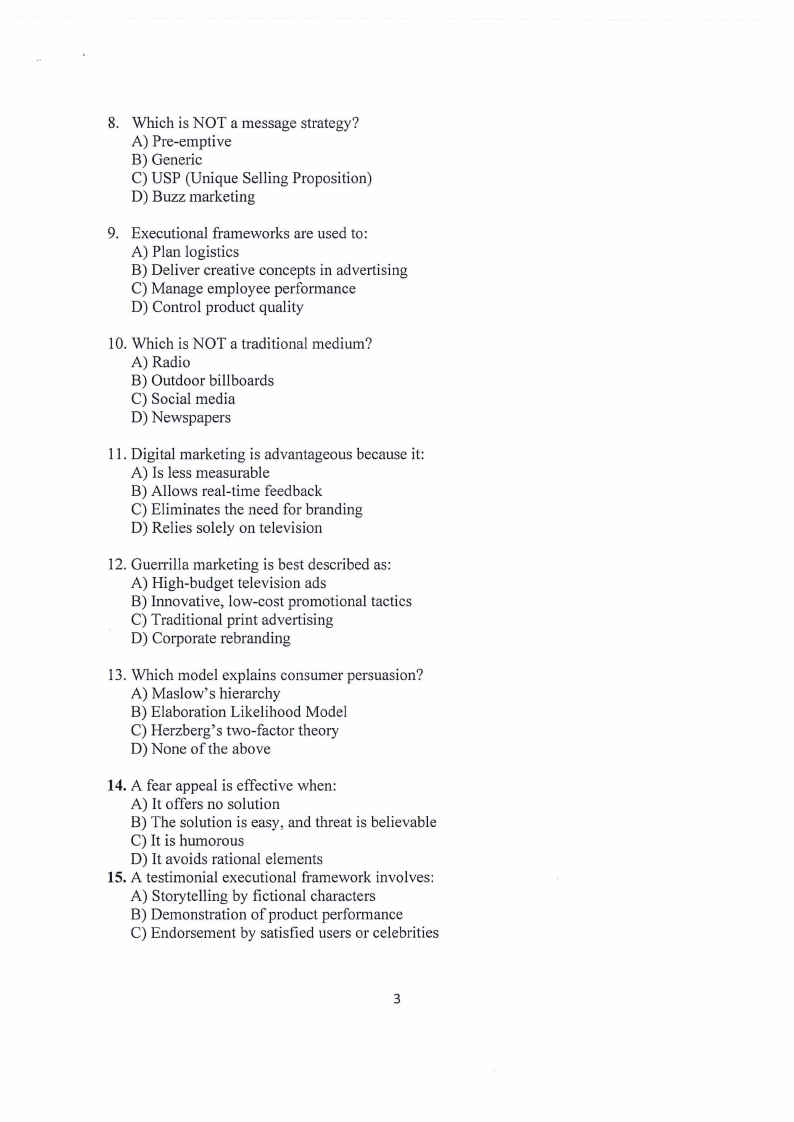
8. Which is NOT a message strategy?
A) Pre-emptive
B) Generic
C) USP (Unique Selling Proposition)
D) Buzz marketing
9. Executional frameworks are used to:
A) Plan logistics
B) Deliver creative concepts in adve1iising
C) Manage employee performance
D) Control product quality
10. Which is NOT a traditional medium?
A) Radio
B) Outdoor billboards
C) Social media
D) Newspapers
11 . Digital marketing is advantageous because it:
A) Is less measurable
B) Allows real-time feedback
C) Eliminates the need for branding
D) Relies solely on television
12. Gue1Tilla marketing is best described as:
A) High-budget television ads
B) Innovative, low-cost promotional tactics
C) Traditional print advertising
D) Corporate rebranding
13. Which model explains consumer persuasion?
A) Maslow's hierarchy
B) Elaboration Likelihood Model
C) Herzberg' s two-factor theory
D) None of the above
14. A fear appeal is effective when:
A) It offers no solution
B) The solution is easy, and threat is believable
C) It is humorous
D) It avoids rational elements
15. A testimonial executional framework involves:
A) Storytelling by fictional characters
B) Demonstration of product performance
C) Endorsement by satisfied users or celebrities
3
|
|
4 Page 4 |
▲back to top |
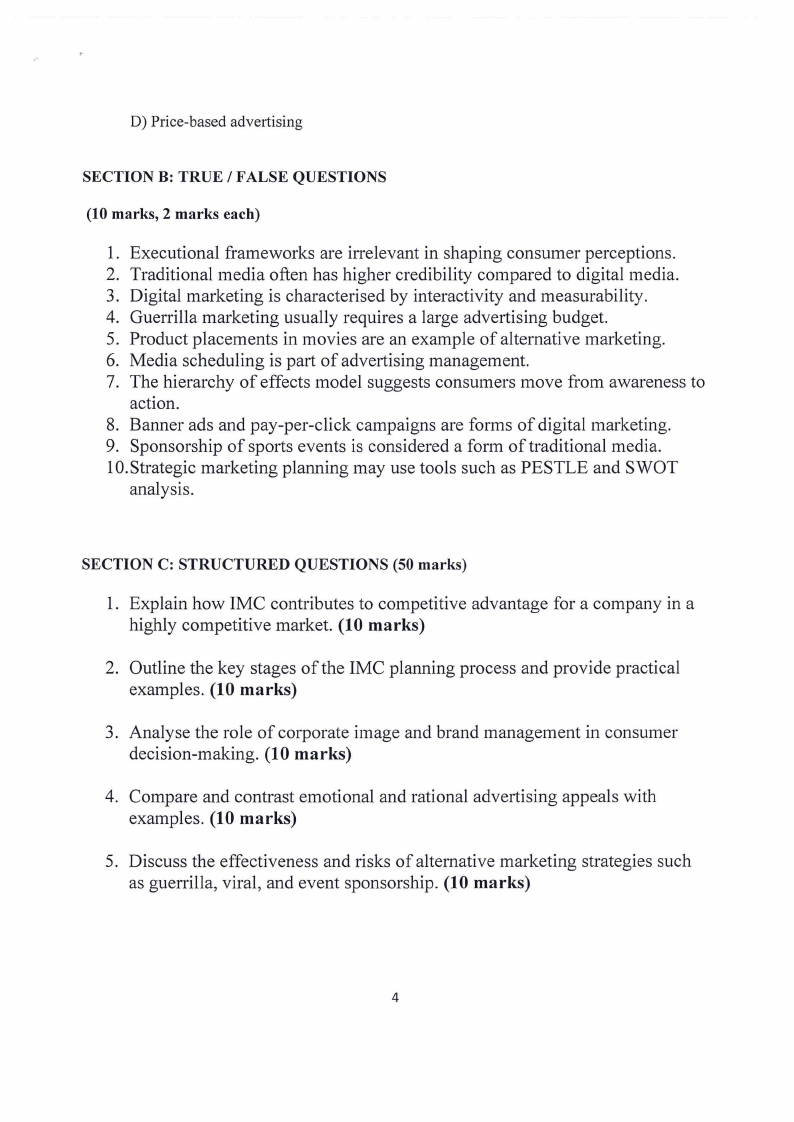
D) Price-based advertising
SECTION B: TRUE/FALSE QUESTIONS
(10 marks, 2 marks each)
1. Executional frameworks are irrelevant in shaping consumer perceptions.
2. Traditional media often has higher credibility compared to digital media.
3. Digital marketing is characterised by interactivity and measurability.
4. Guerrilla marketing usually requires a large advertising budget.
5. Product placements in movies are an example of alternative marketing.
6. Media scheduling is part of advertising management.
7. The hierarchy of effects model suggests consumers move from awareness to
action.
8. Banner ads and pay-per-click campaigns are forms of digital marketing.
9. Sponsorship of sports events is considered a form of traditional media.
IO.Strategic marketing planning may use tools such as PESTLE and SWOT
analysis.
SECTION C: STRUCTURED QUESTIONS (50 marks)
1. Explain how IMC contributes to competitive advantage for a company in a
highly competitive market. (10 marks)
2. Outline the key stages of the IMC planning process and provide practical
examples. (10 marks)
3. Analyse the role of corporate image and brand management in consumer
decision-making. (10 marks)
4. Compare and contrast emotional and rational adve11ising appeals with
examples. (10 marks)
5. Discuss the effectiveness and risks of alternative marketing strategies such
as guerrilla, viral, and event sponsorship. (10 marks)
4
|
|
5 Page 5 |
▲back to top |
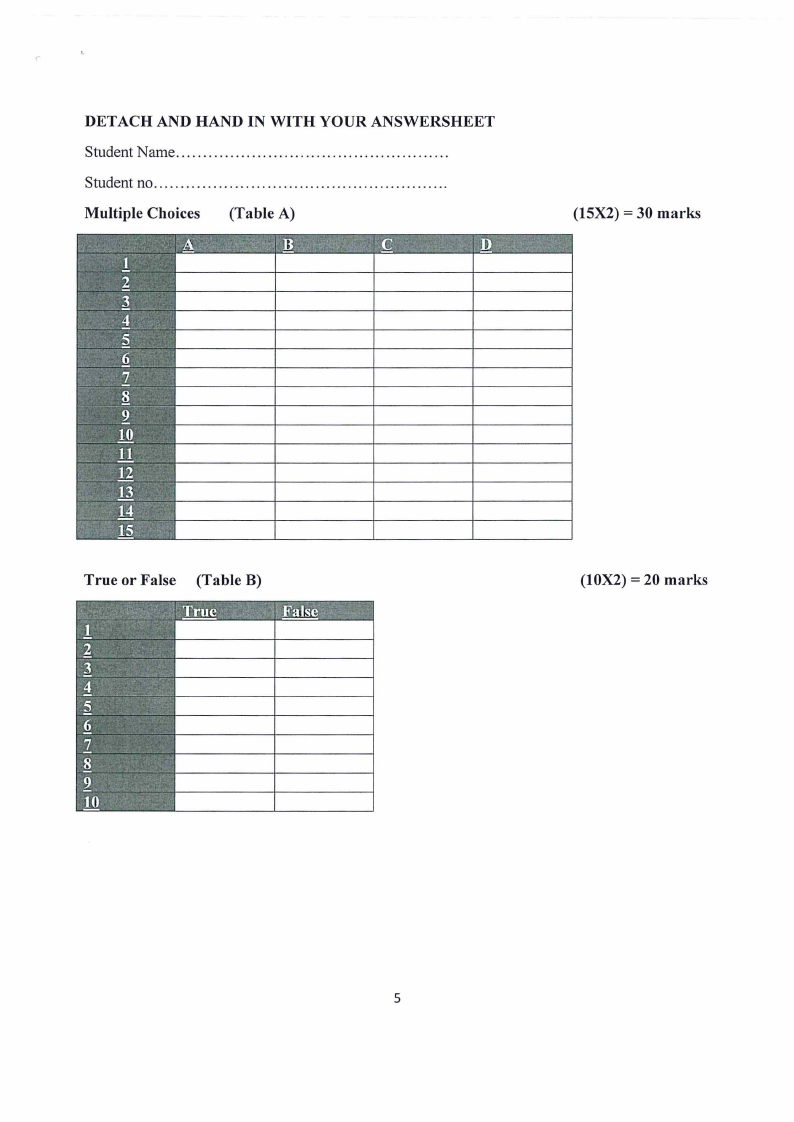
DETACH AND HAND IN WITH YOUR ANSWERSHEET
Student Name .................. . .. . .. .. .. . . .. . . .. . .. .... . ... .. . .
Student no .................. ............... .. ......... . . . .... ... .
Multiple Choices (Table A)
(15X2) = 30 marks
True or False (Table B)
(10X2) = 20 marks
5