


 |
MVT610S - MARKETING IN VET - 2ND OPP - JULY 2025 |
|
|
1 Page 1 |
▲back to top |

nAmlBIA UnlVERSITY
OF SCIEnCE Ano TECHnOLOGY
FACULTY OF COMMERCE, HUMAN SCIENCE AND EDUCATION
DEPARTMENT OF TECHNICAL, VOCATIONAL EDUCATION AND TRAINING
QUALIFICATION: DIPLOMA IN TECHNICAL AND VOCATIONAL EDUCATION AND TRAINING:
TRAINER
QUALIFICATION CODE: 06DTVM
COURSE CODE: MVT610S
LEVEL: 6
COURSE NAME: MARKETING IN VET
SESSION: JULY 2025
PAPER: 2
DURATION: 3 HOURS
MARKS: 100
SECOND OPPORTUNITY EXAMINATION QUESTION PAPER
EXAMINER(S) BERNADETTE E. CLOETE
MODERATOR: NDAKOLUTE S. ABRAHAM
INSTRUCTIONS
1. Answer ALL the questions.
2. Read all the questions carefully before answering.
3. Number the answers clearly
4. Section Band C should be answered in the examination book
provided.
5. Questions 1 to 10 of Section A should be answered on the attached
multiple-choice answer sheet.
6. Choose only one option when answering the multiple-choice
questions
7. Include the Multiple Choice Answer Sheet in your Examination
Answer Book.
THIS QUESTION PAPER CONSISTS OF _7 _ PAGES (Including this front page)
1
|
|
2 Page 2 |
▲back to top |
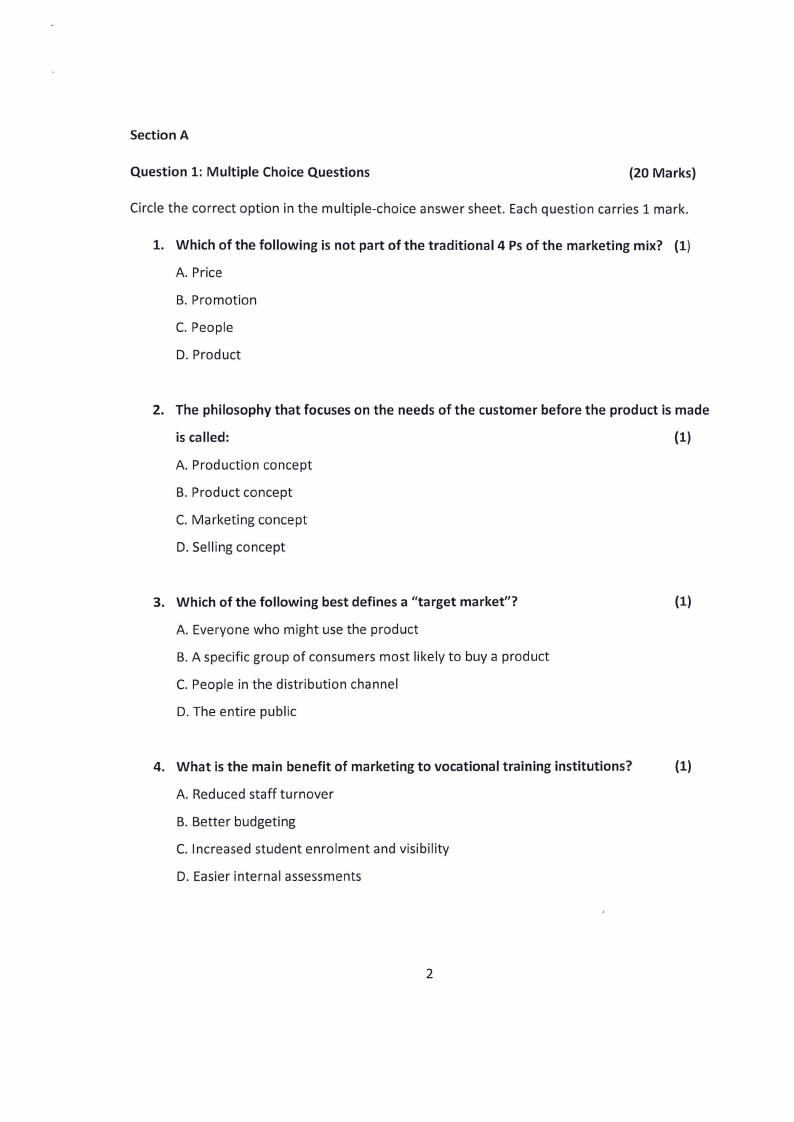
Section A
Question 1: Multiple Choice Questions
(20 Marks)
Circle the correct option in the multiple-choice answer sheet. Each question carries 1 mark.
1. Which of the following is not part of the traditional 4 Psof the marketing mix? (1)
A. Price
B. Promotion
C. People
D. Product
2. The philosophy that focuses on the needs of the customer before the product is made
is called:
(1)
A. Production concept
B. Product concept
C. Marketing concept
D. Selling concept
3. Which of the following best defines a "target market"?
(1)
A. Everyone who might use the product
B. A specific group of consumers most likely to buy a product
C. People in the distribution channel
D. The entire public
4. What is the main benefit of marketing to vocational training institutions?
(1)
A. Reduced staff turnover
B. Better budgeting
C. Increased student enrolment and visibility
D. Easier internal assessments
2
|
|
3 Page 3 |
▲back to top |
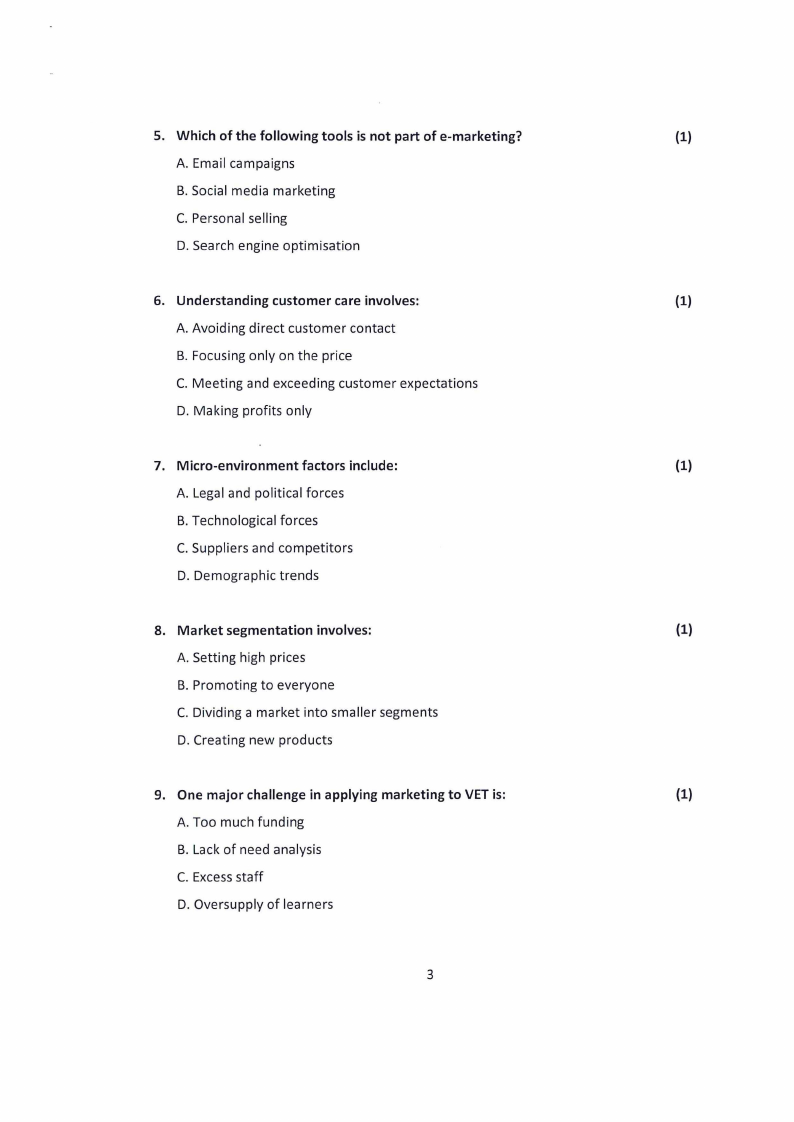
5. Which of the following tools is not part of e-marketing?
(1)
A. Email campaigns
B. Social media marketing
C. Personal selling
D. Search engine optimisation
6. Understanding customer care involves:
(1)
A. Avoiding direct customer contact
B. Focusing only on the price
C. Meeting and exceeding customer expectations
D. Making profits only
7. Micro-environment factors include:
(1)
A. Legal and political forces
B. Technological forces
C. Suppliers and competitors
D. Demographic trends
8. Market segmentation involves:
(1)
A. Setting high prices
B. Promoting to everyone
C. Dividing a market into smaller segments
D. Creating new products
9. One major challenge in applying marketing to VET is:
(1)
A. Too much funding
B. Lack of need analysis
C. Excessstaff
D. Oversupply of learners
3
|
|
4 Page 4 |
▲back to top |
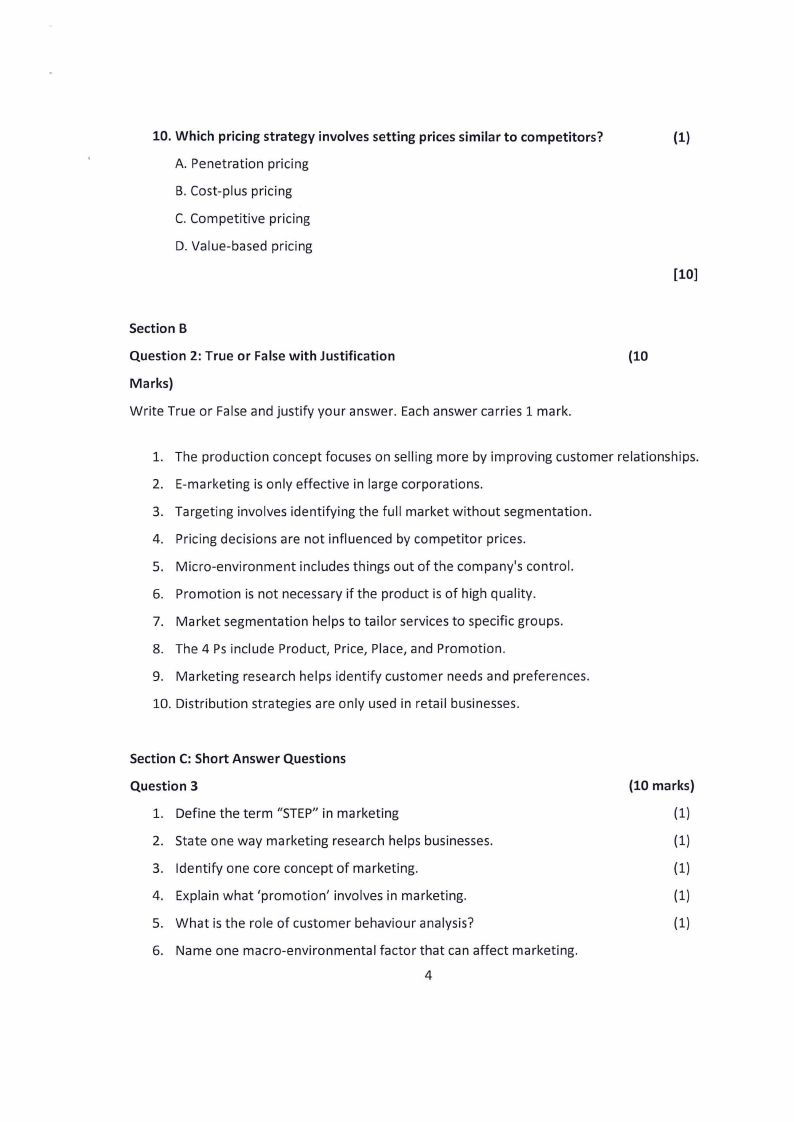
10. Which pricing strategy involves setting prices similar to competitors?
(1)
A. Penetration pricing
B. Cost-plus pricing
C. Competitive pricing
D. Value-based pricing
[10]
Section B
Question 2: True or False with Justification
(10
Marks)
Write True or False and justify your answer. Each answer carries 1 mark.
1. The production concept focuses on selling more by improving customer relationships.
2. E-marketing is only effective in large corporations.
3. Targeting involves identifying the full market without segmentation.
4. Pricing decisions are not influenced by competitor prices.
5. Micro-environment includes things out of the company's control.
6. Promotion is not necessary if the product is of high quality.
7. Market segmentation helps to tailor services to specific groups.
8. The 4 Ps include Product, Price, Place, and Promotion.
9. Marketing research helps identify customer needs and preferences.
10. Distribution strategies are only used in retail businesses.
Section C: Short Answer Questions
Question 3
1. Define the term "STEP" in marketing
2. State one way marketing research helps businesses.
3. Identify one core concept of marketing.
4. Explain what 'promotion' involves in marketing.
5. What is the role of customer behaviour analysis?
6. Name one macro-environmental factor that can affect marketing.
4
(10 marks)
(1)
(1)
(1)
(1)
(1)
|
|
5 Page 5 |
▲back to top |
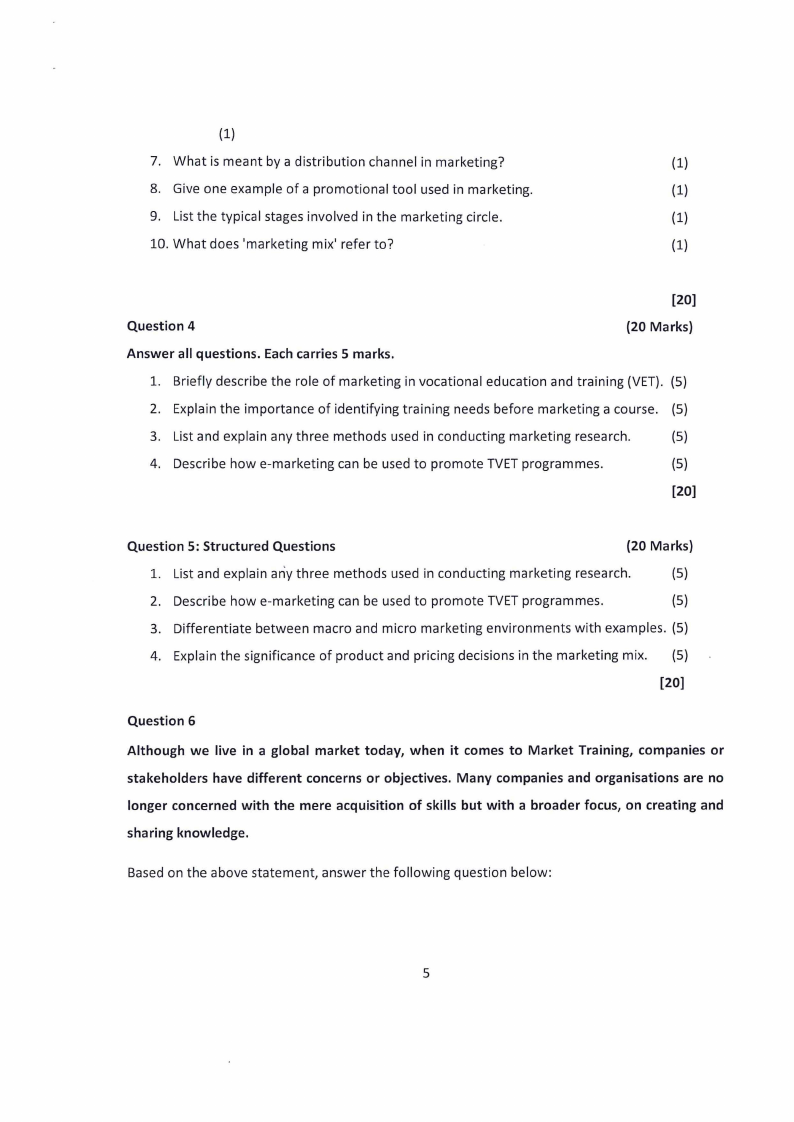
(1)
7. What is meant by a distribution channel in marketing?
(1)
8. Give one example of a promotional tool used in marketing.
(1)
9. List the typical stages involved in the marketing circle.
(1)
10. What does 'marketing mix' refer to?
(1)
[20]
Question 4
(20 Marks)
Answer all questions. Each carries 5 marks.
1. Briefly describe the role of marketing in vocational education and training (VET). (5)
2. Explain the importance of identifying training needs before marketing a course. (5)
3. List and explain any three methods used in conducting marketing research.
(5)
4. Describe how e-marketing can be used to promote TVET programmes.
(5)
[20]
Question 5: Structured Questions
(20 Marks)
1. List and explain any three methods used in conducting marketing research.
(5)
2. Describe how e-marketing can be used to promote TVET programmes.
(5)
3. Differentiate between macro and micro marketing environments with examples. (5)
4. Explain the significance of product and pricing decisions in the marketing mix. (5)
[20]
Question 6
Although we live in a global market today, when it comes to Market Training, companies or
stakeholders have different concerns or objectives. Many companies and organisations are no
longer concerned with the mere acquisition of skills but with a broader focus, on creating and
sharing knowledge.
Based on the above statement, answer the following question below:
5
|
|
6 Page 6 |
▲back to top |

Marketing training needs assessment refers to the process used to determine if training is
necessary. Identify and discuss the areas/stages of the Needs Assessment process in an
organisation. (10)
6
|
|
7 Page 7 |
▲back to top |
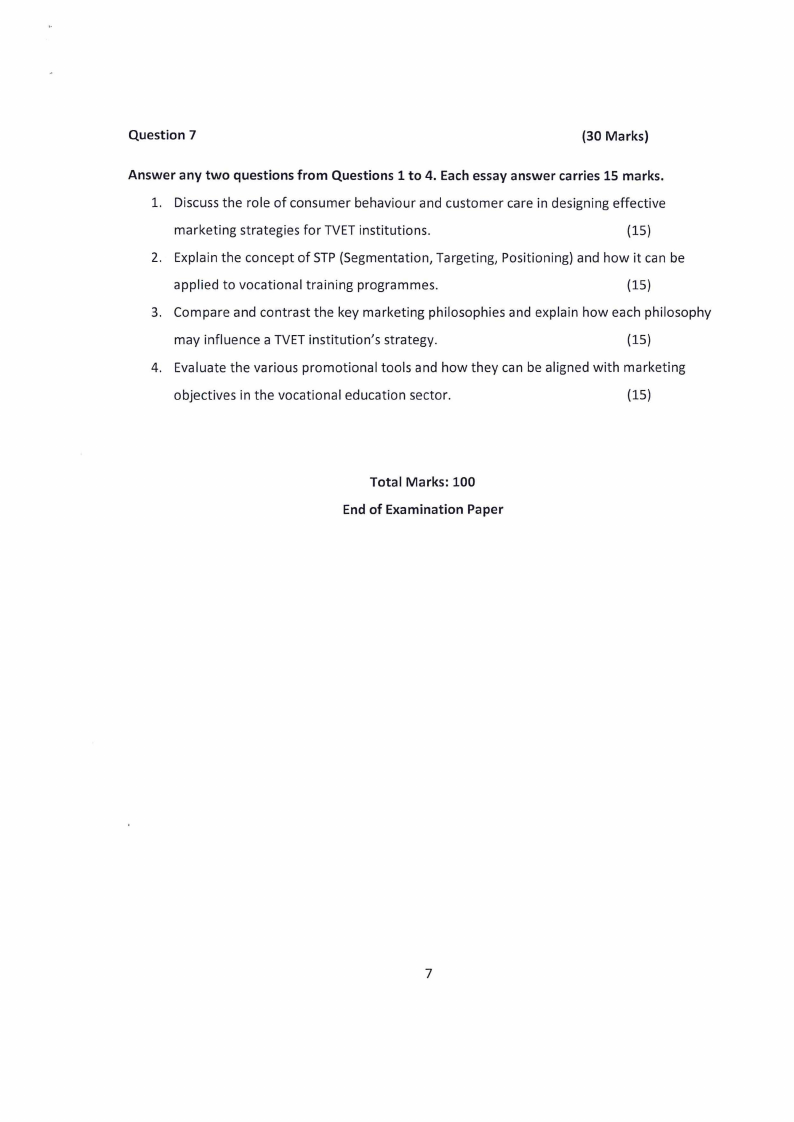
Question 7
(30 Marks)
Answer any two questions from Questions 1 to 4. Each essay answer carries 15 marks.
1. Discuss the role of consumer behaviour and customer care in designing effective
marketing strategies for TVET institutions.
(15)
2. Explain the concept of STP(Segmentation, Targeting, Positioning) and how it can be
applied to vocational training programmes.
(15)
3. Compare and contrast the key marketing philosophies and explain how each philosophy
may influence a TVET institution's strategy.
(15)
4. Evaluate the various promotional tools and how they can be aligned with marketing
objectives in the vocational education sector.
(15)
Total Marks: 100
End of Examination Paper
7
|
|
8 Page 8 |
▲back to top |
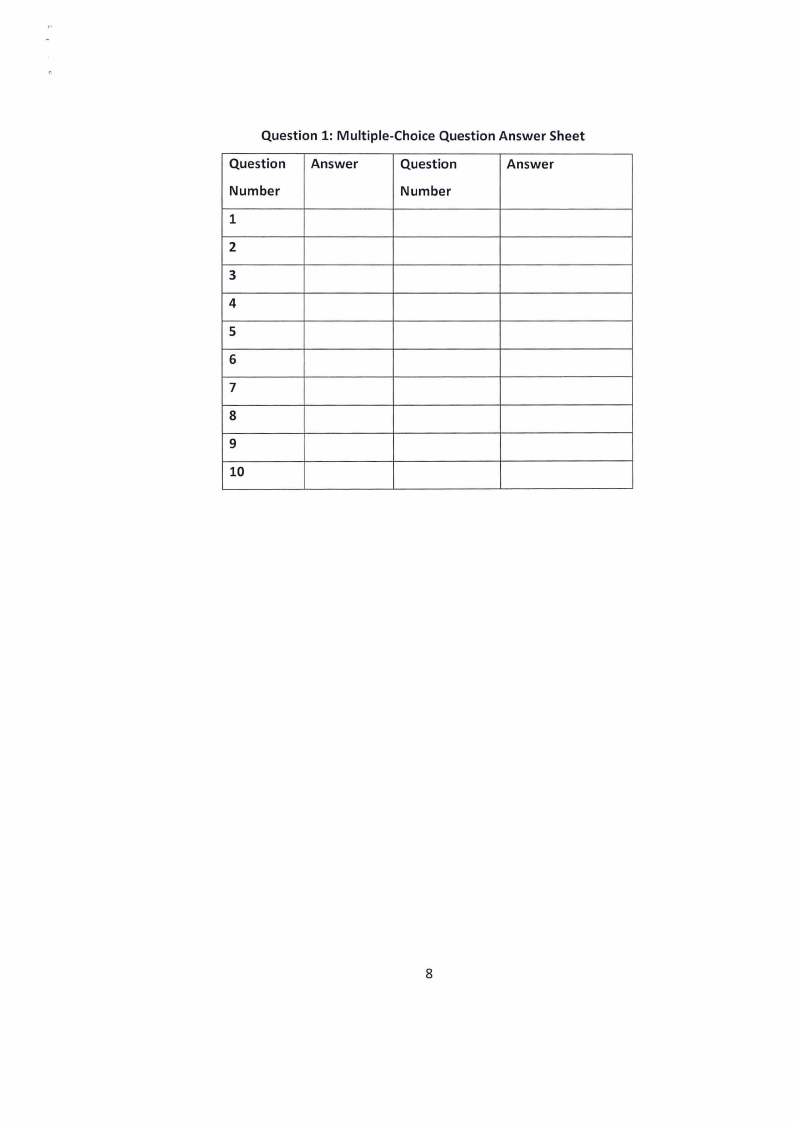
Question 1: Multiple-Choice Question Answer Sheet
Question Answer
Question
Answer
Number
Number
1
2
3
4
5
6
7
8
9
10
8