MAB611S- MONEY AND BANKING - 1ST OPP- JUNE 2025


MAB611S- MONEY AND BANKING - 1ST OPP- JUNE 2025


1 Page 1

▲back to top


nAmlBIA UnlVERSITY
OF SCIEn CE Ano TECHn OLOGY
FACULTY OF COMMERCE, HUMAN SCIENCES AND EDUCATION
DEPARTMENT OF ECONOMICS, ACCOUNTING AND FINANCE
QUALIFICATION: BACHELOR OF ECONOMICS
QUALIFICATION CODE:
O7BEC0
LEVEL: 7
COURSE CODE: MAB6 l l S
COURSE NAME: MONEY AND BANKING
SESSION: JUNE 2025
DURATION: 3 HOURS
PAPER:THEORY
MARKS: 100
FIRST OPPORTUNITY EXAMINATION QUESTION PAPER
EXAMINER(S) Ms Precious Mwikanda
MODERATOR: Mr Mally Likukela
INSTRUCTIONS
1. Answer ALL the questions.
2. Write clearly and neatly.
3. Number the answers clearly.
PERMISSIBLE MATERIALS
1. Pens/pencils/erasers
2. Calculator
3. Ruler
THIS QUESTION PAPER CONSISTS OF 8 PAGES (Excluding this front page)
0

2 Page 2

▲back to top


3 Page 3

▲back to top


SECTION A
20MARKS
In each of the following statements select ONE option as you answer. Write your answers in the
answer book.
1. ..... ... such as bond and stock markets, promote economic efficiency through
channeling funds from people who do not have productive use to
those who do
(1)
(a) Capital markets
(b) Equity markets
(c) Financial markets
(d) Securities market
2. A ..... describes a claim on the residual earnings and assets of the corporation. (1)
(a) Security
(b) Bond
(c) Equity
(d) Share of stock
3. The Ml definition of money includes:
(1)
(a) CmTency outside banks plus checkable deposits plus traveler's checks.
(b) CmTency outside banks plus checkable deposits and Eurodollars.
(c) CmTency outside banks plus checkable deposits plus retail money market deposit
accounts.
(d) CmTency outside banks plus checkable deposits plus small-denomination time deposits.
4. An asset that can be quickly turned into the medium of exchange without taking
a loss is said to be very
(1)
(a) Accountable.
(b) Liquid.
(c) Divisible.
(d) Profitable
5. Which of the following is the most liquid?
(1)
(a) A checking account
(b) A government bond
(c) A traveler's check
(d) A money market deposit account
1

4 Page 4

▲back to top


6. Choose the correct answer from the following options. To calculate the yield to
maturity on a bond, it is necessary to know the....
(1)
(a) inflation rate.
(b) T-bill rate.
(c) coupon payments.
(d) zero-coupon rate.
7. The yield to maturity for a simple loan is the same as the...
(1)
(a) Simple interest rate
(b) yield to maturity for a coupon bond.
(c) present value of the bond.
(d) Capital gains rate.
8. If the maturity of a debt instrument is less than one year, the debt is called: (1)
(a) Short-term.
(b) Intermediate-te1m.
(c) Long-term.
(d) Prima-term.
9. Which of the following statements about the characteristics of debt and equity is
FALSE?
(1)
(a) They can both be long-term financial instruments.
(b) They can both be shmi-term financial instruments.
(c) They both involve a claim on the issuer's income.
(d) They both enable a corporation to raise funds.
10. Collateral is ____
loan.
(a) A liability
(b) An asset
(c) A present
(d) An offering
the lender receives if the borrower does not pay back the
(1)
11. Currency is composed of
(1)
(a) Paper money, coins, and checks.
(b) Paper money and coins.
(c) Paper money and checks.
(d) Paper money, coins, checks, and savings deposits.
2

5 Page 5

▲back to top


12. If a Paige, a saver, expects to receive N$600 from a friend in two-years at an annual
interest rate of 8%, what is the present value of this loan?
(1)
(a) N$614
(b) N$514
(c) N$548
(d) N$588
13. The present value of N$900 to be received in three years, with an annual interest
rate of 10 percent, compounded annually, is equal to N$_____
(1)
(a) 772
(b) 676
(c) 816
(d) 810
14. The most widely used measure of interest rates in bond markets is the...
(1)
(a) coupon rate.
(b) discount rate.
(c) yield to maturity.
(d) cun:ent yield.
15. An increase in the expected rate of inflation causes...
(1)
(a) a decrease in the demand for loanable funds.
(b) an increase in the supply of loanable funds.
(c) interest rates to rise.
(d) interest rates to fall.
16. Which of the following is classified as a liability for a reserve bank?
(1)
(a) Reserves.
(b) Loans to financial institutions.
(c) Demand deposits.
(d) Securities.
17. A financial market in which only short-term debt instruments are traded is called
the ___
market.
(1)
(a) Bond
(b) Money
(c) Capital
(d) Stock
3

6 Page 6

▲back to top


18. An example of the problem of ____ is when a corporation uses the funds
raised from selling bonds to fund corporate expansion to pay for Caribbean
cruises for all of its employees and their families.
(1)
(a) Adverse selection
(b) Moral hazard
(c) Risk sharing
(d) Credit risk
19. The transactions motive links money demand and ...
(1)
(a) interest rates.
(b) money supply.
(c) income.
(d) the liquidity trap.
20. A major reason for the existence of financial intermediaries is
(1)
(a) transactions costs that would be incurred without their existence.
(b) the fees charged by dealers and brokers in direct finance are so high.
(c) the problem of symmetric inf01mation.
(d) to assist borrowers in buying securities in financial markets.
4

7 Page 7

▲back to top


SECTION B
[10 marks)
In this section, choose your option or fill in your answer and write your answer in the
answer book next to the question number.
1. In an economy it is argued that an increase in real gross domestic product cannot take
place without an increase/ decrease in the money supply.
(1)
2. A South African government bond issue dominated in euro in a Eurozone country will
be classified as a foreign bond/Eurobond.
(1)
3. The portfolio themy of money / the quantity theory of money assumes changes in
money supply affect only the price level.
(1)
4. The potential for investment losses that can be triggered by a move upward in the
prevailing rates for new debt instruments is called credit risk/interest rate risk. ( 1)
5. The management of money and interest rates is called ____
conducted by a nation's ____ bank.
policy and is
(2)
6. Financial institutions' search for ____ has resulted in many financial
innovations.
(1)
7. The composition of money aggregate in Namibia is made up of ___ and__ (2)
8. The present value of an asset can be found by calculating for/ discounting the future
value.
(1)
5

8 Page 8

▲back to top


SECTIONC
[10 MARKS]
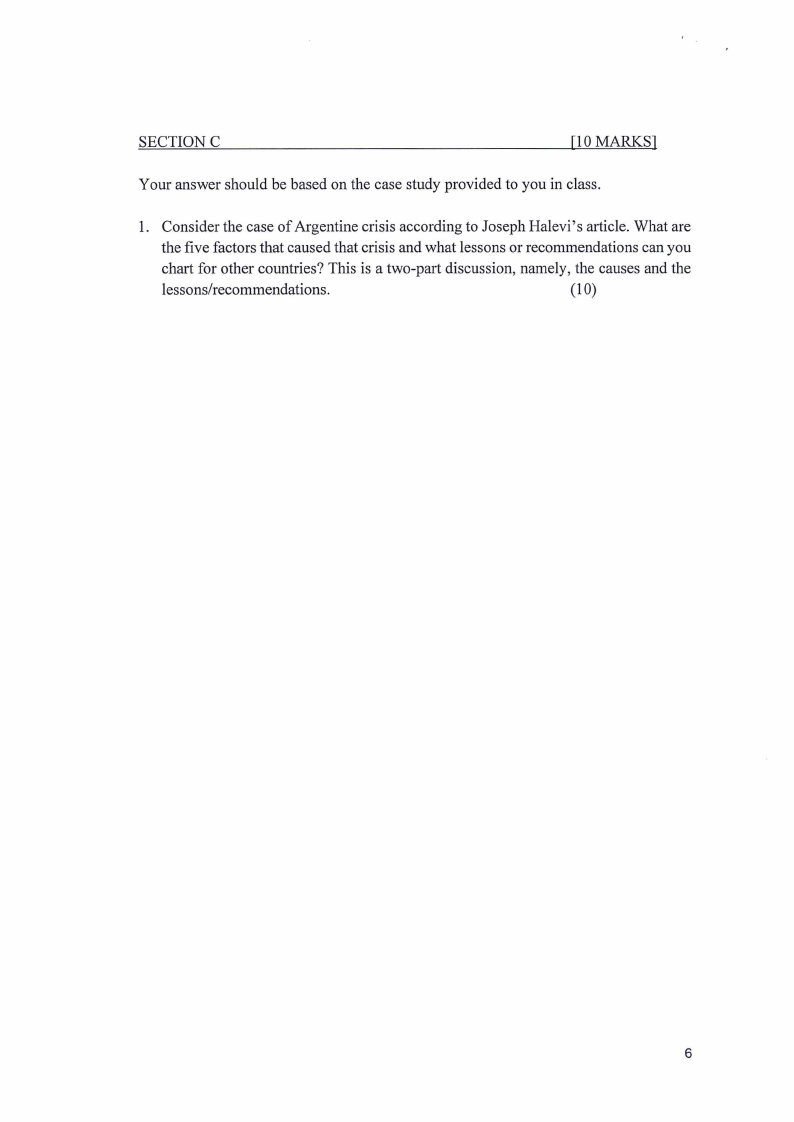
Your answer should be based on the case study provided to you in class.
1. Consider the case of Argentine crisis according to Joseph Halevi' s article. What are
the five factors that caused that crisis and what lessons or recommendations can you
chart for other countries? This is a two-pait discussion, namely, the causes and the
lessons/recommendations.
(10)
6

9 Page 9

▲back to top


SECTION D
[60)
Answer all three in this section.
QUESTION 1
(20)
1. Calculate the yearly coupon payment for a N$5,000 coupon bond with a coupon rate of
13%.
(3)
2. What is the return on a 5% coupon bond that initially sells for N$1,000 and in the
following year sells for N$900?
(3)
3. If a N$10,000 face-value discount bond maturing in one year is selling for N$8,000,
then what is its yield to maturity?
(3)
4. What is the price of a consol that has a coupon of N$50 per year and a yield to
maturity of 2.5%? If the yield to maturity doubles, what will happen to the consol's
price?
(6)
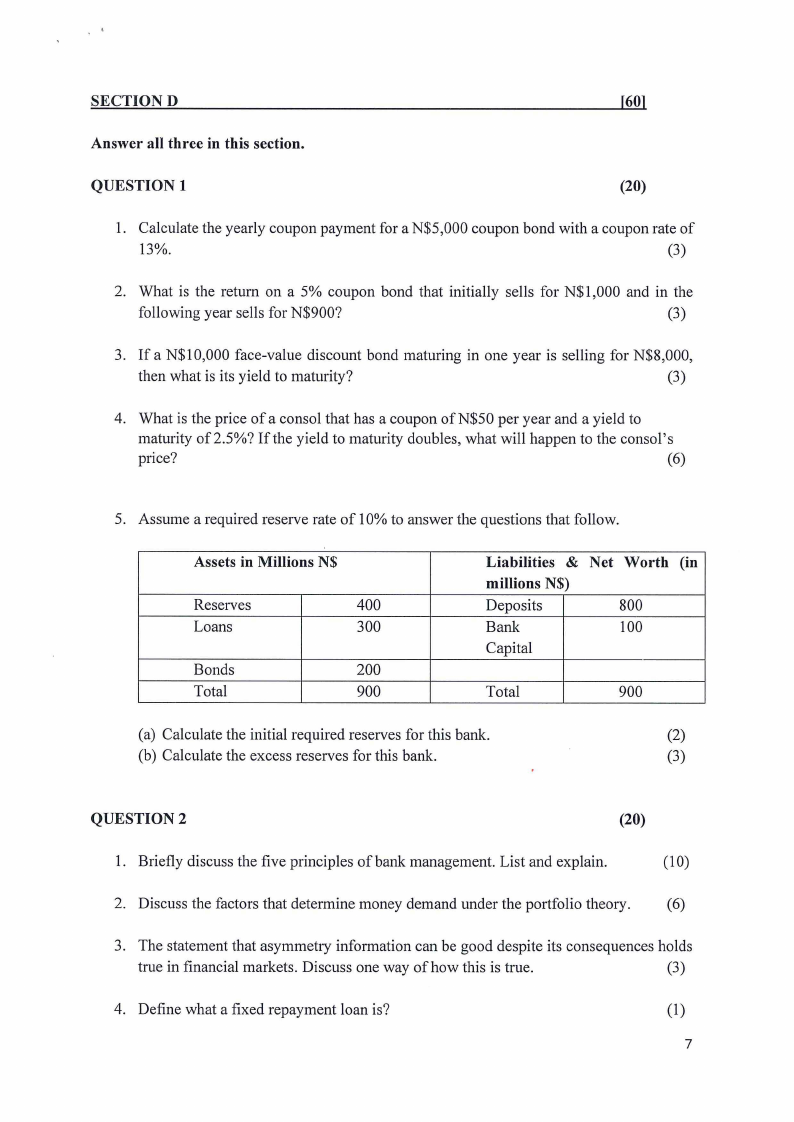
5. Assume a required reserve rate of 10% to answer the questions that follow.
Assets in Millions N$
Reserves
400
Loans
300
Bonds
200
Total
900
Liabilities & Net Worth (in
millions N$)
Deposits
800
Bank
100
Capital
Total
900
(a) Calculate the initial required reserves for this bank.
(2)
(b) Calculate the excess reserves for this bank.
(3)
QUESTION 2
(20)
1. Briefly discuss the five principles of bank management. List and explain.
(10)
2. Discuss the factors that determine money demand under the portfolio theory.
( 6)
3. The statement that asymmetry information can be good despite its consequences holds
true in financial markets. Discuss one way of how this is true.
(3)
4. Define what a fixed repayment loan is?
(1)
7

10 Page 10

▲back to top


QUESTION3
(20)
1. Briefly discuss and illustrate with a diagram how the bond market would respond to a
business cycle expansion.
(10)
2. Distinguish between velocity of money and inflation.
(4)
3. For each of the following assets, indicate in which monetary aggregates (Ml or M2),
does it fall:
(6)
(a) Currency
(b) Money market mutual funds
(c) Small-denomination time deposits
(d) Checkable deposits
TOTAL MARKS: 100
8