MAB611S-MONEY AND BANKING-2ND OPP-JULY 2025


MAB611S-MONEY AND BANKING-2ND OPP-JULY 2025


1 Page 1

▲back to top


nAmlBIA UnlVERSITY
OF SCIEn CE Ano TECHn OLOGY
FACULTY OF COMMERCE, HUMAN SCIENCESAND EDUCATION
DEPARTMENT OF ECONOMICS, ACCOUNTING AND FINANCE
QUALIFICATION: BACHELOR OF ECONOMICS
QUALIFICATION CODE: O7BEC0
LEVEL: 7
COURSE CODE: MAB611S
COURSE NAME: MONEY AND BANKING
SESSION: JULY 2025
DURATION: 3 HOURS
PAPER: THEORY
MARKS: 100
SECOND OPPORTUNITY EXAMINATION QUESTION PAPER
EXAMINER(S) Ms Precious Mwikanda
MODERATOR: Mr Mally Likukela
INSTRUCTIONS
1. Answer ALL the questions.
2. Write clearly and neatly.
3. Number the answers clearly.
PERMISSIBLE MATERIALS
1. Pens/pencils/ erasers
2. Calculator
3. Ruler
ANSWER IN YOUR EXAMINATION
ANSWER BOOK.
THIS QUESTION PAPER CONSISTS OF 7 PAGES (Excluding this front page)
0

2 Page 2

▲back to top


3 Page 3

▲back to top


SECTIONA
20 MARKS
In each of the following statements select ONE option as your answer.
1. Bonds that are sold in a foreign country and are denominated in a currency other
than that of the country in which it is sold are known as
{1)
(a) Foreign bonds.
(b) Eurobonds.
(c) Equity bonds.
(d) Country bonds.
2. ......are markets in which dealers at different locations who have an inventory of
securities stand ready to buy and sell securities "over the counter" to anyone who
comes to them and is willing to accept their prices
(1)
(a) Secondary markets.
(b) primary markets.
(c) Over-the-counter markets.
(d) Exchange markets.
3. ......helps with investing in a collection of assets whose returns do not always move
together, with the result that overall risk is lower than for individual assets. (1)
(a) Risk analysis
(b) Financial analysis
(c) diversification
(d) securitization
4. Adverse selection is a problem associated with equity and debt contracts arising
from
{1)
(a) The lender's inability to legally require sufficient collateral to cover a 100% loss if
the borrower defaults.
(b) The borrower's lack of incentive to seek a loan for highly risky investments.
(c) The borrower's lack of good options for obtaining funds.
(d) The lender's relative lack of information about the borrower's potential returns
and risks of his investment activities.
1

4 Page 4

▲back to top


5. Financial intermediaries are better equipped than individuals to screen out bad
credit risks from good ones, thus reducing losses due to:
(1)
(a) Moral hazard.
(b) Free riding.
(c) Adverse selection.
(d) Debt contracts.
6. Which of the following is not a goal that banks strive to achieve when managing
their assets?
(1)
(a) Acquiring ample excess reserves regularly.
(b) Seek the highest possible returns on loans and securities.
(c) Credit and interest rate risk reduction.
(d) Having adequate liquidity in its balance sheet.
7. Rate- sensitive assets means that
(1)
(a) The rate fluctuates interest rates change.
(b) The rate is fixed even when interest rates change.
(c) The rate is sensitive due to changes in the balance sheet.
(d) The rate is fixed due to the sensitivity of the assets.
8. Which of the following is not a participant in the money supply process?
(1)
(a) Investors.
(b) Depositors.
(c) Banks.
(d) Reserve bank.
9. The motive for money that explains that people hold money as a cushion for
unexpected circumstances is called......:
(1)
(a) transaction
(b) precautionary
(c) speculative
(d) preventive
10. According to the Fisher Quantity theory of money, the demand for money is affected
by....
(1)
(a) interest rate.
(b) % change in inflation.
(c) fixed nominal level of income.
(d) velocity of money.
2

5 Page 5

▲back to top


11. Stage one of most financial crises that have occurred in advanced economies have
been recognized through:
(1)
(a) debt deflation.
(b) severe fiscal imbalance.
(c) financial liberalizations and innovation.
(d) currency risk.
12. Which one of the following is one of the factors that contributed to the great
depression of the 1930s?
(1)
(a) debt deflation.
(b) adverse selection
(c) financial liberalizations and innovation.
(d) moral hazard.
13. The riskiness of a bond in relation to other assets will cause the demand for that
bond to:
(1)
(a) Increase.
(b) Decrease.
(c) Stay the same due to the substitute of other assets.
(d) Invite investors who want to buy into risky assets due to their high return
14. The total expected return of a bond over its lifespan, taking into account compounding and
reinvested interest is called
(1)
(a) Discount rate.
(b) Expected return.
(c) Yield to maturity.
(d) Compounded Interest rate.
15. The formula for calculating a perpetuity bond price is:
(1)
(a) C/ (1 +i)n
(b) C/(1-i)n
(c) C/ic
(d) C/Pc
16. Over the last century, hyperinflation has hit many economies but the worst of them
was experienced by...
(1)
(a) Libya
(b) South Korea.
(c) Germany.
(d) Zimbabwe
3

6 Page 6

▲back to top


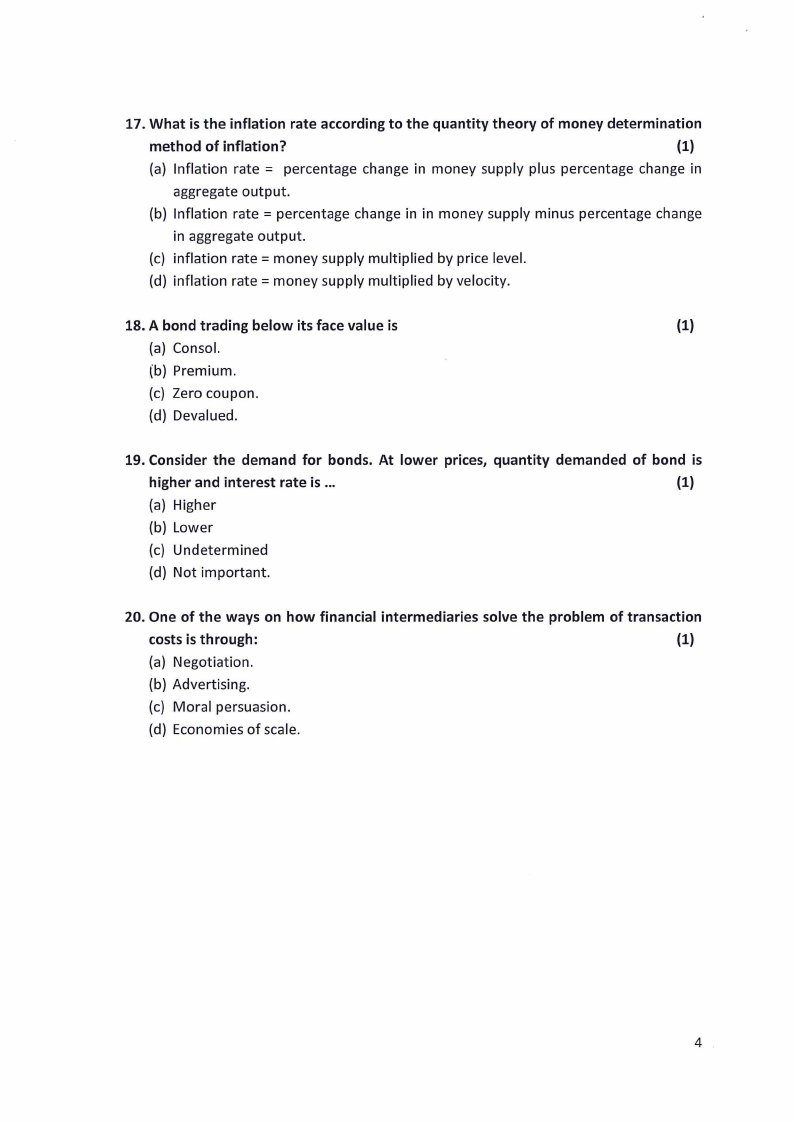
17. What is the inflation rate according to the quantity theory of money determination
method of inflation?
(1)
(a} Inflation rate = percentage change in money supply plus percentage change in
aggregate output.
(b) Inflation rate= percentage change in in money supply minus percentage change
in aggregate output.
(c) inflation rate= money supply multiplied by price level.
(d} inflation rate= money supply multiplied by velocity.
18. A bond trading below its face value is
(1)
(a} Consol.
(b} Premium.
(c} Zero coupon.
(d} Devalued.
19. Consider the demand for bonds. At lower prices, quantity demanded of bond is
higher and interest rate is ...
(1)
(a} Higher
(b) Lower
(c} Undetermined
(d) Not important.
20. One of the ways on how financial intermediaries solve the problem of transaction
costs is through:
(1)
(a} Negotiation.
(b} Advertising.
(c} Moral persuasion.
(d} Economies of scale.
4

7 Page 7

▲back to top


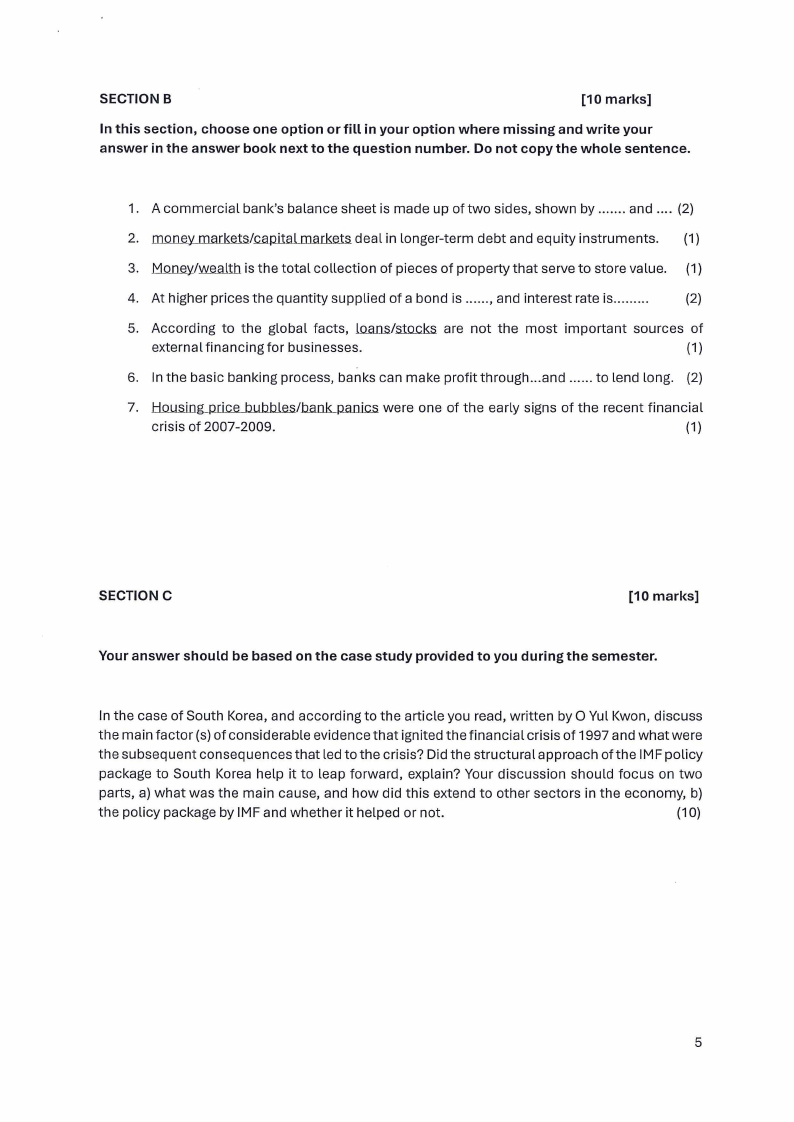
SECTION B
[10 marks]
In this section, choose one option or fill in your option where missing and write your
answer in the answer book next to the question number. Do not copy the whole sentence.
1. A commercial bank's balance sheet is made up of two sides, shown by ....... and .... (2)
2. .DJ.Qllii'i.lllilike:ts/c_apitalmarkets deal in longer-term debt and equity instruments. (1)
3. Mrn';'/wealth is the total collection of pieces of property that serve to store value. (1)
4. At higher prices the quantity supplied of a bond is ...... , and interest rate is.........
(2)
5. According to the global facts, l.Qans/stocks are not the most important sources of
external financing for businesses.
(1)
6. In the basic banking process, banks can make profit through ...and ...... to lend long. (2)
7. Housing_~/han.k_p_a_ni_c_s
crisis of 2007-2009.
were one of the early signs of the recent financial
(1)
SECTION C
[10 marks]
Your answer should be based on the case study provided to you during the semester.
In the case of South Korea, and according to the article you read, written by O Yul Kwon, discuss
the main factor (s) of considerable evidence that ignited the financial crisis of 1997 and what were
the subsequent consequences that led to the crisis? Did the structural approach of the IMF policy
package to South Korea help it to leap forward, explain? Your discussion should focus on two
parts, a) what was the main cause, and how did this extend to other sectors in the economy, b)
the policy package by IMF and whether it helped or not.
(10)
5

8 Page 8

▲back to top


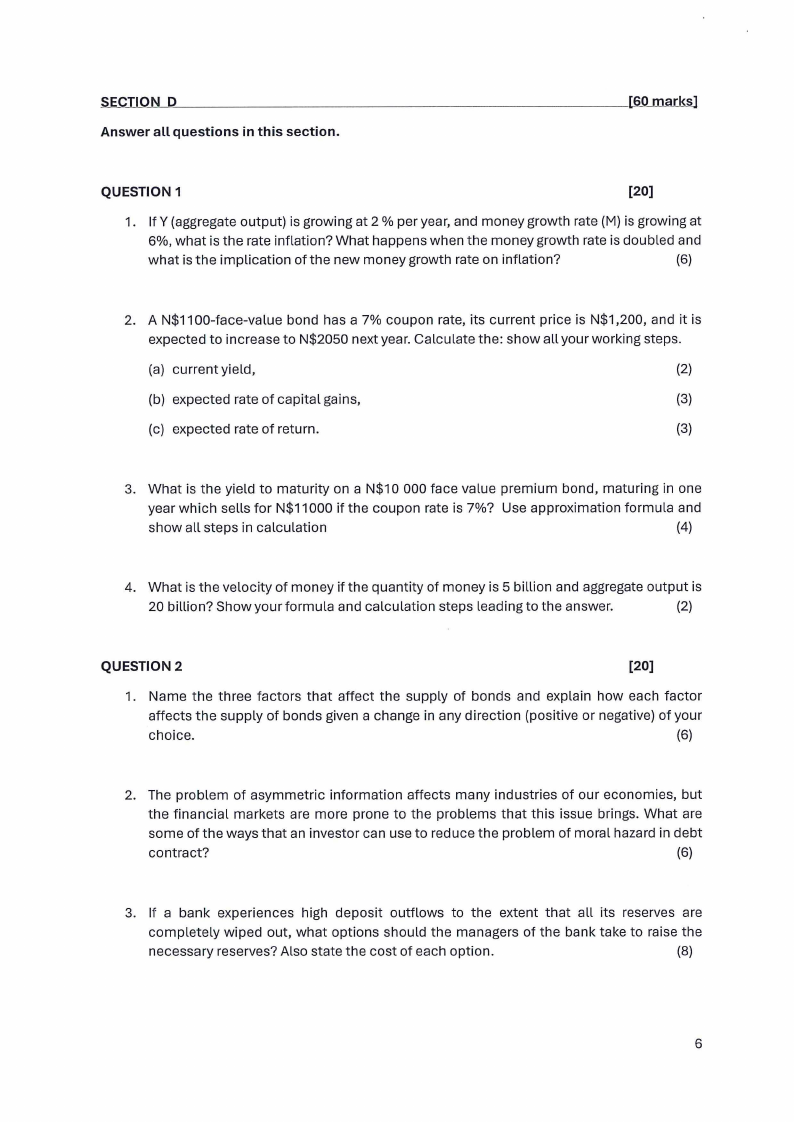
SECTION D
Answer all questions in this section.
[60 marks]
QUESTION 1
[20]
1. If Y (aggregate output) is growing at 2 % per year, and money growth rate (M) is growing at
6%, what is the rate inflation? What happens when the money growth rate is doubled and
what is the implication of the new money growth rate on inflation?
(6)
2. A N$1100-face-value bond has a 7% coupon rate, its current price is N$1,200, and it is
expected to increase to N$2050 next year. Calculate the: show all your working steps.
(a) current yield,
(2)
(b) expected rate of capital gains,
(3)
(c) expected rate of return.
(3)
3. What is the yield to maturity on a N$10 000 face value premium bond, maturing in one
year which sells for N$11000 if the coupon rate is 7%? Use approximation formula and
show all steps in calculation
(4)
4. What is the velocity of money if the quantity of money is 5 billion and aggregate output is
20 billion? Show your formula and calculation steps leading to the answer.
(2)
QUESTION 2
[20]
1. Name the three factors that affect the supply of bonds and explain how each factor
affects the supply of bonds given a change in any direction (positive or negative) of your
choice.
(6)
2. The problem of asymmetric information affects many industries of our economies, but
the financial markets are more prone to the problems that this issue brings. What are
some of the ways that an investor can use to reduce the problem of moral hazard in debt
contract?
(6)
3. If a bank experiences high deposit outflows to the extent that all its reserves are
completely wiped out, what options should the managers of the bank take to raise the
necessary reserves? Also state the cost of each option.
(8)
6

9 Page 9

▲back to top


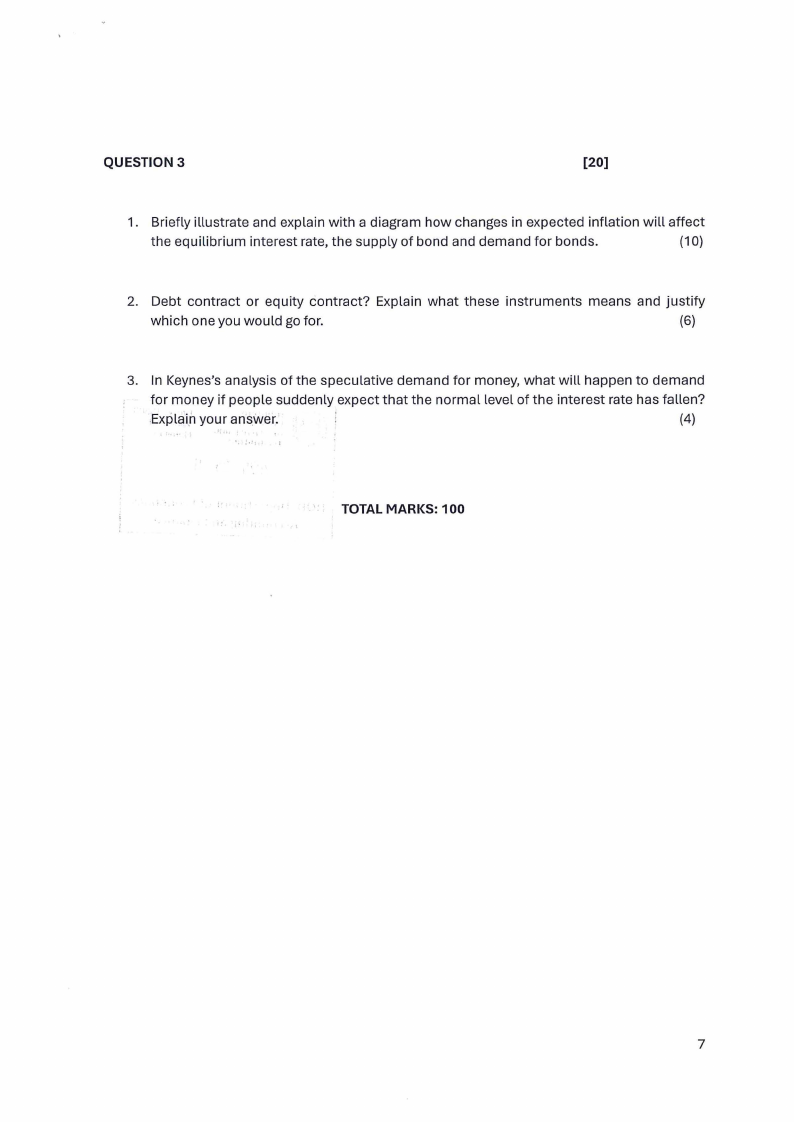
QUESTION 3
[20]
1. Briefly illustrate and explain with a diagram how changes in expected inflation will affect
the equilibrium interest rate, the supply of bond and demand for bonds.
(1 O)
2. Debt contract or equity contract? Explain what these instruments means and justify
which one you would go for.
(6)
3. In Keynes's analysis of the speculative demand for money, what will happen to demand
for money if people suddenly expect that the normal level of the interest rate has fallen?
.Explai_nyour answer.
(4)
TOTAL MARKS: 100
7

10 Page 10

▲back to top


'l
,,. )
nAmlBIA
un1vERSITY
u,
P/Bag 13388
. 'Nhm'lnTdllbhloaek
<1 --f--!.~).._- 2025·05·07
)
.Ic1=) -r ,
I
D_( ,)_;)"JS _H__ODA:cD_ecp_aorutm_ne,.n:,t:tf1lr!:~n;_Ec:cmn~!o,cg~@_n:a~no~md:o.,~__lc:~1,