


 |
MTC821S - MANAGEMENT OF TECHNOLOGY - 2ND OPP - NOV 2025 |
|
|
1 Page 1 |
▲back to top |
nAmlBIA unlVERSITY
OF SCIEnCE Ano TECHnOLOGY
FACULTY OF COMMERCE, HUMAN SCIENCES AND EDUCATION
DEPARTMENT OF GOVERNANCE AND MANAGEMENT SCIENCES
MANAGEMENT SECTION
QUALIFICATION : BACHELOR OF BUSINESS MANAGEMENT HONOURS
QUALIFICATION CODE: 08BBMAH
LEVEL: 8
COURSE CODE: MTC821S
COURSE NAME: MANAGEMENT OF TECHNOLOGY
SESSION: DECEMBER 2025
DURATION: 3 HOURS
PAPER: THEORY
MARKS: 100
EXAMINER{S)
SECOND OPPORTUNITY EXAMINATION QUESTION PAPER
DR MOSES WAIGANJO
MODERATOR:
MR ERNEST MBANGA
INSTRUCTIONS
The question paper consists of two sections. Section One is compulsory, while in Section Two students
are required to answer any five questions of their choice.
The total marks for this examination are 100 marks.
1. Answer ALL the questions in the answer book provided.
2. Write clearly and neatly.
3. Number the answers clearly.
THIS EXAM PAPER CONSISTS OF 3 PAGES {Including this front page)
|
|
2 Page 2 |
▲back to top |
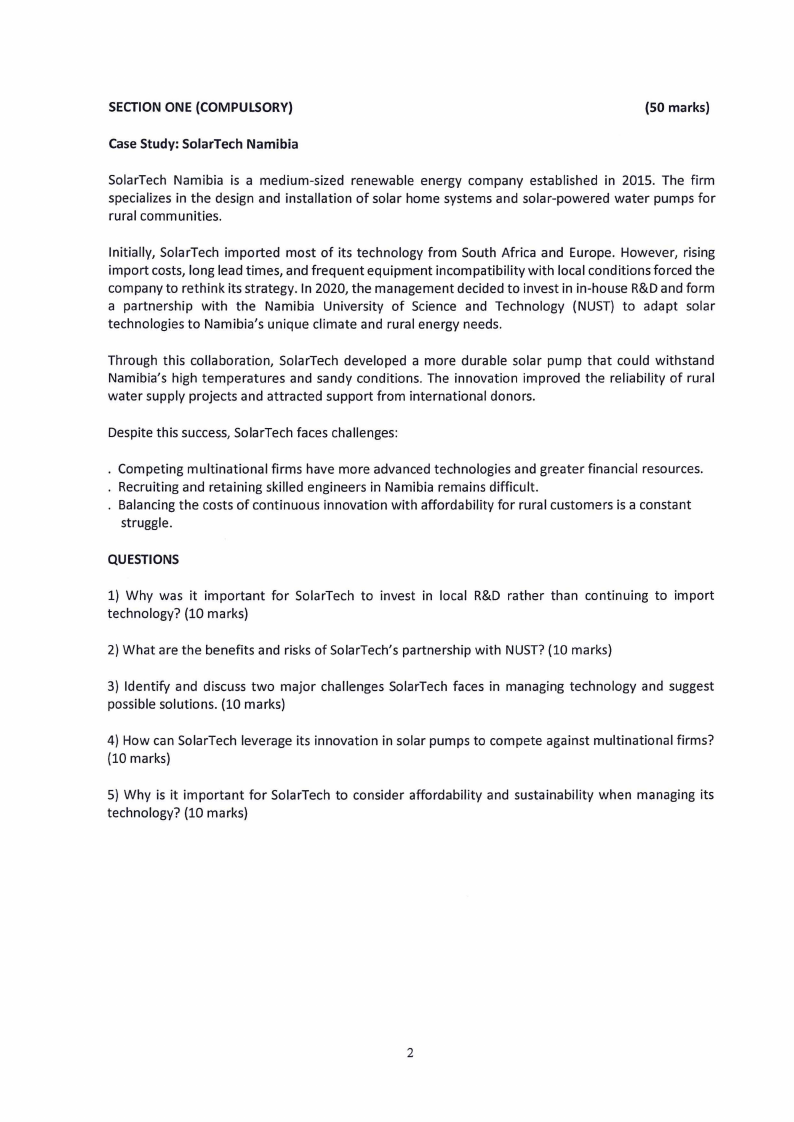
SECTION ONE (COMPULSORY)
(SO marks)
Case Study: SolarTech Namibia
SolarTech Namibia is a medium-sized renewable energy company established in 2015. The firm
specializes in the design and installation of solar home systems and solar-powered water pumps for
rural communities.
Initially, SolarTech imported most of its technology from South Africa and Europe. However, rising
import costs, long lead times, and frequent equipment incompatibility with local conditions forced the
company to rethink its strategy. In 2020, the management decided to invest in in-house R&D and form
a partnership with the Namibia University of Science and Technology (NUST) to adapt solar
technologies to Namibia's unique climate and rural energy needs.
Through this collaboration, SolarTech developed a more durable solar pump that could withstand
Namibia's high temperatures and sandy conditions. The innovation improved the reliability of rural
water supply projects and attracted support from international donors.
Despite this success, SolarTech faces challenges:
Competing multinational firms have more advanced technologies and greater financial resources.
Recruiting and retaining skilled engineers in Namibia remains difficult.
Balancing the costs of continuous innovation with affordability for rural customers is a constant
struggle.
QUESTIONS
1) Why was it important for SolarTech to invest in local R&D rather than continuing to import
technology? (10 marks)
2) What are the benefits and risks of SolarTech's partnership with NUST? (10 marks)
3) Identify and discuss two major challenges SolarTech faces in managing technology and suggest
possible solutions. (10 marks)
4) How can SolarTech leverage its innovation in solar pumps to compete against multinational firms?
(10 marks)
5) Why is it important for SolarTech to consider affordability and sustainability when managing its
technology? (10 marks)
2
|
|
3 Page 3 |
▲back to top |
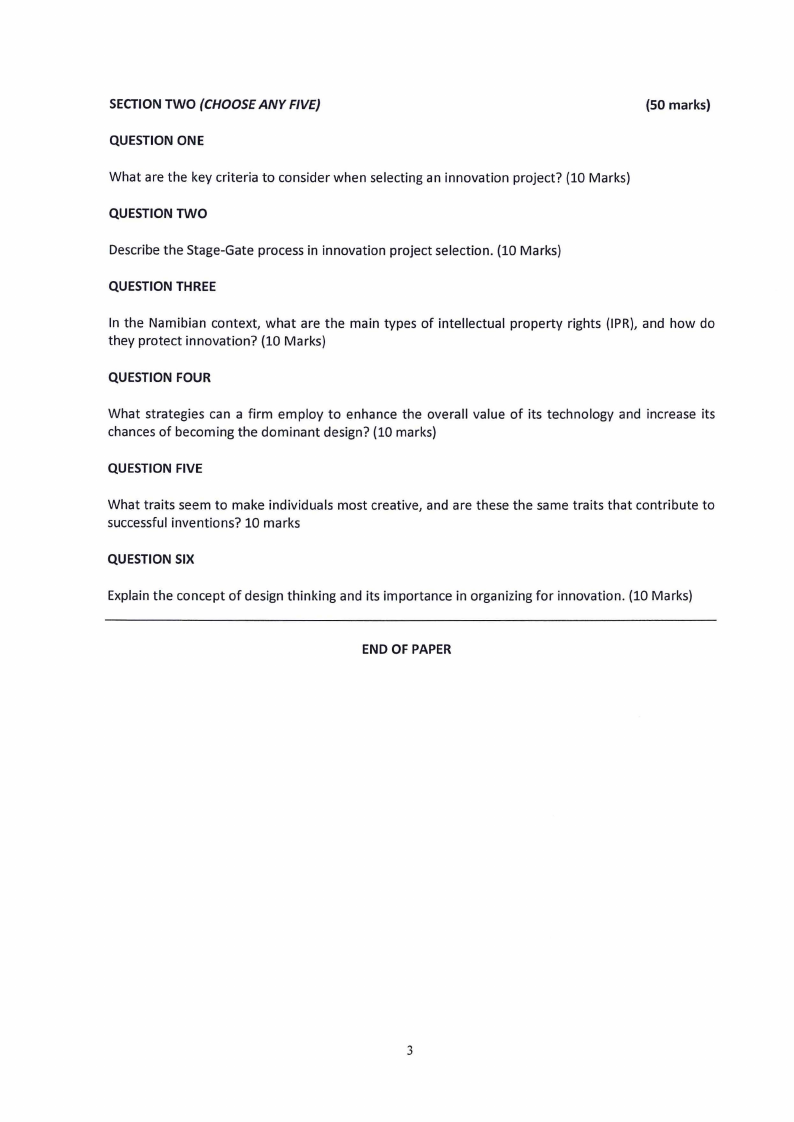
SECTION TWO {CHOOSE ANY FIVE)
(SO marks)
QUESTION ONE
What are the key criteria to consider when selecting an innovation project? (10 Marks)
QUESTION TWO
Describe the Stage-Gate process in innovation project selection. (10 Marks)
QUESTION THREE
In the Namibian context, what are the main types of intellectual property rights (IPR), and how do
they protect innovation? (10 Marks)
QUESTION FOUR
What strategies can a firm employ to enhance the overall value of its technology and increase its
chances of becoming the dominant design? (10 marks)
QUESTION FIVE
What traits seem to make individuals most creative, and are these the same traits that contribute to
successful inventions? 10 marks
QUESTION SIX
Explain the concept of design thinking and its importance in organizing for innovation. (10 Marks)
END OF PAPER
3