


 |
MTS621s - Maritime And Safety And Infrastructure Considerations - 1st Opp - Nov 2025 |
|
|
1 Page 1 |
▲back to top |
nAm I BI A un IVE RS ITY
OF SCIEnCE Ano TECHnOLOGY
FACULTY OF COMMERCE, HUMAN SCIENCES AND EDUCATION
DEPARTMENT OF MARKETING, LOGISTICS AND SPORTS MANAGEMENT
QUALIFICATIONS: BACHELOR OF TRANSPORT MANAGEMENT
QUALIFICATION CODE: 07BTRA
COURSE CODE: MTS621S
LEVEL: 6
COURSE NAME: MARITIME AND AIR SAFETY
AND INFRASTRUCTURE CONSIDERATIONS
SESSION: NOVEMBER 2025
PAPER: THEORY
DURATION: 3 HOURS
MARKS: 100
FIRST OPPORTUNITY EXAMINATION PAPER
EXAMINER(S): MR OSCAR KAVERU (FM & PM STUDENTS)
MR RODNEY APRIL (DI STUDENTS)
MR. AUGUSTUS STEPHANUS (FM EENHANA STUDENTS)
MODERATOR: MR VETIRAIJE TJIPOMBO
INSTRUCTIONS
1. ANSWER ANY FOUR (4) QUESTIONS
2. WRITE NEATLY AND LEGIBLY IN INK
3. CLOSED BOOK EXAMINATION
THIS MEMORANDUM PAPER CONSISTS OF 7 PAGES (Including this front page)
|
|
2 Page 2 |
▲back to top |
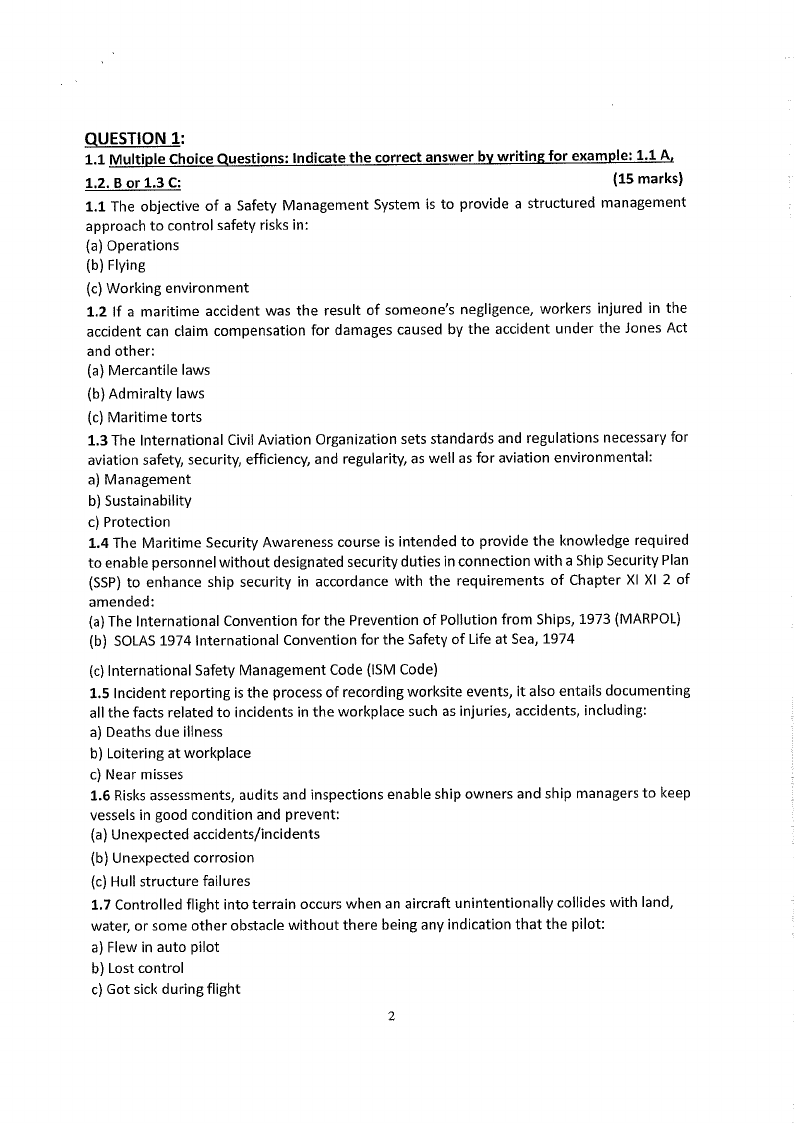
QUESTION 1:
1.1 Multiple Choice Questions: Indicate the correct answer by writing for example: 1.1 A,
1.2. B or 1.3 C:
(15 marks)
1.1 The objective of a Safety Management System is to provide a structured management
approach to control safety risks in:
(a) Operations
(b) Flying
(c) Working environment
1.2 If a maritime accident was the result of someone's negligence, workers injured in the
accident can claim compensation for damages caused by the accident under the Jones Act
and other:
(a) Mercantile laws
(b) Admiralty laws
(c) Maritime torts
1.3 The International Civil Aviation Organization sets standards and regulations necessary for
aviation safety, security, efficiency, and regularity, as well as for aviation environmental:
a) Management
b) Sustainability
c) Protection
1.4 The Maritime Security Awareness course is intended to provide the knowledge required
to enable personnel without designated security duties in connection with a Ship Security Plan
(SSP) to enhance ship security in accordance with the requirements of Chapter XI XI 2 of
amended:
(a) The International Convention for the Prevention of Pollution from Ships, 1973 (MARPOL)
(b) SOLAS 1974 International Convention for the Safety of Life at Sea, 1974
(c) International Safety Management Code {ISM Code)
1.5 Incident reporting is the process of recording worksite events, it also entails documenting
all the facts related to incidents in the workplace such as injuries, accidents, including:
a) Deaths due illness
b) Loitering at workplace
c) Near misses
1.6 Risks assessments, audits and inspections enable ship owners and ship managers to keep
vessels in good condition and prevent:
(a) Unexpected accidents/incidents
(b) Unexpected corrosion
(c) Hull structure failures
1.7 Controlled flight into terrain occurs when an aircraft unintentionally collides with land,
water, or some other obstacle without there being any indication that the pilot:
a) Flew in auto pilot
b) Lost control
c) Got sick during flight
2
|
|
3 Page 3 |
▲back to top |
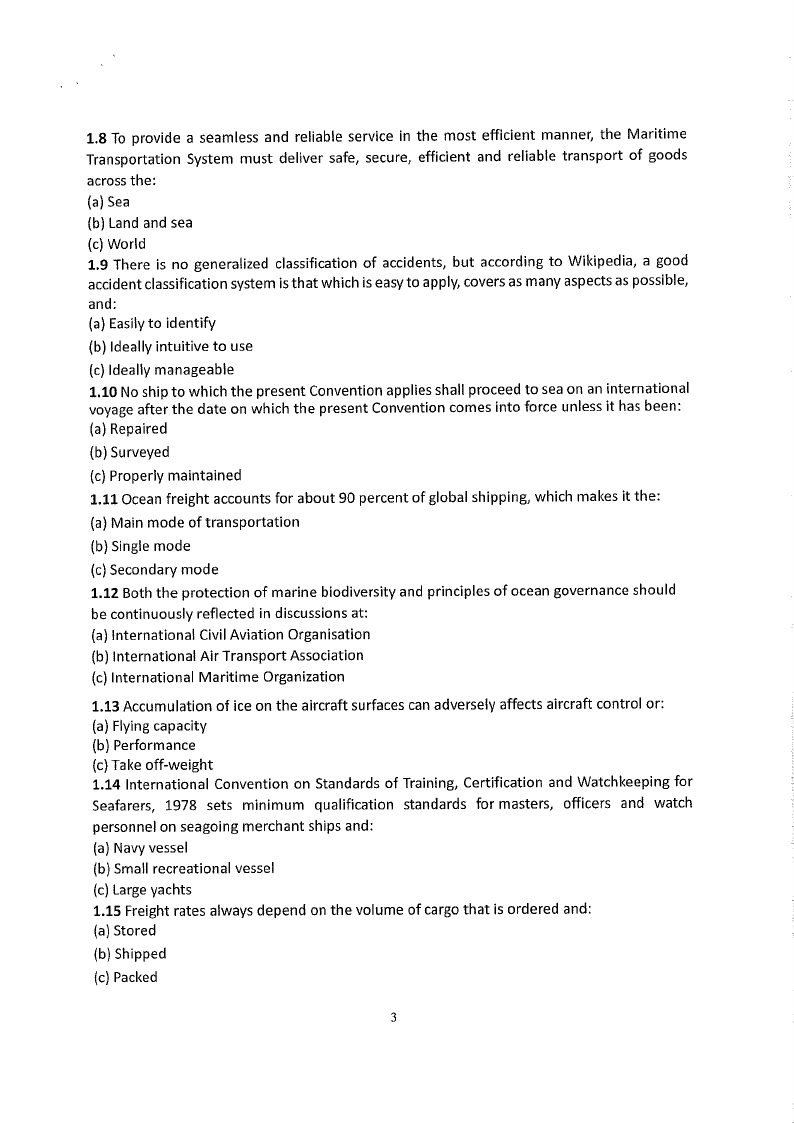
1.8 To provide a seamless and reliable service in the most efficient manner, the Maritime
Transportation System must deliver safe, secure, efficient and reliable transport of goods
across the:
(a) Sea
(b) Land and sea
(c) World
1.9 There is no generalized classification of accidents, but according to Wikipedia, a good
accident classification system is that which is easy to apply, covers as many aspects as possible,
and:
(a) Easily to identify
(b) Ideally intuitive to use
(c) Ideally manageable
1.10 No ship to which the present Convention applies shall proceed to sea on an international
voyage after the date on which the present Convention comes into force unless it has been:
(a) Repaired
(b) Surveyed
(c) Properly maintained
1.11 Ocean freight accounts for about 90 percent of global shipping, which makes it the:
(a) Main mode of transportation
(b) Single mode
(c) Secondary mode
1.12 Both the protection of marine biodiversity and principles of ocean governance should
be continuously reflected in discussions at:
(a) International Civil Aviation Organisation
(b) International Air Transport Association
(c) International Maritime Organization
1.13 Accumulation of ice on the aircraft surfaces can adversely affects aircraft control or:
(a) Flying capacity
(b) Performance
(c) Take off-weight
1.14 International Convention on Standards of Training, Certification and Watchkeeping for
Seafarers, 1978 sets minimum qualification standards for masters, officers and watch
personnel on seagoing merchant ships and:
(a) Navy vessel
(b) Small recreational vessel
(c) Large yachts
1.15 Freight rates always depend on the volume of cargo that is ordered and:
(a) Stored
(b) Shipped
(c) Packed
3
|
|
4 Page 4 |
▲back to top |
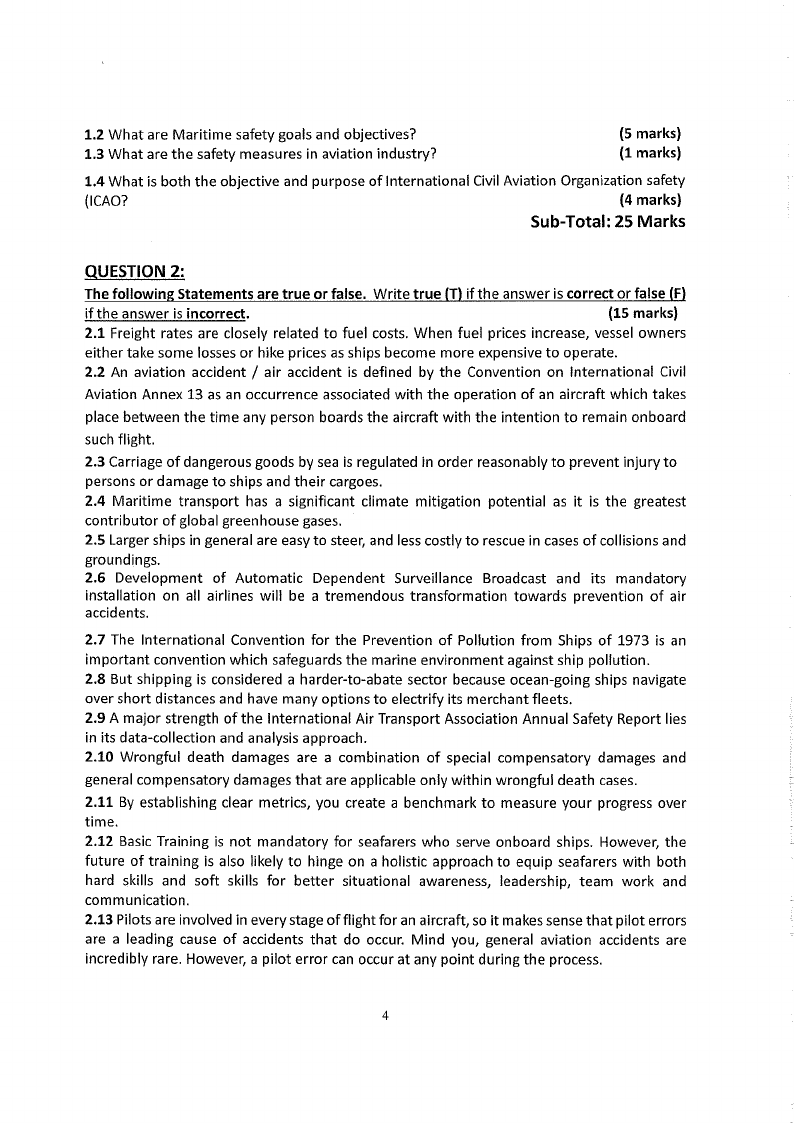
1.2 What are Maritime safety goals and objectives?
1.3 What are the safety measures in aviation industry?
(5 marks)
(1 marks)
1.4 What is both the objective and purpose of International Civil Aviation Organization safety
(ICAO?
(4 marks)
Sub-Total: 25 Marks
QUESTION 2:
The following Statements are true or false. Write true (Tl if the answer is correct or false IF)
if the answer is incorrect.
(15 marks)
2.1 Freight rates are closely related to fuel costs. When fuel prices increase, vessel owners
either take some losses or hike prices as ships become more expensive to operate.
2.2 An aviation accident / air accident is defined by the Convention on International Civil
Aviation Annex 13 as an occurrence associated with the operation of an aircraft which takes
place between the time any person boards the aircraft with the intention to remain on board
such flight.
2.3 Carriage of dangerous goods by sea is regulated in order reasonably to prevent injury to
persons or damage to ships and their cargoes.
2.4 Maritime transport has a significant climate mitigation potential as it is the greatest
contributor of global greenhouse gases.
2.5 Larger ships in general are easy to steer, and less costly to rescue in cases of collisions and
groundings.
2.6 Development of Automatic Dependent Surveillance Broadcast and its mandatory
installation on all airlines will be a tremendous transformation towards prevention of air
accidents.
2.7 The International Convention for the Prevention of Pollution from Ships of 1973 is an
important convention which safeguards the marine environment against ship pollution.
2.8 But shipping is considered a harder-to-abate sector because ocean-going ships navigate
over short distances and have many options to electrify its merchant fleets.
2.9 A major strength of the International Air Transport Association Annual Safety Report lies
in its data-collection and analysis approach.
2.10 Wrongful death damages are a combination of special compensatory damages and
general compensatory damages that are applicable only within wrongful death cases.
2.11 By establishing clear metrics, you create a benchmark to measure your progress over
time.
2.12 Basic Training is not mandatory for seafarers who serve onboard ships. However, the
future of training is also likely to hinge on a holistic approach to equip seafarers with both
hard skills and soft skills for better situational awareness, leadership, team work and
communication.
2.13 Pilots are involved in every stage of flight for an aircraft, so it makes sense that pilot errors
are a leading cause of accidents that do occur. Mind you, general aviation accidents are
incredibly rare. However, a pilot error can occur at any point during the process.
4
|
|
5 Page 5 |
▲back to top |
2.14 The best way to articulate and manage your safety outcomes is to make sure your goals
are not measurable.
2.15 "Creating a safety culture has to come from down to top and be taken seriously at
every level, from cadet to Chief Executive Officer."
2.2 What is accident reporting and why do we need to do accident reporting? (10 marks)
Sub-Total: 25 Marks
QUESTION 3:
3.1 Fill-in the missing word: Indicate the correct answer by writing for example: 3.1 A ,3.2 B
or 3.3 C:
(15 marks)
3.1 The bill of lading is a legally binding document providing the shipper and the carrier all the
details needed to process the freight shipment and ..................... it correctly:
(a) Discharge
(b) Invoice
(c) Receipt
3.2 Before arrival of a ship, the required .................................... space must be allocated taking
the prospective time the ship spends in the terminal into account:
(a) Capacity
(b) Layout
(c) Berthing
3.3 Based on the stowage plan, planners in container terminals determine the sequence of
unloading ........................... and of loading outbound containers:
(a) Inbound containers
(b) Terminal Yard
(c) Transit containers
3.4 The bill of lading is a contract between the between the ................................. and shipper:
(a) Carrier
(b) Government
(c) Community
3.5 Sustainable development is development that meets the needs of the present without
................................. the ability of future generations to meet their own needs:
(a) Wasting
(b) Compromising
(c) Disposing
3.6 For maritime transport systems to be seamless, fluid and operational there is need for
reliable information flows between stakeholders enabled by manual documentation and
increasingly the information flows are being done ...................................................:
(a) Smartly
(b) Smoothly
(c) Electronically
5
|
|
6 Page 6 |
▲back to top |
3.7 Paying attention to the bill's accuracy when using it, is one of the most important things
you can do to run your .............................. department effectively:
(a) Warehouses
(b) Depots'
(c) Logistics
3.8 Under the flags of convenience (FOC) countries allows any individual ship operator or
companies to register their respective ship under their ...................:
(a) Maritime jurisdiction
(b) Flag
(c) Exclusive economic zone
3.9 The issuance of the bill of lading is proof that the carrier has received to goods from the
shipper or their third-party logistic service provider in .................................. order and
condition, as handed over by the shipper:
(a) Good condition
(b) Apparent good
(c) Excellent condition
3.10 The bill of lading is sufficient evidence of a legal contract and can be used in .......... :
(a) Litigation
(b) Carriage
(c) Arguments
3.11 For example accidents associated with crane operations or resulting in oil spills were
counted as ........................... :
(a) Other accidents
(b) Collision
(c) Fire
3.12 Performance metrics are quantifiable measures used to gauge the effectiveness and
efficiency of your actions as an aviation safety ............................:
(a) Analyst
(b) Officer
(c) Inspector
3.13 Setting a safety goal involves identifying specific, measurable, achievable, relevant, and
time-bound objectives that will improve ........................... safety.
(a) Industry
(b) Workplace
(c) Company
3.14 The initial phases of the investigation of accidents consists of the following phases which
is the collection of data, analysis of data, and .................................:
(a) Perusals of data
(b) Interrogation of witnesses
(c) Presentation of findings
6
|
|
7 Page 7 |
▲back to top |
3.15 Both 'inadequate training/experience' and 'poor design' were identified as immediate
and contributory causes of fire and ................................. accidents:
(a) Slippery
(b) Explosion
(c) Ballast
3.2 For transport to be competitive, vehicles must be ready in these four (4) areas please,
name the areas in question and briefly elaborate on the same areas?
(10 marks)
Sub-Total: 25 Marks
Question 4:
4.1 Green corridors can support a country's objectives within the following areas, name the
five (S) national and regional policy for green shipping corridors?
(15 marks)
4.2 What are the main five elements of maritime transportation infrastructure? (5 marks)
4.3 What is marine infrastructure?
(5 marks)
Sub-Total: 25 Marks
Question 5:
5.1 Name any seven (7) advantages and four (4) disadvantages of Air Transportation and
briefly elaborate on their respective functions?
(25 marks)
Sub-Total: 25 Marks
Grand Total: 100 Marks
7