


 |
MPS521C-MARKETING PRINCIPLES-2ND OPP-JULY 2025 |
|
|
1 Page 1 |
▲back to top |
nAm I BIA u nlVERS ITY
OF SCIEnCE Ano TECHnOLOGY
FACULTY OF COMMERCE; HUMAN SCIENCES AND EDUCATION
HAROLD PUPKEWITZ GRADUATE SCHOOL OF BUSINESS
QUALIFICATION : DIPLOMA IN BUSINESS PROCESS MANAGEMENT
QUALIFICATION CODE: 06DBPM LEVEL: 5
COURSE CODE: MPS521C
COURSE NAME: MARKETING PRINCIPLES
SESSION: JULY 2025
DURATION: 3 HOURS
PAPER: PAPER I
MARKS: 100
SECOND OPPORTUNITY EXAMINATION - QUESTION PAPER
EXAMINER(S) MR. S. TJITAMUNISA
MODERATOR: DR. G. KARITA
INSTRUCTIONS
1. Write clearly and be tidy
2. Answer any all the questions
3. Use the Tables on pages 7 to answer Section A & B
4. Read each question carefully before attempting it
5. This paper consist of five (5) pages and five (5) questions
THIS QUESTION PAPER CONSISTS OF 7 PAGES (Including this front page)
llPage
|
|
2 Page 2 |
▲back to top |
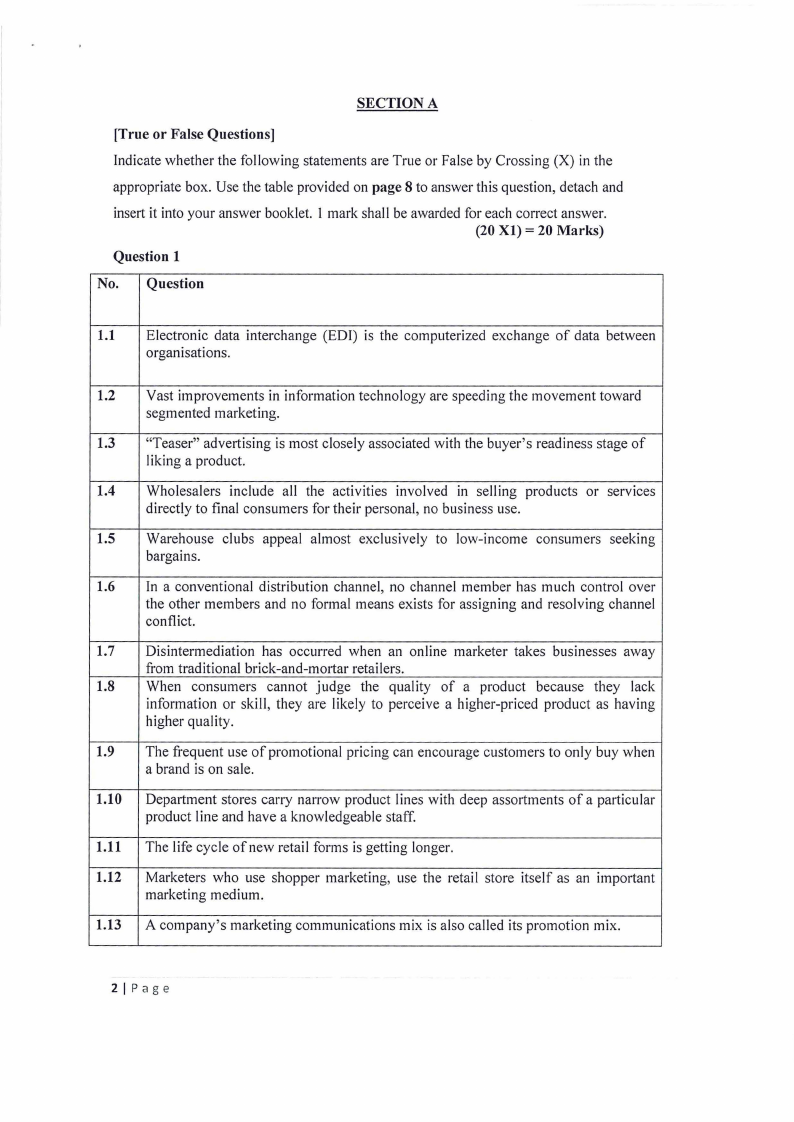
SECTION A
[True or False Questions]
Indicate whether the following statements are True or False by Crossing (X) in the
appropriate box. Use the table provided on page 8 to answer this question, detach and
insert it into your answer booklet. I mark shall be awarded for each correct answer.
(20 Xl) = 20 Marks)
Question 1
No. Question
1.1 Electronic data interchange (EDI) is the computerized exchange of data between
organisations.
1.2 Vast improvements in information technology are speeding the movement toward
segmented marketing.
1.3 "Teaser" advertising is most closely associated with the buyer's readiness stage of
liking a product.
1.4 Wholesalers include all the activities involved in selling products or services
directly to final consumers for their personal, no business use.
1.5 Warehouse clubs appeal almost exclusively to low-income consumers seeking
bargains.
1.6 In a conventional distribution channel, no channel member has much control over
the other members and no formal means exists for assigning and resolving channel
conflict.
1.7 Disintermediation has occurred when an online marketer takes businesses away
from traditional brick-and-mo11ar retailers.
1.8 When consumers cannot judge the quality of a product because they lack
information or skill, they are likely to perceive a higher-priced product as having
higher quality.
1.9 The frequent use of promotional pricing can encourage customers to only buy when
a brand is on sale.
1.10 Depai1ment stores carry narrow product lines with deep assortments of a particular
product line and have a knowledgeable staff.
1.11 The life cycle of new retail forms is getting longer.
1.12 Marketers who use shopper marketing, use the retail store itself as an important
marketing medium.
1.13 A company's marketing communications mix is also called its promotion mix.
21Page
|
|
3 Page 3 |
▲back to top |
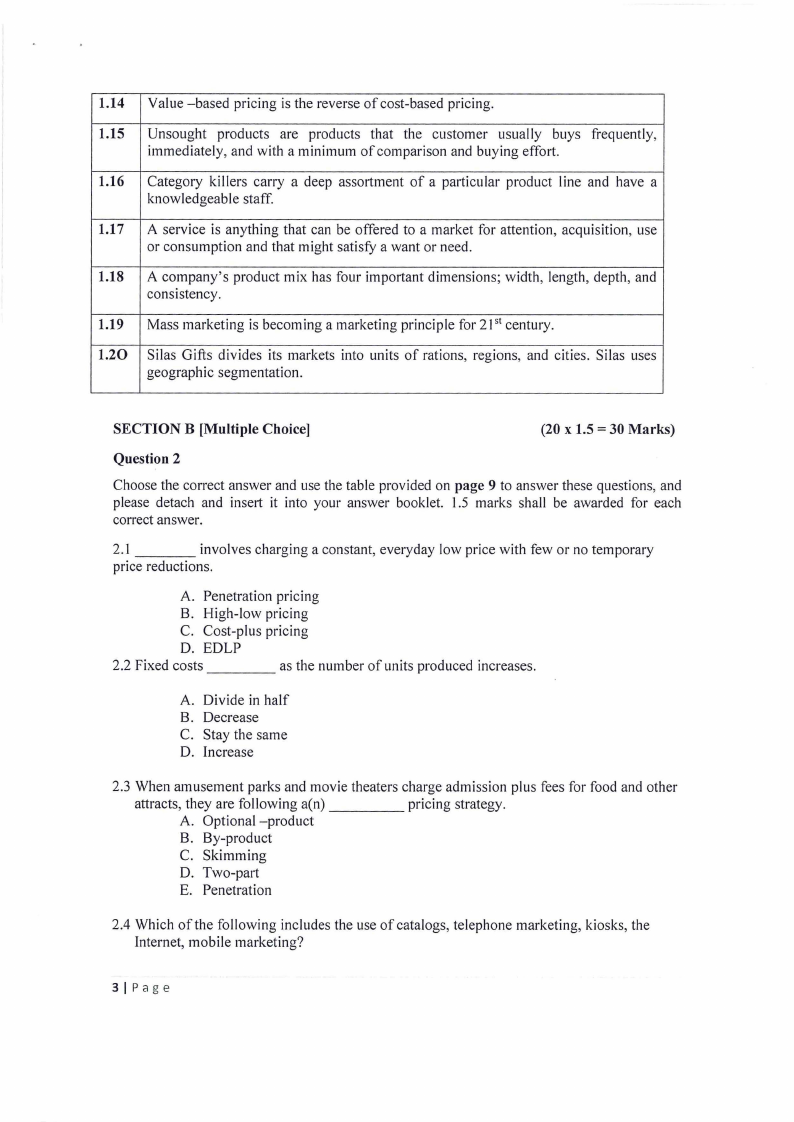
1.14 Value -based pricing is the reverse of cost-based pricing.
1.15 Unsought products are products that the customer usually buys frequently,
immediately, and with a minimum of comparison and buying effort.
1.16 Category killers carry a deep assortment of a particular product line and have a
knowledgeable staff.
1.17 A service is anything that can be offered to a market for attention, acquisition, use
or consumption and that might satisfy a want or need.
1.18 A company's product mix has four important dimensions; width, length, depth, and
consistency.
1.19 Mass marketing is becoming a marketing principle for 21 st century.
1.20 Silas Gifts divides its markets into units of rations, regions, and cities. Silas uses
geographic segmentation.
SECTION B [Multiple Choice]
(20 x 1.5 = 30 Marks)
Question 2
Choose the correct answer and use the table provided on page 9 to answer these questions, and
please detach and insert it into your answer booklet. 1.5 marks shall be awarded for each
correct answer.
2.1 ____
involves charging a constant, everyday low price with few or no temporary
price reductions.
A. Penetration pricing
B. High-low pricing
C. Cost-plus pricing
D. EDLP
2.2 Fixed costs ____
as the number of units produced increases.
A. Divide in half
B. Decrease
C. Stay the same
D. Increase
2.3 When amusement parks and movie theaters charge admission plus fees for food and other
attracts, they are following a(n) _____
pricing strategy.
A. Optional -product
B. By-product
C. Skimming
D. Two-part
E. Penetration
2.4 Which of the following includes the use of catalogs, telephone marketing, kiosks, the
Internet, mobile marketing?
3IPage
|
|
4 Page 4 |
▲back to top |
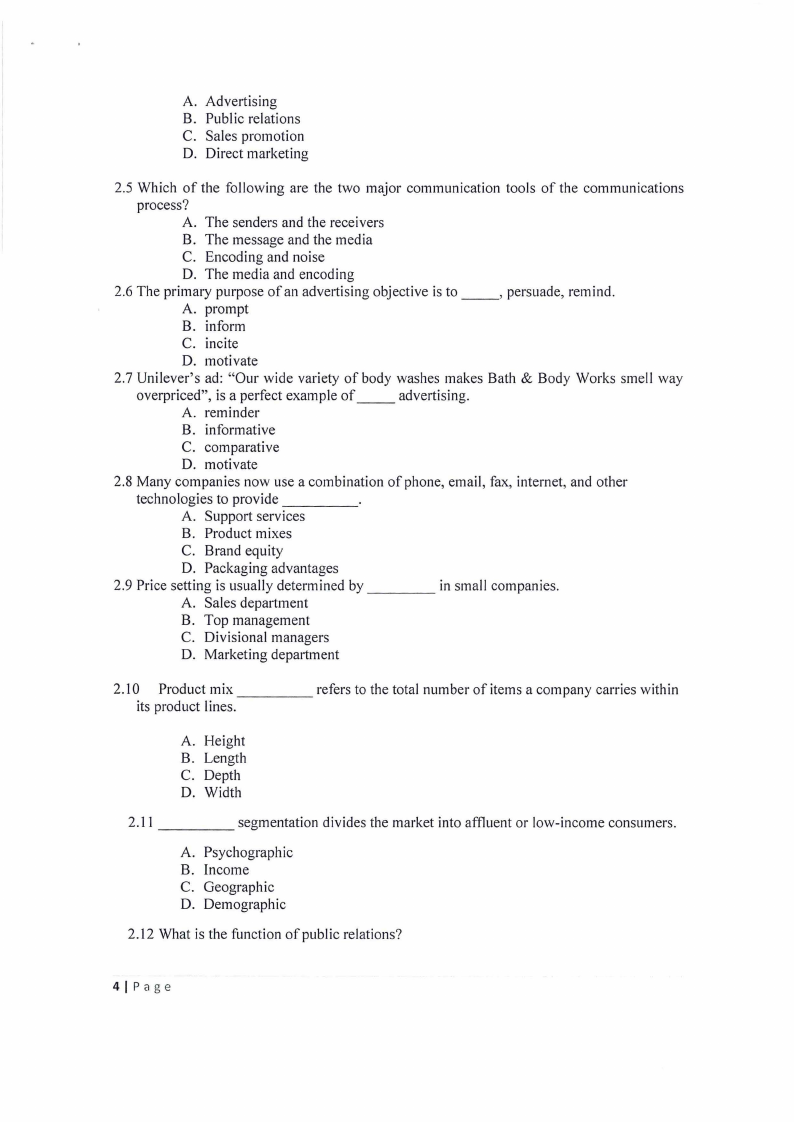
A. Advertising
B. Public relations
C. Sales promotion
D. Direct marketing
2.5 Which of the following are the two major communication tools of the communications
process?
A. The senders and the receivers
B. The message and the media
C. Encoding and noise
D. The media and encoding
2.6 The primary purpose of an advertising objective is to __ , persuade, remind.
A. prompt
B. inform
C. incite
D. motivate
2.7 Unilever's ad: "Our wide variety of body washes makes Bath & Body Works smell way
overpriced", is a perfect example of __ advertising.
A. reminder
B. informative
C. comparative
D. motivate
2.8 Many companies now use a combination of phone, email, fax, internet, and other
technologies to provide -----
A. Support services
B. Product mixes
C. Brand equity
D. Packaging advantages
2.9 Price setting is usually determined by ____
in small companies.
A. Sales depaitment
B. Top management
C. Divisional managers
D. Marketing department
2.10 Product mix _____
its product lines.
refers to the total number of items a company carries within
A. Height
B. Length
C. Depth
D. Width
2.11 _____
segmentation divides the market into affluent or low-income consumers.
A. Psychographic
B. Income
C. Geographic
D. Demographic
2.12 What is the function of public relations?
41Page
|
|
5 Page 5 |
▲back to top |
A. Building up a good corporate image
B. Building a direct connection with customer
C. Obtaining immediate customer response
D. Making sales
2.13 Which method for setting the promotional budget begins with total revenues, deducts
operating expenses and capital outlays, and then devotes some portion of the remaining
funds to advertising?
A. Percentage-of-sales method
B. Competitive-parity method
C. Affordable method
D. Objective-and-task method
2.14 Many marketers are now embracing the concept of __ , using in-store promotions and
advertising to extend brand equity to "the last mile" and encourage favorable in-store
purchase decisions.
A. disintermediation
B. market skimming
C. shopper marketing
D. exclusive marketing
2.15 A product is a key element in the ____
. At one extreme it may consist of pure
tangible goods or at the other extreme, pure services.
A. Co-branding
B. Value chain
C. Brand equity
D. Market offering
2.16 ____
marketing targets the whole market with one offer.
A. Differentiated
B. Concentrated
C. Undifferentiated
D. Local marketing
E. Product marketing
2.17 To differentiate themselves, many companies go beyond offering products and services;
they are also developing and delivering customer ___ _
A. Events
B. Experiences
C. Product lines
D. Brands
2.18 __ positioning involves meeting
requirements at a much lower price.
A. Same for less
B. More for the same
C. Less for much less
D. More for more
consumers'
lower performance
or quality
2.19 Which of the following are two dimensions of product quality?
SI Page
|
|
6 Page 6 |
▲back to top |
A. Level and consistency
B. Consistency and accuracy
C. Reliability and level
D. Accuracy and reliability
2.20 __ divides buyers into different segments based on social class, lifestyle, or
personality characteristics.
A. Behavioral segmentation
B. Psychographic segmentation
C. Demographic segmentation
D. Gender segmentation
SECTIONC
(50 marks)
Question 3
(10 Marks)
With relevant Namibian examples; explain what you understand by the following?
3.1 Intensive Distribution
(2 marks)
3.2 Direct Marketing
(2 marks)
3.3 Convenience store
(2 marks)
3.4 Third -party Logistics (3PL)
(2 marks)
3.5 Franchise retail organization
(2 marks)
Question 4
(20 Marks)
4.1 With fixed costs of N$600,000.00, a variable cost ofN$60, and expected sales of 80,000
units, what is the manufacturer's unit cost?
(4 marks)
4.2 Identify and define the important internal and external factors affecting (minimum five) a
firms pricing decisions.
(10 marks)
4.3 Compare and contrast the two new product pricing strategies in marketing (Market
penetration pricing/Market skimming pricing strategies) and discuss the conditions under
which each is appropriate.
(6 Marks)
Question 5
(20 Marks)
5.1 Just because a marketer identifies a segment does not necessarily mean that it's a useful
one to target. There are many ways to segment a market, but not al I segmentations are
effective. Name and describe the five (5) requirements for useful market segments.
(10 Marks)
5.2 Identify and explain any 5 (FIVE) of the various segmentation variables. Be specific in
your answer and use examples to demonstrate what each means.
(10 Marks)
GI Page
|
|
7 Page 7 |
▲back to top |
,,.
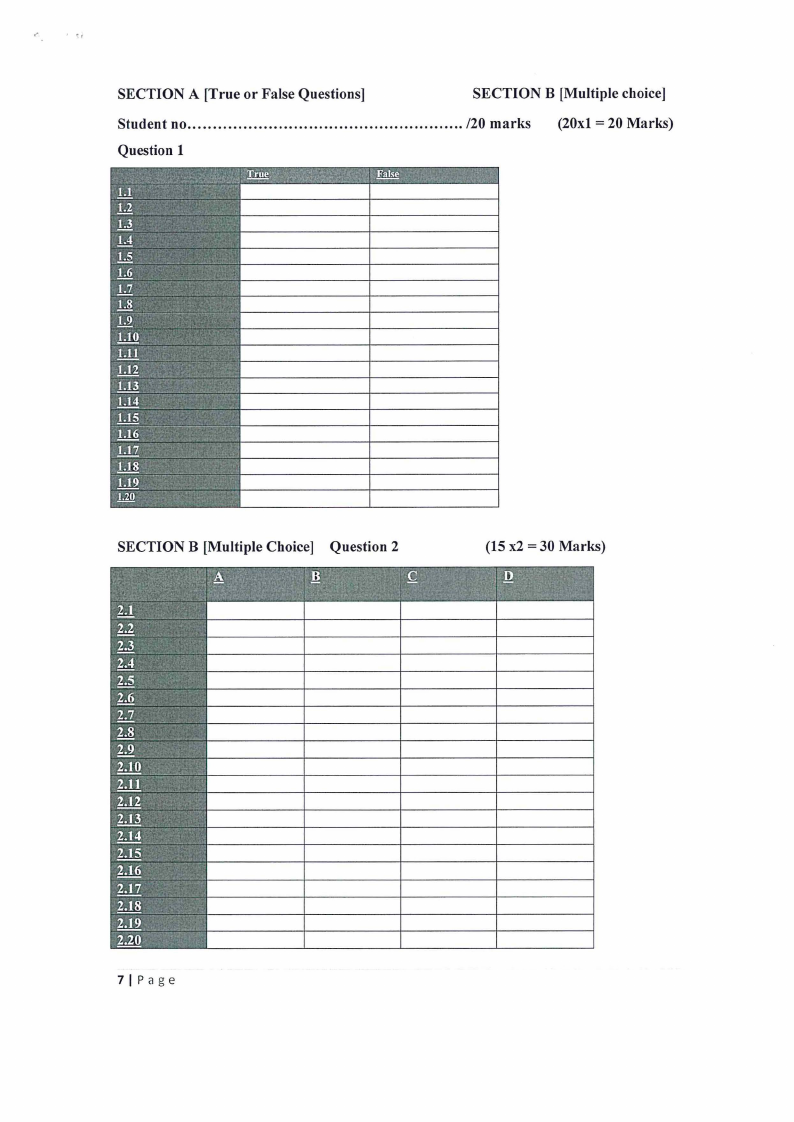
SECTION A [True or False Questions]
Student no .......................................................
Question 1
SECTION B [Multiple choice]
/20 marks (20xl = 20 Marks)
SECTION B [Multiple Choice] Question 2
(15 x2 = 30 Marks)
71Page