


 |
MIS611S - MEDICAL INFORMATION SYSTEM 2A - 2ND OPP - JULY 2025 |
|
|
1 Page 1 |
▲back to top |
nAmlBIA unlVERSITY
OF SCIEnCE Ano TECHnOLOGY
FACULTY OF COMMERCE, HUMAN SCIENCES& EDUCATION
DEPARTMENT OF GOVERNANCE & MANAGEMENT SCIENCES
QUALIFICATION: Bachelor of Business & Information Administration
QUALIFICATIONCODE: 07BBIA
LEVEL: 6
COURSE: Medical Information Systems 2A
DATE: July 2025
COURSECODE: M IS611S
SESSION: 2
DURATION: 2 Hours
MARKS: 100
EXAMINER:
2nd OPPORTUNITYEXAMINATION QUESTION PAPER
MS A SCHROEDER
MODERATOR: MS L TRIPODI
THIS QUESTION PAPERCONSISTSOF 5 PAGES
(INCLUDING THIS FRONT PAGE)
INSTRUCTIONS
a) Answer ALL the questions and start each question on a new page.
b) Read all questions carefully before answering.
c) Number answers according to the numbering structure provided in the question paper.
1
|
|
2 Page 2 |
▲back to top |
QUESTION 1
[20)
Identify the letter of the choice that best completes the statement or answers the question.
(10)
1.1 __ is the introduction of sperm into the reproductive tract of a female by means other than sexual
intercourse for impregnating the female.
A. Artificial insemination
B. Amniocentesis
C. Reproductive rights
D. Surrogacy
E. In vitro fertilisation
1.2 Health care professionals are required to perform in a manner that is consistent with the expectations of their
profession. This is a legal concept known as __ _
A. Litigation
B. Standards of care
C. Malpractice
D. Abandonment
E. Emergency
1.3 A medical appointment that is arranged upon the recommendation of another healthcare professional, usually
a primary care provider (PCP) or general practitioner (GP), for the patient to see a specialist or receive
specialised care. Select the type of appointment being referred to in this scenario.
A. Ancillary appointment
B. Cancelled appointment
C. Walk-in
D. No-show
E. Referral appointment
1.4 Nicole has a been referred to Pathcare by her General Practitioner for the extraction of blood samples.
She is restless, nervousness, fearful before and during her appointment. Select which type of patient is
Nicole.
A. Violent patient
B. Elderly patient
C. Angry patient
D. Anxious patient
E. Disabled patient
1.5 Which of the following is an example of a criminal offense that could occur in a medical administrative
setting?
A. Accidentally entering incorrect patient information in a file
B. Sharing a patient's medical records with an insurance company with consent
C. Billing for medical services that were not actually provided
D. Refusing to schedule an appointment without a referral
E. None of the above
1.6 Which of the following is the most appropriate facility to receive a patient who has been critically injured in a
car accident?
A. Outpatient clinic
B. Rehabilitation centre
C. General practitioner's office
D. Manager's office
E. Emergency room
2
|
|
3 Page 3 |
▲back to top |
1.7 Select which of the following is a common disadvantage of using a manual appointment system in a healthcare
facility.
A. It requires electricity and internet access
B. It automatically sends reminders to patients
C. It can be easily updated in real-time
D. It is more prone to human errors and double bookings
E. It integrates with electronic health records
1.8 Indicate which of the following is an example of a civil law case in a medical environment.
A. A nurse being arrested for drug possession
B. A patient suing a doctor for medical negligence
C. A hospital violating public health regulations
D. A doctor being charged with assault
E. A paramedic failing a government licensing exam
1.9 What is the purpose that Pathologist examine tissues and specimens removed by biopsy or surgery of
patients?
A. To sterilise surgical instruments
B. To train new healthcare workers
C. To diagnose diseases by distinguishing abnormal from normal tissues
D. To improve hospital interior design
E. To identify patient medical aid status
1.10 Select the reason why new patients are usually asked to arrive early for their medical appointments.
A. To finish their treatment faster
B. To avoid interacting with other patients
C. To complete paperwork and registration before seeing the doctor
D. To receive free samples and medications
E. To ensure the doctor has extra break time
Medical Office Assistants need to be familiar with a variety of medical abbreviations that are
commonly used in the medical office. Indicate what the following abbreviations stand for.
(10)
1.11
1.12
1.13
1.14
1.15
1.16
1.17
1.18
1.19
1.20
AKA
BP
cc
DVT
ENT
gm
HBV
Hx
LP
MRI
3
|
|
4 Page 4 |
▲back to top |
QUESTION 2
[20)
2.1 In the medical office administration environment, maintaining a professional appearance is essential not only
for creating a positive impression but also for ensuring patient confidence, safety, and hygiene. Discuss "hair",
"tattoos", and "jewellery" as three key aspects of professional appearance in this setting.
(6)
2.2 In any healthcare setting, effective communication is not just important-it is essential. Medical Office
Assistants (MOAs) are part of a broader team that includes doctors, nurses, receptionists, administrators, and
sometimes even specialists. Discuss "communication skill" as one of the important qualities a MOAs should
possess.
(5)
2.3 Both Home Health Care and Hospice Care provide important medical services outside of traditional hospital
settings, but they serve different patient needs and goals. Examine the difference between "Home Health
Care" and "Hospice Care" at health care facilities options available to patients.
(6)
2.4 Discussthree advantages of a computerised appointment schedule.
(3)
QUESTION 3
[20)
3.1 Peter has lost his father recently in a tragic car accident and he has informed you that it is incredibly painful.
As a Medical Information Systems student, you can support him not only emotionally, but also by helping him
understand the natural grieving process through the KUbier-Ross model of the five stages of loss. Examine the
five stages of loss of the Kubler-Ross model.
(10)
3.2 Medical Office Assistants (MOAs) interact with a wide variety of patient groups every day, each with unique
needs, backgrounds, and communication preferences. Examine five appropriate communication procedures
that a (MOA) should consider when dealing with an elderly patient.
(5)
3.3 Outline a dialogue between you as the Medical Office Assistant and your best friend during dinner after seeing
her pregnancy test results earlier during the day, keeping in mind professionalism, confidentiality, and ethics
in the medical field.
(5)
4
|
|
5 Page 5 |
▲back to top |
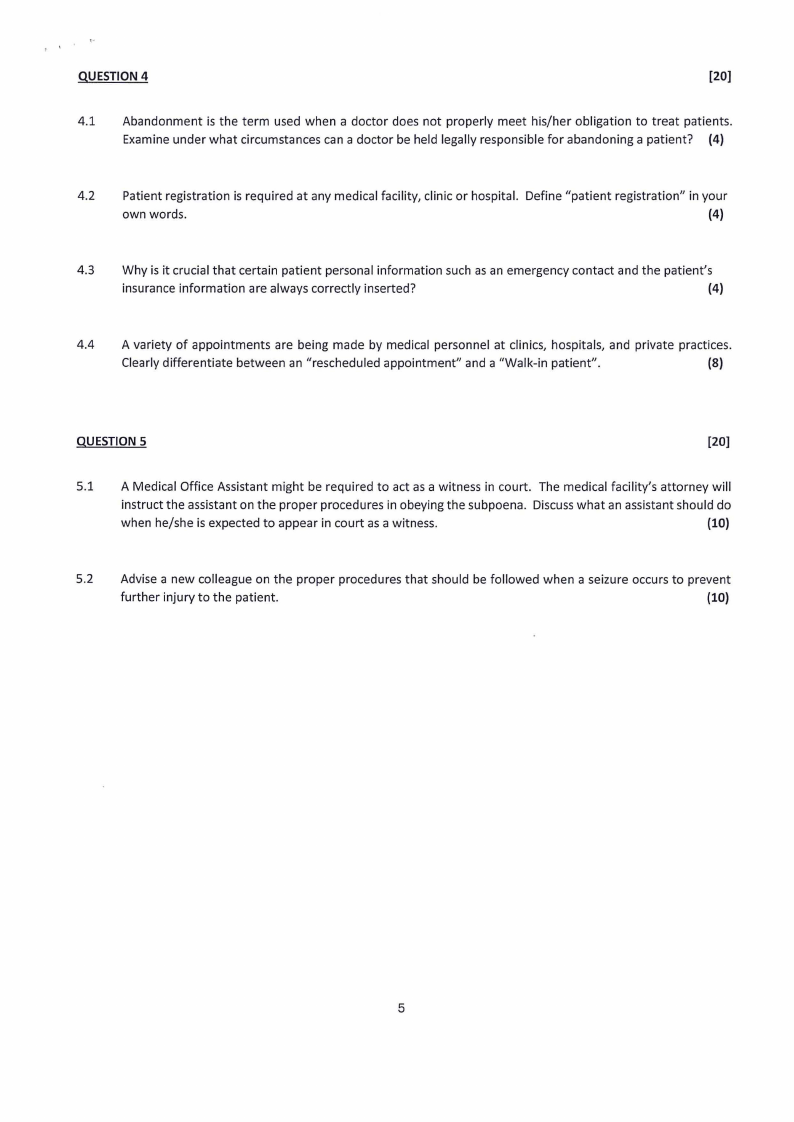
QUESTION 4
[20)
4.1 Abandonment is the term used when a doctor does not properly meet his/her obligation to treat patients.
Examine under what circumstances can a doctor be held legally responsible for abandoning a patient? (4)
4.2 Patient registration is required at any medical facility, clinic or hospital. Define "patient registration" in your
own words.
(4)
4.3 Why is it crucial that certain patient personal information such as an emergency contact and the patient's
insurance information are always correctly inserted?
(4)
4.4 A variety of appointments are being made by medical personnel at clinics, hospitals, and private practices.
Clearly differentiate between an "rescheduled appointment" and a "Walk-in patient".
(8)
QUESTION 5
[20)
5.1 A Medical Office Assistant might be required to act as a witness in court. The medical facility's attorney will
instruct the assistant on the proper procedures in obeying the subpoena. Discusswhat an assistant should do
when he/she is expected to appear in court as a witness.
(10)
5.2 Advise a new colleague on the proper procedures that should be followed when a seizure occurs to prevent
further injury to the patient.
(10)
5