


 |
BIO521S OR IBC521S - BIOCHEMISTRY - 2ND OPP - DEC 2025 |
|
|
1 Page 1 |
▲back to top |
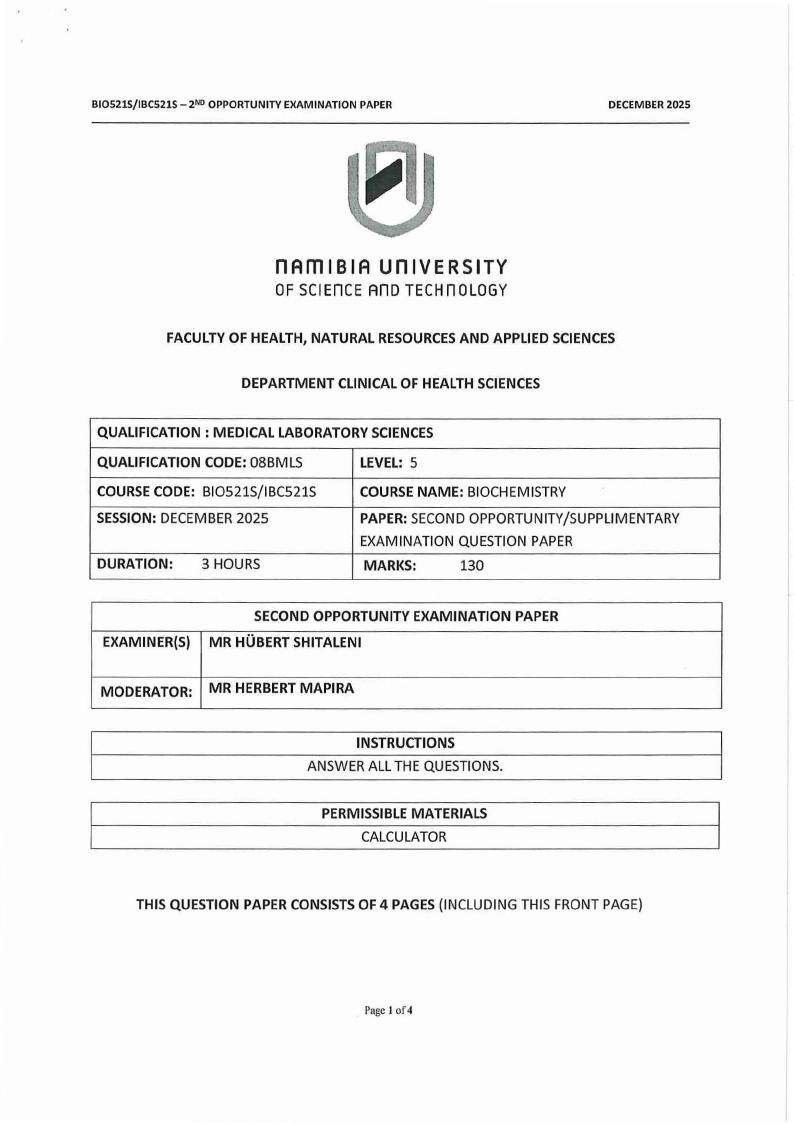
B1O5215/IBC5215 - 2ND OPPORTUNITY EXAMINATION PAPER
DECEMBER 2025
nAmlBIA unlVERSITY
OF SCIEnCE Ano TECHnOLOGY
FACULTY OF HEALTH, NATURAL RESOURCES AND APPLIED SCIENCES
DEPARTMENT CLINICAL OF HEALTH SCIENCES
QUALIFICATION : MEDICAL LABORATORY SCIENCES
QUALIFICATION CODE: 08BMLS
LEVEL: 5
COURSE CODE: BIO521S/IBC521S
SESSION: DECEMBER 2025
DURATION: 3 HOURS
COURSE NAME: BIOCHEMISTRY
PAPER: SECOND OPPORTUNITY/SUPPLIMENTARY
EXAMINATION QUESTION PAPER
MARKS:
130
SECOND OPPORTUNITY EXAMINATION PAPER
EXAMINER(S) MR HUBERT SHITALENI
MODERATOR: MR HERBERT MAPIRA
INSTRUCTIONS
ANSWER ALL THE QUESTIONS.
PERMISSIBLE MATERIALS
CALCULATOR
THIS QUESTION PAPER CONSISTS OF 4 PAGES (INCLUDING THIS FRONT PAGE)
Page l of4
|
|
2 Page 2 |
▲back to top |
BIO521S/IBC521S - 2No OPPORTUNITY EXAMINATION PAPER
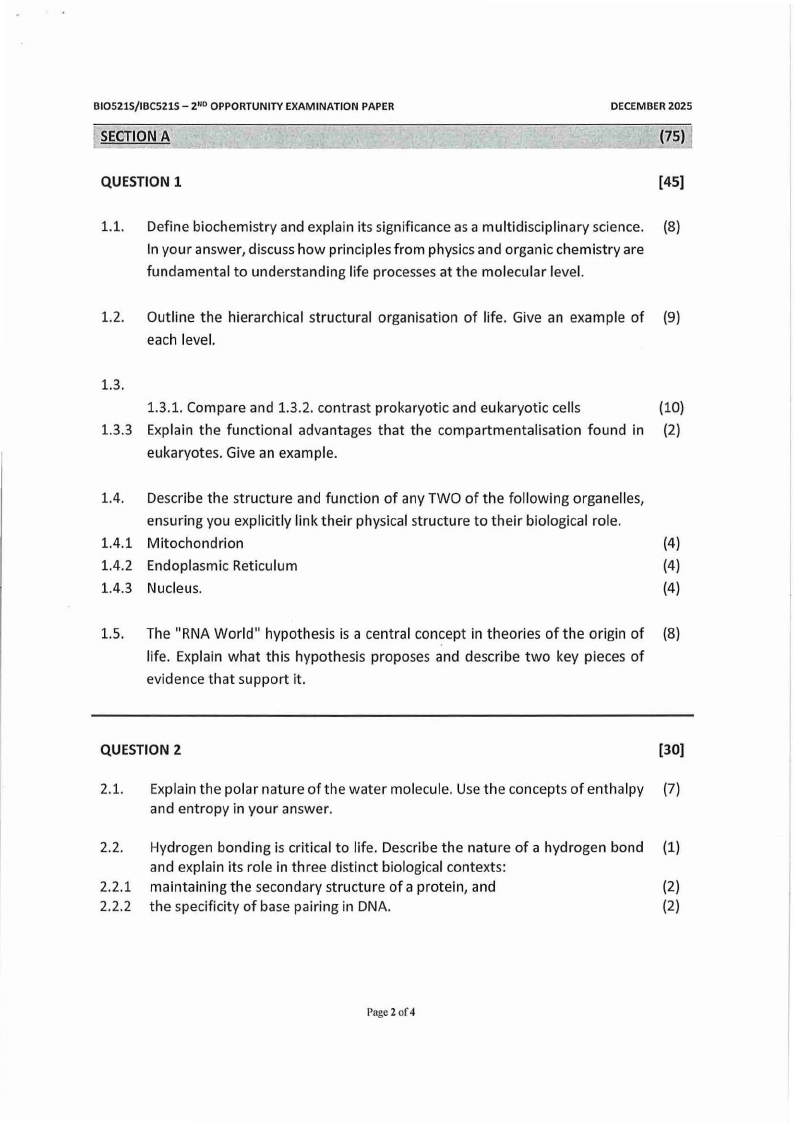
SECTION A
DECEMBER 2025
QUESTION 1
[45)
1.1. Define biochemistry and explain its significance as a multidisciplinary science. (8)
In your answer, discuss how principles from physics and organic chemistry are
fundamental to understanding life processes at the molecular level.
1.2. Outline the hierarchical structural organisation of life. Give an example of (9)
each level.
1.3.
1.3.1. Compare and 1.3.2. contrast prokaryotic and eukaryotic cells
(10)
1.3.3 Explain the functional advantages that the compartmentalisation found in (2)
eukaryotes. Give an example.
1.4. Describe the structure and function of any TWO of the following organelles,
ensuring you explicitly link their physical structure to their biological role.
1.4.1 Mitochondrion
(4)
1.4.2 Endoplasmic Reticulum
(4)
1.4.3 Nucleus.
(4)
1.5. The "RNA World" hypothesis is a central concept in theories of the origin of (8)
life. Explain what this hypothesis proposes and describe two key pieces of
evidence that support it.
QUESTION 2
[30)
2.1. Explain the polar nature ofthe water molecu le. Use the concepts of enthalpy (7)
and entropy in your answer.
2.2. Hydrogen bonding is critical to life. Describe the nature of a hydrogen bond (1)
and explain its role in three distinct biological contexts:
2.2.1 maintaining the secondary structure of a protein, and
(2)
2.2.2 the specificity of base pairing in DNA.
(2)
Page 2 of4
|
|
3 Page 3 |
▲back to top |
BIO521S/IBC5215 - 2No OPPORTUNITY EXAMINATION PAPER
DECEMBER 2025
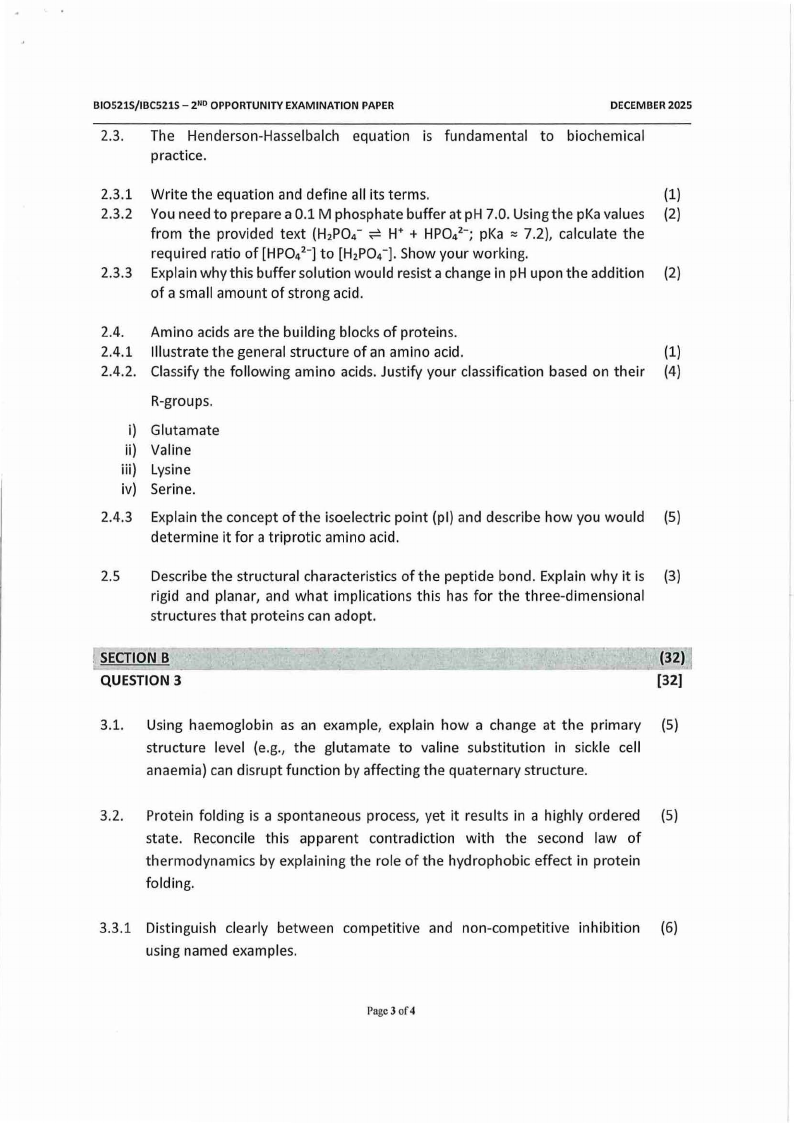
2.3. The Henderson-Hasselbalch equation is fundamental to biochemical
practice.
2.3.1 Write the equation and define all its terms.
(1)
2.3.2 You need to prepare a 0.1 M phosphate buffer at pH 7.0. Using the pKa va lues (2)
from the provided text (H2PO4- ~ W + HPO42-; pKa :::: 7.2), calculate the
required ratio of [HPo/-J to [H2PO4- J. Show your working.
2.3.3 Explain why this buffer solution would resist a change in pH upon the addition (2)
of a sma ll amount of strong acid.
2.4. Amino acids are the building blocks of proteins.
2.4.1 Illustrate the general structure of an amino acid.
(1)
2.4.2. Classify the following amino acids. Justify your classification based on their (4)
R-groups.
i) Glutamate
ii) Valine
iii) Lysine
iv) Serine.
2.4.3 Explain the concept of the isoelectric point (pl) and describe how you would (5)
determine it for a triprotic amino acid.
2.5 Describe the structural characteristics of the peptide bond. Explain why it is (3)
rigid and planar, and what implications this has for the three-dimensional
structures that proteins can adopt.
SECTION B
(32)
QUESTION 3
[32]
3.1. Using haemoglobin as an example, explain how a change at the primary (5)
structure level (e.g., the glutamate to valine substitution in sickle cell
anaemia) can disrupt function by affecting the quaternary structure.
3.2. Protein folding is a spontaneous process, yet it results in a highly ordered (5)
state. Reconcile this apparent contradiction with the second law of
thermodynamics by exp laining the role of the hydrophobic effect in protein
folding.
3.3.1 Distinguish clearly between competitive and non-competitive inhibition (6)
using named examples.
Page 3 of4
|
|
4 Page 4 |
▲back to top |
BIOS215/IBCS215- 2ND OPPORTUNITY EXAMINATION PAPER
DECEMBER 2025
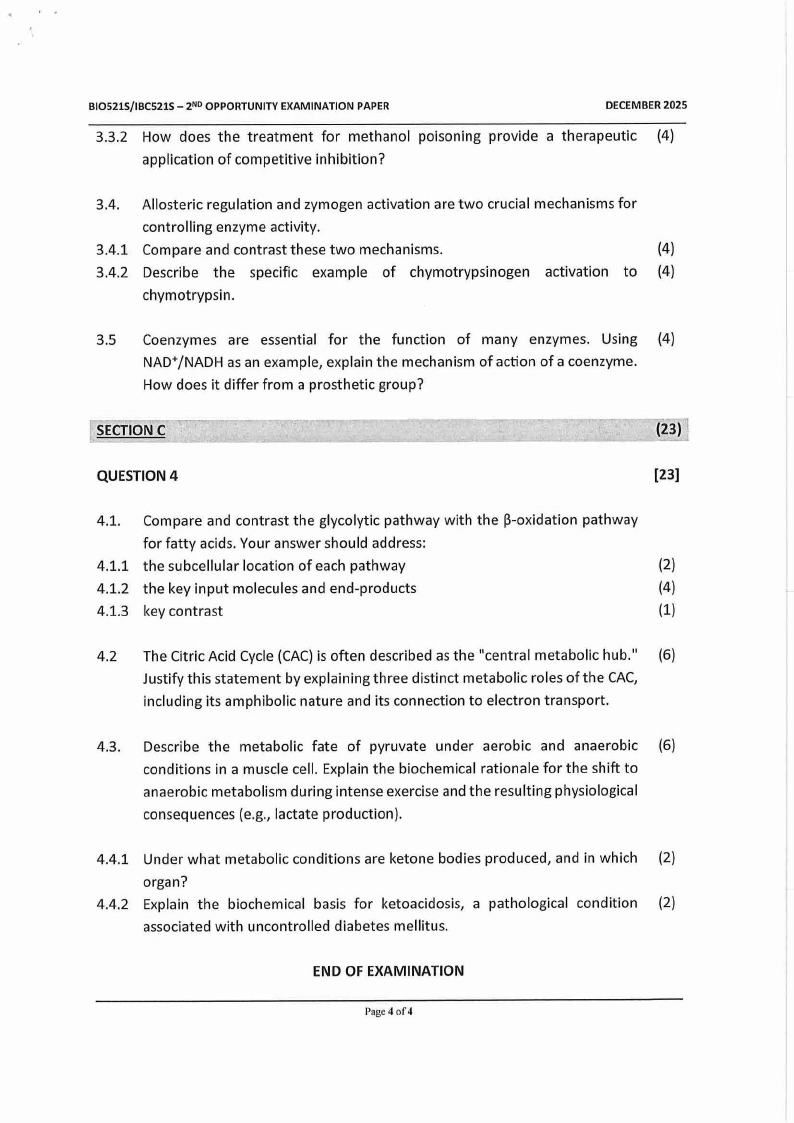
3.3.2 How does the treatment for methanol poisoning provide a therapeutic (4)
application of competitive inhibition?
3.4. Allosteric regulation and zymogen activation are two crucial mechanisms for
controlling enzyme activity.
3.4.1 Compare and contrast these two mechanisms.
(4)
3.4.2 Describe the specific example of chymotrypsinogen activation to {4)
chymotrypsi n.
3.5 Coenzymes are essential for the function of many enzymes. Using (4)
NAD+/NADH as an example, explain the mechanism of action of a coenzyme.
How does it differ from a prosthetic group?
SECTION C
(23 )7
QUESTION 4
[23]
4.1. Compare and contrast the glycolytic pathway with the ~-oxidation pathway
for fatty acids. Your answer should address:
4.1.1 the subcellular location of each pathway
(2)
4.1.2 the key input molecules and end-products
(4)
4.1.3 key contrast
(1)
4.2 The Citric Acid Cycle {CAC) is often described as the 11 central metabolic hub. 11 (6)
Justify this statement by explaining three distinct metabolic roles of the CAC,
including its amphibolic nature and its connection to electron transport.
4.3. Describe the metabolic fate of pyruvate under aerobic and anaerobic (6)
conditions in a muscle cell. Explain the biochemical rationale for the shift to
anaerobic metabolism during intense exercise and the resulting physiological
consequences {e.g., lactate production).
4.4.1 Under what metabolic conditions are ketone bodies produced, and in which (2)
organ?
4.4.2 Explain the biochemical basis for ketoacidosis, a pathological condition (2)
associated with uncontrolled diabetes mellitus.
END OF EXAMINATION
Page 4 of4