


 |
MLY612S - Marketing Communication Strategy - 1st Opp - Nov 2025 |
|
|
1 Page 1 |
▲back to top |
nAmlBIA unlVERSITY
OF SCIEnCE Ano TECHnDLOGY
FACULTY OF COMMERCE, HUMAN SCIENCES AND EDUCATION
DEPARTMENT OF MARKETING, LOGISTICS AND SPORT MANAGEMENT
QUALIFICATION : BACHELOR OF MARKETING
QUALIFICATION CODE: 07BMAR
LEVEL: NQF LEVEL 7
COURSE: MARKETING
COMMUNICATIONS STRATEGY
COURSE CODE: MLY612S
PAPER: THEORY
DURATION: THREE (3) HOURS
DATE: NOVEMBER2025
MARKS: 100
t 8T OPPORTUNITY EXAMINATION QUESTION PAPER
EXAMINER(S) MR. S TJITAMUNISA
MODERATOR: PROF. MAXWELL CHUFAMA
THIS QUESTION PAPER CONSISTS OF FIVE (5) PAGES
(Including this front page)
INSTRUCTIONS
• PLEASE ANSWERS ALL THE QUESTIONS, WRITE NEATLY AND TO THE
POINT.
• SECTION A & B: USE TABLES PROVIDED ON PAGE 5 OF THIS QUESTION
PAPER.
• MAKE SURE YOU INSERT THE TABLE INSIDE YOUR ANSWER BOOK
1
|
|
2 Page 2 |
▲back to top |
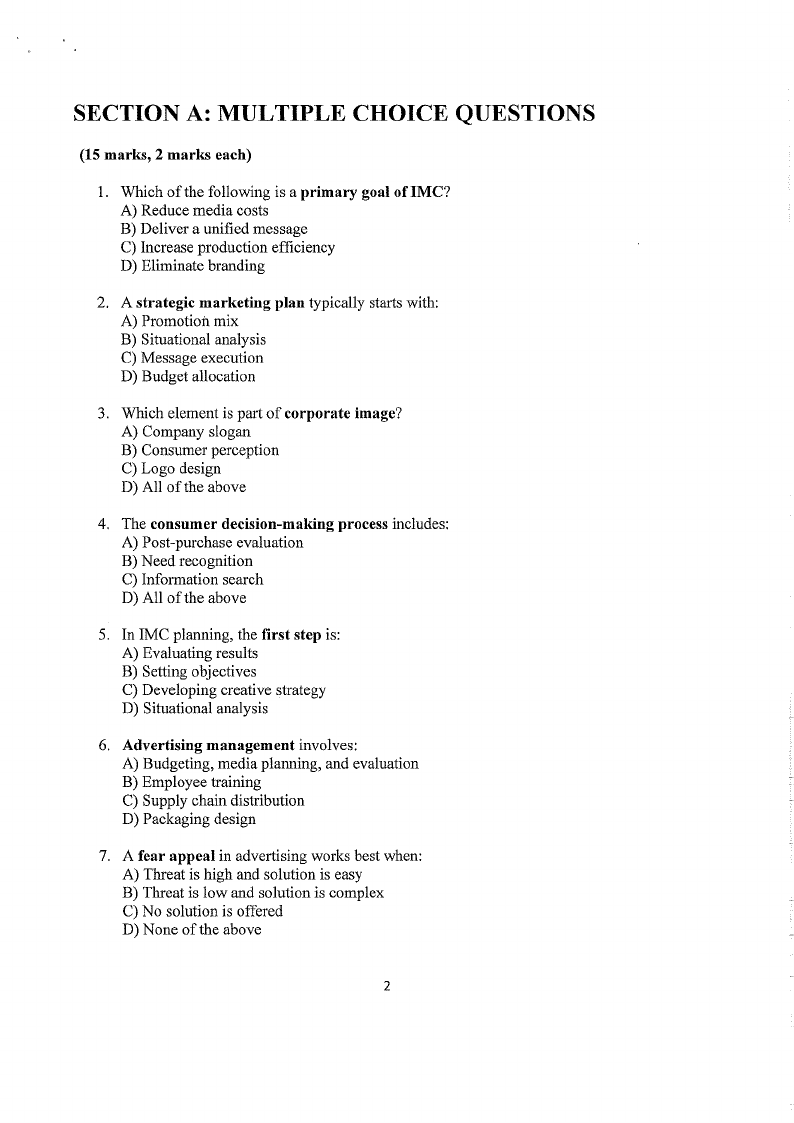
SECTION A: MULTIPLE CHOICE QUESTIONS
(15 marks, 2 marks each)
1. Which of the following is a primary goal ofIMC?
A) Reduce media costs
B) Deliver a unified message
C) Increase production efficiency
D) Eliminate branding
2. A strategic marketing plan typically starts with:
A) Promotion mix
B) Situational analysis
C) Message execution
D) Budget allocation
3. Which element is part of corporate image?
A) Company slogan
B) Consumer perception
C) Logo design
D) All of the above
4. The consumer decision-making process includes:
A) Post-purchase evaluation
B) Need recognition
C) Infonnation search
D) All of the above
5. In IMC planning, the first step is:
A) Evaluating results
B) Setting objectives
C) Developing creative strategy
D) Situational analysis
6. Advertising management involves:
A) Budgeting, media planning, and evaluation
B) Employee training
C) Supply chain distribution
D) Packaging design
7. A fear appeal in advertising works best when:
A) Threat is high and solution is easy
B) Threat is low and solution is complex
C) No solution is offered
D) None of the above
2
|
|
3 Page 3 |
▲back to top |
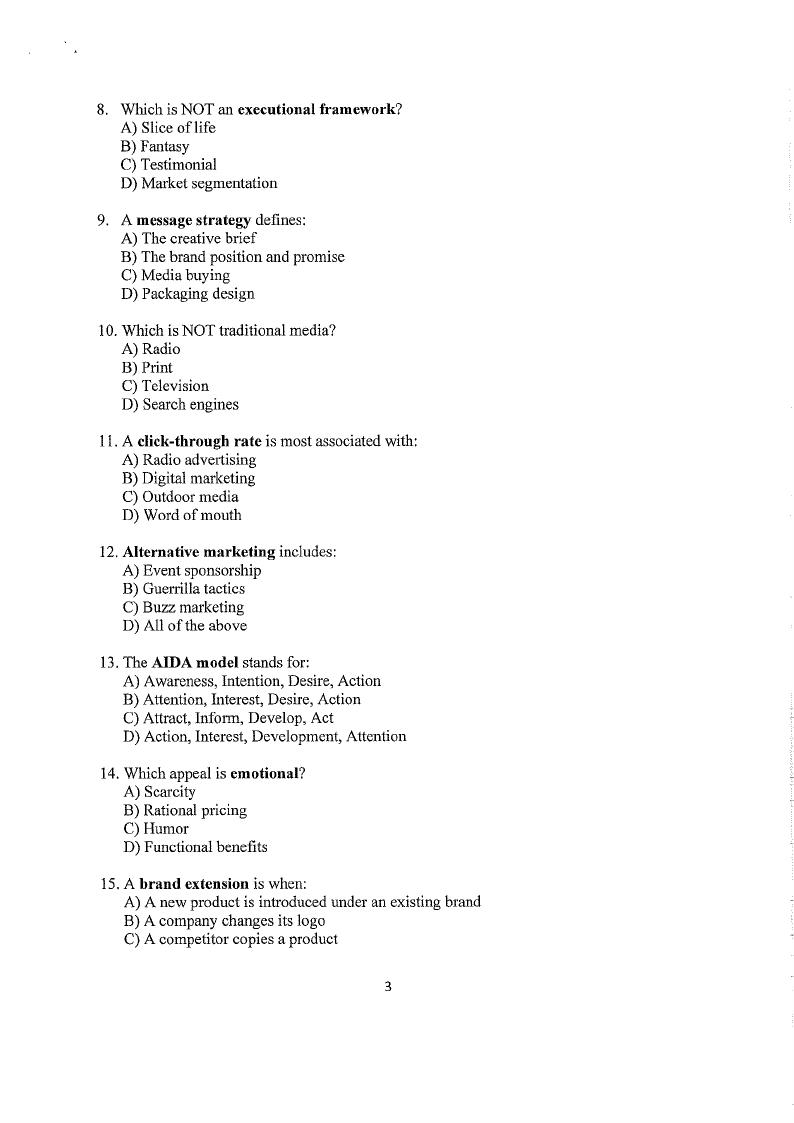
8. Which is NOT an executional framework?
A) Slice of life
B) Fantasy
C) Testimonial
D) Market segmentation
9. A message strategy defines:
A) The creative brief
B) The brand position and promise
C) Media buying
D) Packaging design
10. Which is NOT traditional media?
A) Radio
B) Print
C) Television
D) Search engines
11. A click-through rate is most associated with:
A) Radio advertising
B) Digital marketing
C) Outdoor media
D) Word of mouth
12. Alternative marketing includes:
A) Event sponsorship
B) Guenilla tactics
C) Buzz marketing
D) All of the above
13. The AIDA model stands for:
A) Awareness, Intention, Desire, Action
B) Attention, Interest, Desire, Action
C) Attract, Inform, Develop, Act
D) Action, Interest, Development, Attention
14. Which appeal is emotional?
A) Scarcity
B) Rational pricing
C) Humor
D) Functional benefits
15. A brand extension is when:
A) A new product is introduced under an existing brand
B) A company changes its logo
C) A competitor copies a product
3
|
|
4 Page 4 |
▲back to top |
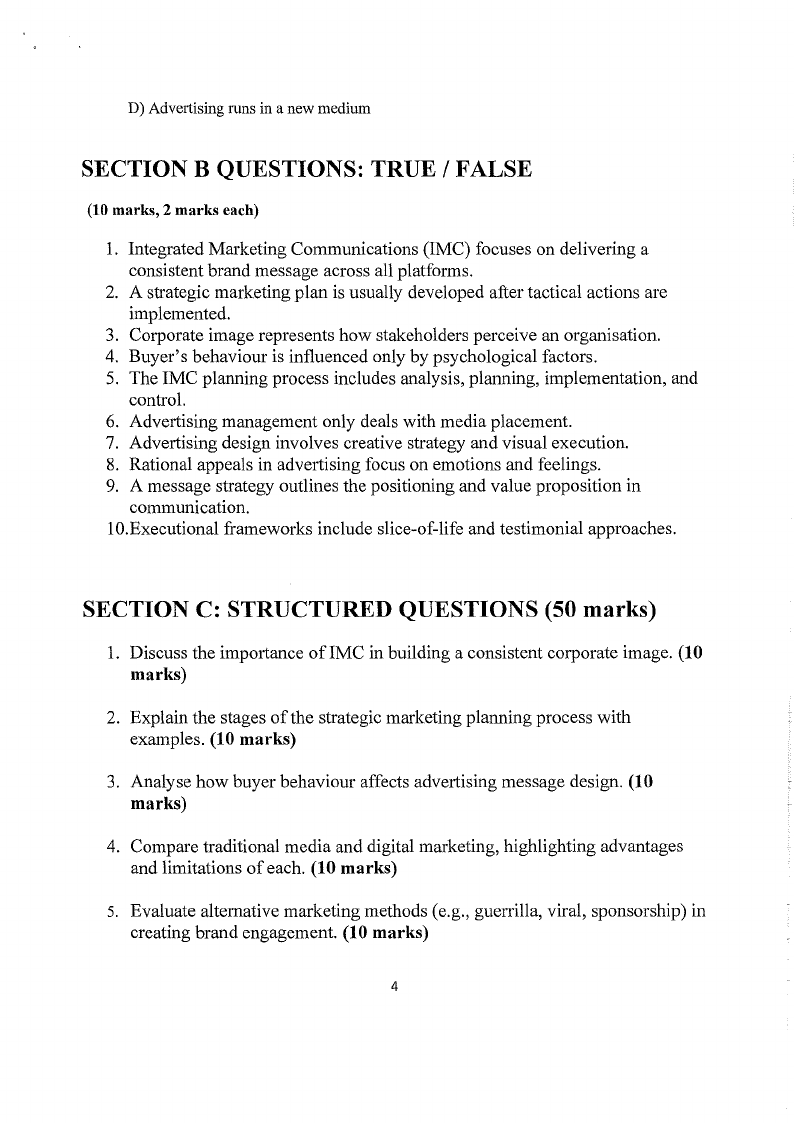
D) Advertising mns in a new medium
SECTION B QUESTIONS: TRUE/ FALSE
(10 marks, 2 marks each)
1. Integrated Marketing Communications (IMC) focuses on delivering a
consistent brand message across all platforms.
2. A strategic marketing plan is usually developed after tactical actions are
implemented.
3. Corporate image represents how stakeholders perceive an organisation.
4. Buyer's behaviour is influenced only by psychological factors.
5. The IMC planning process includes analysis, planning, implementation, and
control.
6. Advertising management only deals with media placement.
7. Advertising design involves creative strategy and visual execution.
8. Rational appeals in advertising focus on emotions and feelings.
9. A message strategy outlines the positioning and value proposition in
communication.
IO.Executional frameworks include slice-of-life and testimonial approaches.
SECTION C: STRUCTURED QUESTIONS (50 marks)
1. Discuss the importance of IMC in building a consistent corporate image. (10
marks)
2. Explain the stages of the strategic marketing planning process with
examples. (10 marks)
3. Analyse how buyer behaviour affects advertising message design. (10
marks)
4. Compare traditional media and digital marketing, highlighting advantages
and limitations of each. (10 marks)
5. Evaluate alternative marketing methods (e.g., guen-illa, viral, sponsorship) in
creating brand engagement. (10 marks)
4
|
|
5 Page 5 |
▲back to top |
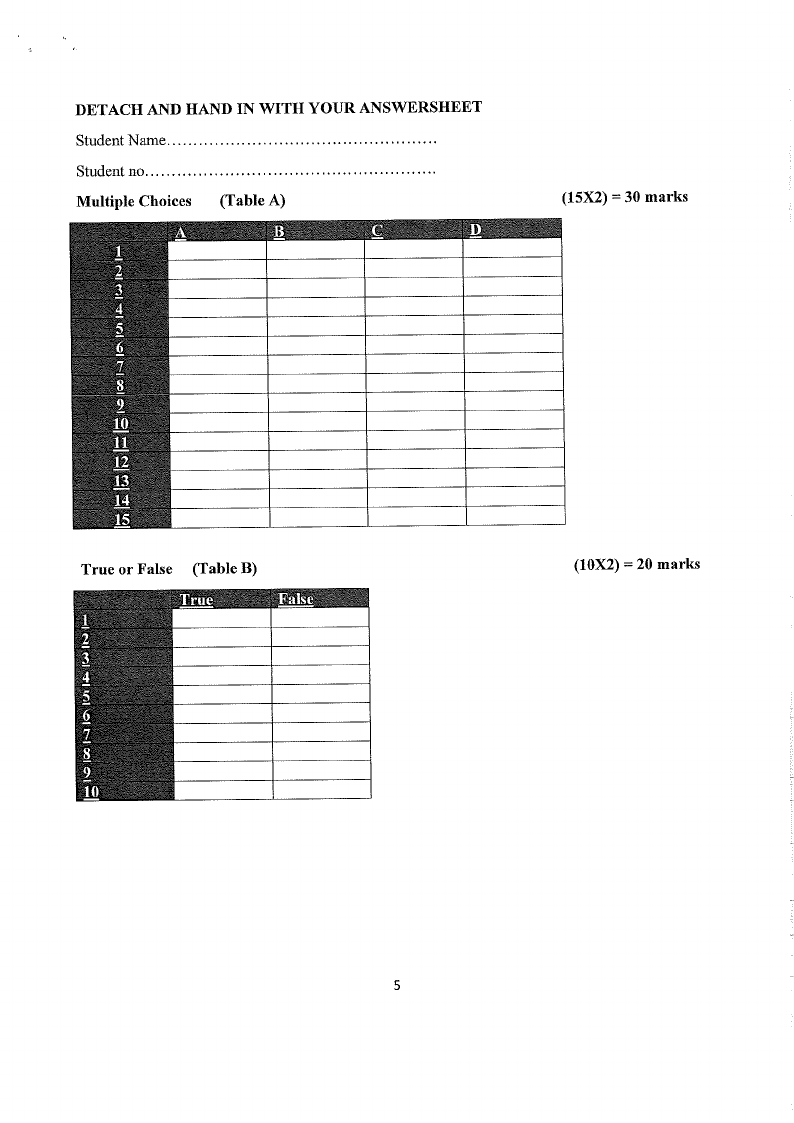
DETACH AND HAND IN WITH YOUR ANSWERSHEET
Student Name .................................................. .
Student no ...................................................... .
Multiple Choices (Table A)
(15X2) =30 marks
True or False (Table B)
(10X2) =20 marks
5