


 |
HAM621S - HAEMATOLOGY 2B - 2ND OPP - DEC 2025 |
|
|
1 Page 1 |
▲back to top |
nAmlBIA unlVERSITY
OF SCIEnCE Ano TECHnOLOGY
FACULTY OF HEALTH, APPLIED SCIENCES AND NATURAL RESOURCES
DEPARTMENT OF CLINICAL HEALTH SCIENCES
QUALIFICATION : BACHELOR OF MEDICAL LABORATORY SCIENCES
QUALIFICATION CODE: 08BMLS
COURSE CODE: HAM621S
LEVEL: 6
COURSE NAME: HAEMATOLOGY 2B
SESSION:
DECEMBER 2025
PAPER:
THEORY
DURATION: 3 HOURS
MARKS:
100
EXAMINER(S)
SECOND OPPORTUNITY/SUPPLEMENTARY EXAMINATION PAPER
Ms EDWIG SHINGENGE
MODERATOR:
Ms BELINDA ROSELIN TSAUSES
INSTRUCTIONS
1. Answ er ALL th e questions.
2. W rite clearly and neatly.
3. Number th e answ ers clearly.
4. Non-programmable calculator allow ed
THIS QUESTION PAPER CONSISTS OF 6 PAGES (Including this front page)
|
|
2 Page 2 |
▲back to top |
SECTION A:
QUESTION 1
(10]
Evaluate the statements in each numbered section and select the most appropriate answer or
phrase from the given possibilities. Write the appropriate letter next to the number of the
statement/phrase.
1.1 What is the appropriate sequence of the monocytic lineage?
(1)
A) Monoblast, macrophage, promonocyte, monocyte
B) Monoblast, monocyte, promonocyte, macrophage
C) Monoblast, promonocyte, monocyte, macrophage
D) Monoblast, promonocyte, macrophage, monocyte
1.2 Neutrophils seen in acute infections have the following characteristics:
(1)
A) Hypersegmentation, large granules & Di:ihle bodies
B) Toxic granulation, hypersegmented nuclei & blue cytoplasm
C) Toxic granulation, bi-lobed nuclei & Chediak higashi granules
D) Dohle bodies, vacuolation and toxic granulation
1.3 A patient has a platelet count of 700x109 with abnormally shaped platelets in size and
granularity. The white cell count is 12xl09/I and the haemoglobin is llg/dl. Philadelphia (1)
chromosome was absent although they did find a JAK2 mutation. What is the likely
diagnosis?
A) Reactive thrombocytosis
B) Essential Thrombocythemia
C) Myelofibrosis
D) Chromic Myeloid Leukaemia
1.4 The expression of cell surface markers is determined in the flow cytometer by which of (1)
these?
A) chemiluminescence
B) radioactivity
C) fluorescence
D) scatter
1.5 Non-specific esterases are usually a good cytochemistry stain for malignancies from which (1)
linage?
A) Erythrocytic
B) Basophilic
C) Lymphocytic
D) Monocytic
2
|
|
3 Page 3 |
▲back to top |
1.6 Which of the following leukaemia symptoms are a result of a release of cytokines?
(1)
A) Bleeding
B) Fever
C) Infections
D) Bone pain
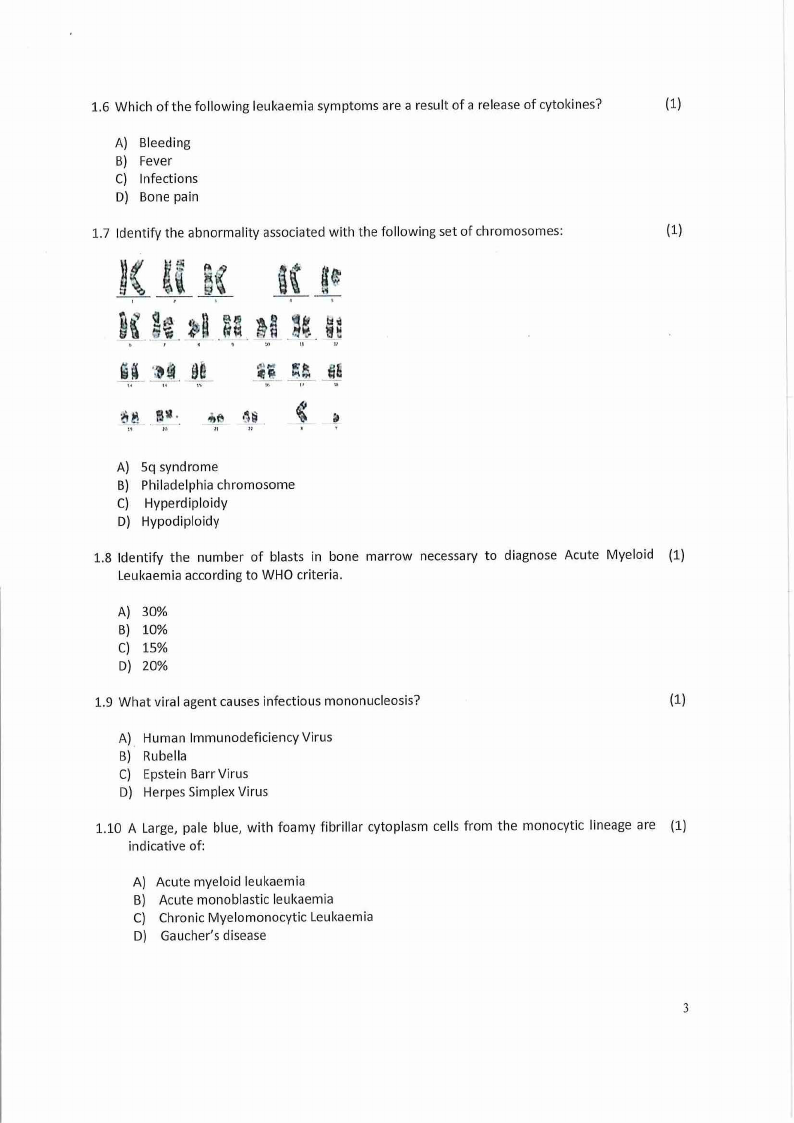
1.7 Identify the abnormality associated with the following set of chromosomes:
(1)
,~ ~{ 4; S(
'
,
'
ii a<J~ ~~ ~~ ~I ~;
:,
il,. l
·.,,. i.
ae
"
;,.i
~~
"
ij
"
~~
"
B,." .
oft6 •1ij
""
~~
'
'
A) Sq syndrome
B) Philadelphia chromosome
C) Hyperdiploidy
D) Hypodiploidy
1.8 Identify the number of blasts in bone marrow necessary to diagnose Acute Myeloid (1)
Leukaemia according to WHO criteria.
A) 30%
B) 10%
C) 15%
D) 20%
1.9 What viral agent causes infectious mononucleosis?
(1)
A) Human Immunodeficiency Virus
B) Rubella
C) Epstein Barr Virus
D) Herpes Simplex Virus
1.10 A Large, pale blue, w ith foamy fibrillar cytoplasm cells from the monocytic lineage are (1)
indicative of:
A) Acute myeloid leukaem ia
B) Acute monoblastic leukaemia
C) Chronic Myelomonocytic Leukaemia
D) Gaucher's disease
3
|
|
4 Page 4 |
▲back to top |
QUESTION 2
[18)
2.1 Identify the granulocytic cells which make up the following pools:
(4)
a) Miotic Pool
b) Post Miotic
c) Storage
(1/2 marks)
2.2 Answer the following questions regarding leukaemia and its origins:
(2)
2.2.1 Briefly describe the term leukaemia.
(2)
2.2.2 Leukaemia is attributed to a mutated......... and ............
2.2.3 There are several host and environmental risk factors associated with the development (4)
of leukaem ia. List four environmental and four host factors.
2.2.4 The term clonal progression refers to how diseases may gain new.........accompanied by (2)
new...............changes.
2.2.5 Suggest at least four general symptoms presenting in leukaemia patients attributed to (4)
cytopenia's.
(SECTION B:
(41 MARKS]
[24)
QUESTION 3
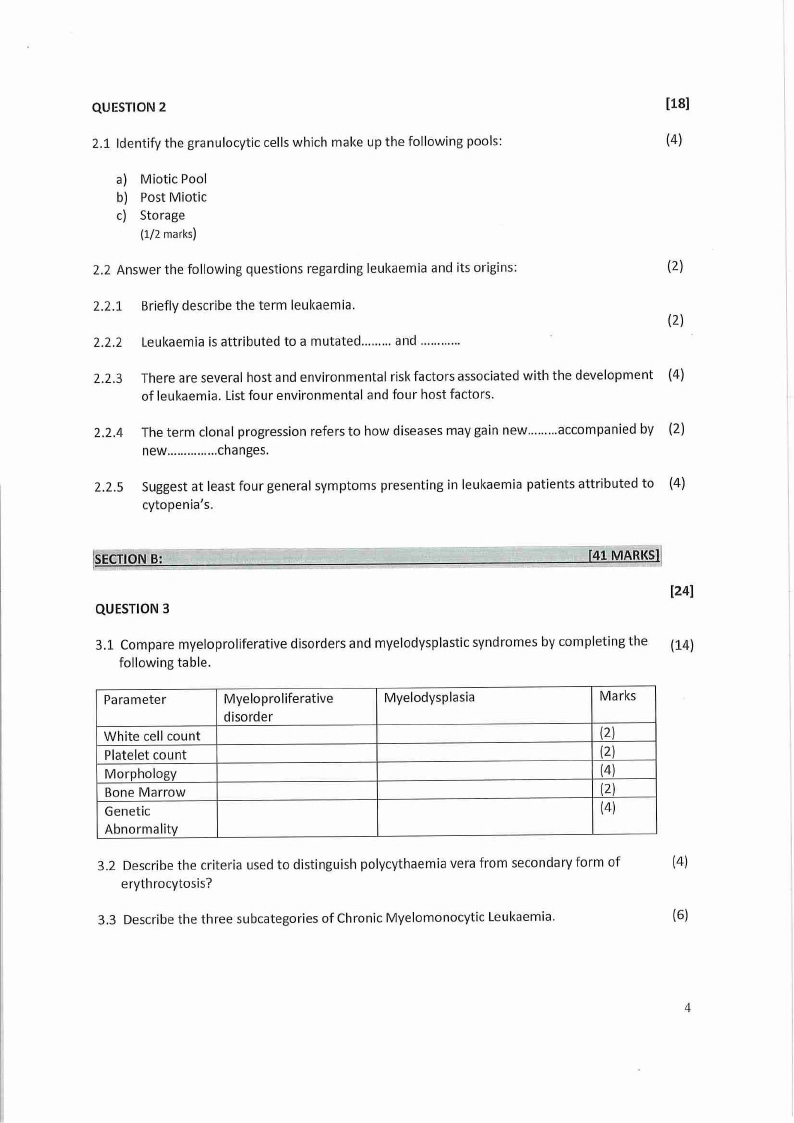
3.1 Compare myeloproliferative disorders and myelodysplastic syndromes by completing the (14)
following table.
Parameter
White cell count
Platelet count
Morphology
Bone Marrow
Genetic
Abnormality
Myeloproliferative
disorder
Myelodysplasia
Marks
(2)
(2)
(4)
(2)
(4)
3.2 Describe the criteria used to distinguish polycythaemia vera from secondary form of
(4)
erythrocytosis?
3.3 Describe the three subcategories of Chronic Myelomonocytic Leukaemia.
(6)
4
|
|
5 Page 5 |
▲back to top |
QUESTION 4
[17]
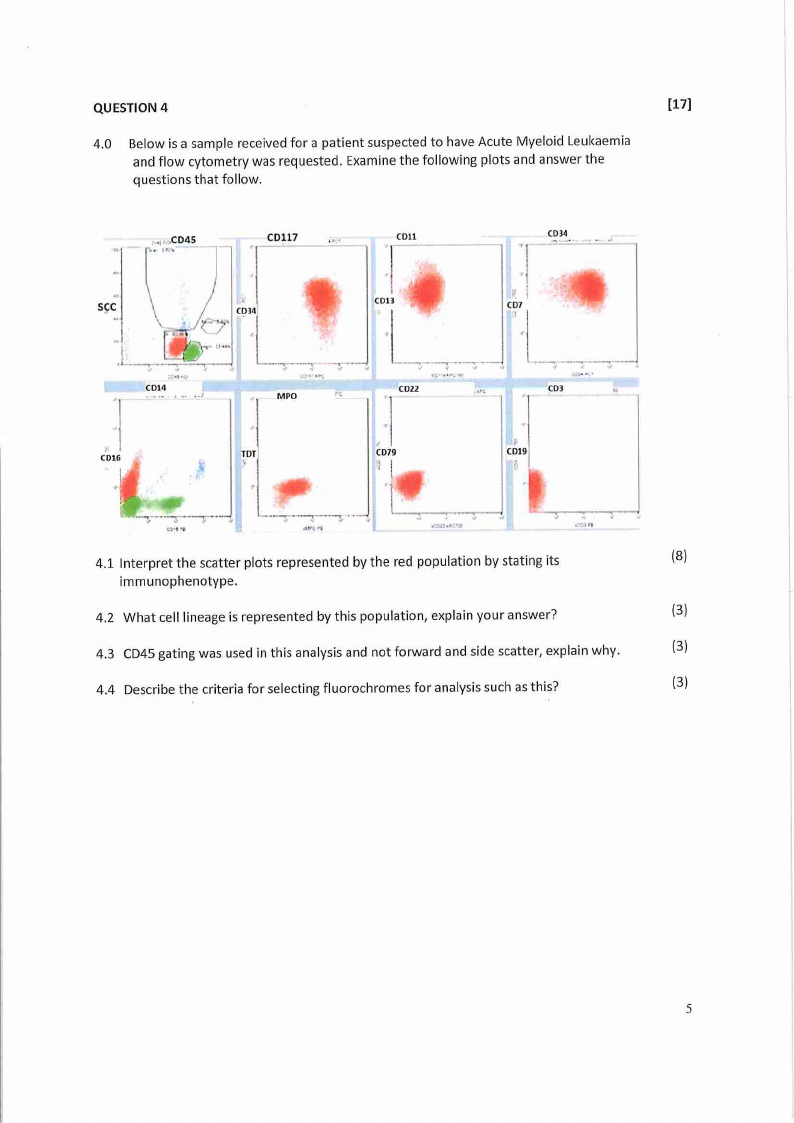
4.0 Below is a sample received for a patient suspected to have Acute Myeloid Leukaemia
and flow cytometry was requested. Examine the following plots and answer the
questions that follow.
,-.C045
\\"
C0117
".
~-
CD11
s~c
(~34
I ['.
. , l - ~ - - - - -
..,. >
-(01..4 . .. ..,
~
'7 ..,.. ~
MPO
r<
CDll
C..D.,.3. 4..
(07
:
· -- - - T '- • . - . . , . - - - - : .
.. ~--·
(03
~
(016
-,-......~-- -.. ,---.,,
'-,.,...
4.1 Interpret the scatter plots represented by the red population by stating its
(8)
immunophenotype.
4.2 What cell lineage is represented by this population, explain your answer?
(3)
4.3 CD45 gating was used in t his analysis and not forward and side scatter, explain why.
(3)
4.4 Describe the criteria for selecting fluorochromes for ana lysis such as this?
(3)
5
|
|
6 Page 6 |
▲back to top |
SECTION C:
,I
QUESTION 5
[21)
(Print in colour)
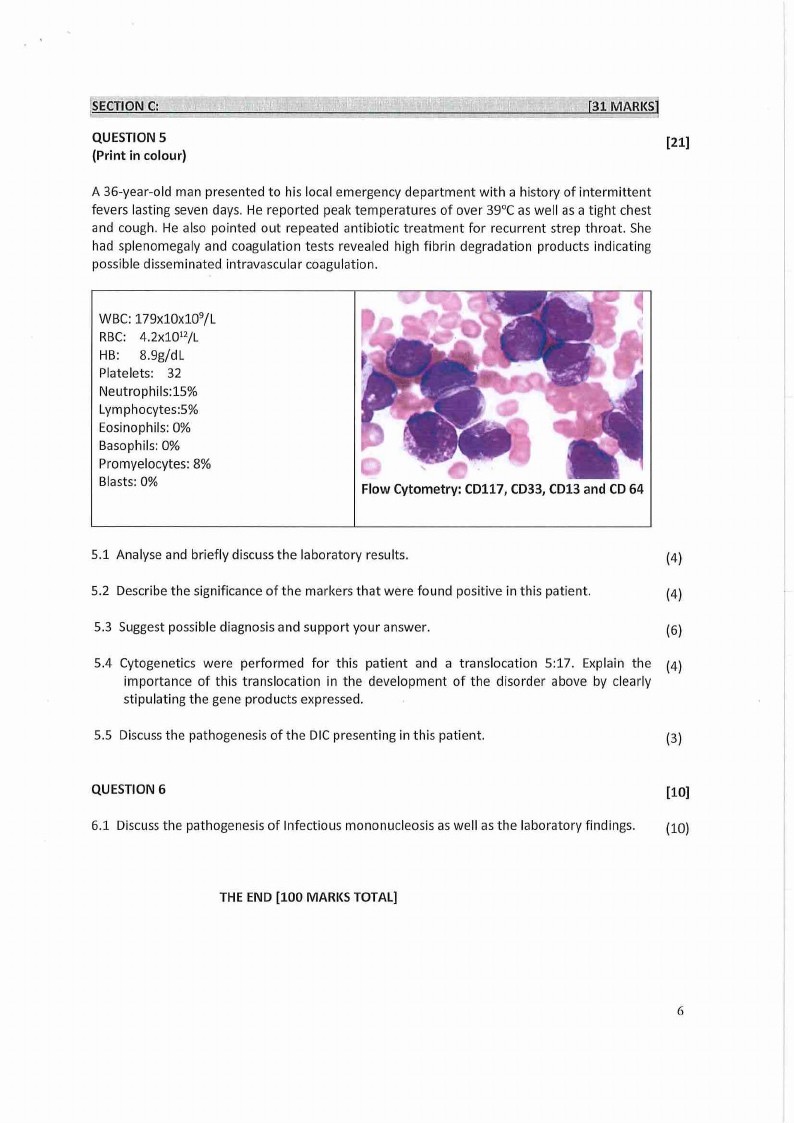
A 36-year-old man presented to his local emergency department with a history of intermittent
fevers lasting seven days. He reported peak temperatures of over 39°C as well as a tight chest
and cough. He also pointed out repeated antibiotic treatment for recurrent strep throat. She
had splenomegaly and coagulation tests revealed high fibrin degradation products indicating
possible disseminated intravascular coagulation.
WBC: 179x10x109/L
RBC: 4.2xl012/L
HB: 8.9g/dl
Platelets: 32
Neutrophils:15%
Lymphocytes:5%
Eosinophils: 0%
Basophils: 0%
Promyelocytes: 8%
Blasts: 0%
Flow Cytometry: CD117, CD33, CD13 and CD 64
5.1 Analyse and briefly discuss the laboratory results.
(4)
5.2 Describe the significance of the markers that were found positive in this patient.
(4)
5.3 Suggest possible diagnosis and support your answer.
(6)
5.4 Cytogenetics were performed for this patient and a translocation 5:17. Explain the (4)
importance of this translocation in the development of the disorder above by clearly
stipulating the gene products expressed.
5.5 Discuss the pathogenesis of the DIC presenting in this patient.
(3)
QUESTION 6
[10)
6.1 Discuss the pathogenesis of Infectious mononucleosis as well as the laboratory findings. (10)
THE END [100 MARl(S TOTAL]
6