


 |
LTI611S - LANDTRANSPORT SAFETY AND INFRASTRUCTURE CONSIDERATIONS - 1ST OPP -JUNE 2025 |
|
|
1 Page 1 |
▲back to top |
nAmlBIA UnlVERSITY
OFSCIEnCEAno TECHn0L0GY
FACULTYOFCOMMERCEH, UMANSCIENCEAS ND EDUCATION
DEPARTMENTOF MARKETINGL,OGISTICASND SPORTMANAGEMENT
QUALIFICATION: BACHELOROFTRANSPORTMANAGEMENT
QUALIFICATIONCODE: 07BTRA
COURSENAME: LANDTRANSPORTSAFETYAND
INFRASTRUCTURECONSIDERATIONS
LEVEL: 6
COURSECODE:LTl611S
SESSION:JUNE 2025
DURATION: 3 HOURS
PAPER:THEORY
MARKS: 100
EXAMINERS
FIRSTOPPORTUNITYEXAMINATION QUESTION PAPER
MS. MARTHA POLLA(FM)
MS. ELINA LUMBU (PM)
MS DIINA HAIKWIYU (EF)
MR. BONNYCHICKEN(DI)
MODERATOR: MR. VETIRAIJETJIPOMBO
INSTRUCTIONS
1. Answer ALLQuestions from Sections A and B, and ANY THREE(3) Questions from
Section C
2. Write clearly and neatly.
3. Number the answers clearly.
THIS QUESTIONPAPERCONSISTSOF LPAGES (Including this front page).
|
|
2 Page 2 |
▲back to top |
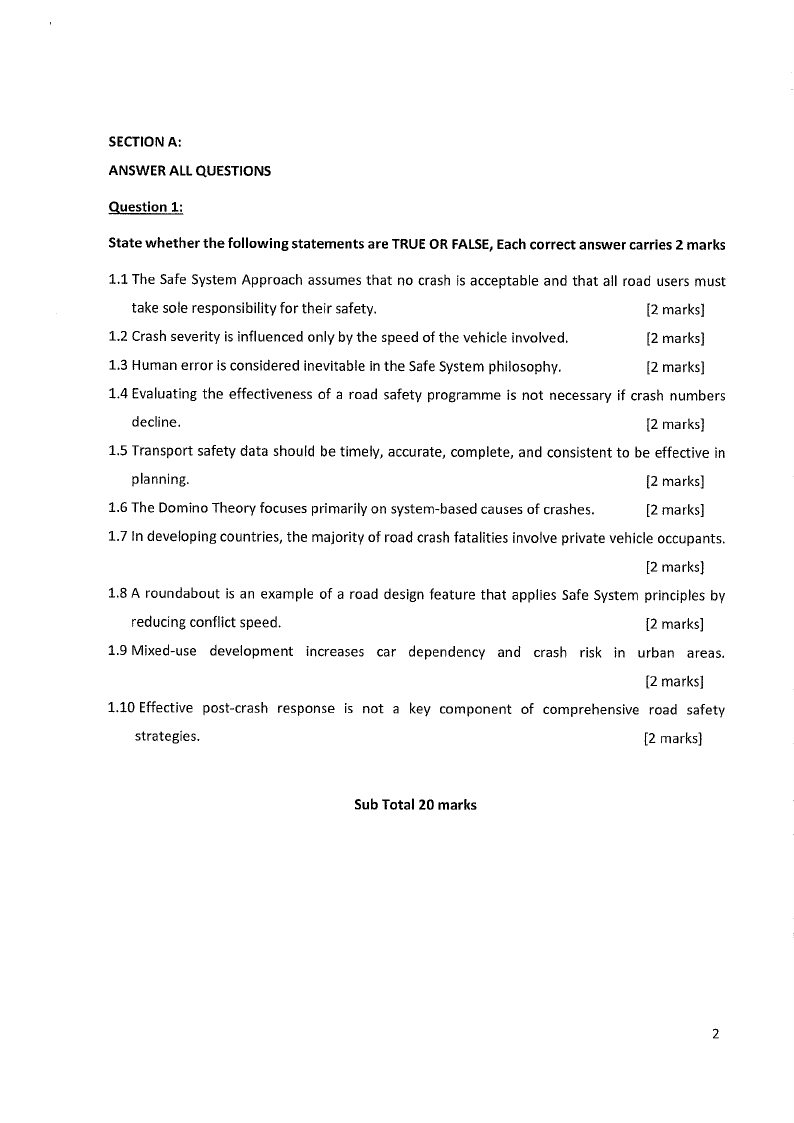
SECTION A:
ANSWER ALL QUESTIONS
Question 1:
State whether the following statements are TRUE OR FALSE,Each correct answer carries 2 marks
1.1 The Safe System Approach assumes that no crash is acceptable and that all road users must
take sole responsibility for their safety.
[2 marks]
1.2 Crash severity is influenced only by the speed of the vehicle involved.
[2 marks]
1.3 Human error is considered inevitable in the Safe System philosophy.
[2 marks]
1.4 Evaluating the effectiveness of a road safety programme is not necessary if crash numbers
decline.
[2 marks]
1.5 Transport safety data should be timely, accurate, complete, and consistent to be effective in
planning.
[2 marks]
1.6 The Domino Theory focuses primarily on system-based causes of crashes.
[2 marks]
1.7 In developing countries, the majority of road crash fatalities involve private vehicle occupants.
[2 marks]
1.8 A roundabout is an example of a road design feature that applies Safe System principles by
reducing conflict speed.
[2 marks]
1.9 Mixed-use development increases car dependency and crash risk in urban areas.
[2 marks]
1.10 Effective post-crash response is not a key component of comprehensive road safety
strategies.
[2 marks]
Sub Total 20 marks
2
|
|
3 Page 3 |
▲back to top |
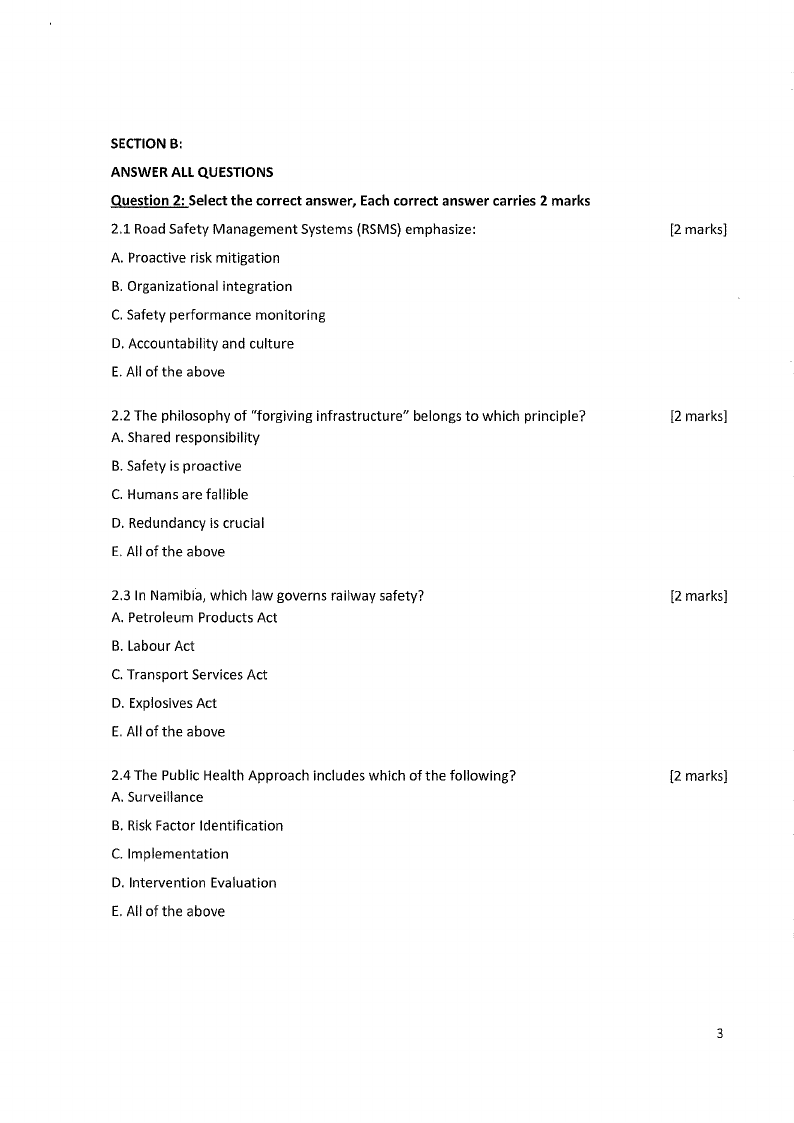
SECTIONB:
ANSWERALLQUESTIONS
Question 2: Select the correct answer, Eachcorrect answer carries 2 marks
2.1 Road Safety Management Systems (RSMS)emphasize:
A. Proactive risk mitigation
B. Organizational integration
C. Safety performance monitoring
D. Accountability and culture
E.All of the above
2.2 The philosophy of "forgiving infrastructure" belongs to which principle?
A. Shared responsibility
B. Safety is proactive
C. Humans are fallible
D. Redundancy is crucial
E. All of the above
2.3 In Namibia, which law governs railway safety?
A. Petroleum Products Act
B. Labour Act
C. Transport Services Act
D. Explosives Act
E. All ofthe above
2.4 The Public Health Approach includes which of the following?
A. Surveillance
B. Risk Factor Identification
C. Implementation
D. Intervention Evaluation
E. All of the above
[2 marks]
[2 marks]
[2 marks]
[2 marks]
3
|
|
4 Page 4 |
▲back to top |
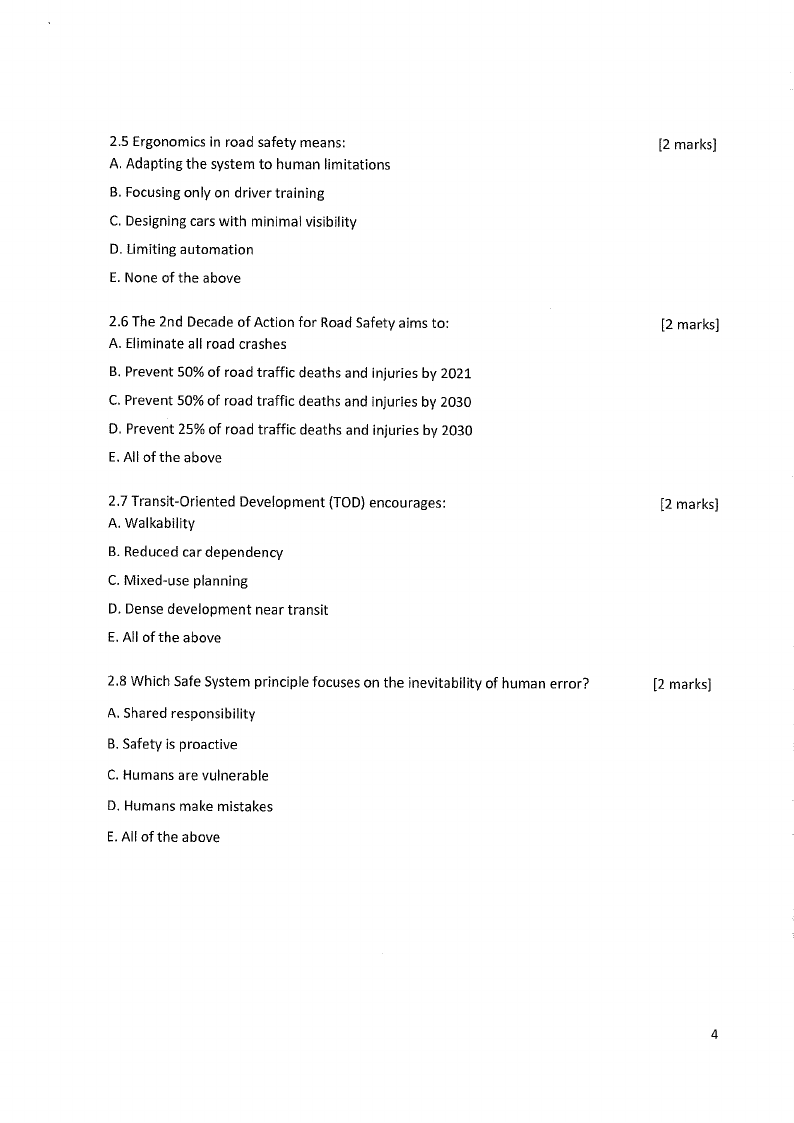
2.5 Ergonomics in road safety means:
A. Adapting the system to human limitations
B. Focusing only on driver training
C. Designing cars with minimal visibility
D. Limiting automation
E. None of the above
2.6 The 2nd Decade of Action for Road Safety aims to:
A. Eliminate all road crashes
B. Prevent SO%of road traffic deaths and injuries by 2021
C. Prevent SO%of road traffic deaths and injuries by 2030
D. Prevent 25% of road traffic deaths and injuries by 2030
E.All of the above
2.7 Transit-Oriented Development (TOD) encourages:
A. Walkability
B. Reduced car dependency
C. Mixed-use planning
D. Dense development near transit
E. All of the above
2.8 Which Safe System principle focuses on the inevitability of human error?
A. Shared responsibility
B. Safety is proactive
C. Humans are vulnerable
D. Humans make mistakes
E.All of the above
[2 marks]
[2 marks]
[2 marks]
[2 marks]
4
|
|
5 Page 5 |
▲back to top |
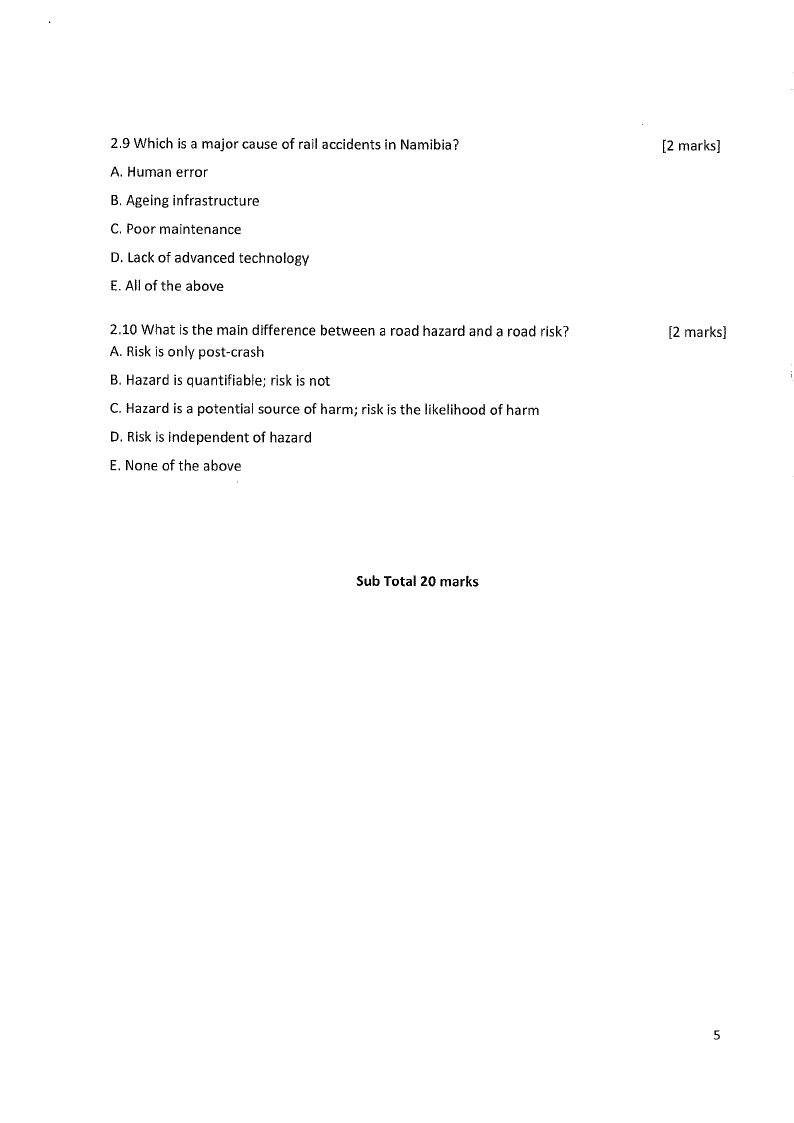
2.9 Which is a major cause of rail accidents in Namibia?
A. Human error
B. Ageing infrastructure
C. Poor maintenance
D. Lack of advanced technology
E. All of the above
2.10 What is the main difference between a road hazard and a road risk?
A. Risk is only post-crash
B. Hazard is quantifiable; risk is not
C. Hazard is a potential source of harm; risk is the likelihood of harm
D. Risk is independent of hazard
E. None of the above
[2 marks]
[2 marks]
Sub Total 20 marks
5
|
|
6 Page 6 |
▲back to top |
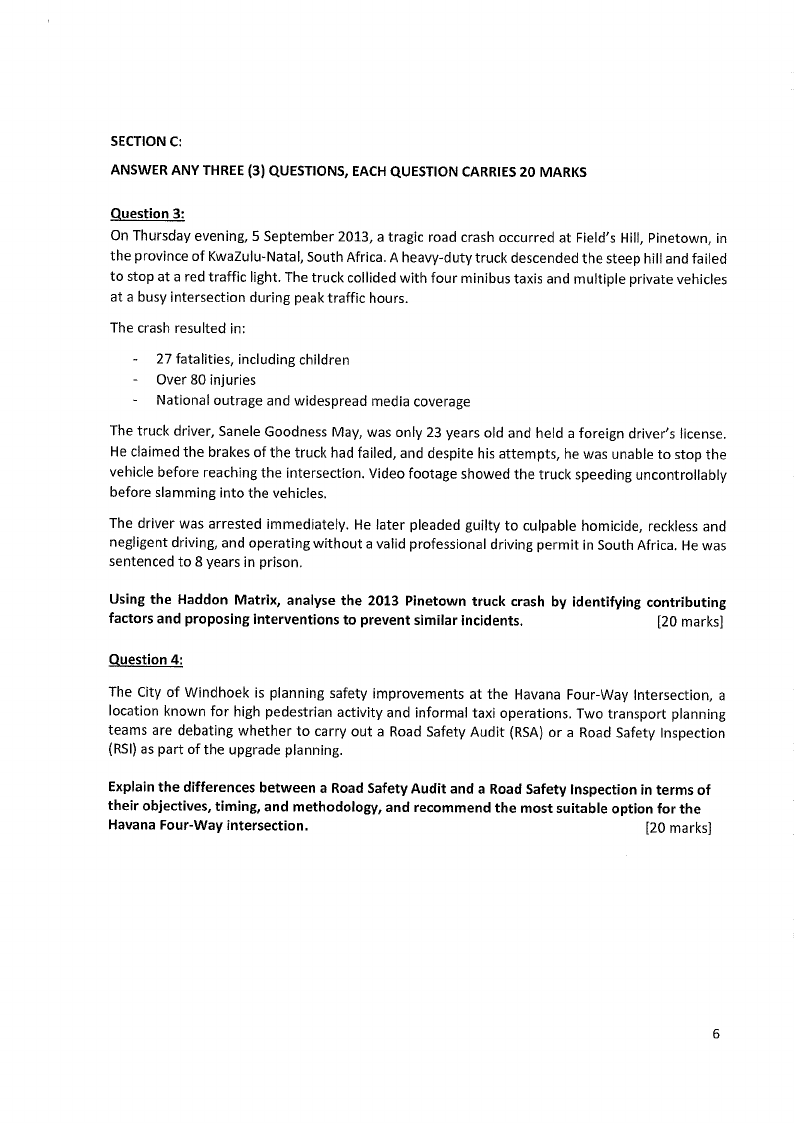
SECTION C:
ANSWER ANY THREE (3) QUESTIONS, EACHQUESTION CARRIES20 MARKS
Question 3:
On Thursday evening, 5 September 2013, a tragic road crash occurred at Field's Hill, Pinetown, in
the province of KwaZulu-Natal, South Africa. A heavy-duty truck descended the steep hill and failed
to stop at a red traffic light. The truck collided with four minibus taxis and multiple private vehicles
at a busy intersection during peak traffic hours.
The crash resulted in:
27 fatalities, including children
Over 80 injuries
National outrage and widespread media coverage
The truck driver, Sanele Goodness May, was only 23 years old and held a foreign driver's license.
He claimed the brakes of the truck had failed, and despite his attempts, he was unable to stop the
vehicle before reaching the intersection. Video footage showed the truck speeding uncontrollably
before slamming into the vehicles.
The driver was arrested immediately. He later pleaded guilty to culpable homicide, reckless and
negligent driving, and operating without a valid professional driving permit in South Africa. He was
sentenced to 8 years in prison.
Using the Haddon Matrix, analyse the 2013 Pinetown truck crash by identifying contributing
factors and proposing interventions to prevent similar incidents.
(20 marks]
Question 4:
The City of Windhoek is planning safety improvements at the Havana Four-Way Intersection, a
location known for high pedestrian activity and informal taxi operations. Two transport planning
teams are debating whether to carry out a Road Safety Audit (RSA) or a Road Safety Inspection
(RSI)as part of the upgrade planning.
Explain the differences between a Road Safety Audit and a Road Safety Inspection in terms of
their objectives, timing, and methodology, and recommend the most suitable option for the
Havana Four-Way intersection.
(20 marks]
6
|
|
7 Page 7 |
▲back to top |
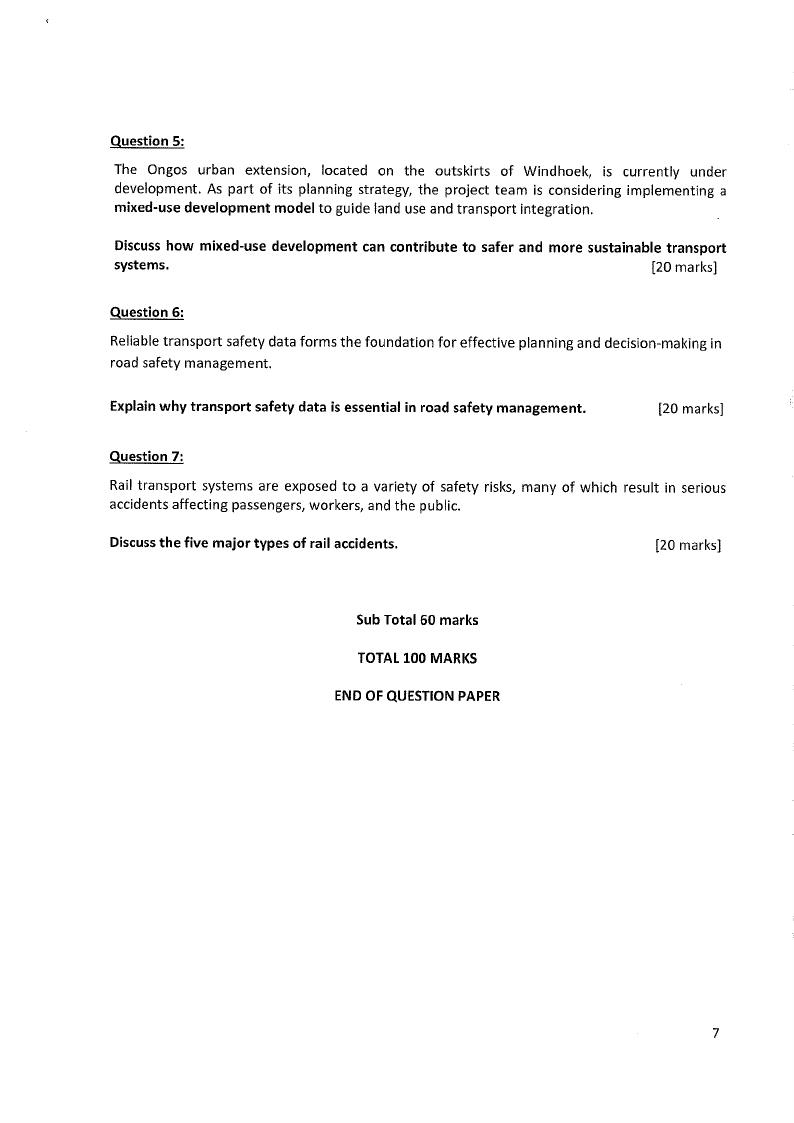
Question 5:
The Ongos urban extension, located on the outskirts of Windhoek, is currently under
development. As part of its planning strategy, the project team is considering implementing a
mixed-use development model to guide land use and transport integration.
Discuss how mixed-use development can contribute to safer and more sustainable transport
systems.
[20 marks]
Question 6:
Reliable transport safety data forms the foundation for effective planning and decision-making in
road safety management.
Explain why transport safety data is essential in road safety management.
[20 marks]
Question 7:
Rail transport systems are exposed to a variety of safety risks, many of which result in serious
accidents affecting passengers, workers, and the public.
Discussthe five major types of rail accidents.
[20 marks]
Sub Total 60 marks
TOTAL100 MARKS
END OF QUESTIONPAPER
7