IMY521S - IMMUNOLOGY - 2ND OPP - DEC 2025


IMY521S - IMMUNOLOGY - 2ND OPP - DEC 2025


1 Page 1

▲back to top


IMY521S IMMUNOLOGY SECOND OPPORTUNITY DECEMBER 2025
nAmlBIA UnlVERSITY
OF SCIEnCE Ano TECHnOLOGY
FACULTY OF HEALTH, NATURAL RESOURCES AND APPLIED SCIENCES
DEPARTMENT OF CLINICAL HEALTH SCIENCES
QUALIFICATION : BACHELOR OF MEDICAL LABORATORY SCIENCES
QUALIFICATION CODE: 08BMLS
LEVEL: 5
COURSE CODE: IMY521S
COURSE NAME: IMMUNOLOGY
SESSION: DECEMBER 2025
DURATION: 3 HOURS
PAPER: SECOND OPPORTUNITY
I
I
MARKS: 100
SECOND OPPORTUNITY EXAMINATION PAPER
EXAMINER(S}
MODERATOR:
MR. HERBERT T. MAPIRA
MRS. EDWIG SHINGENGE
INSTRUCTIONS
ANSWER ALL THE QUESTIONS.
PERMISSIBLE MATERIALS
PEN
THIS QUESTION PAPER CONSISTS OF 9 PAGES (Including this front page)

2 Page 2

▲back to top


•IMY521S IMMUNOLOGY SECOND OPPORTUNITY DECEMBER 2025
SECTION A MULTIPLE CHOICE QUESTIONS
QUESTION 1
[30 MARl<S]
{30}
Choose the correct answer and report only the suitable letter next to the
relevant question number.
1.1 Which of the following is cleaved because of activation of the classical complement
{1}
pathway?
A. Properdin factor B
B. Clq
C. C4
D. C3b
1.2 Components of the complement system most likely to coat a cel l are:
A. Cl and C2
( 1)
B. C3 and C4
C. C6 and C7
D. CB and C9
1.3 The serological test that can be modified to selectively detect only specific lgM antibody
in untreated serum is:
(1)
A. Ouchterlony
B. Enzyme immunoassay
C. Hemagglutination inhibition
D. Passive hemagglutination
1.4 T lymphocytes are incapable of functioning as:
A. Cytotoxic T cells
( 1)
B. Helper T cells
C. Phagocytic cells
D. Regulatory T cells
1.5 Nonspecific killing of tumor cel ls is carried out by:
A. Cytotoxic T cel ls
(1)
B. Helper T cells
C. Natural killer cells
D. Antibody and complement
2

3 Page 3

▲back to top


' IMY521S IMMUNOLOGY SECOND OPPORTUNITY DECEMBER 2025
1.6 Which of the following mediators is released during T cell activation?
(1)
A. lmmunoglobulins
B. Thymosin
C. Serotonin
D. Cytokines
1.7 What is the immunologic method utilized in flow cytometry?
A. Latex agglutination
(1)
B. Enzyme linked immunoassay
C. lmmunofluorescence
D. Radioimmunoassay
1.8 Delayed hypersensitivity may be induced by:
A. Contact sensitivity to inorganic chemicals
(1)
B. Transfusion reaction
C. Anaphylactic reaction
D. Bacterial septicemia
1.9 The MOST rapid immediate hypersensitivity reaction is associated with:
A. Transfusion
(1)
B. Anaphylaxis
C. Contact dermatitis
D. Serum sickness
1.10 Which cells recognize antigens presented by MHC Class II molecules?
(1)
A. cos+ T cells
B. B cells
C. co4+ T helper cells
D. Natural killer cells
1.11 Which of the following is true about haptens?
(1)
A. They are immunogenic on their own
B. They require a carrier to elicit an immune response
C. They are large proteins
D. They are part of the MHC complex
3

4 Page 4

▲back to top


•IMY521S IMMUNOLOGY SECOND OPPORTUNITY DECEMBER 2025
1.12 Which MHC class is involved in presenting endogenous antigens?
A. Class I
(1)
B. Class II
C. Class Ill
D. Both I and II
1.13 What is the role of ~2-microglobulin in MHC Class I?
A. Antigen binding
B. Structural support
(1)
C. Co-stimulatory signa ling
D. Cytokine production
1.14 Which MHC class is found only on professional antigen-presenting cells?
A. Class I
(1)
B. Class II
C. Class Ill
D. Class IV
1.15 Which of the following is encoded by MHC Class Ill genes?
A. CD4
B. Complement proteins
(1)
C. T cell receptors
D. lmmunoglobulins
1.16. Which HLA allele is associated with ankylosing spondylitis?
A. HLA-A2
B. HLA-B27
(1)
C. HLA-DR4
D. HLA-DQ8
1.17 Which cells arise from co4+T cells with high affinity for self-antigens?
A. Cytotoxic T cells
(1)
B. Helper T cells
C. Regu latory T cells
D. Memory T cells
4

5 Page 5

▲back to top


•IMY52l S IMMUNOLOGY SECOND OPPORTUNITY DECEMBER 2025
1.18 Lymphoid organ filters blood and removes old RBCs?
(1)
A. Lymph node
B. Thymus
C. Spleen
D. Bone marrow
1.19 Which structure returns lymph to the bloodstream?
( 1)
A. Aorta
B. Thoracic duct
C. Lymph node
D. Hepatic vein
1.20 What is the outcome of lymphocyte activation?
A Na'ive cell
(1)
B. Apoptosis
C. Effectors and memory cells
D. Stem cell differentiation
1.21 Which process occurs in germinal centers?
A. T cell selection
B. Somatic hypermutation
(1)
C. Hematopoiesis
D. Antigen presentation
1.22 Which cells present antigens to T cells using MHC molecules?
A. Neutrophils
B. Platelets
(1)
C. Antigen-presenting cells
D. Erythrocytes
1.23 Which pathway leads to IL-2 production in T cells?
(1)
A. CD40-CD40L
B. TCR-CD3-ZAP-70
C. BCR signaling
D. MHC Class Ill activation
5

6 Page 6

▲back to top


•IMY52 l S IMMUNOLOGY SECOND OPPORTUNITY DECEMBER 2025
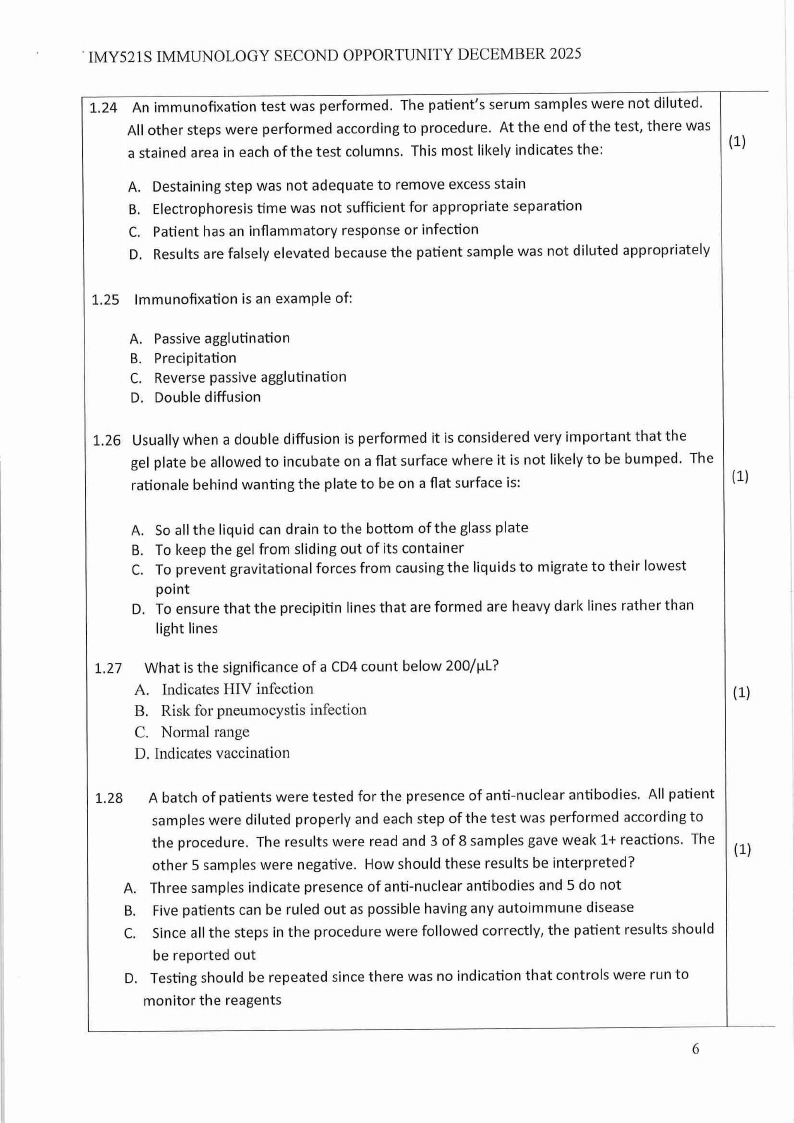
1.24 An immunofixation test was performed. The patient's serum samples were not diluted.
All other steps were performed according to procedure. At the end of the test, there was
a stained area in each of the test columns. This most likely indicates the:
(1)
A. Destaining step was not adequate to remove excess stain
B. Electrophoresis time was not sufficient for appropriate separation
C. Patient has an inflammatory response or infection
D. Results are falsely elevated because the patient sample was not diluted appropriately
1.25 lmmunofixation is an example of:
A. Passive agglutination
B. Precipitation
C. Reverse passive agglutination
D. Double diffusion
1.26 Usually when a double diffusion is performed it is considered very important that the
gel plate be allowed to incubate on a flat surface where it is not likely to be bumped. The
rationale behind wanting the plate to be on a flat surface is:
(1)
A. So all the liquid can drain to the bottom of the glass plate
B. To keep the gel from sliding out of its container
C. To prevent gravitational forces from causing the liquids to migrate to their lowest
point
D. To ensure that the precipitin lines that are formed are heavy dark lines rather than
light lines
1.27 What is the significance of a CD4 count below 200/µL?
A. Indicates HIV infection
(1)
B. Risk for pneumocystis infection
C. Normal range
D. Indicates vaccination
1.28 A batch of patients were tested for the presence of anti-nuclear antibodies. All patient
samples were diluted properly and each step of the test was performed according to
the procedure. The results were read and 3 of 8 samples gave weak 1+ reactions. The (1)
other 5 samples were negative. How should these results be interpreted?
A. Three samples indicate presence of anti-nuclear antibodies and 5 do not
B. Five patients can be ruled out as possible having any autoimmune disease
C. Since all the steps in the procedure were followed correctly, the patient results should
be reported out
D. Testing should be repeated since there was no indication that controls were run to
monitor the reagents
6

7 Page 7

▲back to top


IMY521S IMMUNOLOGY SECOND OPPORTUNITY DECEMBER 2025
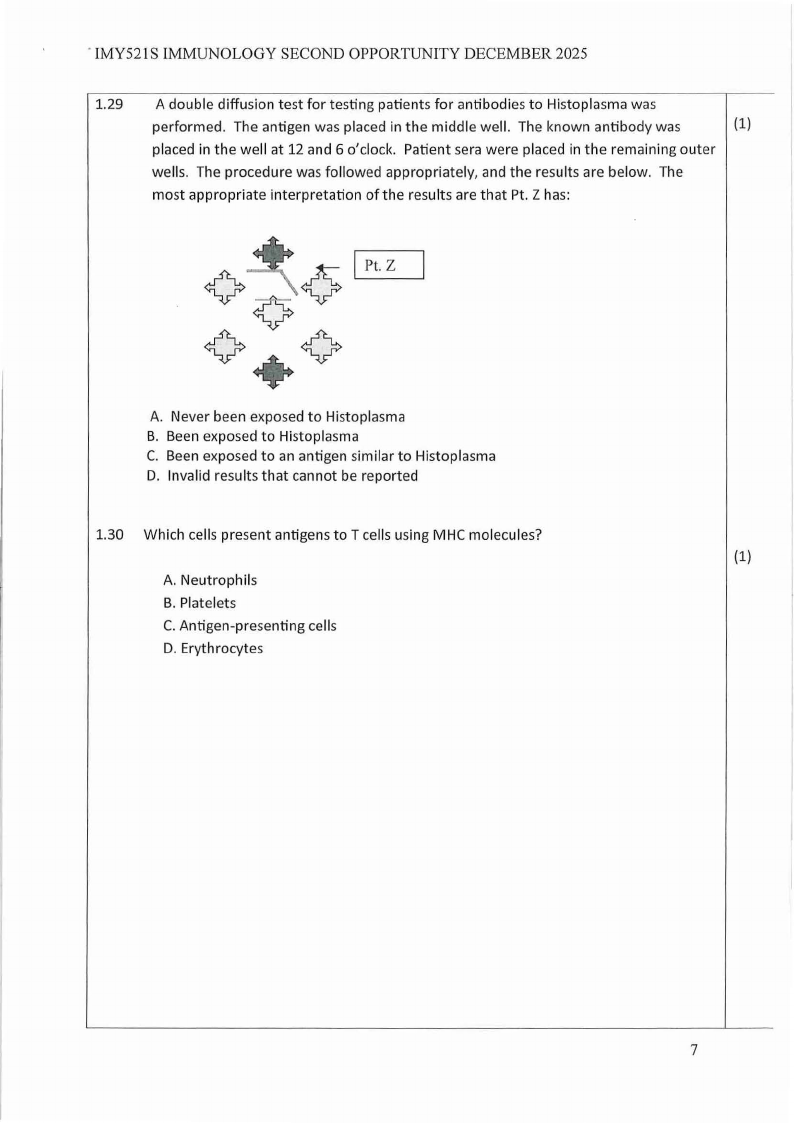
1.29 A double diffusion test for testing patients for antibodies to Histoplasma was
performed. The antigen was placed in the middle well. The known antibody was
(1)
placed in the well at 12 and 6 o'clock. Patient sera were placed in the remaining outer
wells. The procedure was followed appropriately, and the results are below. The
most appropriate interpretation of the results are that Pt. Z has:
A. Never been exposed to Histoplasma
B. Been exposed to Histoplasma
C. Been exposed to an antigen similar to Histoplasma
D. Invalid results that cannot be reported
1.30 Which cells present antigens to T cells using MHC molecu les?
(1)
A. Neutrophils
B. Platelets
C. Antigen-presenting cells
D. Erythrocytes
7

8 Page 8

▲back to top


IMY521S IMMUNOLOGY SECOND OPPORTUNITY DECEMBER 2Q25
SECTION B TRUE OR FALSE QUESTION
QUESTION 2
[30 MARKS]
(30)
Assess the following statements and decide whether they are true or false.
Write only the number of the question and next to it TRUE for a true statement or False
a false statement
2.1 Negative selection eliminates T cells that bind weakly to self-antigens.
(1)
2.2 Peyer's patches are found in the ileum.
(1)
2.3 The spleen contains both red and white pulp.
(1)
2.4 B cells mature in the thymus.
(1)
2.5 MALT includes the appendix and tonsils.
(1)
2.6 Regulatory T cells help suppress immune responses.
(1)
2.7 Lymphatic vessels drain interstitial fluid.
(1)
2.8 Cell maturation occurs in secondary lymphoid organs.
(1)
2.9 Activation of lymphocytes requires co-stimulatory signals.
(1)
2.10 B cells require antigen presentation via MHC for activation.
(1)
2.11 CD28 is a co-stimulatory molecule on T cells.
(1)
2.12 IL-4 promotes class switching to lgE in B cells.
(1)
2.13 T-independent B cell activation requires T cell help.
(1)
2.14 Germinal centers are found in primary lymphoid organs.
(1)
2.15 T cell activation without co-stimulation leads to anergy.
(1)
2.16 Th17 cells recruit neutrophils via IL-17.
(1)
2.17 Memory cells are short-lived and only active during primary response.
(1)
2.18 Activation of cos+ T cells requires MHC Class II.
(1)
2.19 Somatic hypermutation occurs during B cell activation.
(1)
2.20 Tregs suppress immune responses and promote tolerance.
(1)
2.21 Severe combined immunodeficiency is caused by failure in cell activation or
maturation.
(1)
2.22 B cells mature in the thymus.
(1)
2.23 Recombinants immunoblot assay (RIBA) detects viral RNA.
(1)
2.24 Hepatitis Eis commonly associated with chronic liver disease.
(1)
2.25 Ag presence indicates active replication of Hepatitis B virus.
(1)
8

9 Page 9

▲back to top


,. IMY521S IMMUNOLOGY SECOND OPPORTUNITY DECEMBER 2025
2.26 Anti-HBc lgM is the only marker detectable during the core window of Hepatitis B
(1)
infection.
2.27 CD4 counts are not normally distributed; the median and 95% reference range are
(1)
preferred for clinical interpretation.
2.28 The CD4 protein is a receptor for HIV, found on T-helper cells, and is the primary target (1)
for HIV entry via gp120.
2.29 Manual methods for CD4 count determination do correlate well with flow cytometry (1)
methods and are still used in some settings.
2.30 CD4 counts alone are not sufficient for diagnosing HIV; serological tests (e.g., ELISA,
(1)
Western blot) or nucleic acid tests are required for confirmation.
SECTION C SHORT ANSWER QUESTION
QUESTION 3
[40 MARl<S]
(40)
3.1 Describe the following in terms of types of interactions between antigens and antibodies:
a. precipitation
b. double diffusion
(2)
c. immunofixation
(2)
d. passive agglutination
(2)
e. reverse passive agglutination
(2)
(2)
3.2 Describe where and how T-lymphocytes and NI< cells mature, and how this reflect their
roles in immunity?
(3)
3.3 What are the key differences in how T cells and NI< cells become activated?
(3)
3.4 In the classical test for Anti-Streptolysin O how is the presence of the patient antibody
detected?
(10)
3.5 Describe the surface marker that is commonly used to identify all T lymphocytes
(4)
3.6 What surface marker is typically used to identify B lymphocytes, and what is its role?
(6)
3. 7 Describe the role of T-cytotoxic cells, and how they recognize their targets.
(4)
END OF EXAMINATION
9