IMY521S - IMMUNOLOGY - 1ST OPP - NOV 2025


IMY521S - IMMUNOLOGY - 1ST OPP - NOV 2025


1 Page 1

▲back to top


IMY5215 IMMUNOLOGY FIRST OPPORTUNITY OCTOBER 2025
n Am I BI A u n IVER s I TY
OF SCIEnCE Ano TECHnOLOGY
FACULTY OF HEALTH, NATURAL RESOURCES AND APPLIED SCIENCES
DEPARTMENT OF CLINICAL HEALTH SCIENCES
QUALIFICATION: BACHELOR OF MEDICAL LABORATORY SCIENCES
QUALIFICATION CODE: 08BMLS
LEVEL: 5
COURSE CODE: IMY521S
COURSE NAME: IMMUNOLOGY
SESSION: OCTOBER 2025
DURATION: 3 HOURS
PAPER: FIRST OPPORTUNITY
MARKS: 100
FIRST OPPORTUNITY EXAMINATION PAPER
EXAMINER(S) MR. HERBERT. MAPIRA
MODERATOR: MRS. EDWIG SHINGENGE
INSTRUCTIONS
ANSWER ALL THE QUESTIONS
PERMISSIBLE MATERIALS
PEN
THIS QUESTION PAPER CONSISTS OF 9 PAGES {Including this front page).
1

2 Page 2

▲back to top


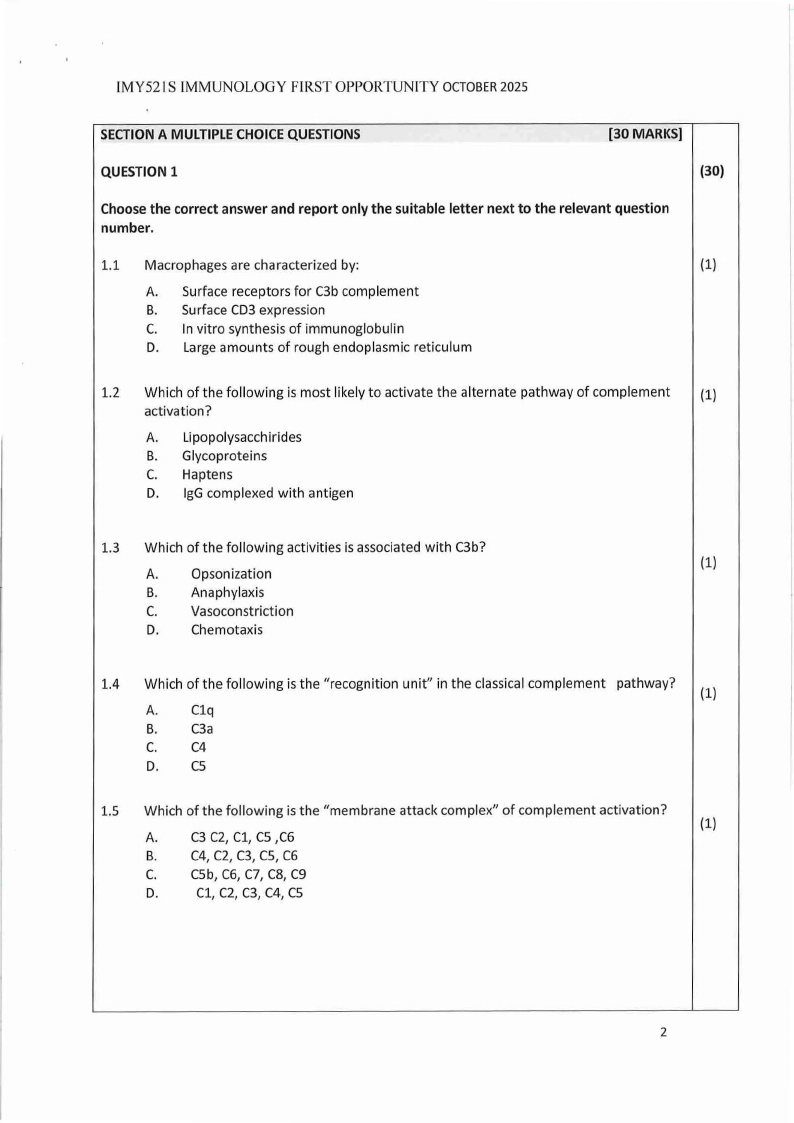
IMY52 IS IMMUNOLOGY FIRST OPPORTUNITY OCTOBER 2025
SECTION A M ULTIPLE CHOICE QUESTIONS
[30 MARKS)
QUESTION 1
(30)
Choose the correct answer and report only the suitable letter next to the relevant question
number.
1.1 Macrophages are characterized by:
(1)
A. Surface receptors for C3b complement
B. Surface CD3 expression
C. In vitro synthesis of immunoglobulin
D. Large amounts of rough endoplasmic reticulum
1.2 Which of the following is most likely to activate the alternate pathway of complement (1)
activation?
A. Lipopolysacchirides
B. Glycoproteins
C. Haptens
D. lgG complexed with antigen
1.3 Which of the following activities is associated with C3b?
(1)
A. Opsonization
B. Anaphylaxis
C. Vasoconstriction
D. Chemotaxis
1.4 Which of the fol lowing is the "recognition unit" in the classical complement pathway? (1)
A. Clq
B. C3a
C. C4
D. CS
1.5 Which of the following is the "membrane attack complex" of complement activation?
(1)
A. C3 C2, Cl, CS ,C6
B. C4,C2,C3,CS,C6
C. C5b,C6,C7, C8,C9
D.
Cl, C2,C3,C4,CS
2

3 Page 3

▲back to top


IMY52 IS IMMUNOLOGY FrRST OPPORTUNITY OCTOBER 2025
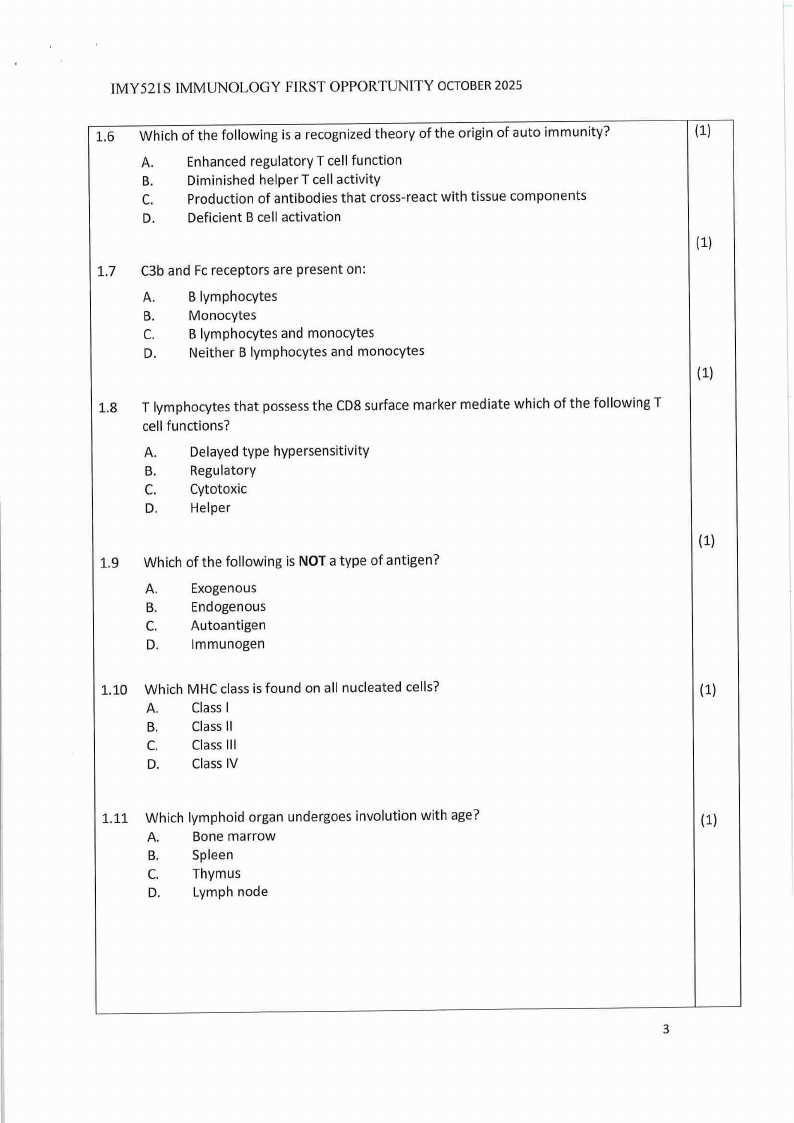
1.6 Which of the following is a recognized theory of the origin of auto immunity?
(1)
A. Enhanced regulatory T cell function
B. Diminished helper T cell activity
C. Production of antibodies that cross-react with tissue components
D. Deficient B cell activation
(1)
1.7 C3b and Fe receptors are present on:
A. B lymphocytes
B. Monocytes
C. B lymphocytes and monocytes
D. Neither B lymphocytes and monocytes
(1)
1.8 T lymphocytes that possess the CD8 surface marker mediate which of the following T
cell functions?
A. Delayed type hypersensitivity
B. Regulatory
C. Cytotoxic
D. Helper
(1)
1.9 Which of the following is NOT a type of antigen?
A. Exogenous
B. Endogenous
C. Autoantigen
D. lmmunogen
1.10 Which MHC class is found on all nucleated cells?
(1)
A. Class I
B. Class II
C. Class Ill
D. Class IV
1.11 Which lymphoid organ undergoes involution with age?
(1)
A. Bone marrow
B. Spleen
C. Thymus
D. Lymph node
3

4 Page 4

▲back to top


IMY52 IS IMMUNOLOGY FIRST OPPORTUNITY OCTOBER 2025
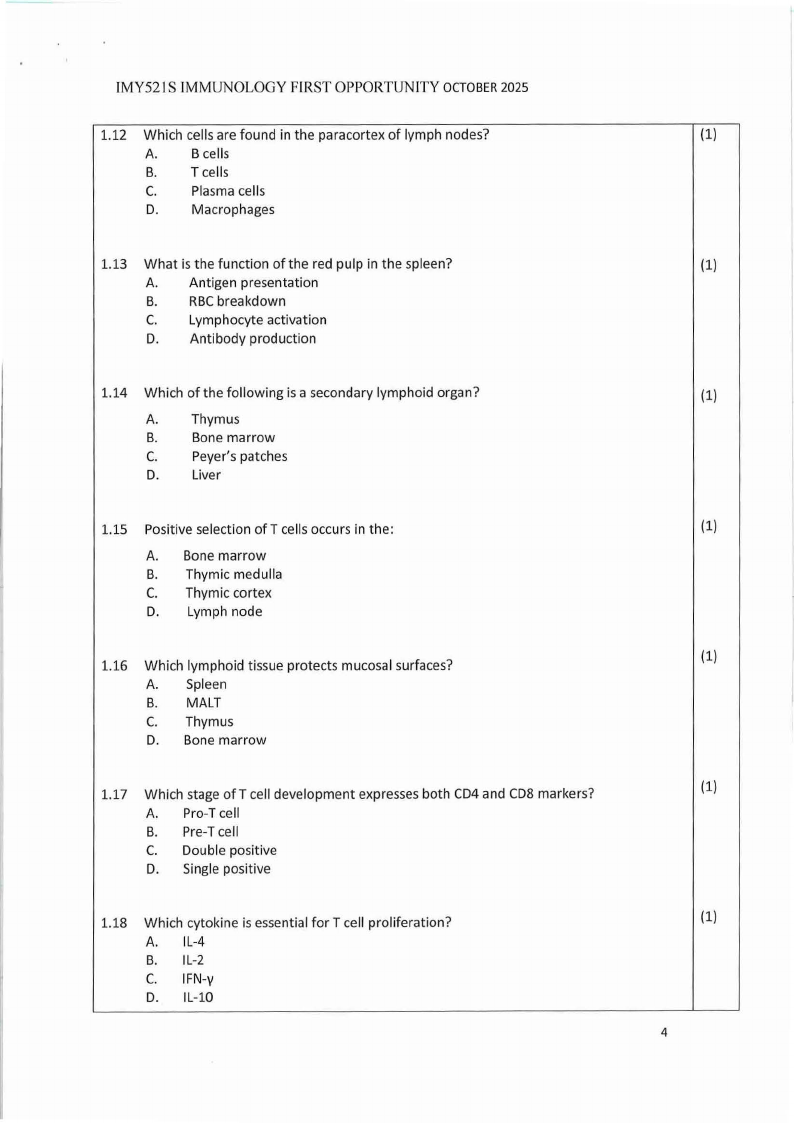
1.12 Which cells are found in the paracortex of lymph nodes?
A. B cells
B. T cells
C. Plasma cells
D. Macrophages
1.13 What is the function of the red pulp in the spleen?
A. Antigen presentation
B. RBC breakdown
C. Lymphocyte activation
D. Antibody production
1.14 Which of the following is a secondary lymphoid organ?
A. Thymus
B. Bone marrow
C. Peyer's patches
D. Liver
1.15 Positive selection ofT cells occurs in the:
A. Bone marrow
B. Thymic medulla
C. Thymic cortex
D. Lymph node
1.16 Which lymphoid tissue protects mucosal surfaces?
A. Spleen
B. MALT
C. Thymus
D. Bone marrow
1.17 Which stage of T cell development expresses both CD4 and CD8 markers?
A. Pro-T cell
B. Pre-T cell
C. Double positive
D. Single positive
1.18 Which cytokine is essential for T cell proliferation?
A. IL-4
B. IL-2
C. IFN-y
D. IL-10
(1)
(1)
(1)
(1)
(1)
(1)
(1)
4

5 Page 5

▲back to top


IMY521S IMMUNOLOGY FIRST OPPORTUNITY OCTOBER 2025
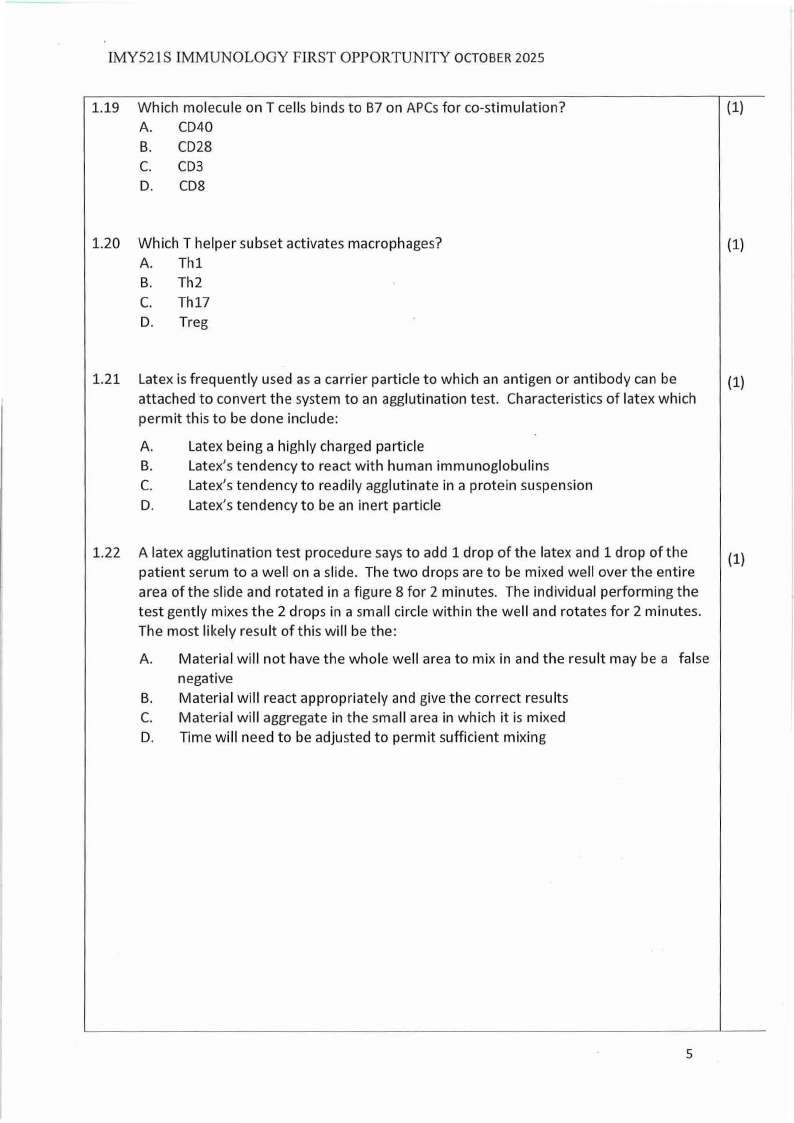
1.19 Which mol ecule on T cells binds to B7 on APCs for co-stimulation?
(1)
A. CD40
B. CD28
C. CD3
D. CD8
1.20 Which T helper subset activates macrophages?
(1)
A. Thl
B. Th2
C. Th17
D. Treg
1.21 Latex is frequ ently used as a carrier particle to which an antigen or antibody can be
(1)
attached to convert th e system to an agglutination test. Characteristics of latex which
permit this to be done include:
A. Latex being a highly charged particle
B.
Latex's tendency to react with human immunoglobulins
C.
Latex's tendency to readily agglutinate in a protein suspension
D. Latex's tendency t o be an inert particle
1.22 A latex agglutination test procedure says to add 1 drop of the latex and 1 drop of the
(1)
patient serum to a well on a slide. The two drops are to be mixed well over the entire
area of the slide and rotated in a figure 8 for 2 minutes. The individual performing th e
test gently mixes the 2 drops in a small circle within the well and rotates for 2 minutes.
The most li kely result of this will be the:
A. Material will not have the whole well area to mix in and the result may be a false
negative
B. Material will react appropriately and give the correct results
C. Material will aggregate in the sma ll area in which it is mixed
D. Time will need to be adjusted to permit sufficient mixing
5

6 Page 6

▲back to top


IMY52lS IMMUNOLOGY FIRST OPPORTUNITY OCTOBER 2025
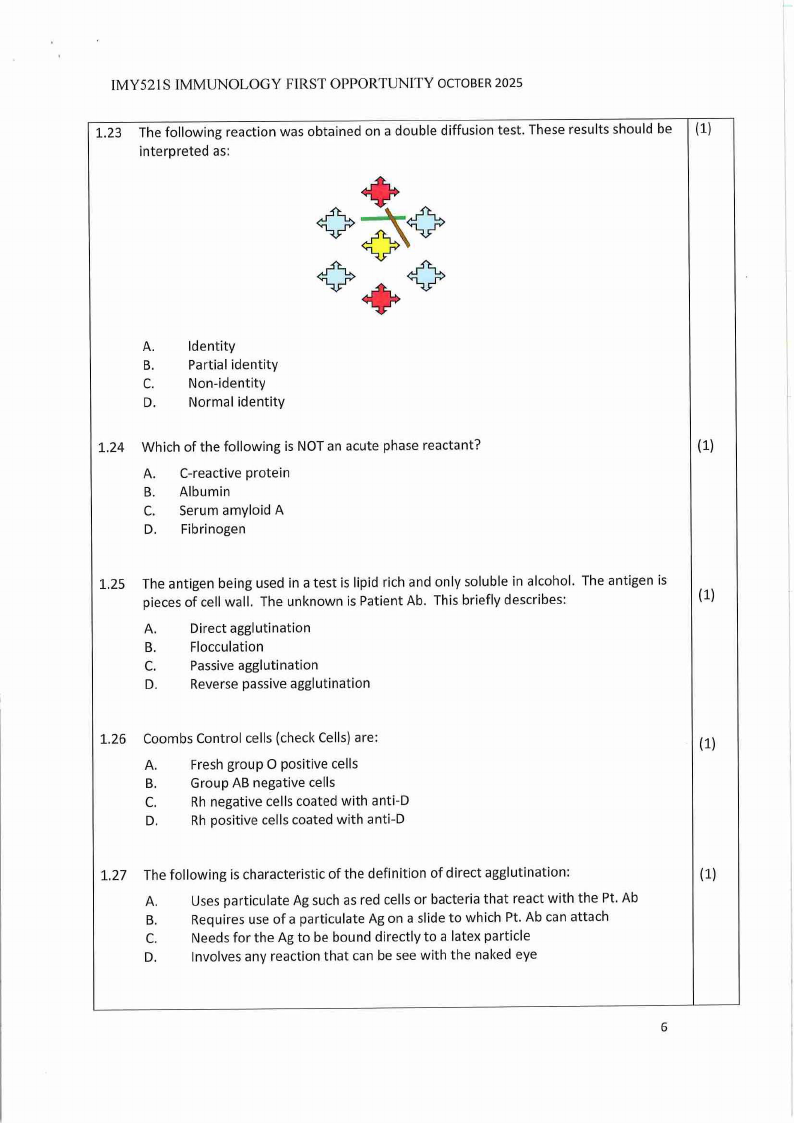
1.23 The following reaction was obtained on a double diffusion test. These results should be (1)
interpreted as:
A. Identity
B. Partial identity
C. Non-identity
D. Normal identity
1.24 Which of the following is NOT an acute phase reactant?
(1)
A. C-reactive protein
B. Albumin
C. Serum amyloid A
D. Fibrinogen
1.25 The antigen being used in a test is lipid rich and only soluble in alcohol. The antigen is
pieces of cell wall. The unknown is Patient Ab. This briefly describes:
(1)
A. Direct agglutination
B. Flocculation
C. Passive agglutination
D. Reverse passive agglutination
1.26 Coombs Control cells (check Cells) are:
(1)
A. Fresh group 0 positive cells
B. Group AB negative cells
C. Rh negative cells coated with anti-D
D. Rh positive cells coated with anti-D
1.27 The following is characteristic of the definition of direct agglutination:
(1)
A. Uses particulate Ag such as red cells or bacteria that react with the Pt. Ab
B. Requires use of a particulate Ag on a slide t o which Pt. Ab can attach
C. Needs for the Ag to be bound directly to a latex particle
D.
Involves any reaction that can be see with the naked eye
6

7 Page 7

▲back to top


IMY52 IS IMMUNOLOGY FIRST OPPORTUNITY OCTOBER 2025
1.28 Indirect immunofluoresence involves:
(1)
A.
Uses specific antiserum complexed with a fluorescien to detect the Pt. Ag.
B.
Testing for the presence of a particulate Ag from the patient
C.
Rabies fluorescing indirectly via the antisera complexed with a fluorescein
D. Having the unknown Pt. Ab. sandwiched between a known particulate Ag and
the anti- human lg conjugate
1.29 A test is performed as follows: Latex to which a known Streptococcal exotoxin is
attached is applied to a well. Patient serum is added to this slide and the latex/serum
are mixed thoroughly. The slide is rotated in a figure 8 for 2 minutes and the reaction is
read. This is an example of:
A. Direct agglutination
(1)
B. Flocculation
C. Passive agglutination
D. Reverse passive agglutination
1.30 In terms of immunofluoresence, all of the following statements are correct EXCEPT:
(1)
A. Direct immunofluoresence usually detects a particulate Unknown Ag
B. Direct immunofluoresence can use the same antisera regardless of the Ag being
detected
C.
Indirect immunofluoresence frequently detects a soluble Unknown Ab
D. Indirect immunofluoresence frequently uses anti-human lgG + fluorescein as the
conj ugate
SECTION B TRUE OR FALSE QUESTIONS
(30 MARKS]
(30)
QUESTION 2
Assess the following statements and decide whether they are true or false.
Write only the number of the question and next to it TRUE for a true statement or False for a
false statement.
2.1 cog+ T cells recognize antigens presented by MHC Class I.
(1)
2.2 MHC Class Ill is directly involved in antigen presentation.
(1)
2.3 Each individual expresses a unique combination of MHC alleles.
(1)
2.4 Tumor antigens are expressed on cancer cells.
(1)
2.5 The endogenous pathway involves antigen uptake by endocytosis.
(1)
2.6 MHC molecules are encoded by genes located on chromosome 6.
(1)
2.7 Antigenic determinants are also ca lled epitopes.
(1)
7

8 Page 8

▲back to top


IMY521S IMMUNOLOGY FIRST OPPORTUNITY OCTOBER 2025
2.8 MHC polymorphism has no impact on disease susceptibi lity.
(1)
2.9 CD4+ T cells require co-stimulatory signals for activation.
(1)
2.10 MHC molecules are involved in self/non-self recognition.
(1)
2.11 The cortex of the thymus contains mature T cells.
(1)
2.12 Splenectomy increases the risk of infection.
(1)
2.13 HIV targets lymphoid tissues.
(1)
2.14 The medulla of lymph nodes contains plasma cells and macrophages.
(1)
2.15 Lymphadenopathy refers to enlarged lymph nodes.
(1)
2.16 The thymus is a secondary lymphoid organ.
(1)
2.17 Lymph nodes filter blood.
(1)
2.18 Positive selection ensures T cells can recognize self-MHC.
(1)
2.19 The complement system is only activated by antibodies.
(1)
2.20 CD4 is found on helper T cells, not cytotoxic T cells.
(1)
2.21 Flow cytometry uses fluorescent dyes for multi-parameter analysis.
(1)
2.22 CD4 count is not diagnostic for HIV; it's used for monitoring.
(1)
2.23 Hepatitis B is a DNA virus; others are RNA viruses.
(1)
2.24 Anti-HBs indicates recovery or successful vaccination.
(1)
2.25 Hepatitis A is transmitted via fecal-oral route, not blood.
(1)
2.26 CD4 levels vary with time of day; consistent timing is important.
(1)
2.27 CD3 is a marker for all mature T cells.
(1)
2.28 Reference ranges vary by population and must be locally validated.
(1)
2.29 CD8 is found on cytotoxic T cells and some NK cells.
(1)
2.30 CD4 <200/µL increases risk for opportunistic infections.
(1)
SECTION C SHORT ANSWER QUESTIONS
QUESTION 3
3.1 Describe the endogenous antigen processing pathway.
3.2 List the three main classes of MHC molecules.
3.3 Describe the role of germinal centers in B cell activation.
[40 MARl<S]
(40)
(2)
(3)
(3)
8

9 Page 9

▲back to top


IMY521S IMMUNOLOGY FIRST OPPORTUNITY OCTOBER 2025
3.4 Explain the difference between maturation and activation.
(2)
3.5 Describe the type of antigens that are presented by MHC Class II.
(2)
3.6 Briefly describe a hapten
(2)
3. 7 Describe the role of co-stimulation in T cell activation.
(2)
3.8 State the function of IL-2 in immune activation.
(2)
3.9 Differentiate between T-dependent and T-independent B cell activation.
(3)
3.10 Describe the process of negative and positive T-cell selection in the thymu s.
(4)
3.11 Name three antigen-presenting cells.
(3)
3.11 Summarize the applications of ELISA in clinical diagnostics.
(3)
3.13 Explain the difference between maturation and activation.
(4)
3.14 Describe the following by the types of interactions between antigens and antibodies:
a. Direct immunofluoresence:
(2)
b. lmmunofluoresence:
(3)
END OF EXAM/NATION
9