


 |
MMB621S - MEDICAL MICROBIOLOGY 2B - 2ND OPP -DEC 2025 |
|
|
1 Page 1 |
▲back to top |
nAm IB IA un1VERSITY
OF SCIEnCE AnDTECHnOLOGY
Faculty of Health, Natural
Resources and Applied
Sciences
School of Health Sciences
Department of Clinical
Health Sciences
13 Jackson Kauje ua Street T: +264 61 207 2970
Private Bag 13380
F: +264 61 207 9970
W indhoek
E: dchs@nust.na
NAMIBI A
W , www.nust.na
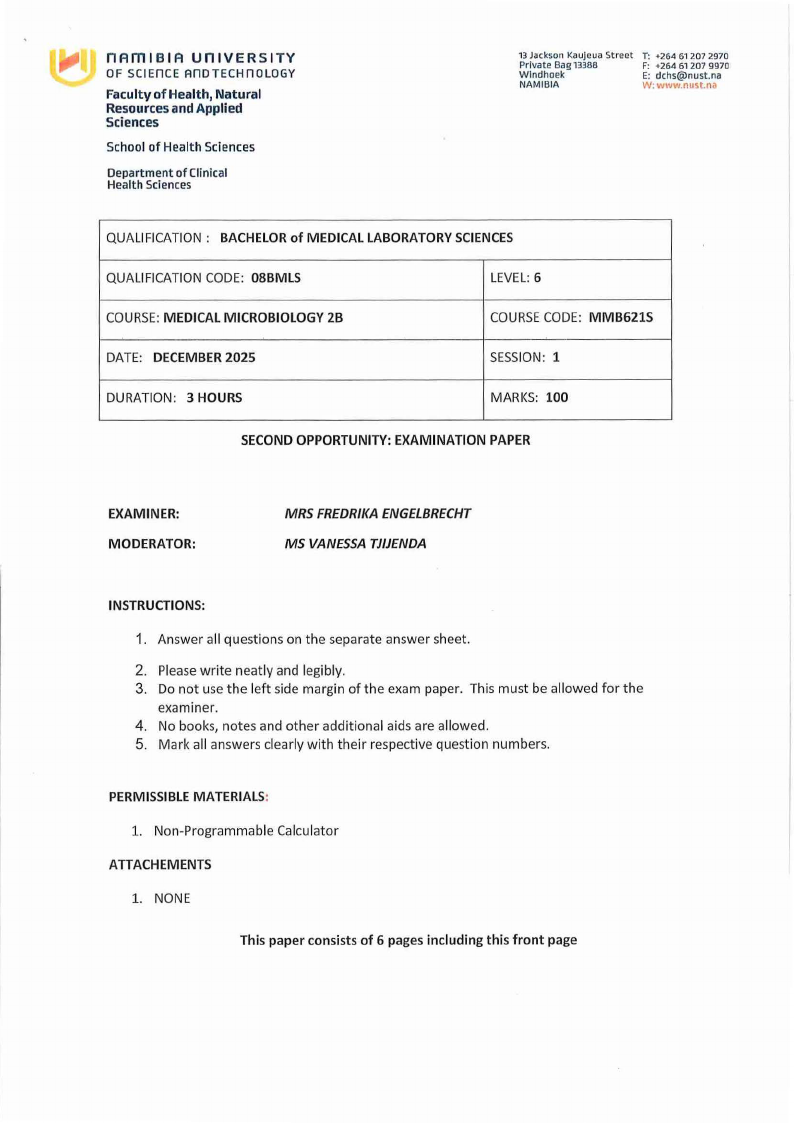
QUALIFICATION : BACHELOR of MEDICAL LABORATORY SCIENCES
QUALIFICATION CODE: 08BMLS
LEVEL: 6
COURSE: MEDICAL MICROBIOLOGY 2B
COURSE CODE: MMB621S
DATE: DECEMBER 2025
SESSION : 1
DURATION: 3 HOURS
MARl<S: 100
SECOND OPPORTUNITY: EXAMINATION PAPER
EXAMINER:
MODERATOR:
MRS FREDRIKA ENGELBRECHT
MS VANESSA Tl/JENDA
INSTRUCTIONS:
1 . Answer all questions on the separate answer sheet.
2. Please write neatly and legibly.
3. Do not use the left side margin of the exam paper. This must be allowed for the
exa miner.
4 . No books, notes and other additional aids are allowed .
5. M ark all answers clearly w ith their respective question numbers.
PERMISSIBLE MATERIALS:
1. Non-Programmable Calculator
ATTACHEMENTS
1. NONE
This paper consists of 6 pages including this front page
|
|
2 Page 2 |
▲back to top |
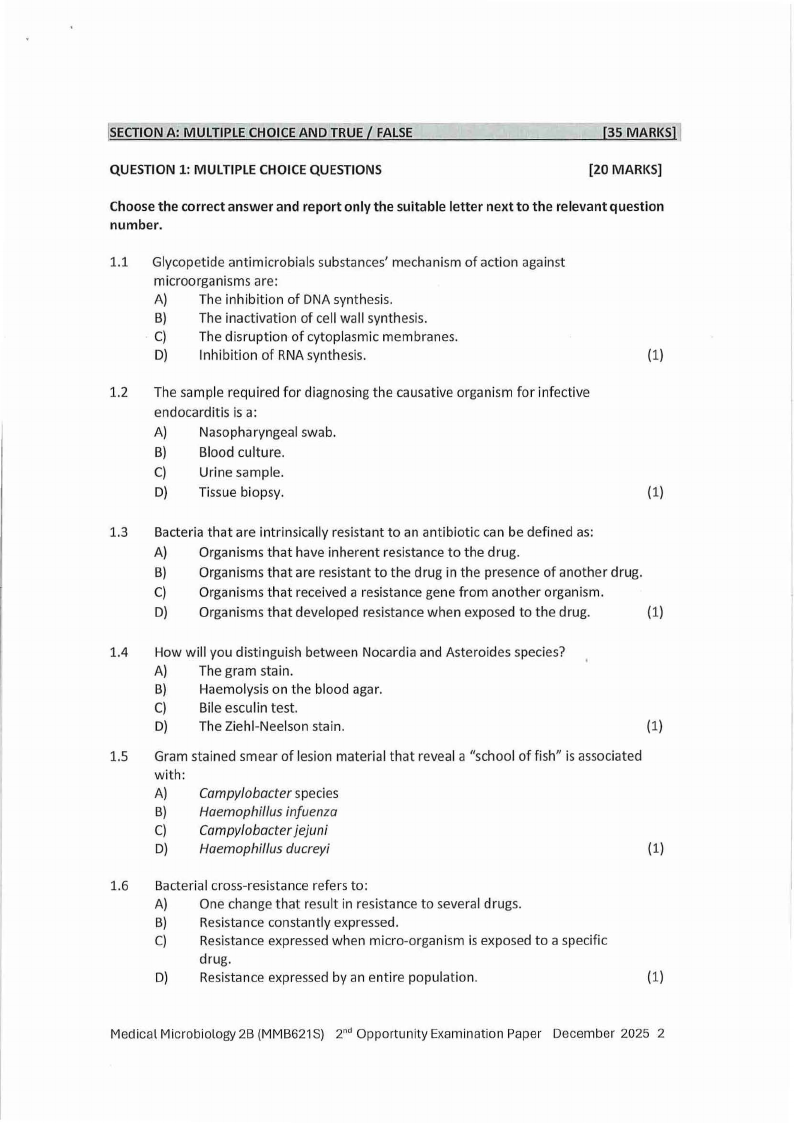
[SECTION A: MULTIPLE CHOICE AND TRUE/ FALSE
[35 MARKS]
QUESTION 1: MULTIPLE CHOICE QUESTIONS
[20 MARKS]
Choose the correct answer and report only the suitable letter next to the relevant question
number.
1.1 Glycopetide antimicrobials substances' mechanism of action against
microorganisms are:
A) The inhibition of DNA synthesis.
B) The inactivation of cell wall synthesis.
C) The disruption of cytoplasm ic membranes.
D) Inhibition of RNA synthesis.
(1)
1.2 The sample required for diagnosing the causative organism for infective
endocarditis is a:
A) Nasopharyngeal swab.
B) Blood culture.
C) Urine sample.
D) Tissue biopsy.
(1)
1.3 Bacteria that are intrinsically resistant to an antibiotic can be defined as:
A) Organisms that have inherent resistance to the drug.
B) Organisms that are resistant to t he drug in the presence of another drug.
C) Organisms that received a resistance gene from another organism.
D) Organisms that developed resistance when exposed to the drug.
(1)
1.4 How will you distinguish between Nocardia and Asteroides species?
A) The gram stain.
B) Haemolysis on the blood agar.
C) Bile esculin test.
D) The Ziehl-Neelson sta in.
(1)
1.5 Gram stained smear of lesion material that reveal a "school of fish" is associated
with:
A) Campylobacter species
B) Haemophil/us infuenza
C) Campylobacter jejuni
D) Haemophil/us ducreyi
(1 )
1.6 Bacteri al cross-resistance refers to:
A) One change that result in resistance to several drugs.
B) Resistan ce constantly expressed.
C) Resistance expressed when micro-organism is exposed to a specific
drug.
D) Resistance expressed by an entire population.
(1)
Medical Microbiology 2B (MMB621 S) 2nd Opportunity Examination Paper December 2025 2
|
|
3 Page 3 |
▲back to top |
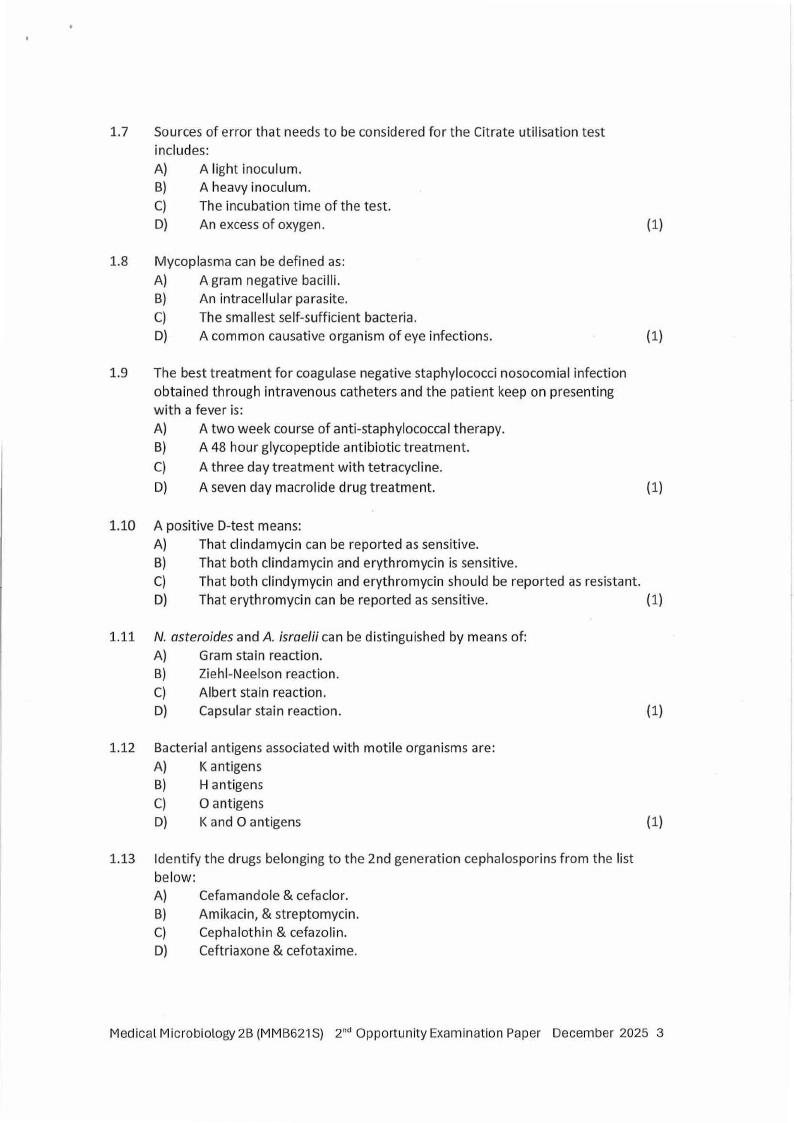
1.7 Sources of error that needs to be considered for the Citrate utilisation test
includes:
A) A light inoculum.
B) A heavy inoculum.
C) The incubation time of the test.
D) An excess of oxygen.
(1)
1.8 Mycoplasma can be defined as:
A) A gram negative bacilli.
B) An intracellular parasite.
C) The sma llest se lf-sufficient bacteria.
D) A common causative organism of eye infections.
(1)
1.9 The best treatment for coagulase negative staphylococci nosocomial infection
obtained through intravenous catheters and the patient keep on presenting
with a fever is:
A) A two week course of anti-staphylococcal therapy.
B) A 48 hour glycopeptide antibiotic treatment.
C) A three day treatment with tetracycline.
D) A seven day macrolide drug treatment.
(1)
1.10
A positive D-test means:
A) That clindamycin can be reported as sensitive.
B) That both clindamycin and erythromycin is sensitive.
C) That both clindymycin and erythromycin should be reported as resistant.
D) That erythromycin can be reported as sensitive.
(1)
1.11 N. asteroides and A. israe/ii can be distinguished by means of:
A) Gram stain reaction.
B) Ziehl-Neelson reaction.
C) Albert stain reaction.
D) Capsular stain reaction.
(1)
1.12 Bacterial antigens associated with motile organisms are:
A) K antigens
B) H antigens
C) O antigens
D) I< and O antigens
(1)
1.13 Identify the drugs belonging to the 2nd generation cephalosporins from the list
below:
A) Cefamandole & cefaclor.
B) Amikacin, & streptomycin.
C) Cephalothin & cefazolin.
D) Ceftriaxone & cefotaxime.
Medical Microbiology 2B (MMB621 S) 2nd Opportunity Examination Pap er December 2025 3
|
|
4 Page 4 |
▲back to top |
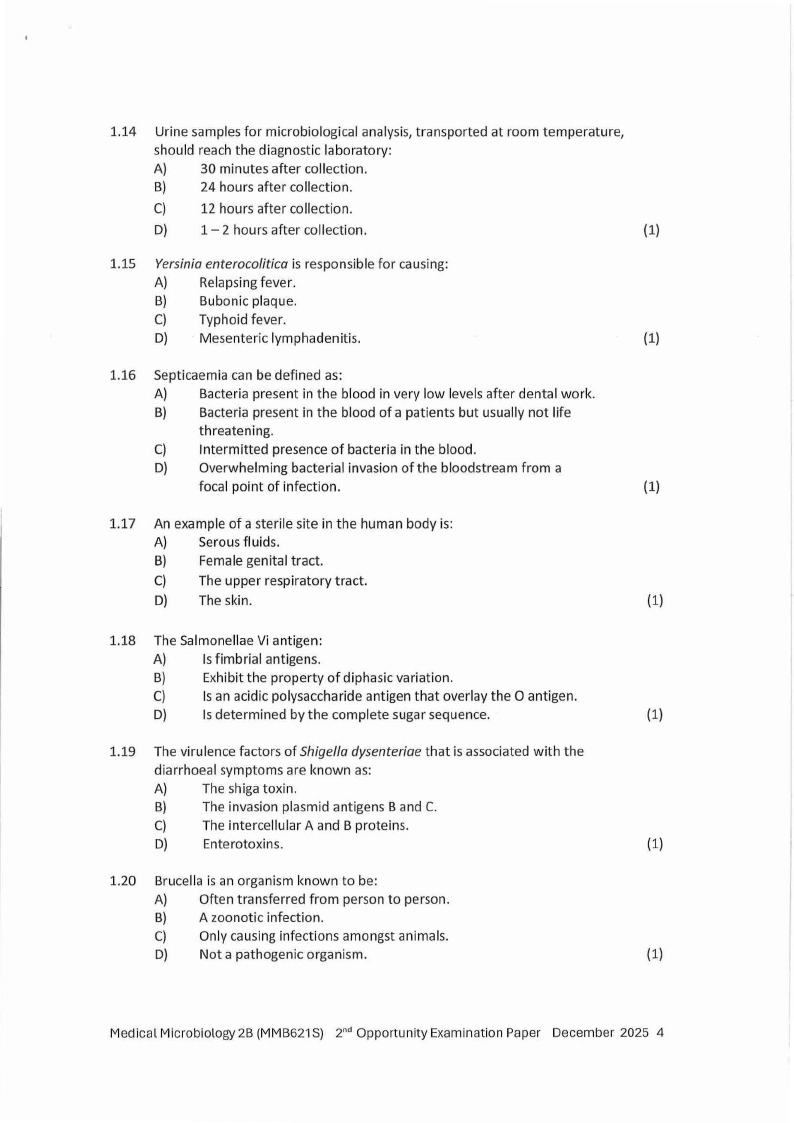
1.14 Urine samples for microbiological analysis, transported at room tempe rature,
should reach t he diagnostic laboratory:
A) 30 minutes after collection.
B)
24 hours after collection.
C)
12 hours after collection.
D) 1- 2 hours after collection.
(1)
1.15 Yersinia enteroco/itica is responsible for causing:
A) Relapsing fever.
B) Bubonic plaque.
C) Typhoid f ever.
D) Mesenteric lymphadenit is.
(1)
1.16 Septicaemia can be defined as:
A) Bacteria present in the blood in very low levels after dental work.
B) Bacteria present in the blood of a patients but usually not life
t hreatening.
C) lntermitted presence of bacteria in the blood.
D) Overwhelming bacterial invasio n of the bloodstream from a
focal point of infection.
{1)
1.17 An exa mple of a sterile site in the human body is:
A) Serous fluids.
B) Female gen ital tract.
C) The upper respiratory tract.
D) The skin.
(1)
1.18 The Sa lmonellae Vi antigen:
A)
Is fimbrial antigens.
B)
Exhibit the property of diphasic variation.
C)
Is an acidic polysaccharide antigen that overlay the O antigen.
D)
Is determined by the complete sugar sequence.
(1)
1.19 The virulence factors of Shigella dysenteriae that is associated with the
diarrhoeal symptoms are known as:
A)
The sh iga toxin.
B)
The invasion plasmid antigens Band C.
C)
The intercellular A and B proteins.
D)
Enterotoxins.
(1)
1.20 Brucel la is an organism known to be:
A) Often transferred from person to person.
B) A zoonotic infection.
C) Only causing infections amongst anima ls.
D) Not a pathogenic organism.
(1)
Medical Microbiology 28 (MM B621S) 2nd Opportunity Examination Paper December 2025 4
|
|
5 Page 5 |
▲back to top |
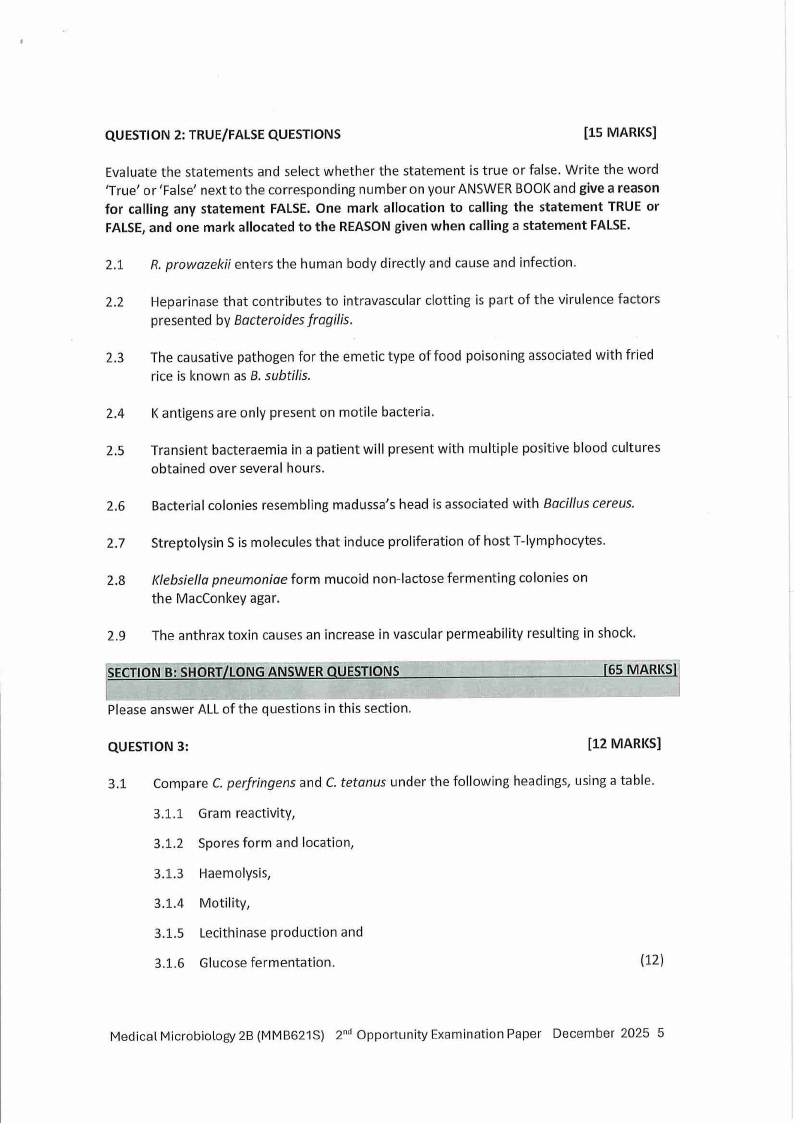
QUESTION 2: TRUE/FALSE QUESTIONS
[15 MARl<S]
Evaluate the statements and select whether the statement is true or false. Write the word
'True' or 'False' next to the corresponding number on your ANSWER BOO1< and give a reason
for calling any statement FALSE. One mark allocation to calling the statement TRUE or
FALSE, and one mark allocated to the REASON given when calling a statement FALSE.
2.1 R. prowazekii enters the hum an body directly and ca use and infection.
2.2 Heparinase that contributes to intravascular clotting is part of the virulence factors
presented by Bacteroides fragilis.
2.3 The causative pathogen for the emetic type of food poisoning associated with fried
rice is known as 8. subtilis.
2.4 I< antigens are only present on motile bacteria.
2.5 Transient bacteraemia in a patient will present with multiple positive blood cultures
obtained over several hours.
2.6 Bacterial colonies resembling madussa's head is associated with Bacillus cereus.
2.7 Streptolysin Sis molecules that induce proliferation of host T-lymphocytes.
2.8 /(/ebsiella pneumoniae form mucoid non-lactose fermenting colonies on
the MacConkey agar.
2.9 The anthrax toxin causes an increase in vascular permeability resulting in shock.
SECTION B: SHORT/LONG ANSWER QUESTIONS
Please answer ALL of the questions in this section.
QUESTION 3:
[12 MARl<S]
3.1 Compare C. perfringens and C. tetanus under the following headings, using a table .
3.1.1 Gram reactivity,
3.1.2 Spores form and location,
3.1.3 Haemolysis,
3.1.4 Motility,
3.1.5 Lecithinase production and
3.1.6 Glucose fermentation.
(12)
Medical Microbiology 2B (MMB621 S) 2nd Opportunity Examin ation Paper December 2025 5
|
|
6 Page 6 |
▲back to top |
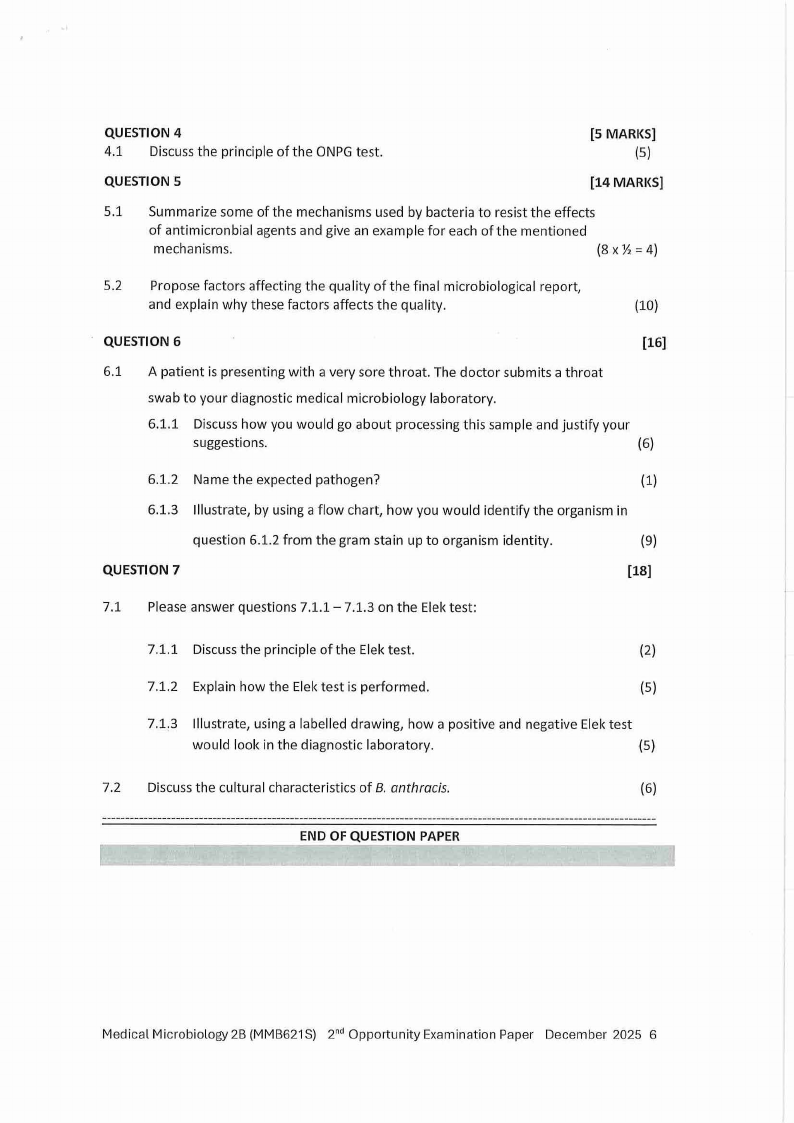
QUESTION 4
4.1 Discuss the principle of the ONPG test.
[5 MARl<S]
(5)
QUESTION 5
[14 MARl<S]
5.1 Summarize some of the mechanisms used by bacteria to resist the effects
of antimicronbial agents and give an example for each ofthe mentioned
mechanisms.
(8 x ½ = 4)
5.2 Propose factors affecting the quality of the final microbiological report,
and explain why these factors affects the quality.
(10)
QUESTION 6
[16)
6.1 A patient is presenting with a very sore throat. The doctor submits a throat
swab to your diagnostic medical microbiology laboratory.
6.1.1 Discuss how you would go about processing this sample and justify your
suggestions.
(6)
6.1.2 Name the expected pathogen?
(1)
6.1.3 Illustrate, by using a flow chart, how you would identify the organism in
question 6.1.2 from the gram stain up to organism identity.
(9)
QUESTION 7
[18)
7.1 Please answer questions 7.1.1- 7.1.3 on the Elek test:
7.1.1 Discuss the principle of the Elek test.
(2)
7.1.2 Explain how the Elek test is performed.
(5)
7.1.3 Illustrate, using a labelled drawing, how a positive and negative Elek test
would look in the diagnostic laboratory.
(5)
7.2 Discuss the cultural characteristics of B. anthracis.
(6)
END OF QUESTION PAPER
Medical Microbiology 2B (MMB621S) 2nd Opportunity Examination Paper December 2025 6