HIS521S - HISTOLOGY - 1ST OPP - DEC 2025


HIS521S - HISTOLOGY - 1ST OPP - DEC 2025


1 Pages 1-10

▲back to top


1.1 Page 1

▲back to top


SECOND OPPORTUNITY EXAMINATION - HISTOLOGY (HIS521S) - OCTOBER 2025
nArnlBIA UnlVERSITY
OF SC IEnCE Ano TECHnOLOGY
FACULTY OF HEATH, APPLIED SCIENCES AND NATURAL RESOURCES
SCHOOL OF HEALTH SCIENCES
DEPARTMENT OF CLINICAL HEALTH SCIENCES
QUALIFICATION: BACHELOR OF MEDICAL LABORATORY SCIENCES
QUALIFICATION CODE: BMLS
COURSE CODE: HIS521S
SESSION: DECEMBER 2025
DURATION: 3 HOURS
LEVEL: 6
COURSE NAME: HISTOLOGY
PAPER: THEORY
MARKS: 100
SECOND OPPORTUNITY EXAMINATION QUESTION PAPER
EXAMINER(S)
MR JOHANNES ENDJALA
MODERATOR
MS NDESHIPEWA HAMATUI-VALOMBOLA
INSTRUCTIONS
I. Answer all the questions.
2. Read all questions carefully before answering.
3. Write clearly and neatly
4. Nmnbers the answers clearly
PERMISSIBLE MATERIALS
1. Examination Question Paper
2. Answering book
3. Non programmable calculator is allowed
THIS QUESTION PAPER CONSISTS OF 11 PAGES (Including this front page)
Page 1 of 11

1.2 Page 2

▲back to top


SECOND OPPORTUNITY EXAMINATION- HISTOLOGY (HIS521S) - OCTOBER 2025
Multiple Choice Questions
SECTION A (36 Marks]
Evaluate each numbered question and select the best option as your answer. Write the
con-ect letter next to each corresponding question.
QUESTION 1
(36)
1.1 Which ofthe following statements about epithelial tissue is TRUE?
(1)
A. It is highly vascularized
B. It has a 1ich extracellular matrix and few cells
C. It forms a protective barrier and participates in secretion and absorption
D. It primaiily stores fut
1.2 Which type of connective tissue provides the most tensile strength in tendons and
ligaments?
(1)
A. Dense regular connective tissue
B. Loose connective tissue
C. Elastic cartilage
D. Bone
1.3 The "representative section" taken dming grossing means:
(1 )
A. A small piece that fits the cassette
B. Tissue selected to represent all important features of the lesion
C. A sampled section of the specimen to be processed
D. Inked surgical margin section of the specimen with malignant features grossly
1.4 Which type of decalcifyi.11g agent is considered the slowest but preserves tissue
morphology the best?
(1)
A. Nitric acid
B. Formic acid
C. EDTA
D. Alkalis
1.5 Which ofthe following steps is performed immediately before embedding?
(I)
A. Fixation
B. Clearing
C. Dehydration
D. Infiltration with paraffin wax
Page 2 of 11

1.3 Page 3

▲back to top


SECOND OPPORTUNITY EXAMINATION- IDSTOLOGY (IDS52 1S) - OCTOBER 2025
1.6 In resin-embedded bone marrow biopsy, ve1y thin sections are obtained for Electron
Microscopy. The main advantage of resin is:
(1)
A. Faster processing
B. Allows sectioning at < I µm thickness
C. Better hematoxyli n staining compare to light microscopy
D. Easier orientation of tissue compare to paraffin
1.7 A biopsy specimen embedded with poor orientation, where the epithelial smfuce is
cut tangentially, may lead to:
())
A. Excellent visualization of epithelial thickness
B. Difficulty in assessing dysplasia
C. Better preservation of co1mective tissue
D. No significant in1pact on diagnosis
1.8 "Chatter" (venetian blind effect) dilling microtomy is usually caused by:
(1)
A. Too sharp a knife
B. Blunt knife edge or hard tissue
C. Too much adhesive on the slide
D. Insufficient tissue processing
1.9 The typical thickness of paraffin-embedded sections for light microscopy is:
(1)
A. 1-2 nm
B. 3-l0nm
C. 3-10 µm
D. 10-15 µm
1. 10 Which of these fixatives is best for ultrastructme for electron microscopy? (1)
A. Bouin's solution
B. Glutaraldehyde
C. 10% NBF
D. Carnoy's solution
Page 3 of 11

1.4 Page 4

▲back to top


SECOND OPPORTUNITY EXAMINATION- HISTOLOGY (ffiS521S)-OCTOBER 2025
1.11 Which of the following is a major disadvantage of c1yostat sections compared to
paraffin sections?
( 1)
A. Poor nuclear detail
B. ExceUent tissue morphological presentation
C. Cannot be stained with H&E
D. Cannot be used for il1m1unohistochemistry
1.12 A 45-year-old woman undergoes excision of a breast lun1p. The specimen was
placed in formalin for only 30 minutes before processing. On microscopy, nuclear
details are indistinct and tissue appears shrunken. What is the most lil<ely cause of
the a1tifuct?
( 1)
A. Incomplete dehydration
B. Inadequate fixation
C. Incomplete clearil1g
D. Improper embedding
1.13 What is the role of xylene in tissue processing?
(1)
A. Fixation
B. Dehydration
C. Clearmg agent
D. Stainmg
1.14 Inking of specilnens during grossing is performed to:
(1)
A. Differentiate benign from malignant tissue
B. Identify surgical margins
C. Enhance tissue staining
D. Visualization of the tissue duril1g embedding
1.15 Which biopsy type is usuaUy inked before grossing?
(1)
A. Punch biopsy
B. Endoscopic biopsy
C. Shave biopsy
D. Excision biopsy
Page 4 of 11

1.5 Page 5

▲back to top


SECOND OPPORTUNITY EXAMINATION- HISTOLOGY (HIS521 S) - OCTOBER 2025
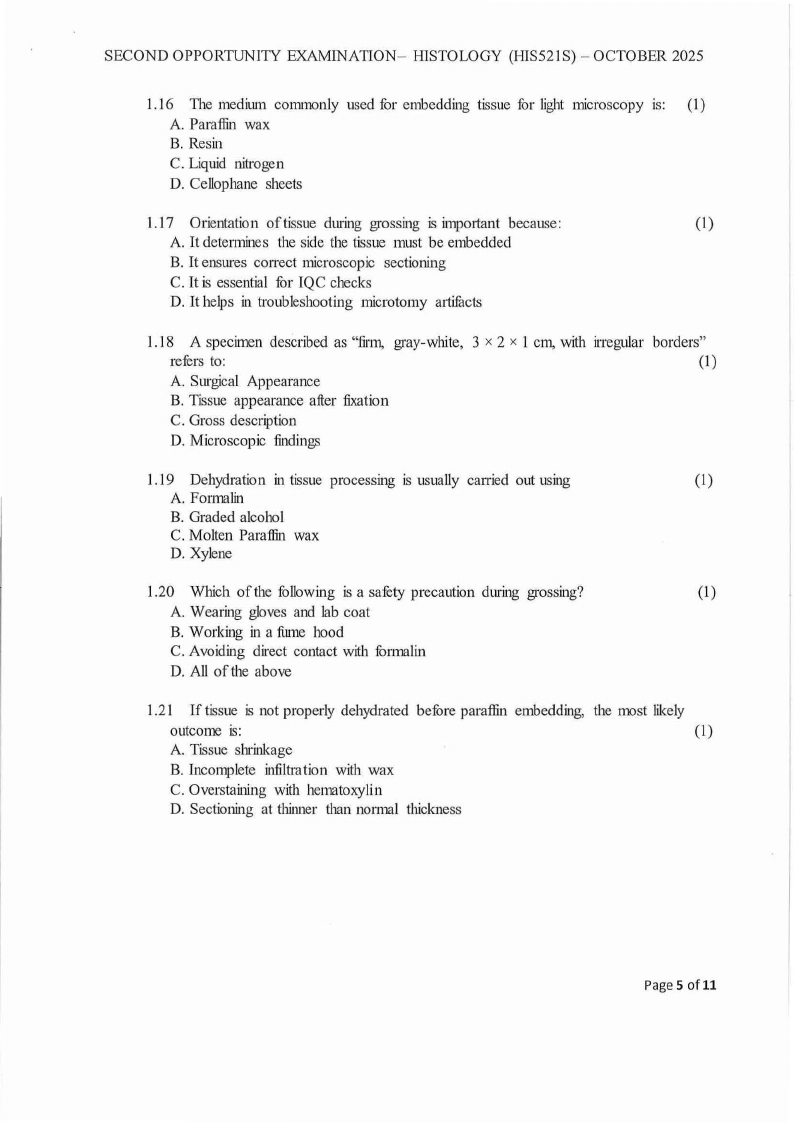
1. 16 The meditun commonly used for embedding tissue for light microscopy 1s: (1)
A. Paraffin wax
B. Resin
C. Liquid nitrogen
D. Cellophane sheets
1.17 Orientation of tissue during grossing is irnpottant because:
(1)
A. It determines the side the tissue must be embedded
B. It ensures correct microscopic sectioning
C. It is essential for IQC checks
D. It helps in troubleshooting microtomy a1tifucts
1.18 A specimen described as "firm, gray-white, 3 x 2 x 1 cm, with irregular borders"
refers to:
(1)
A. Surgical Appearance
B. Tissue appearance after fixation
C. Gross description
D. Microscopic .findings
1.19 Dehydration in tissue processing is usually carried out using
(1)
A. Formalin
B. Graded alcohol
C . Molten Paraffin wax
D. Xylene
1.20 Which ofthe following is a safety precaution during grossing?
(1)
A. Wearing gloves and lab coat
B. Working in a fi.une hood
C . Avoiding direct contact with formalin
D. AJI ofthe above
1.2 1 If tissue is not properly dehydrated before paraffin embedding, the most likely
outcome is:
(1)
A. Tissue shrinkage
B. Incomplete infiltration with wax
C. Overstaining with hematoxylin
D. Sectioning at thinner than normal thickness
Page 5 of 11

1.6 Page 6

▲back to top


SECOND OPPORTUNITY EXAMINATION- HISTOLOGY (HIS521S) - OCTOBER 2025
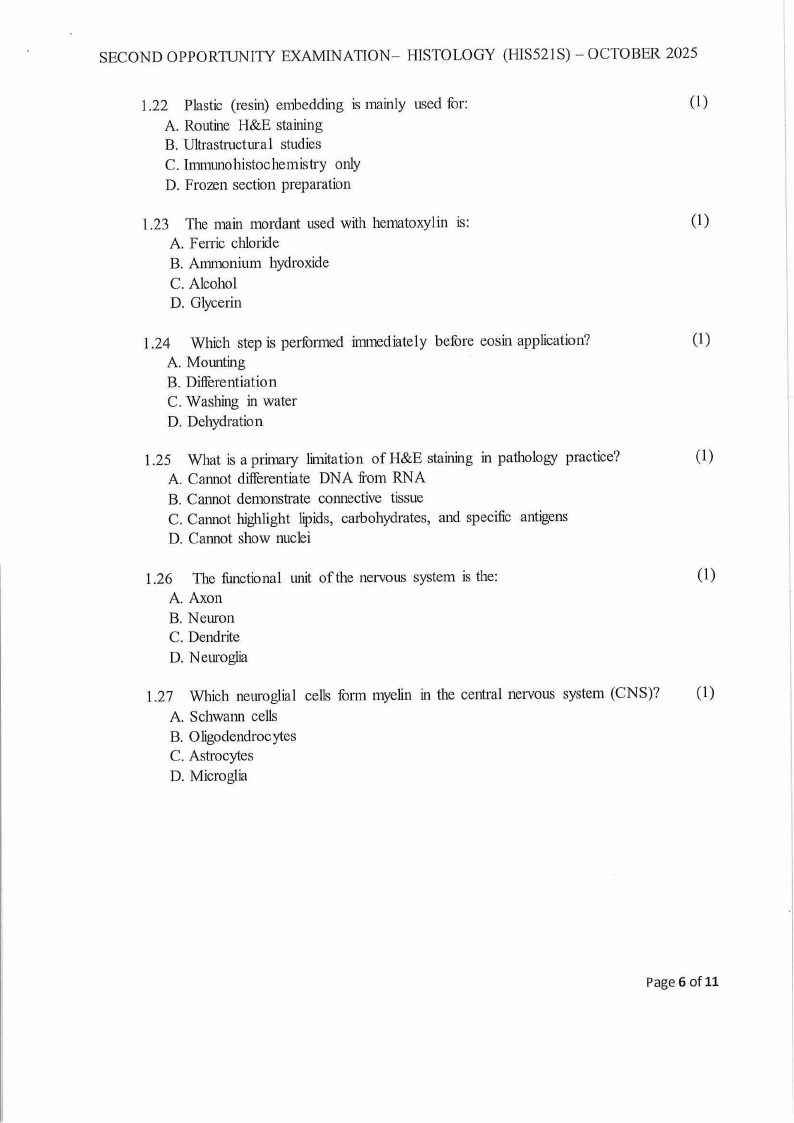
1.22 Plastic (resin) embedding is mainly used for:
(1)
A. Routine H&E staining
B. U1trastructura 1 studies
C. Immunohistochemistry only
D. Frozen section preparation
1.23 The main mordant used with hematoxylin JS:
(1)
A. Ferric chloride
B. Ammonium hydroxide
C. Alcohol
D. Glycerin
1.24 Which step is pe1formed immediately before eosin application?
(1)
A. Mounting
B. Differentiation
C. Washing in water
D. Dehydration
1.25 What is a primary limitation of H&E staining in pathology practice?
(1)
A. Cannot differentiate DNA from RNA
B. Cannot demonstrate connective tissue
C. Cannot highlight lipids, carbohydrates, and specific antigens
D. Cannot show nuclei
1.26 The functional unit of the nervous system is the:
(1)
A. Axon
B. Neuron
C. Dendrite
D. Neuroglia
1.27 Which netu-oglial cells form myelin in the central nervous system (CNS)? (1)
A. Schwann cells
B. 0 ligodendrocytes
C. Astrocytes
D. Microglia
Page 6 of 11

1.7 Page 7

▲back to top


SECOND OPPORTUNJTY EXAMINATION- HISTOLOGY (HIS521S) -OCTOBER 2025
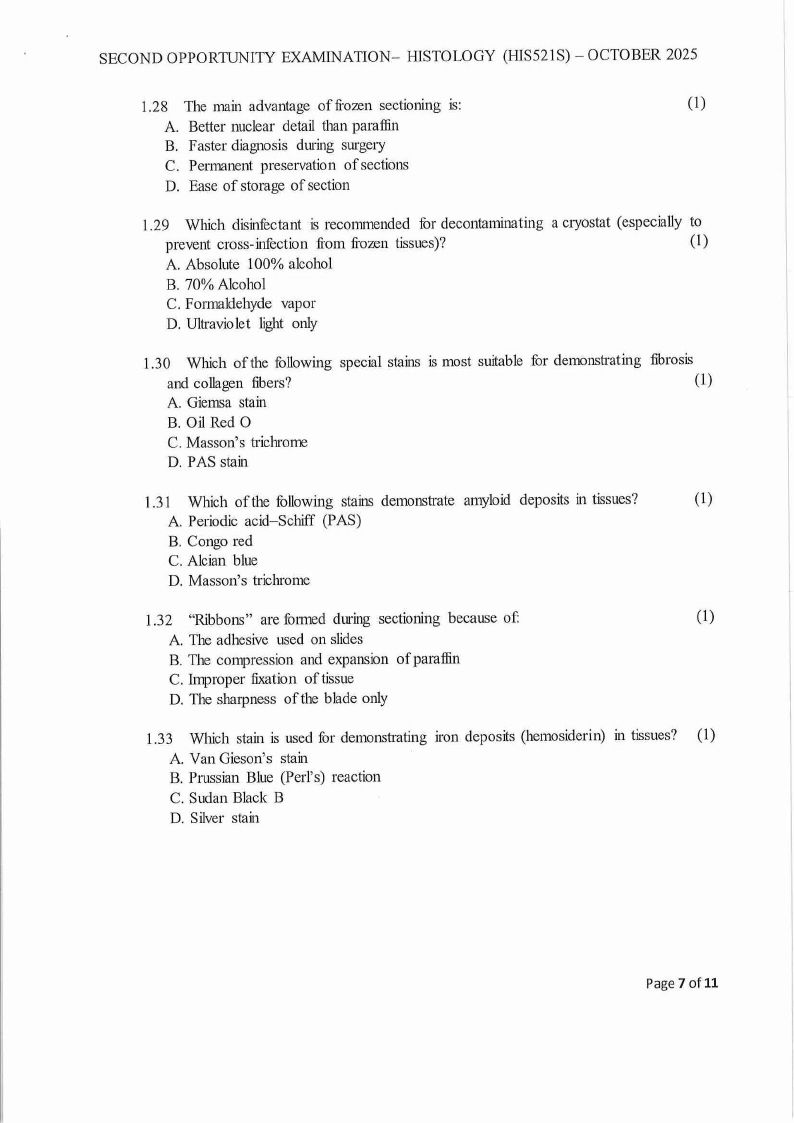
1.28 The main advantage of frozen sectioning IS:
(1)
A. Better nuclear detail than paraffin
B. Faster diagnosis during surge1y
C. Permanent preservation of sections
D. Ease of storage of section
1.29 Which disinfectant is recommended for decontaminating a c1yostat (especially to
prevent cross-infection from frozen tissues)?
(1)
A. Absolute 100% alcohol
B. 70% Alcohol
C. Formaldehyde vapor
D. Ultraviolet light only
1.30 Which of the following special stains is most suitable for demonstrating fibrosis
and collagen fibers?
(1)
A. Giemsa stain
B. Oil Red 0
C. Masson's trichrome
D. PAS stain
1.31 Which of the following stains demonstrate amyloid deposits in tissues?
(1)
A. Periodic acid- Schiff (PAS)
B. Congo red
C. Alcian blue
D. Masson's trichrome
1.32 "Ribbons" are formed during sectioning because of:
(1)
A. The adhesive used on slides
B. The compression and expansion of paraffin
C. Improper fixation of tissue
D. The sharpness of the blade mtly
1.33 Which stain is used for demonstrating iron deposits (hemosiderin) in tissues? (1)
A. Van Gieson's stain
B. Prussian Blue (Perl' s) reaction
C. Sudan Black B
D. Silver stain
Page 7 of 11

1.8 Page 8

▲back to top


SECOND OPPORTUNITY EXAMINATION- HISTOLOGY (HIS521S) - OCTOBER 2025
1.34 What is the role of the secondary antibody in a typical indirect IHC technique (1)
A. It binds to the antigen directly.
B. It catalyzes a color change in the chromogen.
C. It acts as a blocking solution to prevent non-specific binding.
D. It binds to the primary antibody and carries a label to amplify the signal
1.35 A pathologist uses Gomori's Methenamine Silver (GMS) stain to diagnose a
fungal infection. What is the primaiy color of the funga.l elements after this stain? (1)
A. Pink
B. Blue
C. Black
D. Red
1.36 All of the following substances would be expected to stain positive with the
Periodic Acid Schiff (PAS) stain, except:
(1)
A Glycogen
B. Basement membrane components
C. Lipids
D. Fungal organisms
Page 8 of 11

1.9 Page 9

▲back to top


SECOND OPPORTUNITY EXAMINATION- HISTOLOGY (HIS521S) - OCTOBER 2025
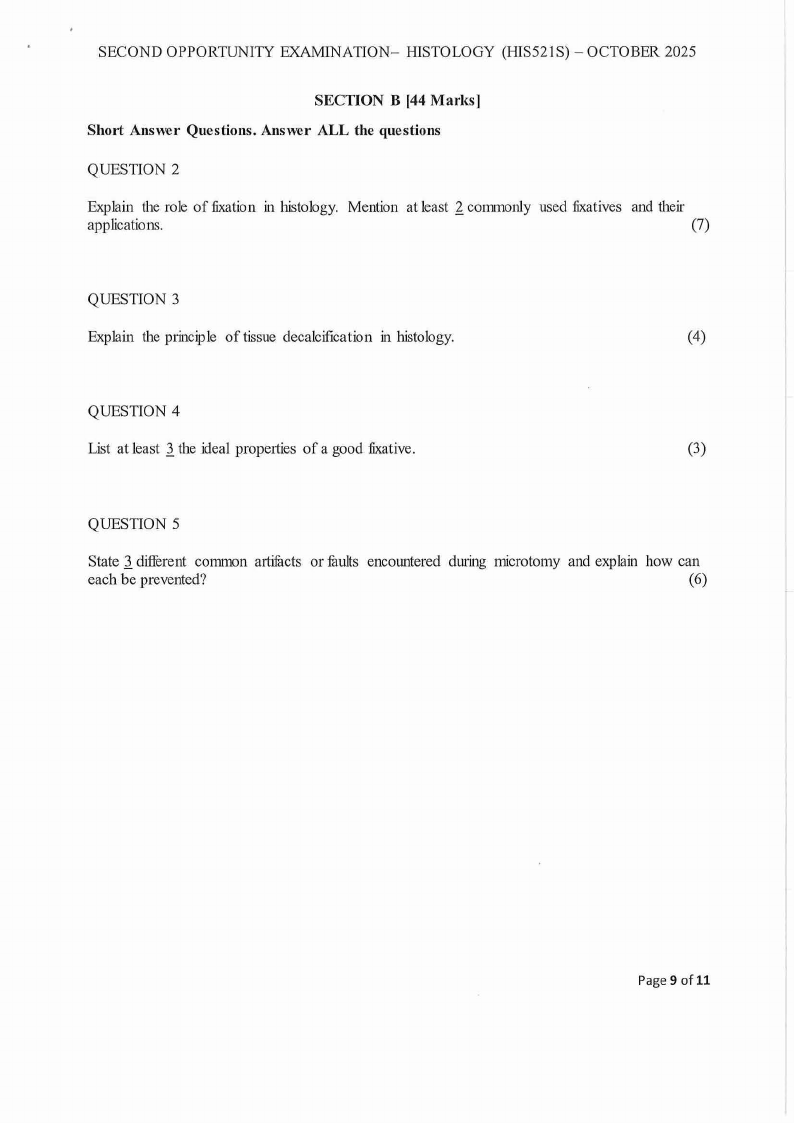
SECTION B [44 Marks]
Short Answer Questions. Answer ALL the questions
QUESTION 2
m Explain the role of fixation in histology. Mention at least 1 commonly used fixatives and their
~~~IB.
QUESTION 3
Explain the principle of tissue decalcifica tion in histology.
(4)
QUESTION 4
List at least J_ the ideal properties of a good fixative .
(3)
QUESTION 5
State 3 difrerent common artifacts or faults encountered during microtomy and explain how can
each be prevented?
(6)
Page 9 of 11

1.10 Page 10

▲back to top


SECOND OPPORTUNITY EXAMINATION- HISTOLOGY (HIS521S) - OCTOBER 2025
QUESTION 6
Compare paraffin sectioning with frozen sectioning in terms of
(12)
6.1 Technique
(2)
6.2 Applications
(2)
6.3 Advantages and disadvantages
(8)
QUESTION 7
What is the role of differentiation in regressive hematoxylin staining?
(1)
QUESTION 8
Why must sections be counterstained after hematoxylin?
(2)
QUESTION 9
Discuss the role of mordants in histologica1 staining with suitable examples.
(6)
QUESTION 10
Connective tissue is one of the four basic types of body tissues, and it provides suppmt, binding,
protection, transpmt, and storage. State 3 main components of connective tissue.
(3)
Page 10 of 11

2 Pages 11-20

▲back to top


2.1 Page 11

▲back to top


SECOND OPPORTUNITY EXAMINATION- HISTOLOGY (HIS521S) - OCTOBER 2025
SECTION C [20 Marks!
ESSAY QUESTIONS
NB!! Only choose ONE question to answer
QUESTION 11
11.1 Describe the principles ofimmunohistochemistry and discuss how antigen- antibody
interactions are visualized in tissue sections.
(20)
OR
QUESTION 12
12. l Define tissue processing and discuss and explain the significance of each sequential step
involved in routine paraffin wax tissue processing. The steps must be discussed in its
chronological order
(20)
OR
QUESTION 13
A cryostat in histology is a specialized piece of equipment used for cutting very thin sections of
biological tissue that has been rapidly frozen. These frozen sections are then used for
microscopic examination, typically in diagnostic pathology, research, and ce1tain surgical
settings. Write an essay about cryostat histology.
(20)
Your essay content must:
13.1 Define cryostat and describe its principle.
13.2 State the indications for using c1yostat frozen sections.
13.3 Describe the advantages and disadvantages of cryostat sections.
13.4 Outline the safety precautions while using a c1yostat.
END OF EXAM. GOOD LUCK!!!!
Page 11 of 11