HIS521S - HISTOLOGY - 1ST OPP - NOV 2025


HIS521S - HISTOLOGY - 1ST OPP - NOV 2025


1 Pages 1-10

▲back to top


1.1 Page 1

▲back to top


FIRST OPPORTUNITY EXAMINATION- HISTOLOGY (HIS52IS) - OCTOBER 2025
nAmlBIA unlVERSITY
OF SCIEnCE AnD TECHnOLOGY
FACULTY OF HEATH, APPLIED SCIENCES AND NATURAL RESOURCES
SCHOOL OF HEALTH SCIENCES
DEPARTMENT OF CLINICAL HEALTH SCIENCES
QUALIFICATION: BACHELOR OF MEDICAL LABORATORY SCIENCES
QUALIFICATION CODE: BMLS
COURSE CODE: HIS521S
SESSION: OCTOBER 2025
DURATION: 3 HOURS
LEVEL: 6
COURSE NAME: HISTOLOGY
PAPER: THEORY
MARKS: 100
FIRST OPPORTUNITY EXAMINATION QUESTION PAPER
EXAMINER(S)
MR JOHANNES ENDJALA
MODERATOR
MS NDESHIPEWA HAMATUI-VALOMBOLA
INSTRUCTIONS
I. Answer all the questions.
2. Read all questions carefully before answering.
3. Write clearly and neatly
4. Numbers the answers clearly
PERMISSIBLE MATERIALS
1. Examination Question Paper
2. Answering book
3. Non programmable calculator is allowed
THIS QUESTION PAPER CONSISTS OF 11 PAGES (Including this front page)
Page 1 of 11

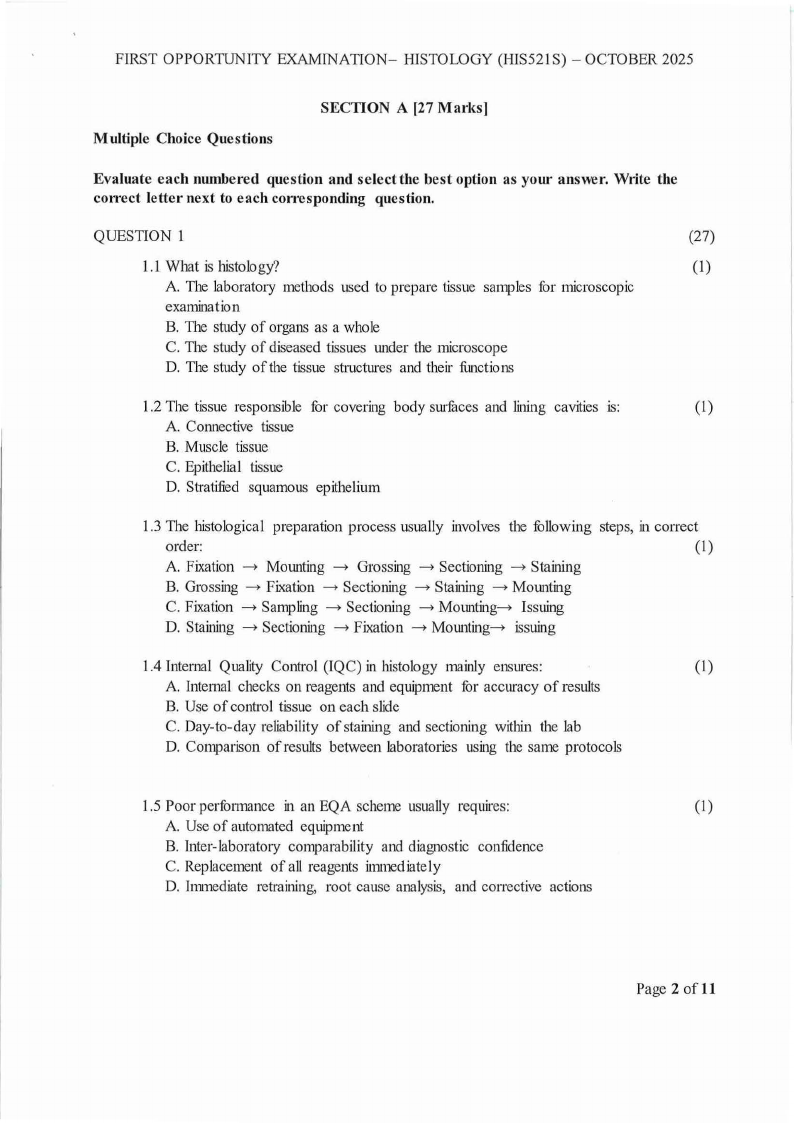
1.2 Page 2

▲back to top


FIRST OPPORTUNITY EXAMINATION- HJSTOLOGY (HIS52 1S) - OCTOBER 2025
Multiple Choice Questions
SECTION A [27 Marks]
Evaluate each numbered question and select the best option as your answer. Waite the
con-ect letter next to each corresponding question.
QUESTION 1
(27)
l. l What is histology?
(l)
A. The laborato1y methods used to prepare tissue samples for microscopic
exarnina t ion
B. The study of organs as a whole
C. The study of diseased tissues under the microscope
D. The study of the tissue structures and their functions
1.2 The tissue responsible for coveting body swfcices and lining cavities ts:
(1)
A. Connective tissue
B. Muscle tissue
C. Epithelial tissue
D. Stratified squamous epithelium
1.3 The histological preparation process usually involves the fo llowing steps, in correct
order:
(1)
A. Fixation -► Mounting -► Grossing -► Sectioning -► Staining
B. Grossing -► Fixation -► Sectioning -► Staining -► Mounting
C. Fixation -► Sampling -► Sectioning -► Mounting-► Issuing
D. Staining -► Sectioning -► Fixation -► Mow1ting-► issuing
1.4 Internal Quality Control (IQC) in histology mainly ensures:
(1)
A. Internal checks on reagents and equipment fo r accuracy of results
B. Use of control tissue on each slide
C. Day-to-day reliability of staining and sectioning within the lab
D. Comparison ofresults between laboratories using the same protocols
1.5 Poor perforrnance in an EQA scheme usually requires:
(1)
A. Use of automated equipment
B. Inter-laborato1y comparability and diagnostic confidence
C. Replacement of all reagents immediately
D. Immediate retraining, root cause analysis, and corrective actions
Page 2 of 11

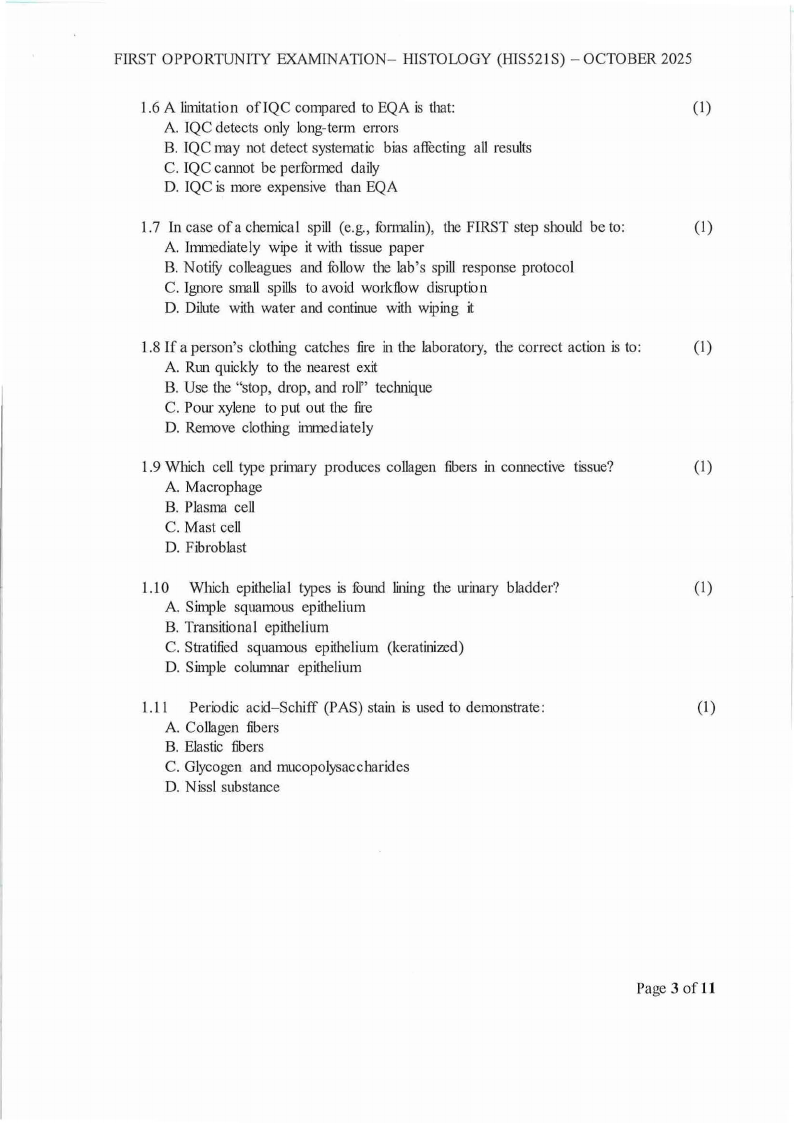
1.3 Page 3

▲back to top


FIRST OPPORTUNITY EXAMINATION- HISTOLOGY (H1S521S) - OCTOBER 2025
1.6 A lirnitation ofIQC compared to EQA is that:
(1)
A. IQC detects only long-term errors
B. IQC may not detect systematic bias affecting all results
C. IQC cannot be performed daily
D. IQC is more expensive than EQA
1.7 In case ofa chemica l spill (e.g., formalin), the FIRST step shottld be to:
(1)
A. Immediately wipe it with tissue paper
B. Notify colleagues and follow the lab's spill response protocol
C. Ignore small spills to avoid worldlow disruption
D. Dilute with water and continue with wiping it
1.8 If a person's clothing catches fire in the laboratory, the correct action is to:
(1)
A. Run quickly to the nearest exit
B. Use the "stop, drop, and roll" technique
C. Pour xylene to put out the fire
D. Remove clothing immediately
1.9 Which cell type primary produces collagen fibers in connective tissue?
(1)
A. Macrophage
B. Plasma cell
C. Mast cell
D. Fibroblast
1. 10 Which epithelial types is fow1d lining the w·inary bladder?
(1)
A. Simple squamous epithelium
B. Transitiona I epithelium
C . Stratified squamous epithelium (keratinized)
D. Simple columnar epithelium
1.11 Periodic acid- Schiff (PAS) stain is used to demonstrate:
(1)
A. Collagen fibers
B. Elastic fibers
C. Glycogen and mucopolysaccharides
D. Niss[ substance
Page 3 of 11

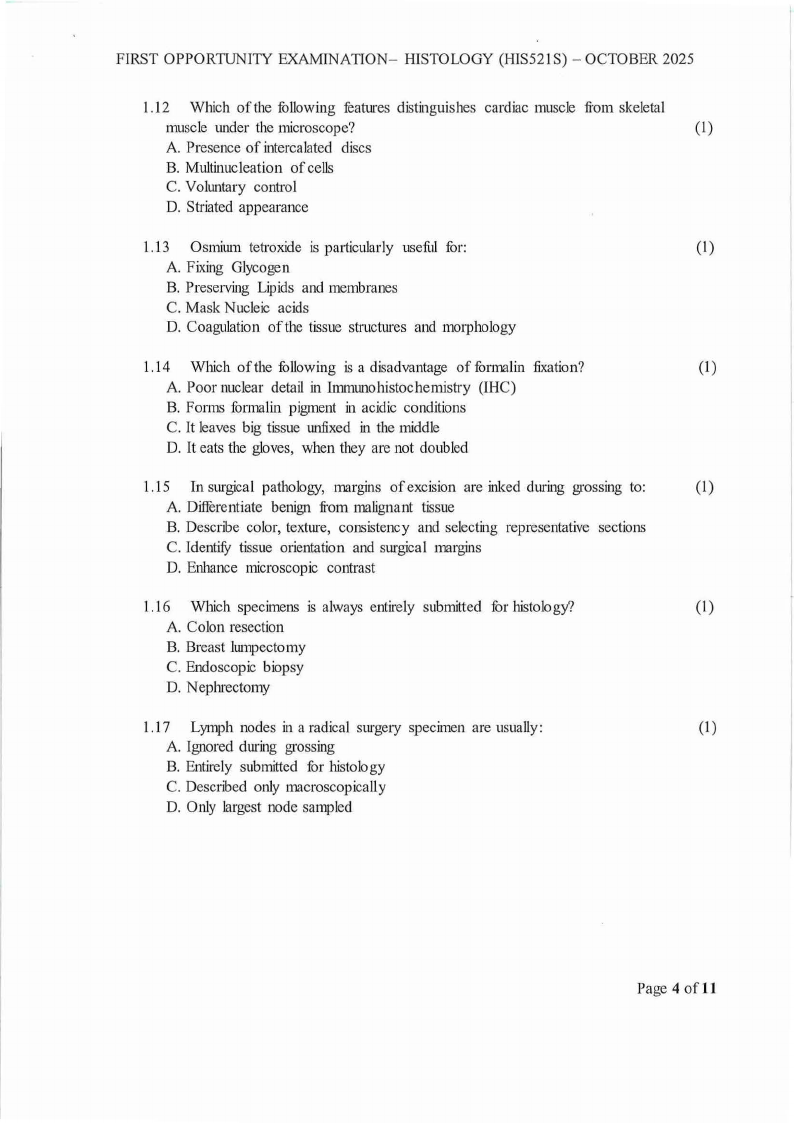
1.4 Page 4

▲back to top


FIRST OPPORTUNITY EXAMINATION- HISTOLOGY (HIS521S) - OCTOBER 2025
1.12 Which of the following features distinguishes cardiac muscle from skeletal
muscle under the microscope?
( 1)
A. Presence of intercalated discs
B. Multinucleation of cells
C. Voluntary control
D. Striated appearance
1.13 Osmium tetroxide is pa1ticularly usefol for:
(1)
A. Fixing Glycogen
B. Preserving Lipids and membranes
C. Mask Nucleic acids
D. Coagulation ofthe tissue strnctures and morphology
1.14 Which of the following is a disadvantage of formalin fixation?
(1)
A. Poor nuclear detail in lrnmunohistochemistry (IHC)
B. Forms formalin pigment in acidic conditions
C. It leaves big tissue unfixed in the middle
D. It eats the gloves, when they are not doubled
1. 15 In surgica l pathology, margins of excision are inked during grossing to:
(1)
A. Differentiate benign from malignant tissue
B. Describe color, texture, consistency and selecting representative sections
C. Identify tissue orientation and surgica l margins
D. Enhance microscopic contrast
1.16 Which specimens is always entirely submitted for histology?
(1)
A. Colon resection
B. Breast lumpectomy
C. Endoscopic biopsy
D. Nephrectomy
1.17 Lymph nodes in a radical surge1y specimen are usually:
(1)
A. Ignored dw·ing grossing
B. Entirely submitted for histology
C. Described only macroscopically
D. Only largest node sampled
Page 4 of 11

1.5 Page 5

▲back to top


FIRST OPPORTUNITY EXAMINATION- HISTOLOGY (HIS521S) - OCTOBER 2025
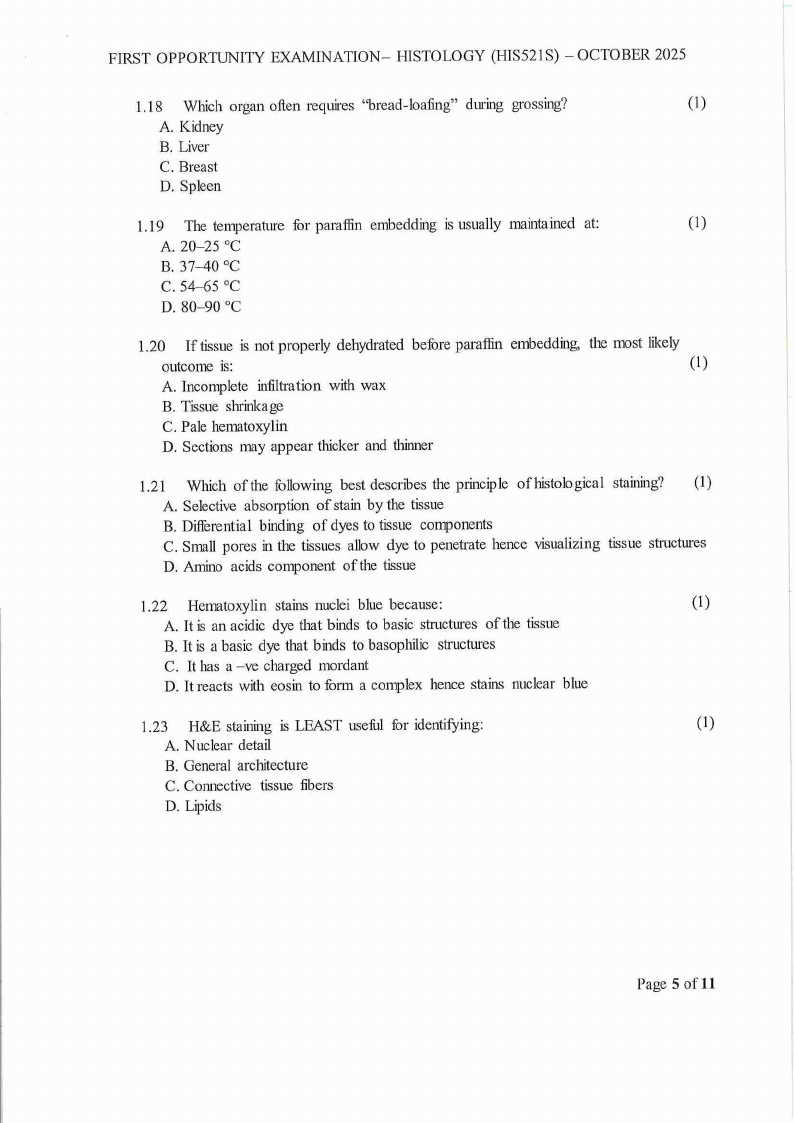
1.18 Which organ often requires ''bread-loafing" during grossing?
(1)
A. Kidney
B. Liver
C. Breast
D. Spleen
1.19 The temperature for paraffin embedding is usually maintained at:
(1)
A. 20-25 °C
B. 37--40 °C
C. 54-65 °C
D. 80- 90 °C
1.20 If tissue is not properly dehydrated before paraffin embedding, the most likely
outcome is:
(1)
A. Incomplete infiltration with wax
B. Tissue slu'it1kage
C. Pale hematoxylin
D. Sections may appear thicker and thinner
1.21 Which ofthe following best describes the principle ofhistological staining? (1)
A. Selective absorption of stain by the tissue
B. Differential binding of dyes to tissue components
C. Small pores in the tissues allow dye to penetrate hence visualizing tissue strnctures
D. Amino acids component ofthe tissue
1.22 Hematoxylin stains nuclei blue because:
(1)
A. It is an acidic dye that binds to basic structures of the tissue
B. It is a basic dye that binds to basophilic structures
C. It has a - ve charged mordant
D. It reacts with eosin to form a complex hence stains nuclear blue
1.23 H&E staining is LEAST usefi.tl for identifying:
(1)
A. Nuclear detail
B. General architecture
C. Co1mective tissue fibers
D. Lipids
Page 5 ofll

1.6 Page 6

▲back to top


FIRST OPPORTUNITY EXAMINATION- HJSTOLOGY (HIS521S) - OCTOBER 2025
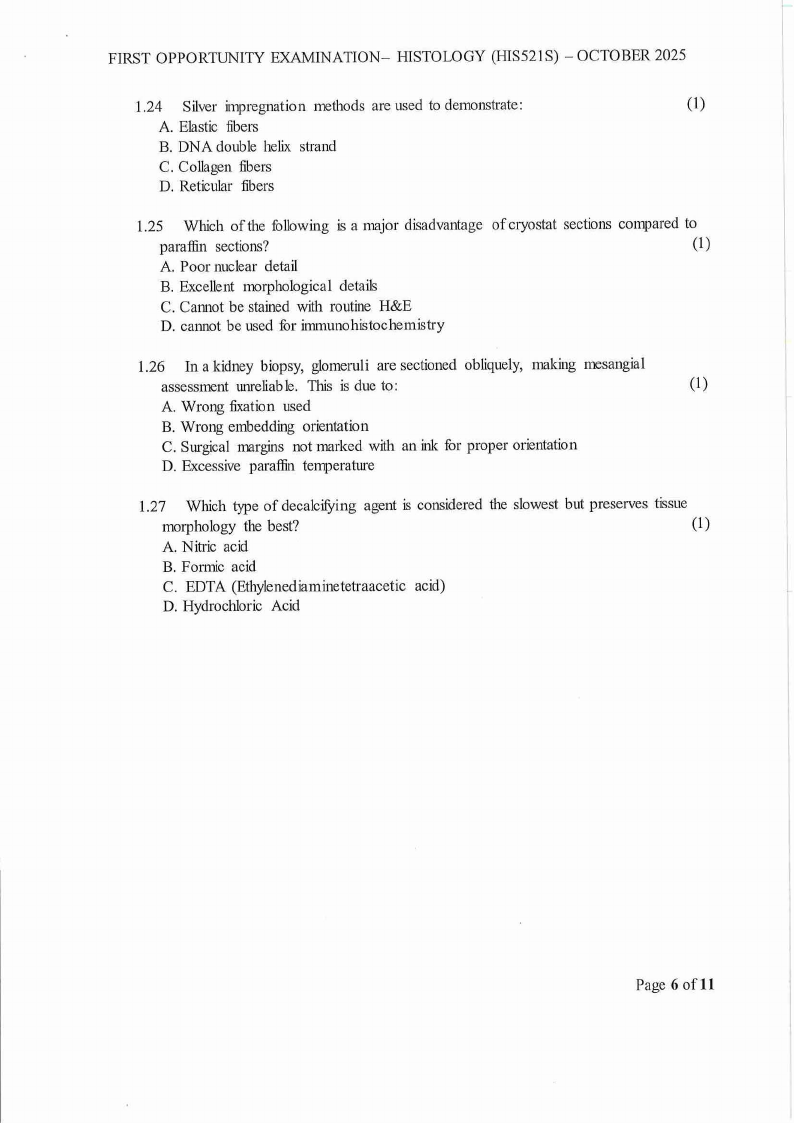
1.24 Silver impregnation methods are used to demonstrate:
(1)
A. Elastic fibers
B. DNA double helix strand
C. Collagen fibers
D. Reticular fibers
1.25 Which of the following is a major disadvantage of cryostat sections compared to
paraffin sections?
(1)
A. Poor nuclear detail
B. Excellent morphological details
C. Cannot be stained with routine H&E
D. cannot be used for immunohistochemistry
1.26 In a kidney biopsy, glomeruli are sectioned obliquely, making mesangial
assessment unreliable. This is due to:
(1)
A. Wrong fixation used
B. Wrong embedding orientation
C. Surgical margins not marked with an ink for proper orientation
D. Excessive paraffin temperature
1.27 Which type of decalcifying agent is considered the slowest but preserves tissue
morphology the best?
(l)
A. Nitric acid
B. Formic acid
C. EDTA (Ethylenediaminetetraacetic acid)
D. Hydrochloric Acid
Page 6 of 11

1.7 Page 7

▲back to top


FIRST OPPORTUNITY EXAMINATION- HISTOLOGY (HIS521 S) - OCTOBER 2025
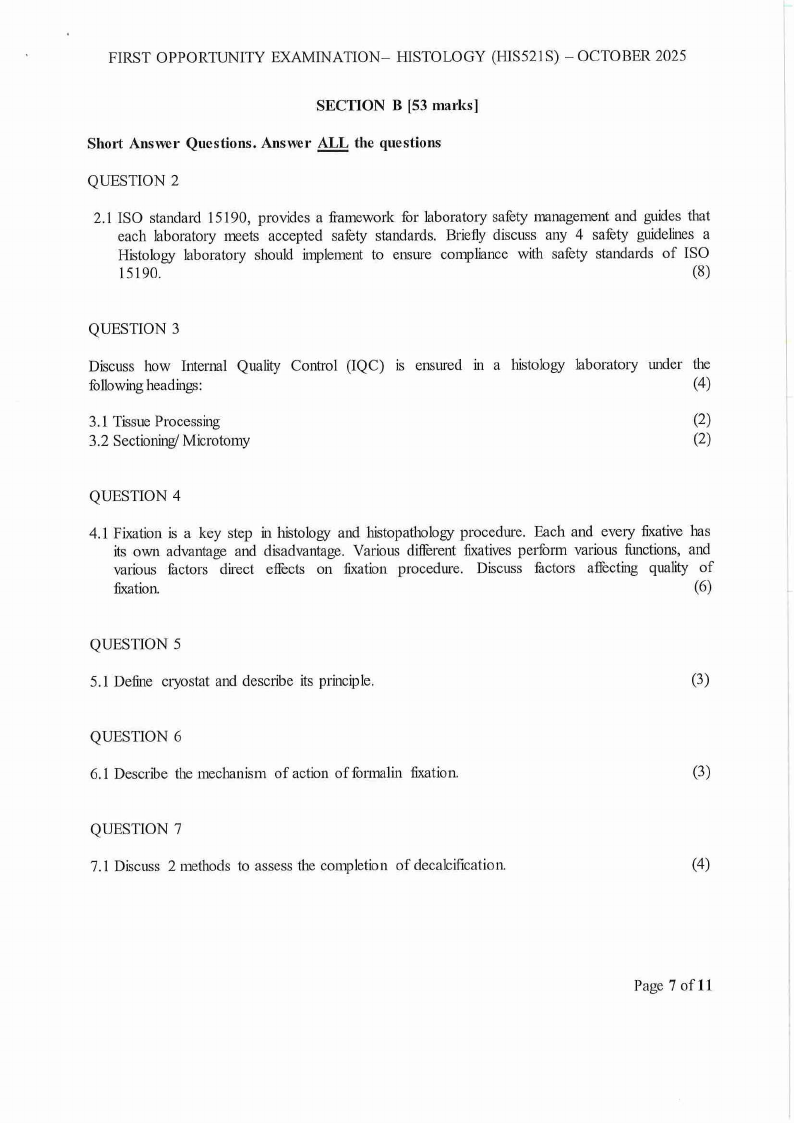
SECTION B [53 marks]
Short Answer Questions. Answer ALL the questions
QUESTION 2
2.1 ISO standard 15190, provides a framework for laboratory safety management and guides that
each laboratory meets accepted safety standards. Briefly discuss any 4 safety guidelines a
Histology laborato1y should implement to ensure compliance with safety standards of ISO
15190.
(8)
QUESTION 3
Discuss how Internal Quality Control (IQC) JS ensured m a histology laborato1y under the
following headings:
(4)
3.1 Tissue Processing
(2)
3.2 Sectioninw Microtomy
(2)
QUESTION 4
4.1 Fixation is a key step in histology and histopathology procedure. Each and eve1y :fixative has
its own advantage and disadvantage. Various different :fixatives pe1form various functions, and
various factors direct effects on fixation procedure. Discuss factors aflecting quality of
:fixation.
(6)
QUESTION 5
5.1 Define c1yostat and describe its principle.
(3)
QUESTION 6
6.1 Describe the mechanism of action of formalin fixatio1L
(3)
QUESTION 7
7.1 Discuss 2 methods to assess the completion of decalci:fication.
(4)
Page 7 of 11

1.8 Page 8

▲back to top


FIRST OPPORTUNITY EXAMINATION- HISTOLOGY (HIS521S) - OCTOBER 2025
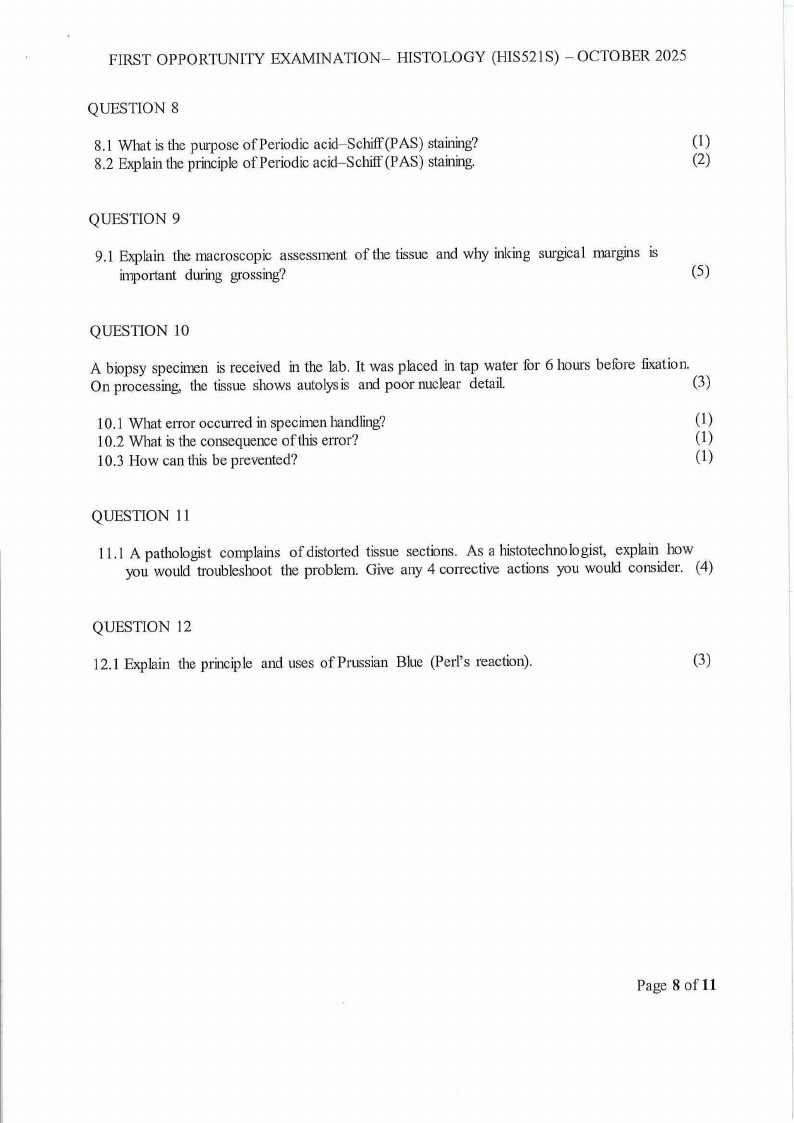
QUESTION 8
8.1 What is the purpose of Periodic acid-Schiff(PAS) staining?
(1)
8.2 Explain the principle of Periodic acid-Schiff (PAS) staining.
(2)
QUESTION 9
9.1 Explain the macroscopic assessment of the tissue and why inking surgica I margins IS
important during grossing?
(5)
QUESTION 10
A biopsy specimen is received in the lab. It was placed in tap water for 6 hours before fixation.
On processing, the tissue shows autolysis and poor nuclear detail.
(3)
10.1 What e1rnr occuned in specimen handling?
(1)
10.2 What is the consequence ofthis error?
(1)
10.3 How can this be prevented?
(1)
QUESTION 11
l 1.1 A pathologist complains of distorted tissue sections. As a histotechnologist, explain how
you would troubleshoot the problem. Give any 4 corrective actions you would consider. (4)
QUESTION 12
12.1 Explain the principle and uses of Prussian Blue (Perl' s reaction).
(3)
Page 8 of 11

1.9 Page 9

▲back to top


FIRST OPPORTUNITY EXAMINATION- IBSTOLOGY (HIS521S) - OCTOBER 2025
QUESTION 13
13.1 Explain how false-positive and false-negative results occur in irnmunohistochemistry (4)
QUESTION 14
A 52-year-old woman undergoes breast-conserving surgery for a lump. The surgeon requests an
intraoperative consultation to assess whether the surgica I margin is free of tumor.
(3)
14.1 Which histological technique would you use?
(1)
14.2 Why is c1yostat preferred here instead ofparaffin sections?
(1)
14.3 What is a limitation ofthis technique in margin assessment?
(1)
Page 9 of 11

1.10 Page 10

▲back to top


FIRST OPPORTUNITY EXAMINATION- HISTOLOGY (HIS521 S) - OCTOBER 2025
SECTION C [20 Marks}
ESSAY QUESTION
NB!! Only choose ONE question to answer
QUESTION 15
Routine (H&E) staining is the corner stone of tissue-based diagnosis. TI1e process stains thin
tissue sections so that pathologists can visualize tissue morphology. The process uses a
haematoxylin dye and an eosin dye to stain tissue structmes. Properly applied, this technique
provides exceptional detail of tissue structure and the makeup of the cells. Write an essay about
routine H&E staining procedure used in Histology.
[20]
Your content must:
15.1 Descnbe the principle of Hematoxylin and Eosin (H&E) staining.
15.2 Outline the routine steps in H&E staining of paraffin-embedded tissue sections.
15.3 What is the diagnostic significance of H&E staining?
15.4 What are the advantages and limitations of H&E staining?
OR
QUESTION 16
Case Study: Breast
A 52-year-old woman presents with a painless breast lump. Histology shows malignant epithelial
cells arranged in duct-like structw·es invading the surrounding stroma, with desmoplastic
reaction.
[20]
Your content must:
16.1 Describe the normal histology of the breast.
16.2 Explain the histological features of invasive ductal carcinoma.
16.3 Correlate the histological findings with possible clinical manifestations.
16.4 Discuss the prognostic significance of histological grading in breast cancer.
Page 10 of 11

2 Pages 11-20

▲back to top


2.1 Page 11

▲back to top


FIRST OPPORTUNITY EXAMINATION- HISTOLOGY (HIS521 S) - OCTOBER 2025
OR
QUESTION 17
A cryostat in histology is a specialized piece of equipment used for cutting very thin sections of
biological tissue that has been rapidly frozen. These frozen sections are then used for
microscopic examination, typically in diagnostic pathology, research, and ce1tain surgical
settings. Write an essay about cryostat histology.
[20]
Your essay content must:
17.1 Define cryostat and describe its principle.
17.2 State the indications for using cryostat frozen sections.
17.3 Describe the advantages and disadvantages of c1yostat sections.
17.4 Outline the safety precautions while using a c1yostat.
END OF EXAM. GOOD LUCK!!!!
Page 11 of 11