


 |
EOA611S-ECONOMICS OF AGRICULTURE- 1ST OPP- JUNE 2025 |
|
|
1 Page 1 |
▲back to top |
nAmlBIA
unlVERSITY
OF SCIEnCE Ano TECHnOLOGY
FACULTY OF COMMERCE, HUMAN SCIENCES AND EDUCATION
DEPARTMENT OF ECONOMICS, ACCOUNTING AND FINANCE
QUALIFICATION: BACHELOR OF ECONOMICS
QUALIFICATION CODE: 07BECO
LEVEL: 7
COURSE CODE: EOA611 S
SESSION: JUNE 2025
COURSE NAME: ECONOMICS OF AGRICULTURE
PAPER: THEORY
DURATION: 3 HOURS
MARKS: 100
FIRST OPPORTUNITY EXAMINATION PAPER
EXAMINER(S) MR. MALLY LIKUKELA
MODERATOR: MR. PINEHAS NANGULA
INSTRUCTIONS
1. This paper consist of section A,B,C and D
2. Answer ALL questions
3. Number your answers in accordance with the question paper.
4. Start each section answer on a new page
5. Write clearly and legibly
PERMISSIBLE MATERIALS
1. Pen/pencil/eraser
2. Ruler
3. Calculator
THIS EXAMINATION PAPER CONSISTS OF 7 PAGES (Including this front page)
|
|
2 Page 2 |
▲back to top |
SECTION A: MULTIPLE CHOICE
10 MARKS
1. Demand is a schedule of
(a) how much of a good a person wants.
(b) each possible price and the amounts people will buy when their incomes change.
(c) how much of a good people will purchase at different prices.
(ct) how much of a good people will purchase at each different price and income.
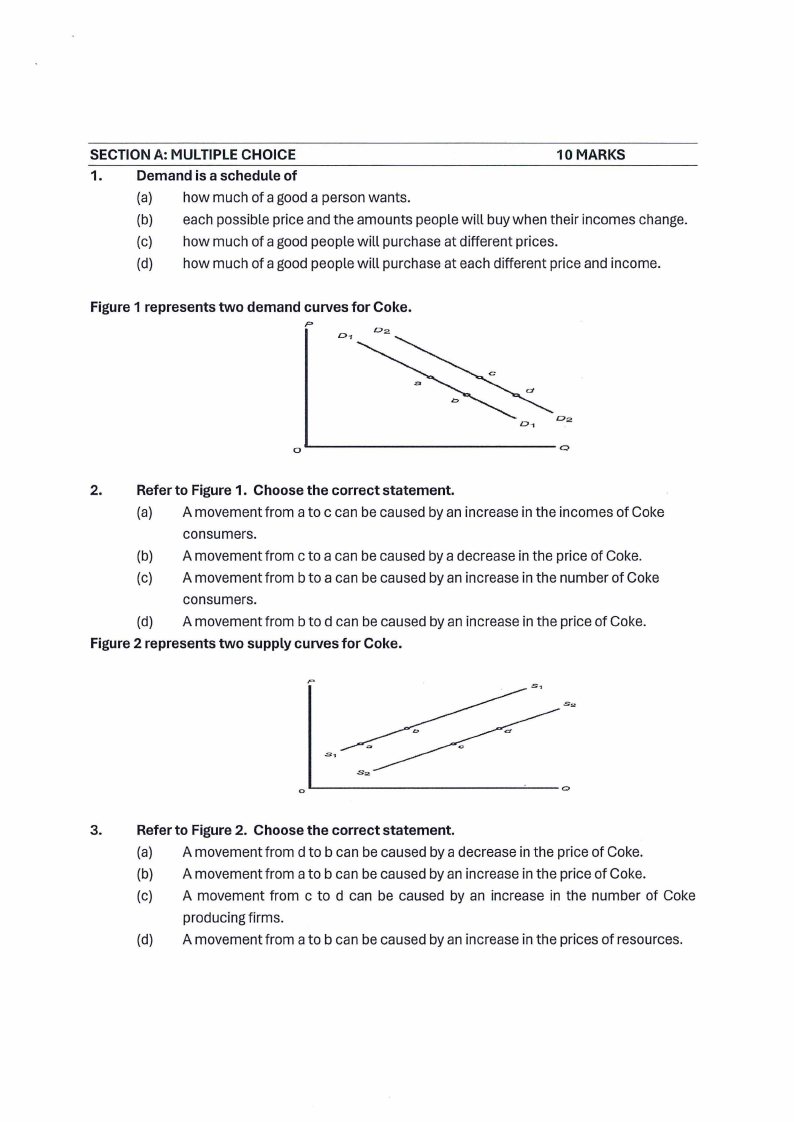
Figure 1 represents two demand curves for Coke.
p
o"----------------0
2. Refer to Figure 1. Choose the correct statement.
(a) A movement from a to c can be caused by an increase in the incomes of Coke
consumers.
(b) A movement from c to a can be caused by a decrease in the price of Coke.
(c) A movement from b to a can be caused by an increase in the number of Coke
consumers.
(ct) A movement from b to ctcan be caused by an increase in the price of Coke.
Figure2 represents two supply curves for Coke.
p
0---------------'---o
3.
Refer to Figure2. Choose the correct statement.
(a) A movement from ctto b can be caused by a decrease in the price of Coke.
(b) A movement from a to b can be caused by an increase in the price of Coke.
(c) A movement from c to ct can be caused by an increase in the number of Coke
producing firms.
(ct) A movement from a to b can be caused by an increase in the prices of resources.
|
|
3 Page 3 |
▲back to top |
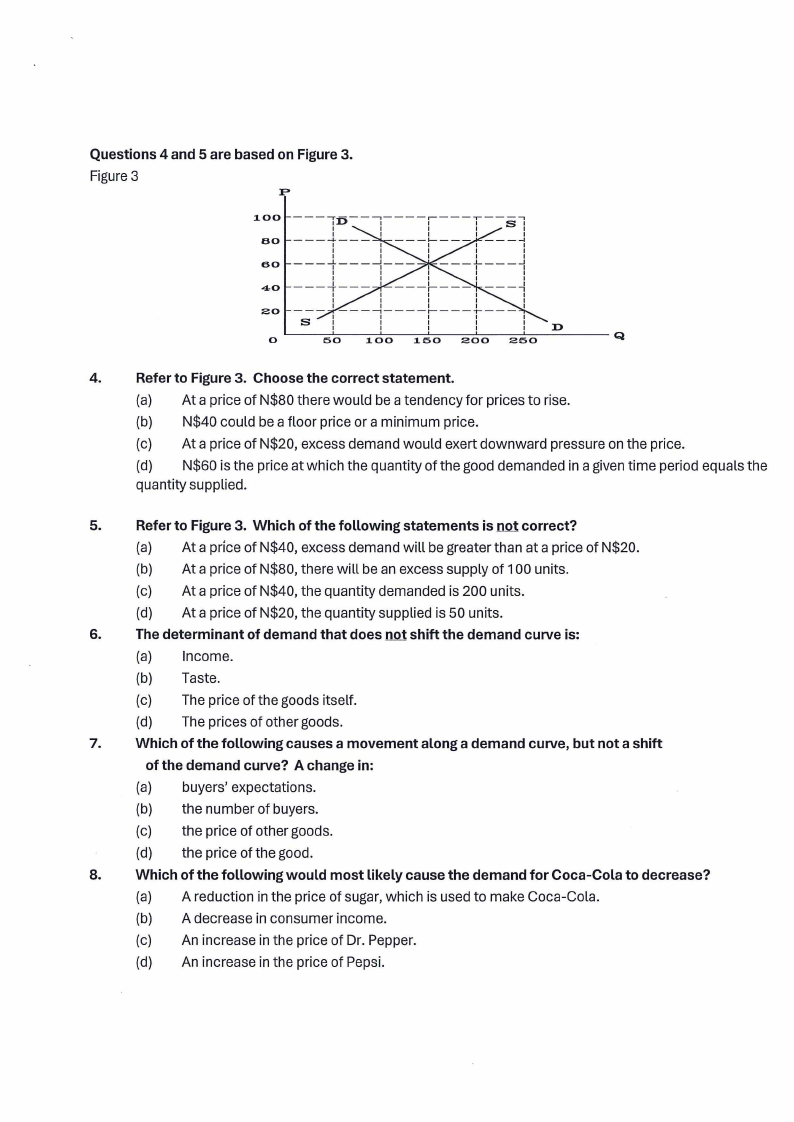
Questions 4 and 5 are based on Figure3.
Figure 3
100
BO
60
4-0
---in--7--------T---7
I
I
---4
I
I
I
---~
I
I
I
---,
I
I
20
--
s
~-I---r---r I
I
I
I
I
o~--5~0--1-o~o--1~5-0--2-0~0--2~5-o----Q
I
I
I
I
I
JI
I
I
7I
I
I
I
D
4.
Refer to Figure 3. Choose the correct statement.
{a) At a price of N$80 there would be a tendency for prices to rise.
{b) N$40 could be a floor price or a minimum price.
{c) At a price of N$20, excess demand would exert downward pressure on the price.
{d) N$60 is the price at which the quantity of the good demanded in a given time period equals the
quantity supplied.
5.
Refer to Figure 3. Which of the following statements is rutl correct?
{a) At a pdce of N$40, excess demand will be greater than at a price of N$20.
{b) At a price of N$80, there will be an excess supply of 100 units.
{c) At a price of N$40, the quantity demanded is 200 units.
{d) At a price of N$20, the quantity supplied is 50 units.
6. The determinant of demand that does not shift the demand curve is:
{a) Income.
{b) Taste.
{c) The price of the goods itself.
{d) The prices of other goods.
7. Which of the following causes a movement along a demand curve, but not a shift
of the demand curve? A change in:
{a) buyers' expectations.
{b) the number of buyers.
{c) the price of other goods.
{d) the price of the good.
8. Which of the following would most likely cause the demand for Coca-Cola to decrease?
{a) A reduction in the price of sugar, which is used to make Coca-Cola.
{b) A decrease in consumer income.
{c) An increase in the price of Dr. Pepper.
{d) An increase in the price of Pepsi.
|
|
4 Page 4 |
▲back to top |
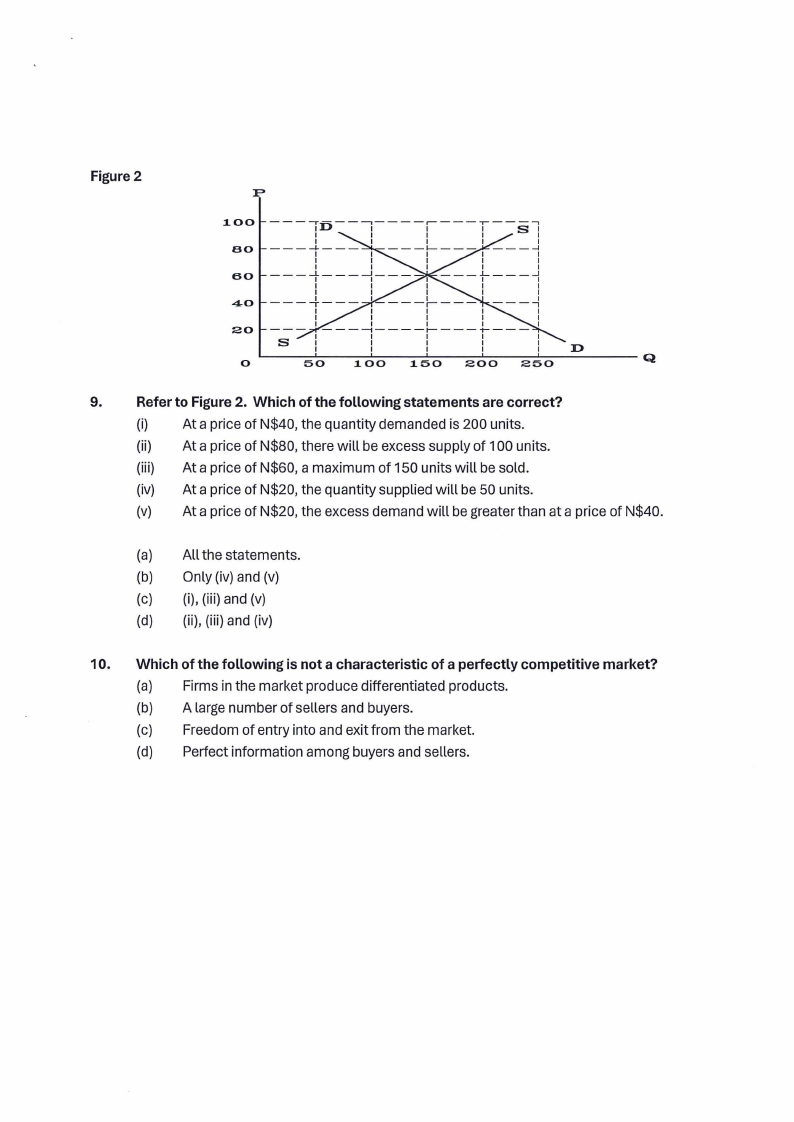
Figure2
100 ---10--7----r---T---7
I
I
I
I
I
I
BO
I
I
I
I
60
---~
I
I
I
I
I
I
I
I
4-0
---,
I
7I
I
I
20
--
~-I---r---r- I
I
S
i
i
i
I
I
I
D
o'---5~0---1-0~0--1-5_.._0
__ 2_,o~o--2-5~0-----Q
9. Refer to Figure2. Which of the following statements are correct?
(i) At a price of N$40, the quantity demanded is 200 units.
(ii) At a price of N$80, there will be excess supply of 100 units.
(iii) At a price of N$60, a maximum of 150 units will be sold.
(iv) At a price of N$20, the quantity supplied will be 50 units.
(v) At a price of N$20, the excess demand will be greater than at a price of N$40.
(a) All the statements.
(b) Only (iv) and (v)
(c) (i), (iii) and (v)
(d) (ii), (iii) and (iv)
10. Which of the following is not a characteristic of a perfectly competitive market?
(a) Firms in the market produce differentiated products.
(b) A large number of sellers and buyers.
(c) Freedom of entry into and exit from the market.
(d) Perfect information among buyers and sellers.
|
|
5 Page 5 |
▲back to top |
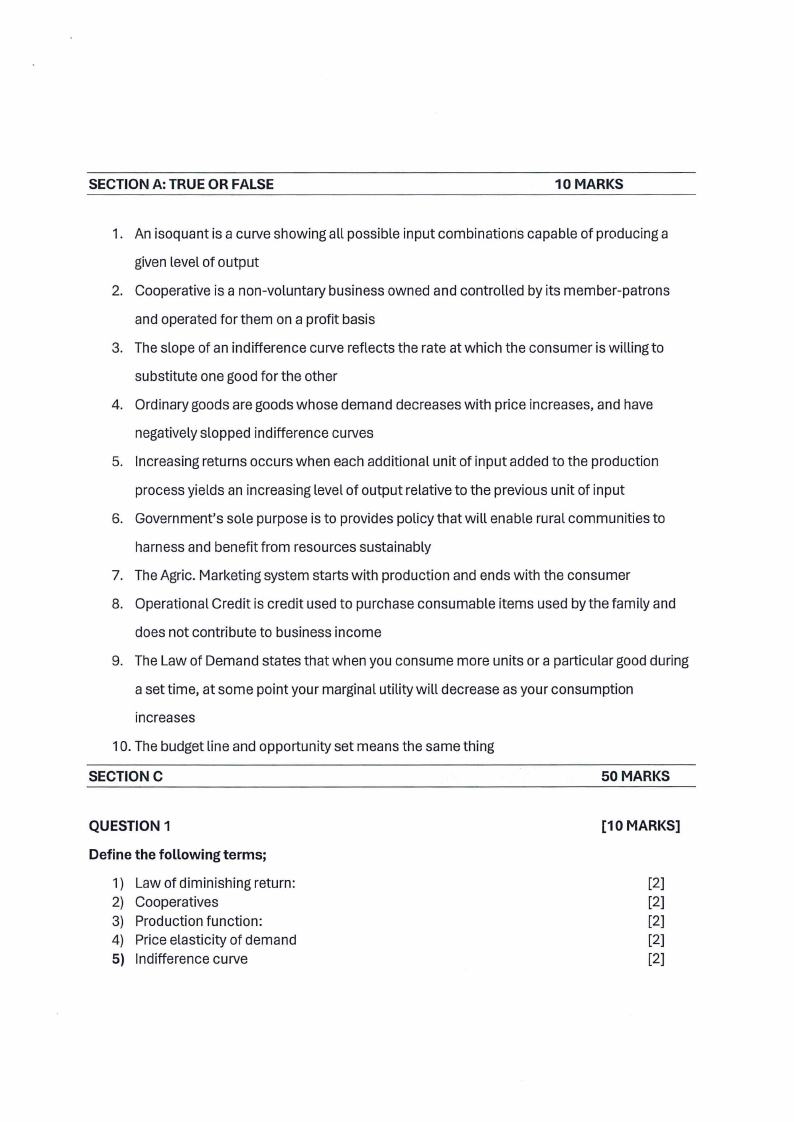
SECTION A: TRUE OR FALSE
10MARKS
1. An isoquant is a curve showing all possible input combinations capable of producing a
given level of output
2. Cooperative is a non-voluntary business owned and controlled by its member-patrons
and operated for them on a profit basis
3. The slope of an indifference curve reflects the rate at which the consumer is willing to
substitute one good for the other
4. Ordinary goods are goods whose demand decreases with price increases, and have
negatively slopped indifference curves
5. Increasing returns occurs when each additional unit of input added to the production
process yields an increasing level of output relative to the previous unit of input
6. Government's sole purpose is to provides policy that will enable rural communities to
harness and benefit from resources sustainably
7. The Agric. Marketing system starts with production and ends with the consumer
8. Operational Credit is credit used to purchase consumable items used by the family and
does not contribute to business income
9. The Law of Demand states that when you consume more units or a particular good during
a set time, at some point your marginal utility will decrease as your consumption
increases
1O.The budget line and opportunity set means the same thing
SECTION C
50 MARKS
QUESTION 1
Define the following terms;
1) Law of diminishing return:
2) Cooperatives
3) Production function:
4) Price elasticity of demand
5) Indifference curve
[10 MARKS]
[2]
[2]
[2]
[2]
[2]
|
|
6 Page 6 |
▲back to top |
QUESTION2
[25 MARKS]
Use the following information to answer the following questions.
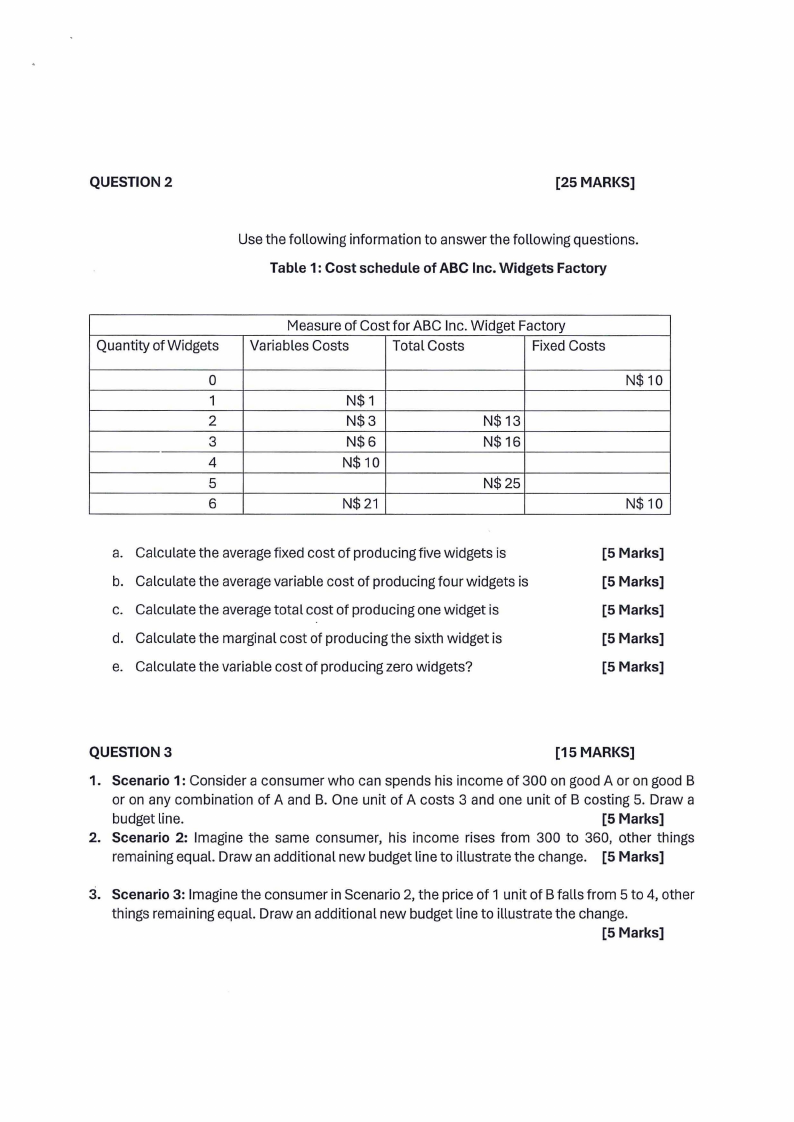
Table 1: Cost schedule of ABC Inc. Widgets Factory
Quantity of Widgets
0
1
2
3
4
5
6
Measure of Cost for ABC Inc. Widget Factory
Variables Costs
Total Costs
Fixed Costs
N$1
N$3
N$6
N$10
N$21
N$13
N$16
N$25
N$10
N$10
a. Calculate the average fixed cost of producing five widgets is
b. Calculate the average variable cost of producing four widgets is
C. Calculate the average total cost of producing one widget is
d. Calculate the marginal cost of producing the sixth widget is
e. Calculate the variable cost of producing zero widgets?
[5 Marks]
[5 Marks]
[5 Marks]
[5 Marks]
[5 Marks]
QUESTION3
[15 MARKS]
1. Scenario 1: Consider a consumer who can spends his income of 300 on good A or on good B
or on any combination of A and B. One unit of A costs 3 and one unit of B costing 5. Draw a
budget line.
[5 Marks]
2. Scenario 2: Imagine the same consumer, his income rises from 300 to 360, other things
remaining equal. Draw an additional new budget line to illustrate the change. [5 Marks]
3. Scenario 3: Imagine the consumer in Scenario 2, the price of 1 unit of B falls from 5 to 4, other
things remaining equal. Draw an additional new budget line to illustrate the change.
[5 Marks]
|
|
7 Page 7 |
▲back to top |
SECTION D
QUESTION 1
30 MARKS
[10 MARKS]
Discuss in detail the main challenges that Government is facing when it come to land reforms in
Namibia·.
[10 Marks]
QUESTION 2:
[10 MARKS]
Suppose that your monthly quantity demand function for a product is Qd = 500-S0P and your
monthly supply function for a product id Qs = 50+25P;
Solve for the equilibrium price and quantity.
QUESTION 3:
[10 MARKS]
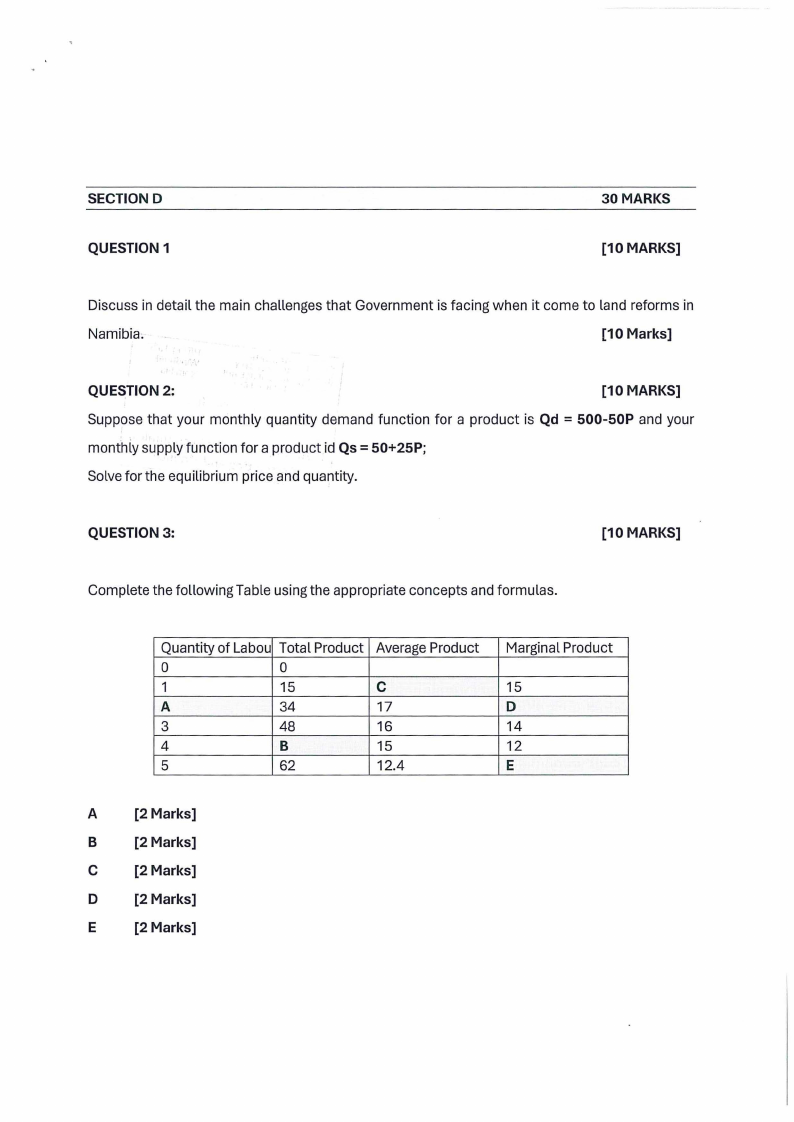
Complete the following Table using the appropriate concepts and formulas.
Quantity of Labou Total Product
0
0
1
15
A
34
3
48
4
B
5
62
Average Product
C
17
16
15
12.4
Marginal Product
15
D
14
12
E
A
[2 Marks]
B
[2 Marks]
C
[2 Marks]
D
[2 Marks]
E
[2 Marks]