


 |
MVT620S - MARKETING IN VET B - 1ST OPP - NOVEMBER 2025 |
|
|
1 Page 1 |
▲back to top |
nAm I BIA un IVERSITY
OF SCIEnCE Ano TECH n OLOGY
FACULTY OF COMMERCE, HUMAN SCIENCE AND EDUCATION
DEPARTMENT OF TECHNICAL, VOCATIONAL EDUCATION AND TRAINING
QUALIFICATION: DIPLOMA IN TECHNICAL AND VOCATIONAL EDUCATION AND TRAINING:
MANAGEMENT
QUALIFICATION CODE: 0GDTVM
COURSE CODE: MVT620S
LEVEL: 6
COURSE NAME: MARKETING IN VET B
SESSION: NOVEMBER 2025
PAPER: 1
DURATION : 3 HOURS
MARKS: 100
FIRST OPPORTUNITY EXAMINATION QUESTION PAPER
EXAMINER(S) BERNADETTE E CLOETE
MODERATOR: NDAKOLUTE S. ABRAHAM
INSTRUCTIONS
1. Answer ALL the questions.
2. Read all the questions carefully before answering.
3. Number the answers clearly
THIS QUESTION PAPER CONSISTS OF _5_ PAGES (Including this front page)
|
|
2 Page 2 |
▲back to top |
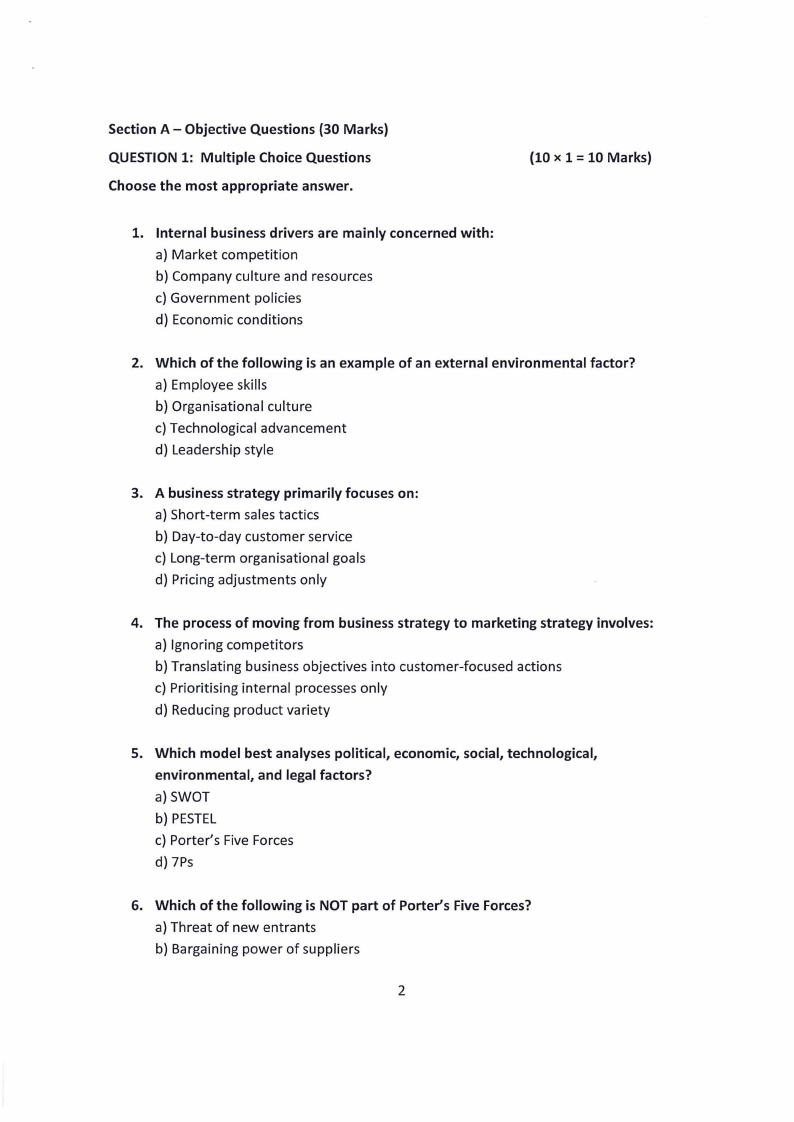
Section A - Objective Questions (30 Marks)
QUESTION 1: Multiple Choice Questions
Choose the most appropriate answer.
(10 x 1 = 10 Marks)
1. Internal business drivers are mainly concerned with:
a) Market competition
b) Company culture and resources
c) Government policies
d) Economic conditions
2. Which of the following is an example of an external environmental factor?
a) Employee skills
b) Organisational culture
c) Technological advancement
d) Leadership style
3. A business strategy primarily focuses on:
a) Short-term sales tactics
b) Day-to-day customer service
c) Long-term organisational goals
d) Pricing adjustments only
4. The process of moving from business strategy to marketing strategy involves:
a) Ignoring competitors
b) Translating business objectives into customer-focused actions
c) Prioritising internal processes only
d) Reducing product variety
5. Which model best analyses political, economic, social, technological,
environmental, and legal factors?
a) SWOT
b) PESTEL
c) Porter's Five Forces
d) 7Ps
6. Which of the following is NOT part of Porter's Five Forces?
a) Threat of new entrants
b) Bargaining power of suppliers
2
|
|
3 Page 3 |
▲back to top |
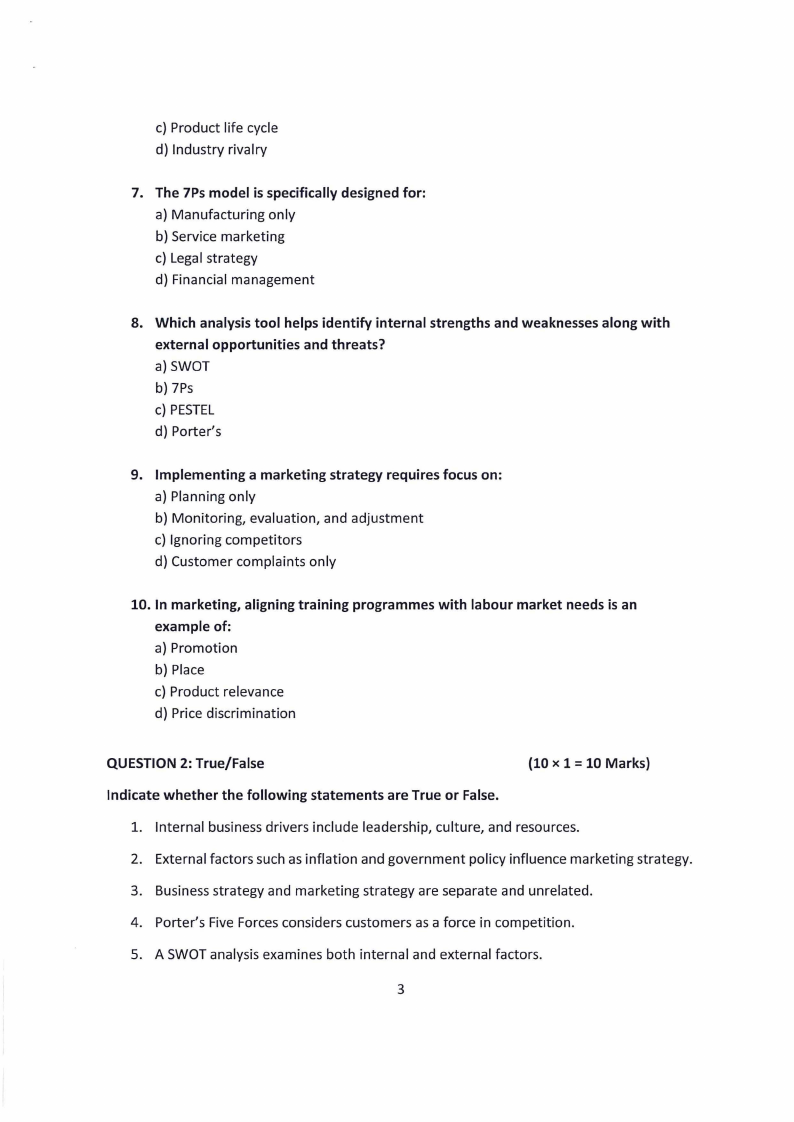
c) Product life cycle
d) Industry rivalry
7. The 7Ps model is specifically designed for:
a) Manufacturing only
b) Service marketing
c) Legal strategy
d) Financial management
8. Which analysis tool helps identify internal strengths and weaknesses along with
external opportunities and threats?
a) SWOT
b) 7Ps
c) PESTEL
d) Porter's
9. Implementing a marketing strategy requires focus on:
a) Planning only
b) Monitoring, evaluation, and adjustment
c) Ignoring competitors
d) Customer complaints only
10. In marketing, aligning training programmes with labour market needs is an
example of:
a) Promotion
b) Place
c) Product relevance
d) Price discrimination
QUESTION 2: True/False
(10 x 1 = 10 Marks)
Indicate whether the following statements are True or False.
1. Internal business drivers include leadership, culture, and resources.
2. External factors such as inflation and government policy influence marketing strategy.
3. Business strategy and marketing strategy are separate and unrelated.
4. Porter's Five Forces considers customers as a force in competition .
5. A SWOT analysis examines both internal and external factors.
3
|
|
4 Page 4 |
▲back to top |
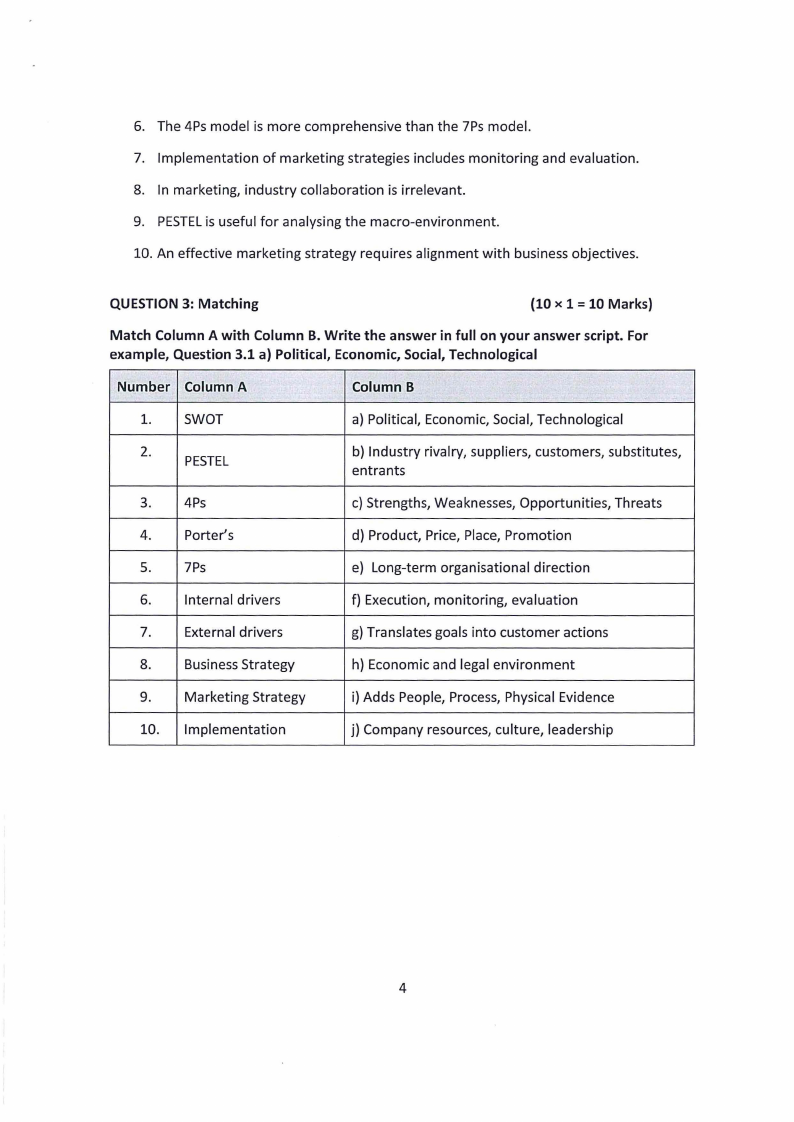
6. The 4Ps model is more comprehensive than the 7Ps model.
7. Implementation of marketing strategies includes monitoring and evaluation.
8. In marketing, industry collaboration is irrelevant.
9. PESTEL is useful for analysing the macro-environment.
10. An effective marketing strategy requires alignment with business objectives.
QUESTION 3: Matching
{10 x 1 = 10 Marks)
Match Column A with Column B. Write the answer in full on your answer script. For
example, Question 3.1 a) Political, Economic, Social, Technological
Number Column A
Column B
1. SWOT
a) Political, Economic, Social, Technological
2.
PESTEL
b) Industry rivalry, suppliers, customers, substitutes,
entrants
3. 4Ps
c) Strengths, Weaknesses, Opportunities, Threats
4. Porter's
d) Product, Price, Place, Promotion
5. 7Ps
e) Long-term organisational direction
6. Internal drivers
f) Execution, monitoring, evaluation
7. External drivers
g) Translates goals into customer actions
8. Business Strategy
h) Economic and legal environment
9. Marketing Strategy
i) Adds People, Process, Physical Evidence
10. Implementation
j) Company resources, culture, leadership
4
|
|
5 Page 5 |
▲back to top |
Section B: - Short Answer Questions
(25 Marks)
QUESTION 4: Answer ALL questions.
(5 x 5 = 25 Marks)
1. Explain the difference between internal and external business drivers, giving one
practical example of each in a TVET institution.
(5)
2. Describe how Porter's Five Forces can be applied to improve a TVET institution's
competitive position.
(5)
3. Using the PESTEL model, identify two external factors that could impact TVET
marketing in Namibia.
(5)
4. Discuss the importance of monitoring and evaluation when implementing a marketing
strategy.
(5)
5. Explain why graduate employment rates and success stories are considered strong
internal marketing tools for a TVET institution.
(5)
Section C- Essay Questions
(45 Marks)
Answer all THREE Questions.
(3 x 15 =45 Marks)
1. Developing a marketing strategy in TVET requires alignment between business
objectives and industry needs. Critically analyse this statement, giving practical
examples from the Namibian TVET context.
(15)
2. Discuss the application of the SWOT and 7Ps models in developing a marketing
strategy for a new short course in a TVET institution.
(15)
3. Implementation is the hardest part of any marketing strategy. Evaluate this statement
with reference to practical challenges and solutions in TVET marketing. (15)
TOTAL MARKS: 100
END OF QUESTION PAPER
5