


 |
MTA611S - MATHEMATICS FOR AGRIBUSINESS - 1ST OPP - JUNE 2025 |
|
|
1 Page 1 |
▲back to top |
nAm I BIA unlVERSITY
OF SCIEnCE Ano TECHnOLOGY
FACULTYOF HEALTH,NATURALRESOURCESAND APPLIEDSCIENCES
SCHOOLOF AGRICULTUREAND NATURALRESOURCESSCIENCES
DEPARTMENTOF AGRICULTURALSCIENCESAND AGRIBUSINESS
QUALIFICATION: BACHELOR OF SCIENCE IN AGRICULTURE
QUALIFICATION CODE: 07BAGA LEVEL: 7
COURSE CODE: MTA611S
SESSION: JUNE 2025
COURSE NAME: MATHEMATICS FOR
AGRIBUSINESS
PAPER: I
DURATION: 3 HOURS
MARKS: 100
FIRST OPPORTUNITY EXAMINATION QUESTION PAPER
EXAMTNER(S) MR POLYKARP AMUKUHU
MODERATOR:
DR TEOFILUS SHIIMI
INSTRUCTIONS
1. Attempt all questions.
2. Write clearly and neatly.
3. Number the answers clearly & correctly.
PERMISSIBLE MATERJALS
I. All written work MUST be done in blue or black ink
2. Calculators allowed
3. The LAST PAGE have FORMULAS
This question paper consists of 6 pages including the front page
|
|
2 Page 2 |
▲back to top |
Mathematics for Agribusiness
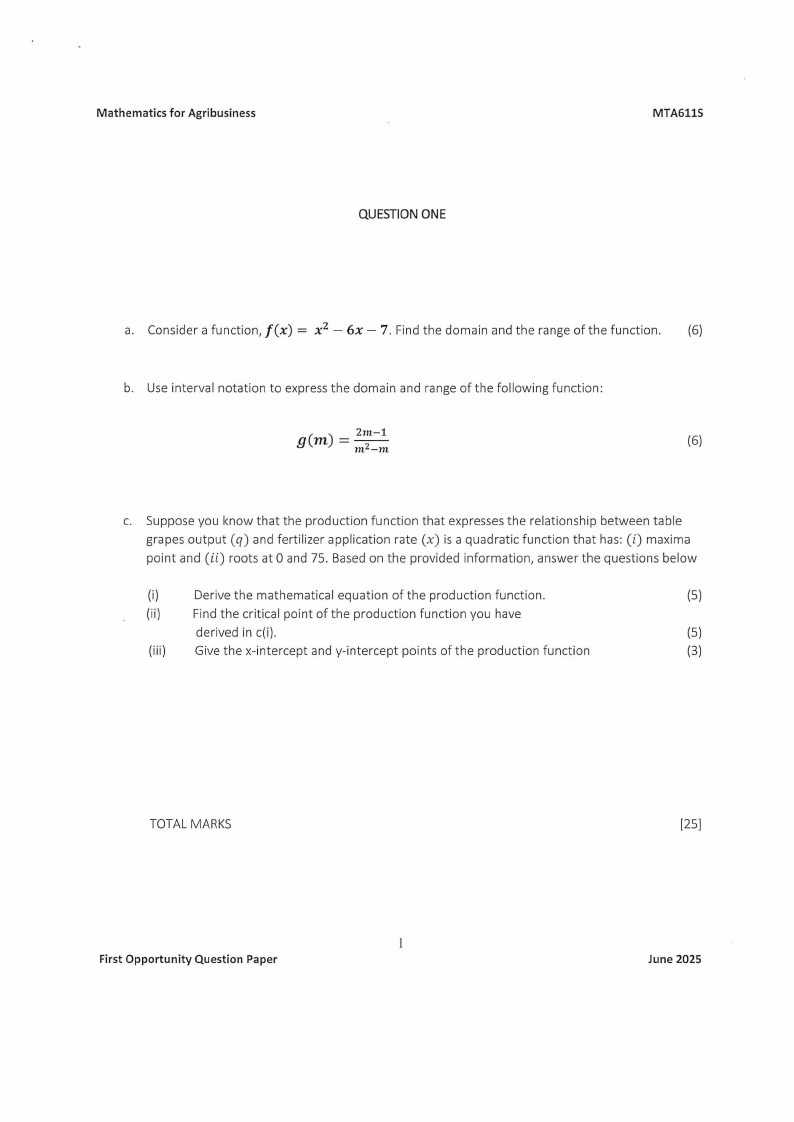
QUESTIONONE
MTA611S
= a. Consider a function, f(x) x2 - 6x- 7. Find the domain and the range of the function.
(6)
b. Use interval notation to express the domain and range of the following function:
= g(m)
Zm-1
m2-m
(6)
c. Suppose you know that the production function that expresses the relationship between table
grapes output (q) and fertilizer application rate (x) is a quadratic function that has: (i) maxima
point and (ii) roots at Oand 75. Based on the provided information, answer the questions below
(i)
Derive the mathematical equation of the production function.
(5)
(ii)
Find the critical point of the production function you have
derived in c(i).
(5)
(iii) Give the x-intercept and y-intercept points of the production function
(3)
TOTAL MARKS
First Opportunity Question Paper
[25]
June 2025
|
|
3 Page 3 |
▲back to top |
Mathematics for Agribusiness
MTA611S
QUESTIONTWO
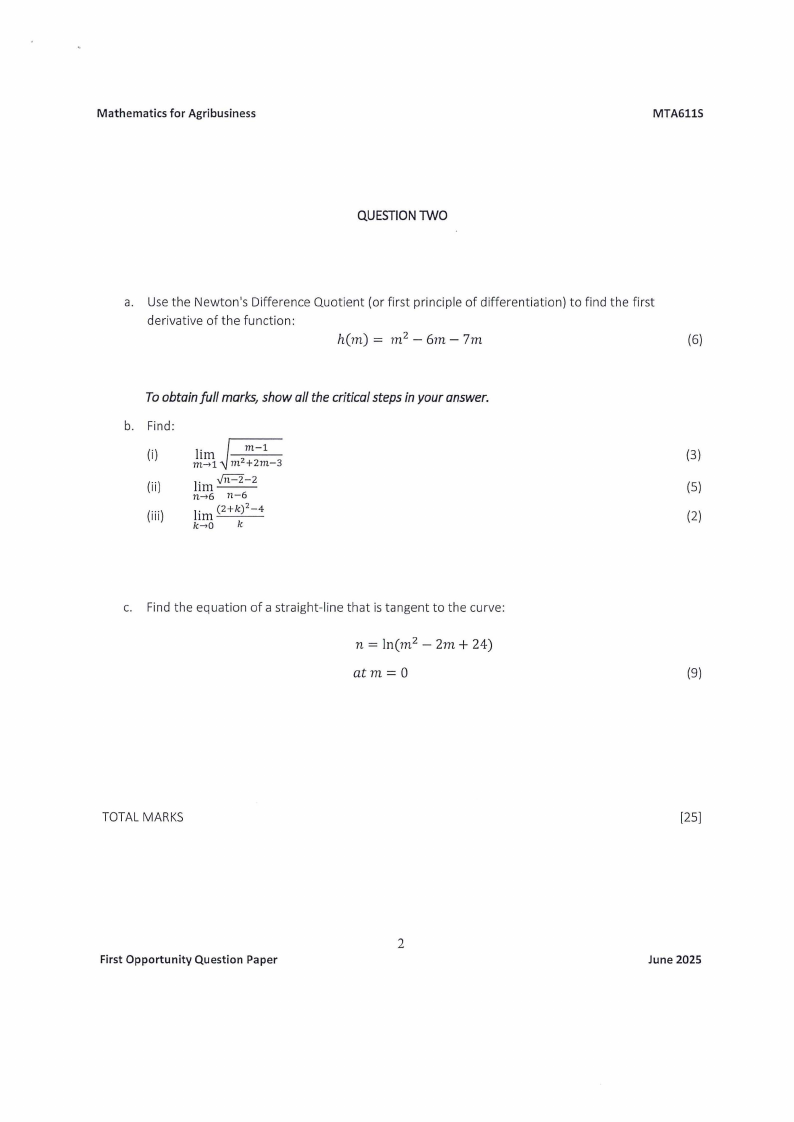
a. Use the Newton's Difference Quotient (or first principle of differentiation) to find the first
derivative of the function:
= h(m) m 2 - 6m - 7m
(6)
Toobtainfullmarks,show allthe criticalsteps inyouranswer.
b. Find:
(i)
Jim
n1->l
m-1
m 2 +2m-3
(3)
(ii)
h. m-.-,-/n-2-2
(S)
n->6 n-6
(iii)
Jr"m (2+k) 2 -4
(2)
k->O
k
c. Find the equation of a straight-line that is tangent to the curve:
n = ln(m 2 - 2m + 24)
atm = 0
(9)
TOTAL MARKS
2
First Opportunity Question Paper
(25]
June 2025
|
|
4 Page 4 |
▲back to top |
Mathematics for Agribusiness
QUESTIONTHREE
MTA611S
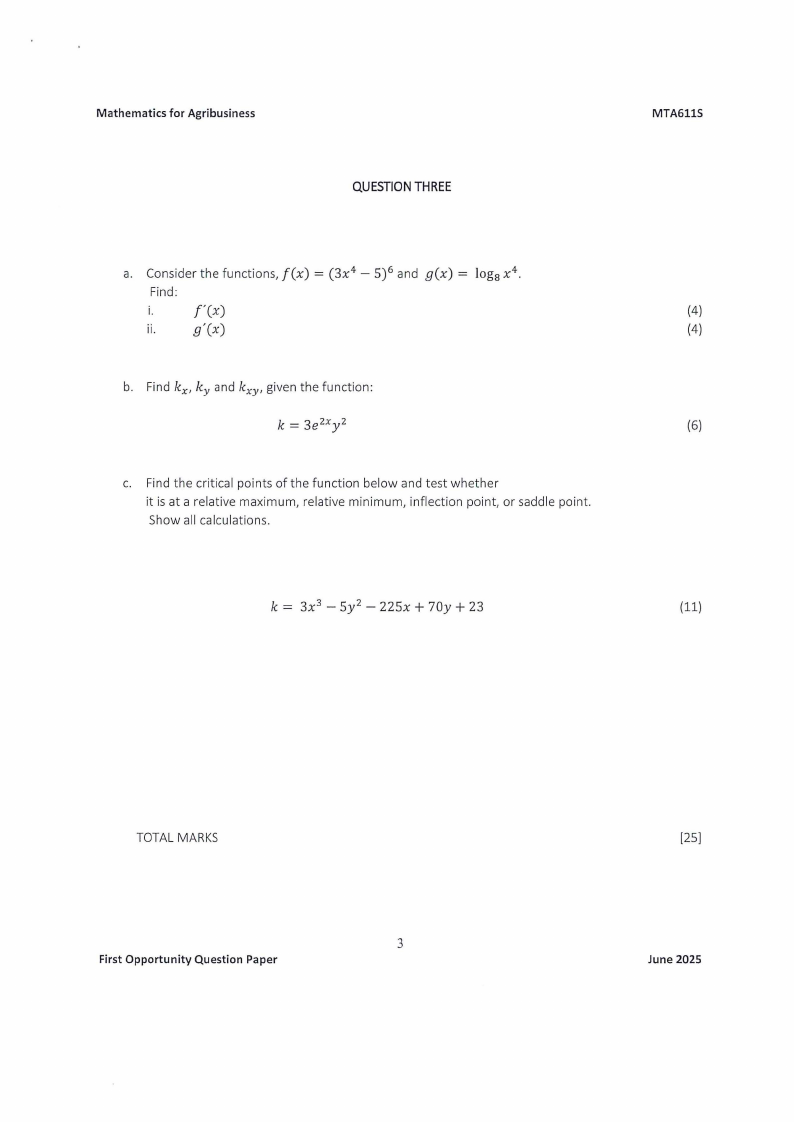
a. Consider the functions, f(x) = (3x 4 - 5) 6 and g(x) = log8 x 4 .
Find:
i.
f'(x)
(4)
ii.
g'(x)
(4)
b. Find kx, ky and kxy, given the function:
(6)
c. Find the critical points of the function below and test whether
it is at a relative maximum, relative minimum, inflection point, or saddle point.
Show all calculations.
k = 3x 3 - Sy 2 - 225x + 70y + 23
(11)
TOTAL MARKS
3
First Opportunity Question Paper
[25]
June 2025
|
|
5 Page 5 |
▲back to top |
Mathematics for Agribusiness
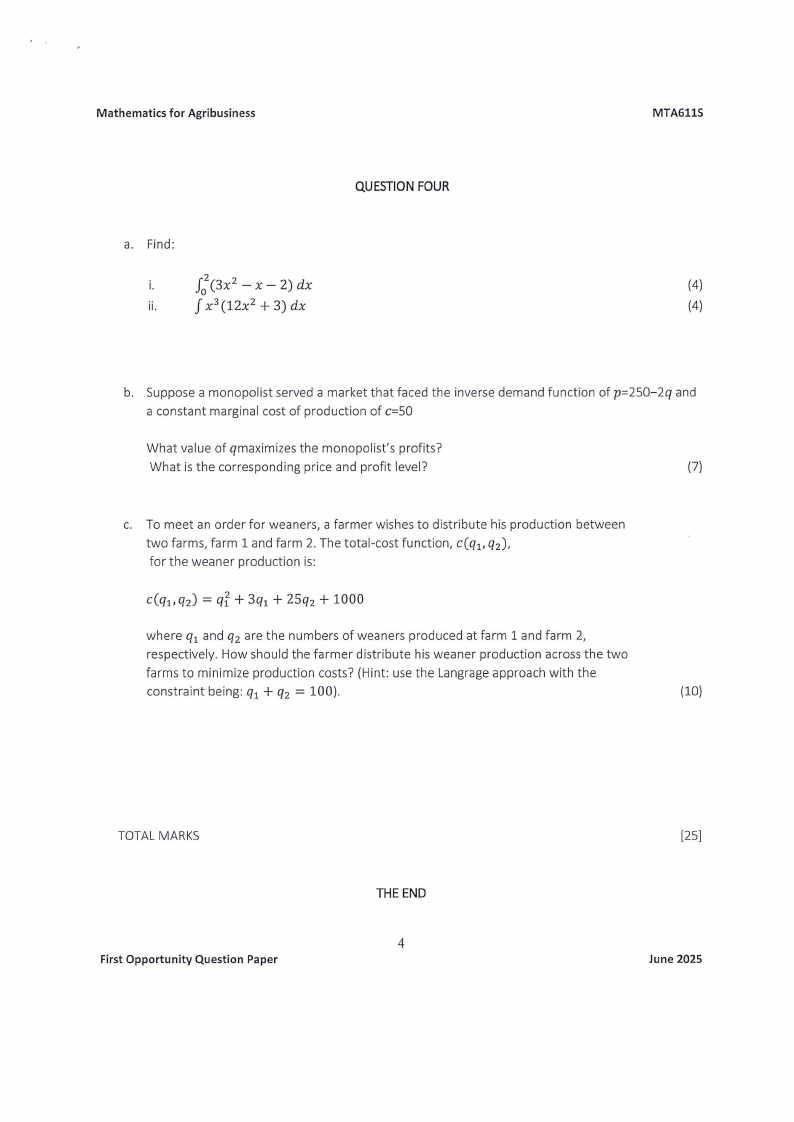
QUESTIONFOUR
a. Find:
i.
J2
0
(3x
2
-
x-
2) dx
ii.
f x 3 (12x 2 + 3) dx
MTA611S
(4)
(4)
b. Suppose a monopolist served a market that faced the inverse demand function of p=250-2q and
a constant marginal cost of production of c=50
What value of qmaximizes the monopolist's profits?
What is the corresponding price and profit level?
(7)
c. To meet an order for weaners, a farmer wishes to distribute his production between
two farms, farm 1 and farm 2. The total-cost function, c(qi, q2 ),
for the weaner production is:
where q1 and q2 are the numbers of weaners produced at farm 1 and farm 2,
respectively. How should the farmer distribute his weaner production across the two
farms to minimize production costs? (Hint: use the Langrage approach with the
constraint being: q1 + q2 = 100).
{10)
TOTAL MARKS
First Opportunity Question Paper
THEEND
4
[25]
June 2025
|
|
6 Page 6 |
▲back to top |
Mathematics for Agribusiness
MTA611S
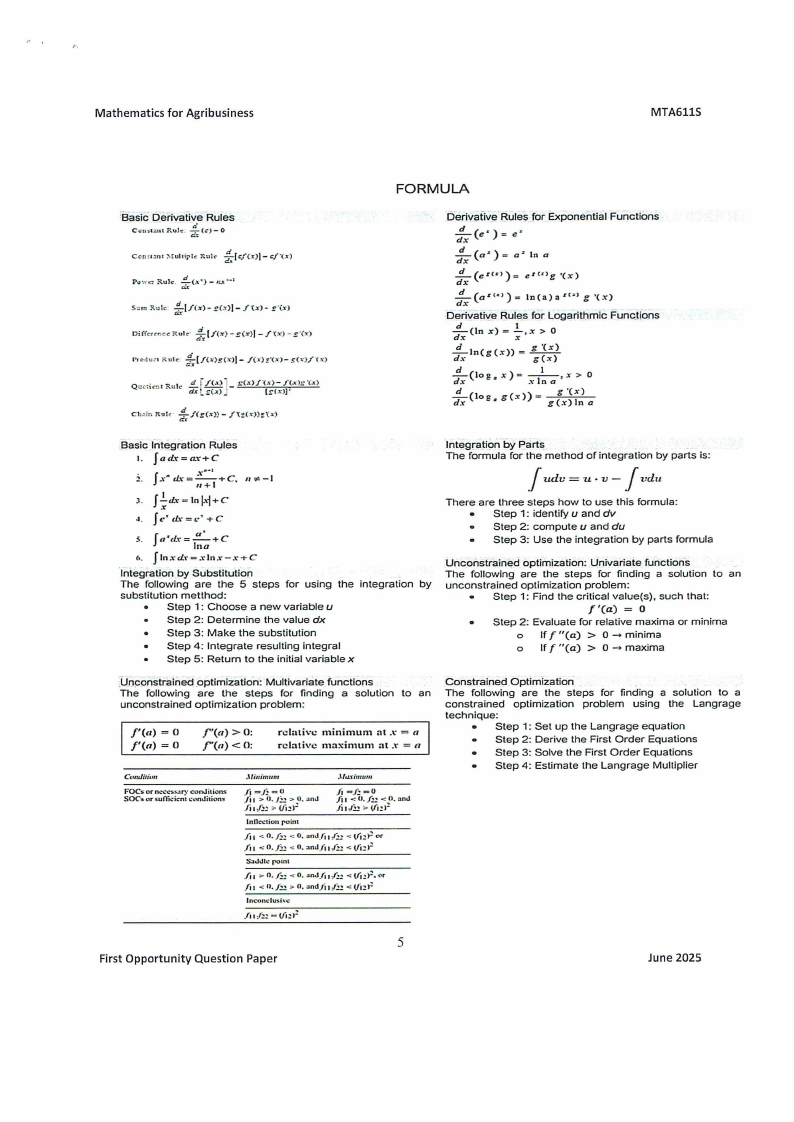
;~asic D_eriy_aiive Rules
C\\!m,t::nt Ru Jc. (c:-)- 0
Sum Ruic: !r,lf(x)- 2(;r)J- f '(x)- ~·(x)
FORMULA
Derivativj;! Rules for Exponential Functions
..!!_(e•) = c'
dx
.!!.._(a•)=
dx
a• In a
.!!.._(er<r>)=
dx
cr<:ng '(.'t')
.!!.._ ( a «• > ) = In (a) a tC; > g '( x)
dx
Deriyatiy_e Buie? for LogariU:imic Func_t[ons
.!!.._(In x) = ..!....,x > 0
d:c
X
.!!.._ln(g(x))
dx
= g '(x)
g(x)
.d!!x.._(log.
x)=
-x -
1
In
-,ax
>0
.!!.._(log g(x}) = g '(x)
dx
•
g(x)lna
J Basic fnt~grat\\on Ri,iles
I. a,L..:=ax+C
J x••l
_..,•d..:=-·--+C,
11+1
n-.o-1
Integration by Part!i
The formula for the method of integration by parts is:
.fudv=u•v-
f 1.,du
J.!.d..:=lnlxJ+c
Jc• ."C
.s.
t.L\\·=,•" +C
There are three steps how to use this formula:
Step 1: identify u and dv
Step 2: compute u and du
s. fa'd'<=~+CIna
Step 3: Use the integration by parts formula
6. Jln:cd..:=.dn.T-x+C
UncoristrainE1d optimization: Univariate functions
·integration by Substitution
The following are the steps for finding a solution to an
The following are the 5 steps for using the integration by unconstrained optimization problem:
substitution metthod:
Step 1: Find the critical value(s), such that:
Step 1: Choose a new variable u
f'(a) = 0
Step 2: Determine the value dx
Step 2: Evaluate for relative maxima or minima
• Step 3: Make the substitution
Step 4: Integrate resulting integral
Step 5: Return to the initial variable x
o If f "(a) > O-> minima
o If f "(a) > o -> maxima
UiJi::onstrained _optimization: Multivariate functions
The following are the steps for finding a solution
unconstrained optimization problem:
to an
f'(a) = O
f'(a) = 0
f"(a) > 0:
f"(a) < 0:
rcla1ivc minimum al x = a
rclalivc maximum al x = a
FOCs or nc.:cs~ry conJi1ion.-.
SOC" or sufficient i.:,..,nJitions
.\\liuimum
=" JJii
=f,
I>
O.
f~
> 0. anJ
Ji •~f~ > Ui~>.!
Ji =h=O
fa 1 < o. f~ < O. :mJ
Jj I J!:! > (fl!l>
lnDcclion roint
/i1-< 0. h.~< 0. ;:mJf11f~
f11 <0.f~ < O. :mJfuf~
<t/i1t1-or
Vi~>!
S:iJJlc roinl
/i1 >0.h.!
/11 <0.f~
....:0. .lnJJi1:f.!.! <(/1.!r.or
> 0, :mdJi1J~ <V.11):!
Inconclusive
Constrained Optimization
.
The following are the steps for finding a solution to a
constrained optimization problem using the Langrage
technique:
Step 1: Set up the Langrage equation
Step 2: Derive the First Order Equations
• Step 3: Solve the Rrst Order Equations
• Step 4: Estimate the Langrage Multiplier
5
First Opportunity Question Paper
June 2025