


 |
MTA611S - MATHEMATICS FOR AGRIBUSINESS - 2ND OPP - JUNE 2025 |
|
|
1 Page 1 |
▲back to top |
nAm I BIA unlVERSITY
OF SCIEnCE Ano TECHnOLOGY
FACULTYOF HEALTH,NATURALRESOURCESAND APPLIEDSCIENCES
SCHOOLOF AGRICULTUREAND NATURALRESOURCESSCIENCES
DEPARTMENT OF AGRICULTURALSCIENCESAND AGRIBUSINESS
QUALIFICATION: BACHELOR OF SCIENCE IN AGRICULTURE
QUALIFICATION CODE: 07BAGA LEVEL: 7
COURSE CODE: MT A6 l l S
SESSION: JULY 2025
COURSE NAME: MATHEMATICS FOR
AGRIBUSINESS
PAPER: 2
DURATION: 3 HOURS
MARKS: 100
SECOND OPPORTUNITY EXAMINATION QUESTION PAPER
EXAMINER(S) MR POL YKARP AMUKUHU
MODERATOR: DR TEOFILUS SHIIMI
INSTRUCTIONS
1. Attempt all questions.
2. Write clearly and neatly.
3. Number the answers clearly & conectly.
PERMISSIBLE MATERJALS
1. All written work MUST be done in blue or black ink
2. Calculators allowed
3. The LAST PAGE have FORMULAS
This question paper consists of 6 pages including the front page
|
|
2 Page 2 |
▲back to top |
Mathematics for Agribusiness
MTA611S
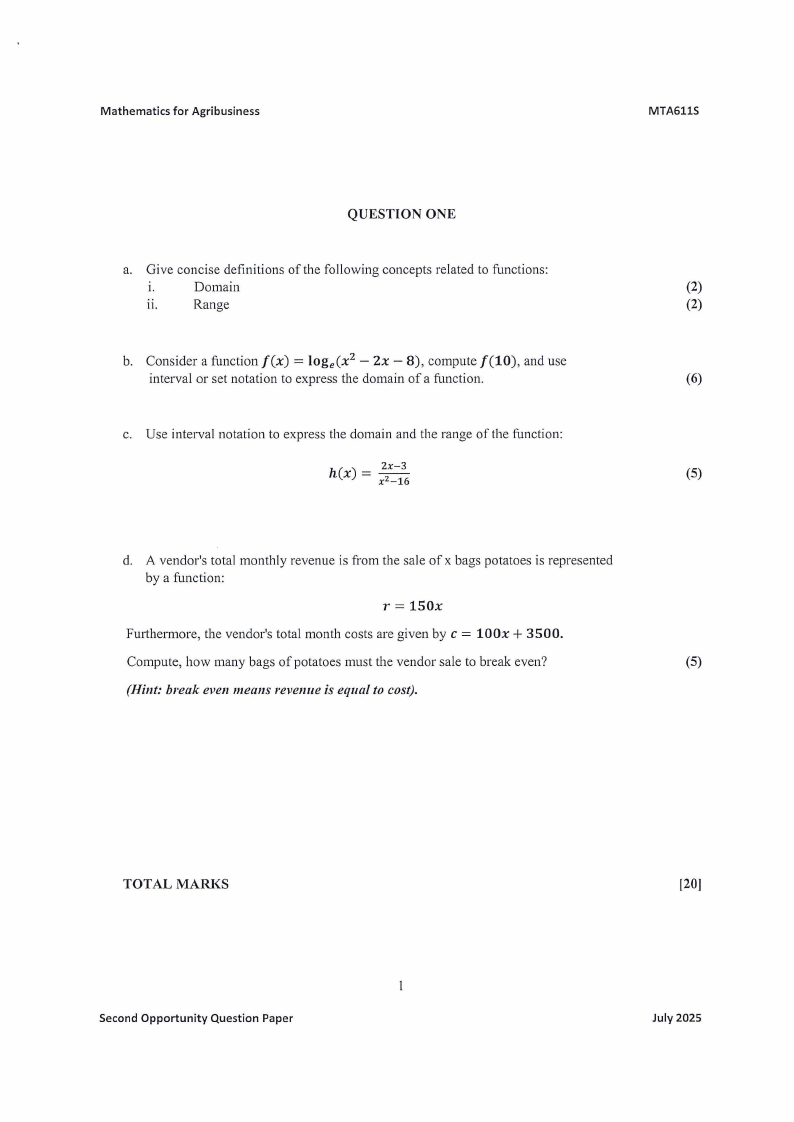
QUESTION ONE
a. Give concise definitions of the following concepts related to functions:
1.
Domain
(2)
11.
Range
(2)
b. Consider a function f (x) = loge(x 2 - 2x - 8), compute f (10), and use
interval or set notation to express the domain of a function.
(6)
c. Use interval notation to express the domain and the range of the function:
(5)
d. A vendor's total monthly revenue is from the sale of x bags potatoes is represented
by a function:
r = 150x
Furthermore, the vendor's total month costs are given by c = 100x + 3500.
Compute, how many bags of potatoes must the vendor sale to break even?
(5)
(Hint: break even means revenue is equal to cost).
TOTAL MARKS
Second Opportunity Question Paper
[20]
July 2025
|
|
3 Page 3 |
▲back to top |
Mathematics for Agribusiness
MTA611S
QUESTION TWO
a. Use mathematical expressions to concisely define the following concepts:
1.
Regular limit.
(2)
11.
Newton's Difference Quotient.
(2)
b. Briefly describe at least two algebraic approaches you would use to find the
limit of a function at a given point, x = a.
(4)
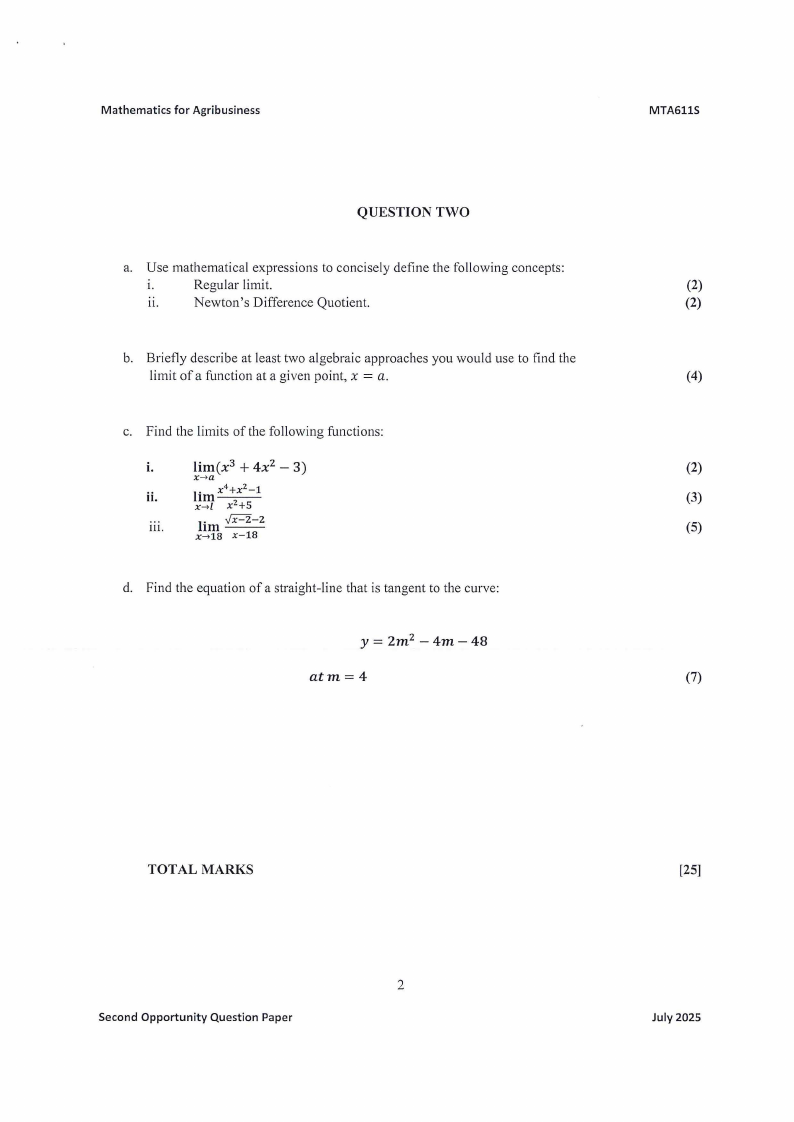
c. Find the limits of the following functions:
i.
lim(x 3 + 4x 2 - 3)
(2)
x->a
ii.
hx.-m>l -x--4x+2x+25-1
(3)
Ill.
h.m---
(5)
x->18 x-18
d. Find the equation of a straight-line that is tangent to the curve:
y = 2m 2 - 4m- 48
atm=4
(7)
TOTAL MARKS
2
Second Opportunity Question Paper
[25]
July 2025
|
|
4 Page 4 |
▲back to top |
Mathematics for Agribusiness
MTA611S
QUESTION THREE
a. Define the following concepts:
1.
Cross derivative
(2)
11.
Partial derivative
(2)
b. Find the second derivatives of the following functions:
i.
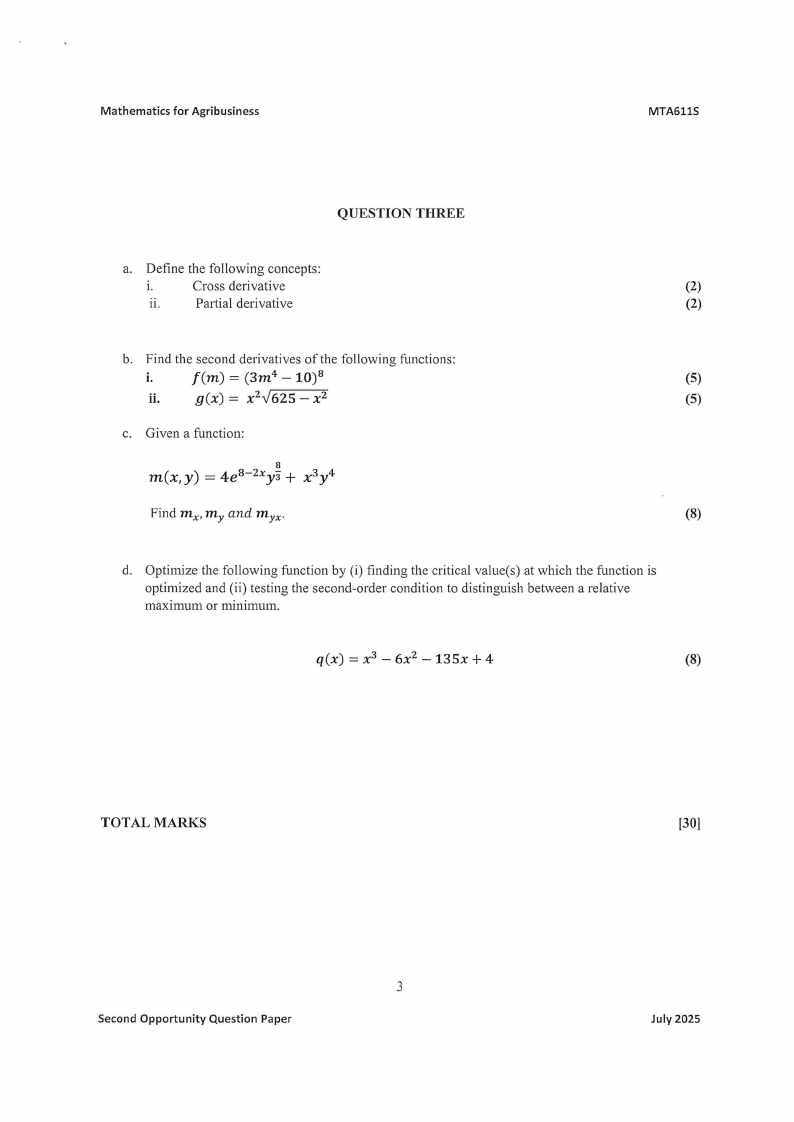
f (m) = (3m 4 - 10)8
(5)
ii.
g(x) =
- x2
(5)
c. Given a function:
m(x,
y)
=
8
4ea-2xy"3
+
x3y4
Find mx, my and myx·
(8)
d. Optimize the following function by (i) finding the critical value(s) at which the function is
optimized and (ii) testing the second-order condition to distinguish between a relative
maximum or mmnnum.
q(x) = x3 - 6x 2 - 135x + 4
(8)
TOTAL MARKS
[30]
3
Second Opportunity Question Paper
July 2025
|
|
5 Page 5 |
▲back to top |
Mathematics for Agribusiness
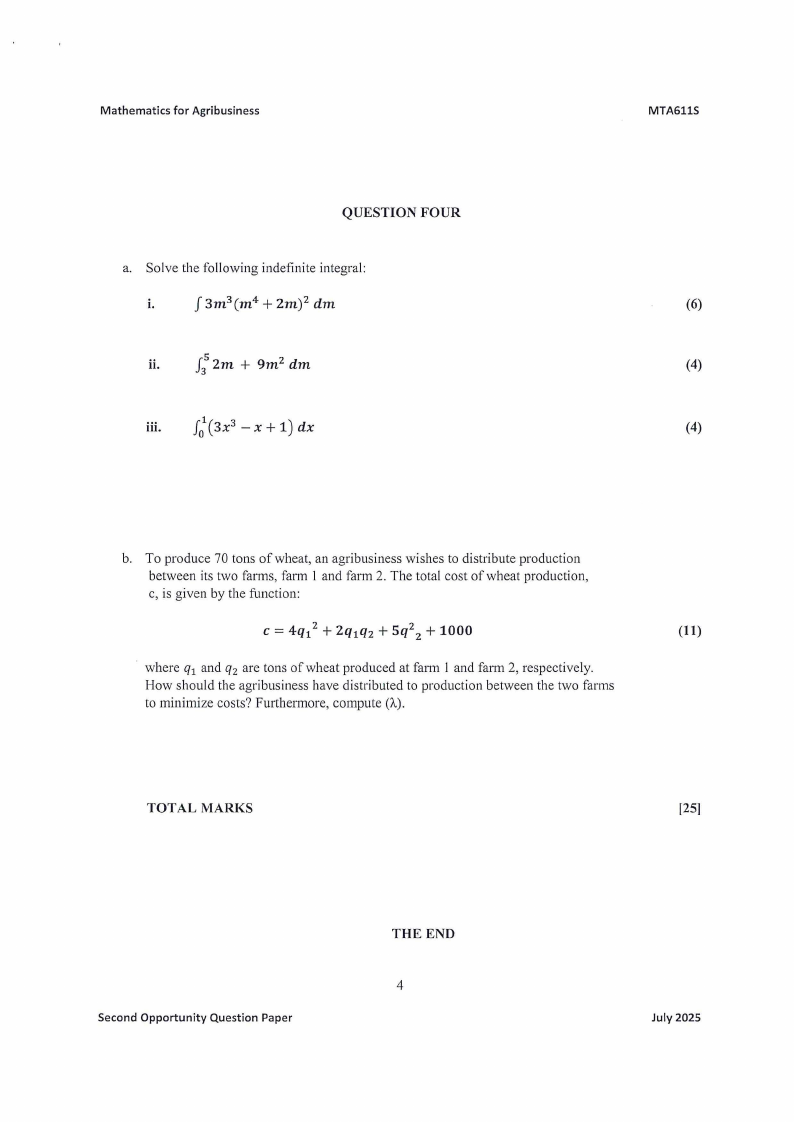
QUESTION FOUR
a. Solve the following indefinite integral:
i.
J3m 3 (m 4 + 2m) 2 dm
ii.
iii.
MTA611S
(6)
(4)
(4)
b. To produce 70 tons of wheat, an agribusiness wishes to distribute production
between its two farms, farm I and farm 2. The total cost of wheat production,
c, is given by the function:
(11)
where q1 and q2 are tons of wheat produced at farm l and farm 2, respectively.
How should the agribusiness have distributed to production between the two farms
to minimize costs? Furthermore, compute (t1,).
TOTAL MARKS
[25]
Second Opportunity Question Paper
THE END
4
July 2025
|
|
6 Page 6 |
▲back to top |
Mathematics for Agribusiness
MTA611S
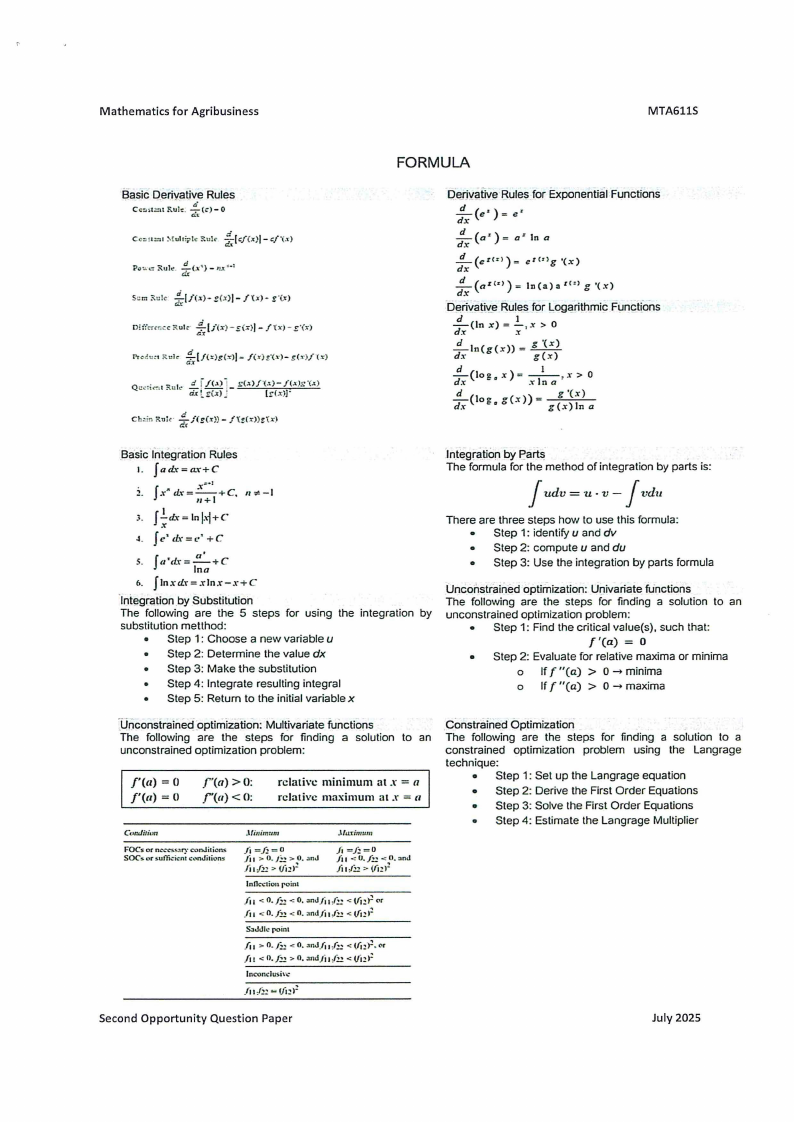
~a_sicQ.eriyatjve Rules
Cc:at.:..~t Rule . .!;-(c-)- 0
c;r
.=:!-.e).x- PO".H":" :tut-:.
Ill .. 1
FORMULA
D~riV?tiV!:)~ules for Exponential Functions
.d!!x.__(e')= e'
.d!x!....(a')= a= In a
.d!x!.__(e"'')= et<•>g '(x)
.!!....(a«•>)= ln(a)a' 1=>g '(x)
dx
Rules for Loga_rithmic F\\.mct[ons
.!!.._(In x) = .!..,x > 0
dx
x
.!!.....1n(g(x)) = g '(x)
dx
g(x)
-d(dxlog.
x)= --,.1r
>0
x In a
.!!....(Joo a(x)) = g '(x)
d:r
O
C'IJ
•
g(x)ln a
B?sic Integration Rules
I. Jadr:=ax+C
2. J.r:• dr:= x•·' +C, 11 ;,-I
11+1
3. J.!.dr:=ln!.,i+C
X
-1. Jc• d,·=,·• +C
s. J,,',fr=~+C
Ina
6. Jtnxdr:=xlnx-x+C
·integration by Substitution
The following are the 5 steps for using the integration by
substitution metthod:
• Step 1: Choose a new variable u
• Step 2: Determine the value dx
• Step 3: Make the substitution
• Step 4: Integrate resulting integral
• Step 5: Return to the initial variable x
Integration by i:>art!'1
.
The formula for the method of integration by parts is:
Judv=u•v-
Jvd-u
There are three steps how to use this formula:
• Step 1: identify u and dv
• Step 2: compute u and du
• Step 3: Use the integration by parts formula
Unconstrained optimization: Uoivariate functions
The following are the steps for finding a solution to an
unconstrained optimization problem:
• Step 1: Find the critical value(s), such that:
f'(a) = 0
• Step 2: Evaluate for relative maxima or minima
o If f "(a) > O .... minima
o If f "(a) > O .... maxima
:Unconstraineci_optimization: Mult_ivariatefunctions
The following are the steps for finding a solution to an
unconstrained optimization problem:
f'(a) = 0
f'(a) = O
f'(a) > 0:
f'(a) <0:
relative minimum at x = a
relative maximum at x = a
CtJnJi1io11
FOCs or n«c-S!,."irvconJirions
SOCs or sulli..:icn'i conJitioru:
.\\liuimum
.\\lu:rimum
ft =h = O
Ji 1 > O. /~ > O. :inJ
Ji 1/:n > (li~) 1
J, =f1 =0
f11 < U.f~ < 0. :mJ
/ii:/~> (fi2) 2
lnllC'l:lion roin1
/11 < O.111< 0. omJJi1:f!1 < l/i:~ or
/11 <0.f~ <0. anJJi1J!l <(/1~,~
.Constrained Op_timizatiorJ
The following are the steps for finding a solution to a
constrained optimization problem using the Langrage
technique:
• Step 1: Set up the Langrage equation
• Step 2: Derive the First Order Equations
• Step 3: Solve the First Order Equations
• Step 4: Estimate the Langrage Multiplier
/11 > O.J~ --:0. anJf11:f!! <Vi~~~~r
/11 < 0./~ > O. andJil/1.!. < Ui:?) 1
lnronclusi\\-c
Second Opportunity Question Paper
July 2025