


 |
MEP711S - MANAGING EMPLOYEE PERFOMANCE - 2ND OPP - JUNE 2025 |
|
|
1 Page 1 |
▲back to top |
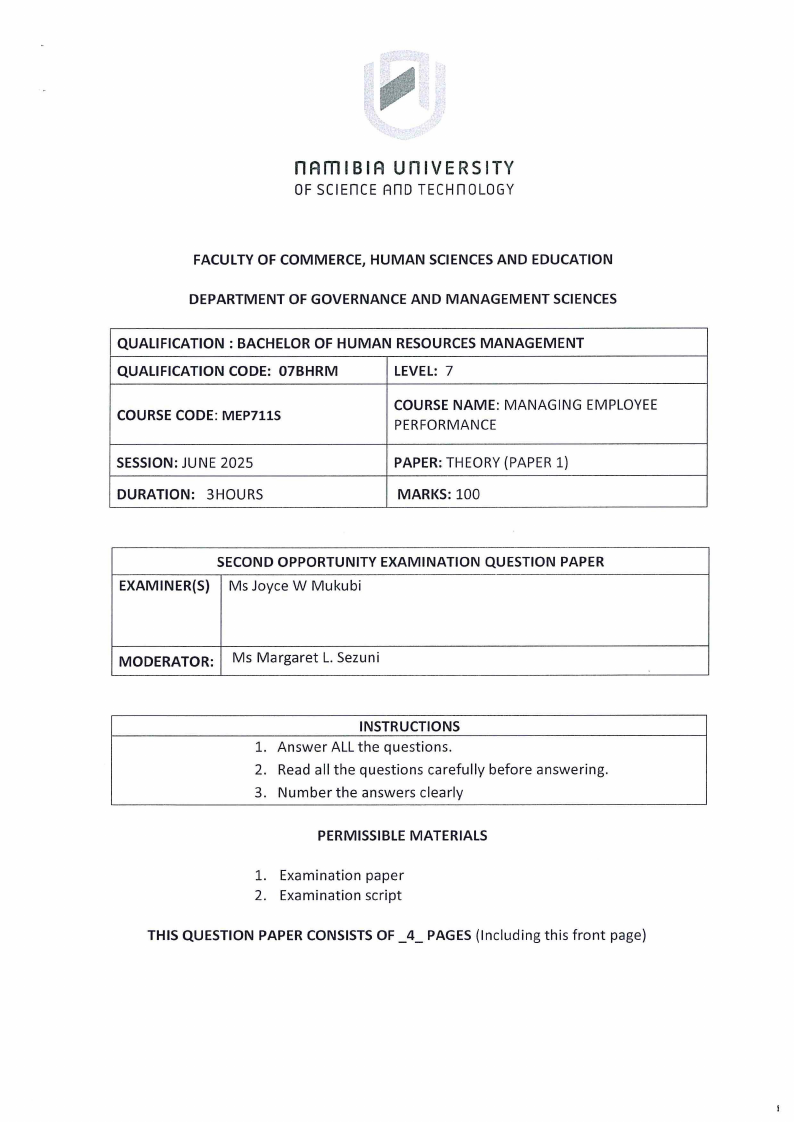
n Am I B I A u n IVE Rs I TY
OF SCIEn CE Ano TECHn OLOGY
FACULTY OF COMMERCE, HUMAN SCIENCES AND EDUCATION
DEPARTMENT OF GOVERNANCE AND MANAGEMENT SCIENCES
QUALIFICATION : BACHELOR OF HUMAN RESOURCES MANAGEMENT
QUALIFICATION CODE: 07BHRM
LEVEL: 7
COURSE CODE: MEP711S
COURSE NAME: MANAGING EMPLOYEE
PERFORMANCE
SESSION: JUNE 2025
DURATION: 3HOURS
PAPER: THEORY (PAPER 1)
MARKS: 100
SECOND OPPORTUNITY EXAMINATION QUESTION PAPER
EXAMINER(S) Ms Joyce W Mukubi
MODERATOR: Ms Margaret L. Sezuni
INSTRUCTIONS
1. Answer ALL the questions.
2. Read all the questions carefully before answering.
3. Number the answers clearly
PERMISSIBLE MATERIALS
1. Examination paper
2. Examination script
THIS QUESTION PAPER CONSISTS OF_ 4_ PAGES (Including this front page)
|
|
2 Page 2 |
▲back to top |
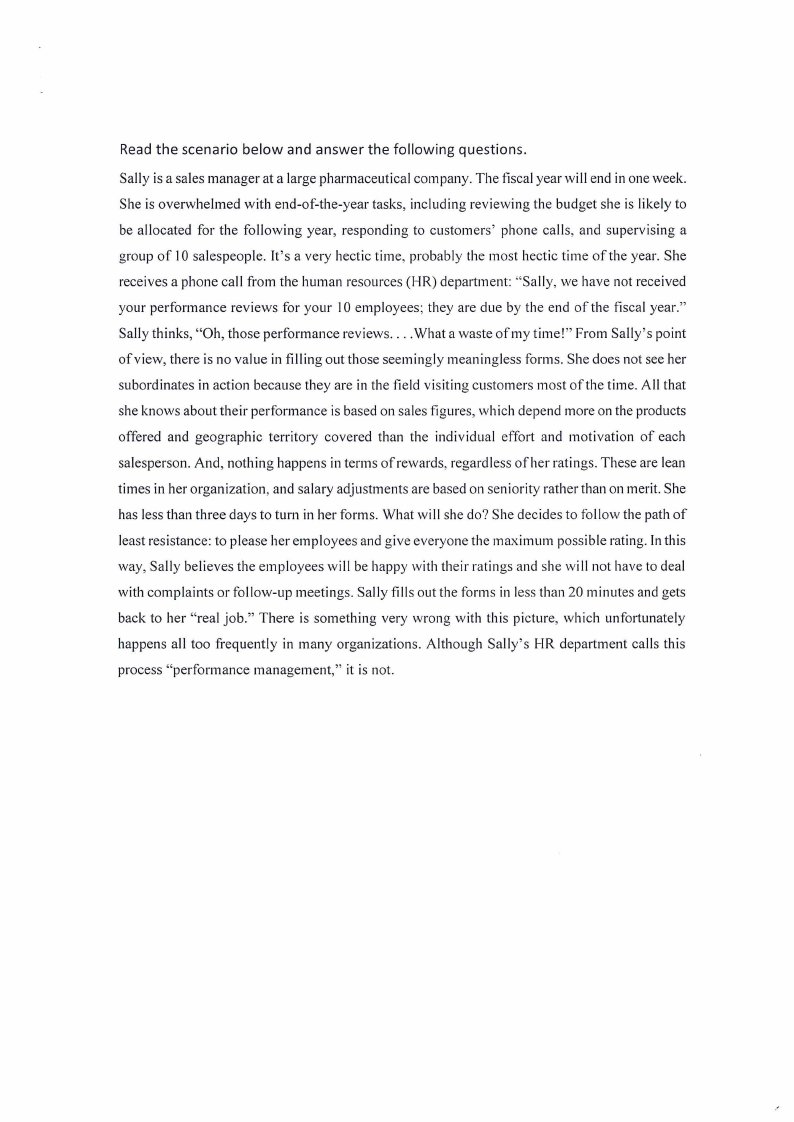
Read the scenario below and answer the following questions.
Sally is a sales manager at a large pharmaceutical company. The fiscal year will end in one week.
She is overwhelmed with end-of-the-year tasks, including reviewing the budget she is likely to
be allocated for the following year, responding to customers' phone calls, and supervising a
group of IO salespeople. It's a very hectic time, probably the most hectic time of the year. She
receives a phone call from the human resources (HR) department: "Sally, we have not received
your performance reviews for your IO employees; they are due by the end of the fiscal year."
Sally thinks, "Oh, those performance reviews .... What a waste of my time!" From Sally's point
of view, there is no value in filling out those seemingly meaningless forms. She does not see her
subordinates in action because they are in the field visiting customers most of the time. All that
she knows about their performance is based on sales figures, which depend more on the products
offered and geographic territory covered than the individual effort and motivation of each
salesperson. And, nothing happens in terms ofrewards, regardless of her ratings. These are lean
times in her organization, and salary adjustments are based on seniority rather than on merit. She
has less than three days to turn in her forms. What will she do? She decides to follow the path of
least resistance: to please her employees and give everyone the maximum possible rating. In this
way, Sally believes the employees will be happy with their ratings and she will not have to deal
with complaints or follow-up meetings. Sally fills out the forms in less than 20 minutes and gets
back to her "real job." There is something very wrong with this picture, which unfo1iunately
happens all too frequently in many organizations. Although Sally's HR depatiment calls this
process "performance management," it is not.
|
|
3 Page 3 |
▲back to top |
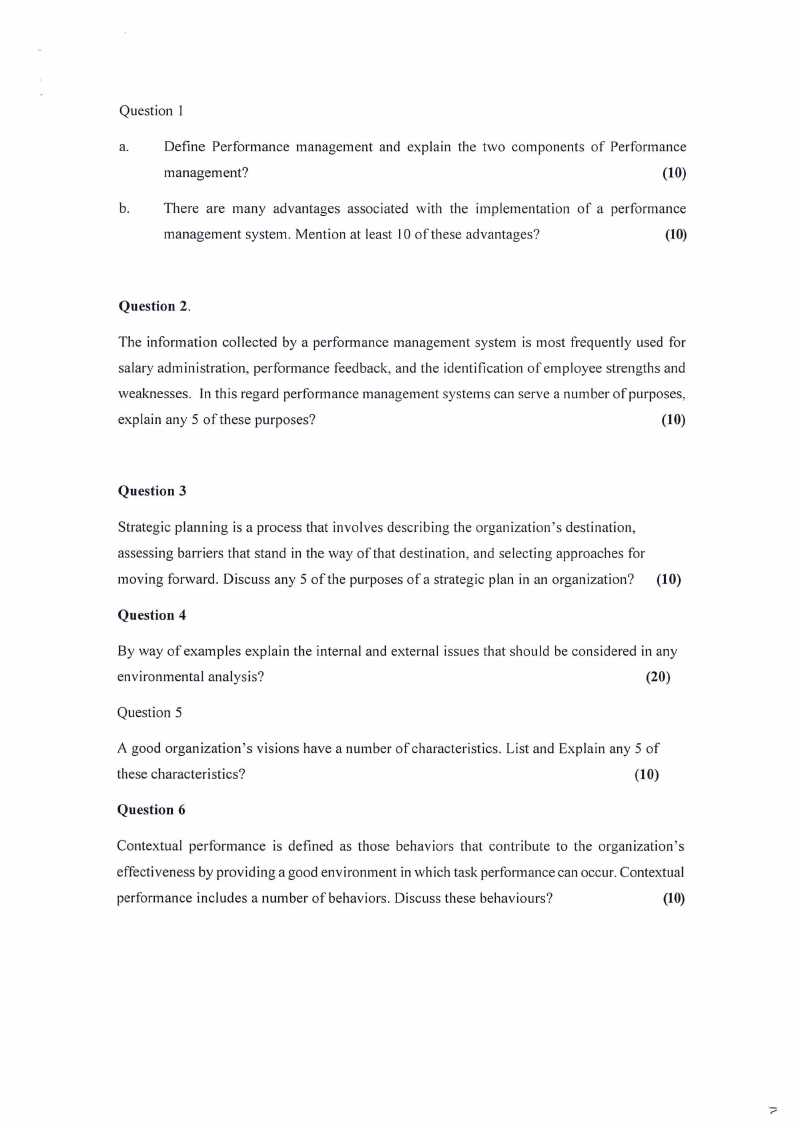
Question 1
a.
Define Performance management and explain the two components of Performance
management?
(10)
b. There are many advantages associated with the implementation of a performance
management system. Mention at least IO of these advantages?
(10)
Question 2.
The information collected by a performance management system is most frequently used for
salary administration, performance feedback, and the identification of employee strengths and
weaknesses. In this regard performance management systems can serve a number of purposes,
explain any 5 of these purposes?
(10)
Question 3
Strategic planning is a process that involves describing the organization's destination,
assessing barriers that stand in the way of that destination, and selecting approaches for
moving forward. Discuss any 5 of the purposes of a strategic plan in an organization? (10)
Question 4
By way of examples explain the internal and external issues that should be considered in any
environmental analysis?
(20)
Question 5
A good organization's visions have a number of characteristics. List and Explain any 5 of
these characteristics?
(10)
Question 6
Contextual performance is defined as those behaviors that contribute to the organization's
effectiveness by providing a good environment in which task performance can occur. Contextual
performance includes a number of behaviors. Discuss these behaviours?
(10)
|
|
4 Page 4 |
▲back to top |
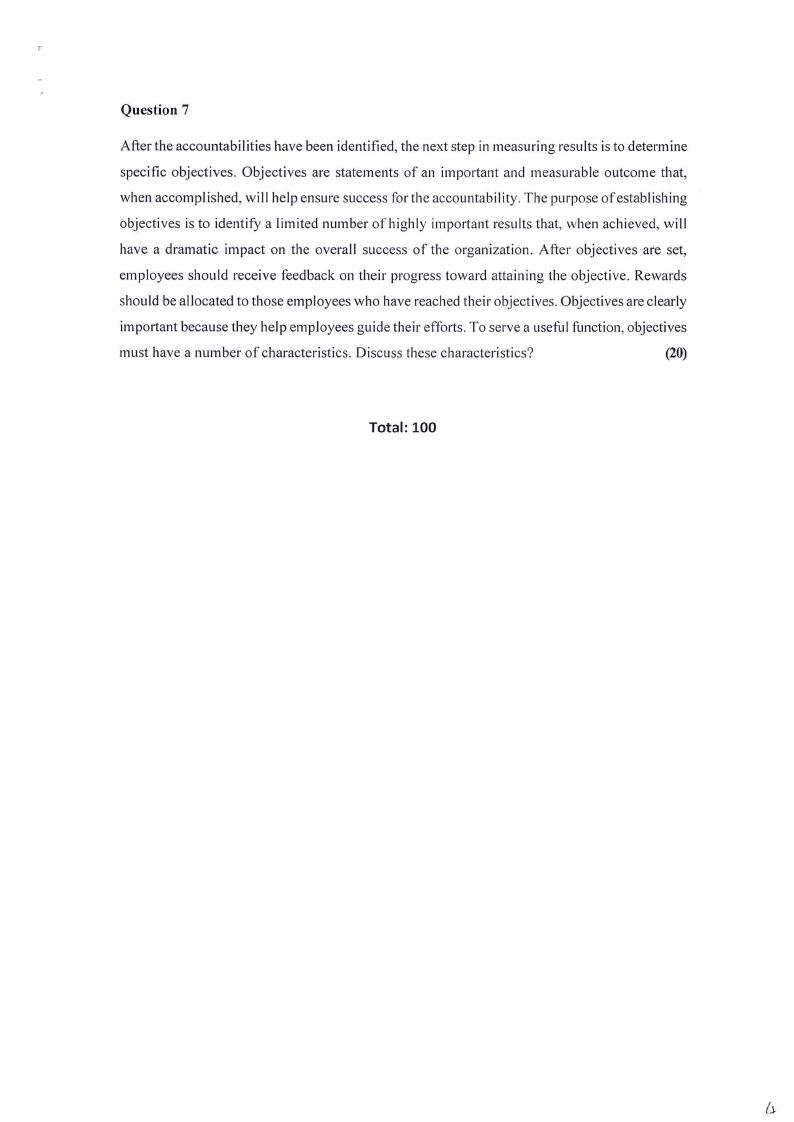
Question 7
After the accountabilities have been identified, the next step in measuring results is to determine
specific objectives. Objectives are statements of an important and measurable outcome that,
when accomplished, wi 11help ensure success for the accountabi Iity. The purpose of establishing
objectives is to identify a limited number of highly important results that, when achieved, will
have a dramatic impact on the overall success of the organization. After objectives are set,
employees should receive feedback on their progress toward attaining the objective. Rewards
should be allocated to those employees who have reached their objectives. Objectives are clearly
important because they help employees guide their efforts. To serve a useful function, objectives
must have a number of characteristics. Discuss these characteristics?
(20)
Total: 100