


 |
MDL611S - MEDIA LAW - 1ST OPP - JUNE 2025 |
|
|
1 Page 1 |
▲back to top |
nAmlBIA unlVERSITY
OF SCIEnCE Ano TECHnOLOGY
FACULTYOF COMPUTING AND INFORMATICS
DEPARTMENT OF JOURNALISMAND MEDIA TECHNOLOGY
QUALIFICATION: BACHELOR OF JOURNALISM AND MEDIA TECHNOLOGY
QUALIFICATIONCODE: 07BJOU
COURSELEVEL:NQF LEVEL6
COURSE:MEDIA LAW
COURSECODE:MDL611S
DATE: JUNE 2025
DURATION: 3HRS
SESSION:1
MARKS: 100
EXAMINER(S)
FIRSTOPPORTUNITYEXAMINATION QUESTION PAPER
DR. WANJA NJUGUNA
MODERATOR:
MS. M. HANEKOM
THIS EXAMINATION PAPERCONSISTSOF £PAGES
(Including this front page)
INSTRUCTIONS
1. Read and understand the questions/instructions well before you embark on the examination.
2. Write clearly and neatly. Marks will be awarded for minimal grammatical errors.
PERMISSIBLEMATERIALS
1. Examination paper.
2. Examination script.
|
|
2 Page 2 |
▲back to top |
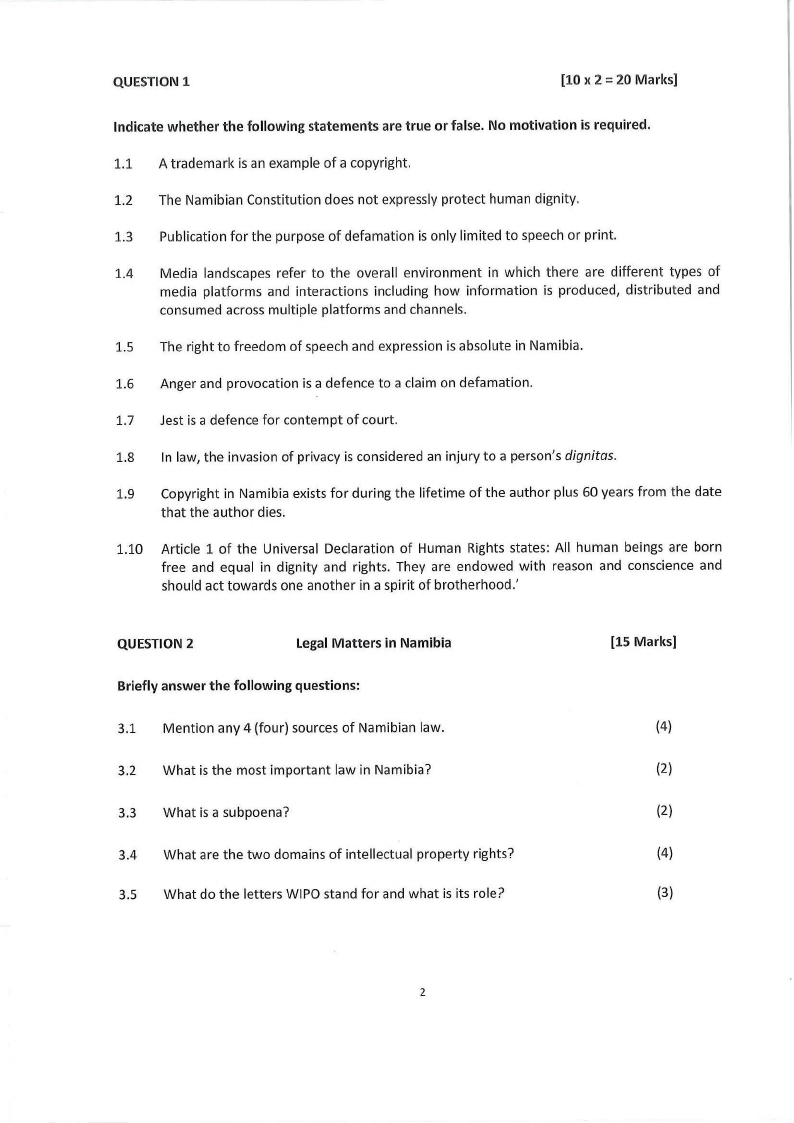
QUESTION 1
[10 x 2 = 20 Marks]
Indicate whether the following statements are true or false. No motivation is required.
1.1 A trademark is an example of a copyright.
1.2 The Namibian Constitution does not expressly protect human dignity.
1.3 Publication for the purpose of defamation is only limited to speech or print.
1.4 Media landscapes refer to the overall environment in which there are different types of
media platforms and interactions including how information is produced, distributed and
consumed across multiple platforms and channels.
1.5 The right to freedom of speech and expression is absolute in Namibia.
1.6 Anger and provocation is a defence to a claim on defamation.
1.7 Jest is a defence for contempt of court.
1.8 In law, the invasion of privacy is considered an injury to a person's dignitas.
1.9 Copyright in Namibia exists for during the lifetime of the author plus 60 years from the date
that the author dies.
1.10 Article 1 of the Universal Declaration of Human Rights states: All human beings are born
free and equal in dignity and rights. They are endowed with reason and conscience and
should act towards one another in a spirit of brotherhood.'
QUESTION 2
Legal Matters in Namibia
Briefly answer the following questions:
3.1 Mention any 4 (four) sources of Namibian law.
3.2 What is the most important law in Namibia?
3.3 What is a subpoena?
3.4 What are the two domains of intellectual property rights?
3.5 What do the letters WIPO stand for and what is its role?
[15 Marks]
(4)
(2)
(2)
(4)
(3)
2
|
|
3 Page 3 |
▲back to top |
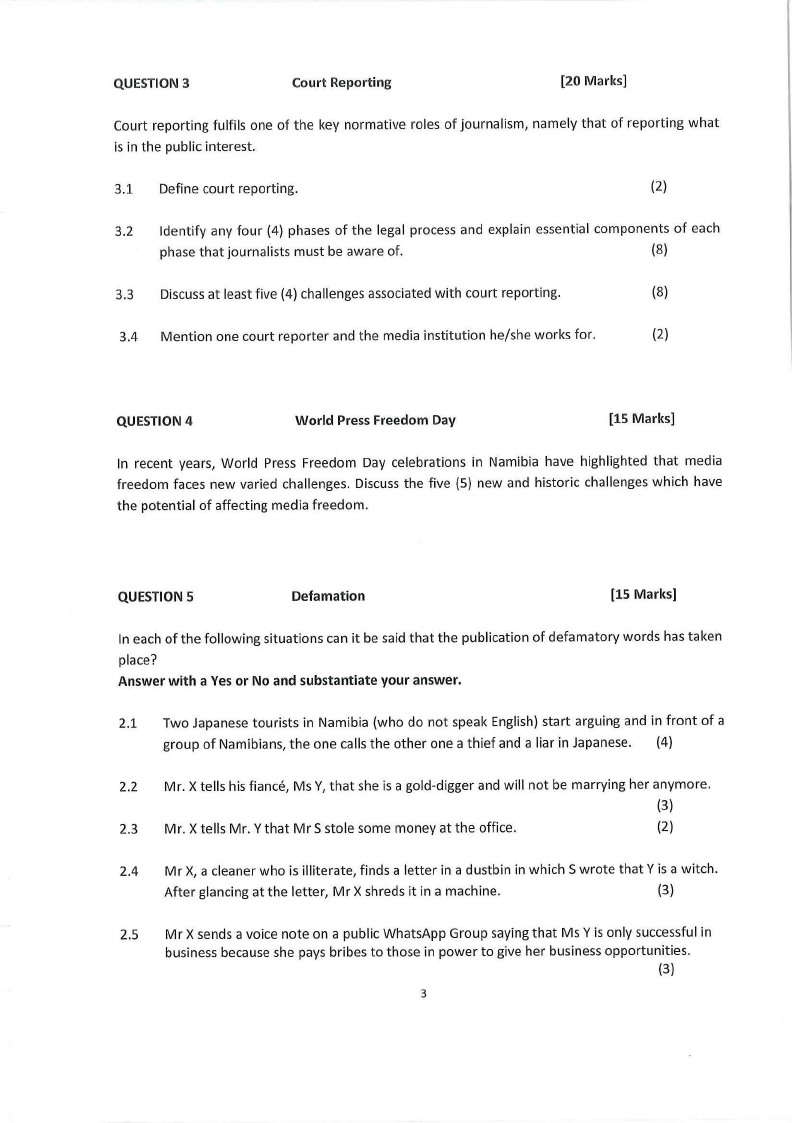
QUESTION 3
Court Reporting
[20 Marks]
Court reporting fulfils one of the key normative roles of journalism, namely that of reporting what
is in the public interest.
3.1 Define court reporting.
(2)
3.2 Identify any four (4) phases of the legal process and explain essential components of each
phase that journalists must be aware of.
(8)
3.3 Discussat least five (4) challenges associated with court reporting.
(8)
3.4 Mention one court reporter and the media institution he/she works for.
(2)
QUESTION 4
World Press Freedom Day
[15 Marks]
In recent years, World Press Freedom Day celebrations in Namibia have highlighted that media
freedom faces new varied challenges. Discuss the five (5) new and historic challenges which have
the potential of affecting media freedom.
QUESTION 5
Defamation
[15 Marks]
In each of the following situations can it be said that the publication of defamatory words has taken
place?
Answer with a Yes or No and substantiate your answer.
2.1 Two Japanese tourists in Namibia (who do not speak English) start arguing and in front of a
group of Namibians, the one calls the other one a thief and a liar in Japanese. (4)
2.2 Mr. X tells his fiance, Ms Y, that she is a gold-digger and will not be marrying her anymore.
(3)
2.3 Mr. X tells Mr. Y that Mr S stole some money at the office.
{2}
2.4 Mr X, a cleaner who is illiterate, finds a letter in a dustbin in which S wrote that Y is a witch.
After glancing at the letter, Mr X shreds it in a machine.
(3)
2.5 Mr X sends a voice note on a public WhatsApp Group saying that Ms Y is only successful in
business because she pays bribes to those in power to give her business opportunities.
(3)
3
|
|
4 Page 4 |
▲back to top |
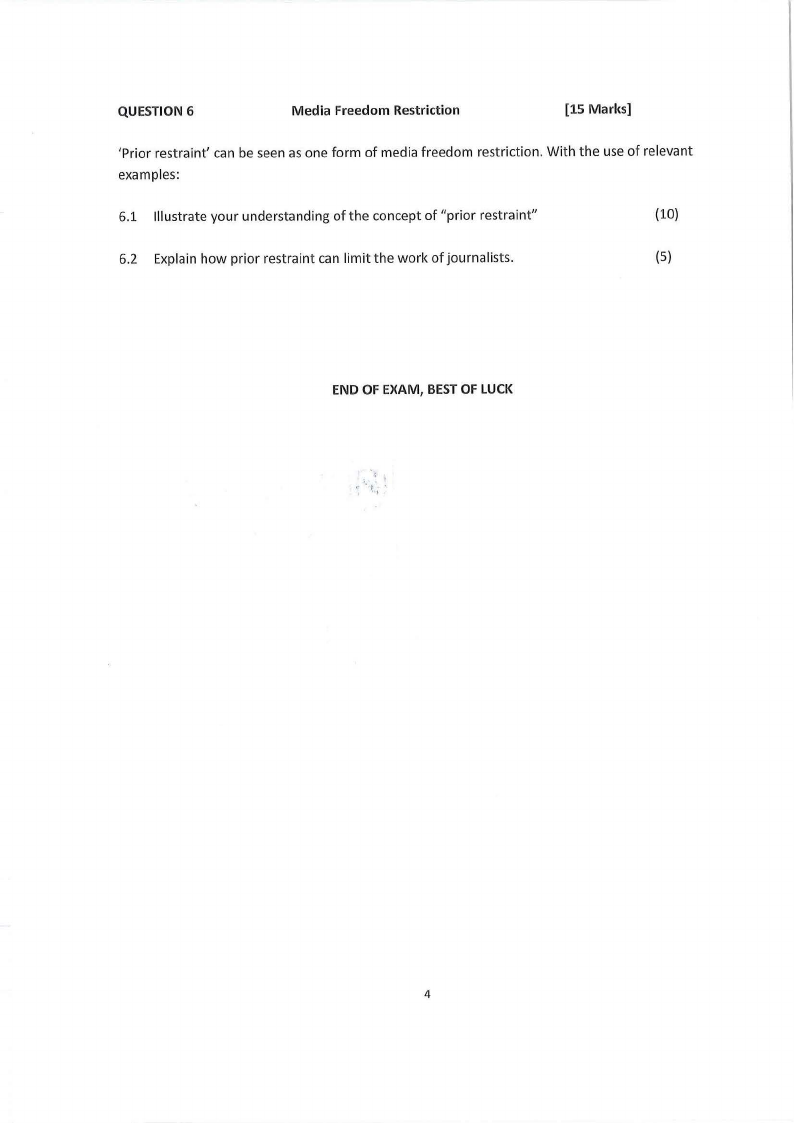
QUESTION 6
Media Freedom Restriction
(15 Marks]
'Prior restraint' can be seen as one form of media freedom restriction. With the use of relevant
examples:
6.1 Illustrate your understanding of the concept of "prior restraint"
(10)
6.2 Explain how prior restraint can limit the work of journalists.
(5)
END OF EXAM, BESTOF LUCK
4