


 |
RRG611S - RANGELAND REGENERATION - 1ST OPP - JUNE 2025 |
|
|
1 Page 1 |
▲back to top |
n Am I BI A u n IVER s ITY
OF SCIEnCEAno TECHnOLOGY
FACULTY OF HEALTH, NATURAL RESOURCES AND APPLIED SCIENCES
SCHOOL OF AGRICULTURE AND NATURAL RESOURCES SCIENCES
DEPARTMENT OF AGRICULTURAL SCIENCES AND AGRIBUSINESS
QUALIFICATIONS: BACHELOROF SCIENCEIN AGRICULTURE
QUALIFICATIONS CODE: 07BAGA
LEVEL: 7
COURSE CODE: RRG611S
DATE: JUNE 2025
COURSE NAME: RANGELAND REGENERATION
PAPER: THEORY
DURATION:
3 HOURS
MARKS: 100
EXAMINER:
MODERATOR:
FIRST OPPORTUNITY EXAMINATION QUESTION PAPER
DR. JEROME BOYS
PROF. HILMA RANTILLAAMWELE
INSTRUCTIONS
1. Answer all questions.
2. Please write neatly and legibly.
3. Do not use the left side margin of the exam paper. This must be allowed for the examiner.
4. No books, notes and other additional aids are allowed.
5. Mark all answers clearly with their respective question numbers.
PERMISSIBLE MATERIALS:
1. None-programmable calculator
IATTACHMENTS
1. None
THIS QUESTION PAPER CONSISTS OF 3 PAGES
(Including This Front Page)
|
|
2 Page 2 |
▲back to top |
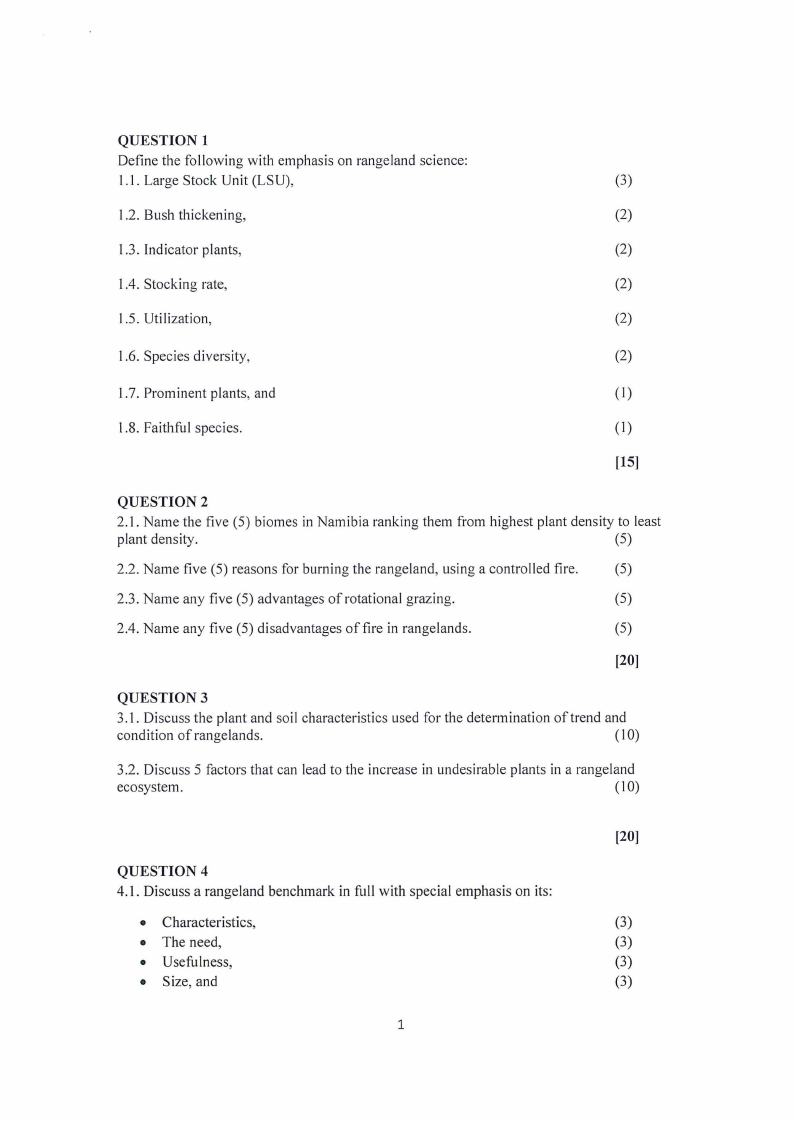
QUESTION 1
Define the following with emphasis on rangeland science:
1.1. Large Stock Unit (LSU),
(3)
1.2. Bush thickening,
(2)
1.3. Indicator plants,
(2)
1.4. Stocking rate,
(2)
1.5. Utilization,
(2)
1.6. Species diversity,
(2)
1.7. Prominent plants, and
(I)
1.8. Faithful species.
(I)
[15]
QUESTION 2
2.1. Name the five (5) biomes in Namibia ranking them from highest plant density to least
plant density.
(5)
2.2. Name five (5) reasons for burning the rangeland, using a controlled fire.
(5)
2.3. Name any five (5) advantages of rotational grazing.
(5)
2.4. Name any five (5) disadvantages of fire in rangelands.
(5)
[20]
QUESTION3
3.1. Discuss the plant and soil characteristics used for the determination of trend and
condition of rangelands.
( I0)
3.2. Discuss 5 factors that can lead to the increase in undesirable plants in a rangeland
ecosystem.
(10)
[20]
QUESTION 4
4.1. Discuss a rangeland benchmark in full with special emphasis on its:
• Characteristics,
(3)
• The need,
(3)
• Usefulness,
(3)
• Size, and
(3)
1
|
|
3 Page 3 |
▲back to top |
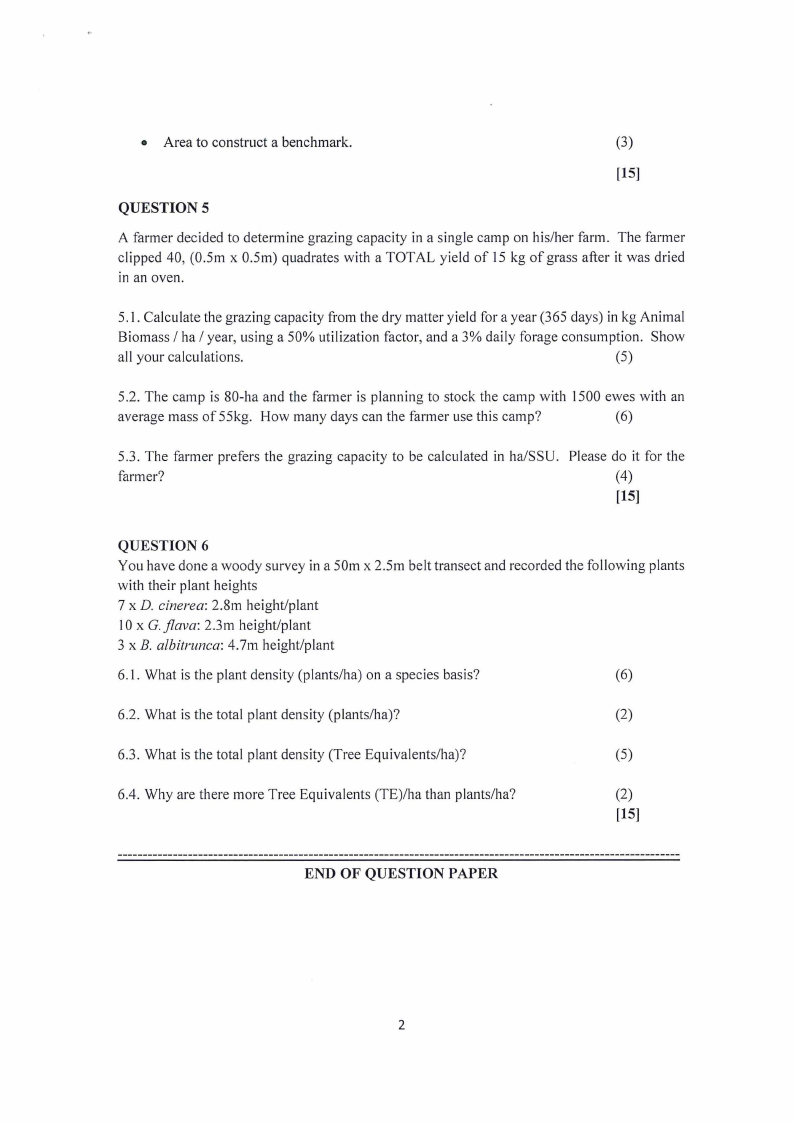
• Area to construct a benchmark.
(3)
[15]
QUESTIONS
A farmer decided to determine grazing capacity in a single camp on his/her farm. The farmer
clipped 40, (0.5m x 0.5m) quadrates with a TOTAL yield of 15 kg of grass after it was dried
in an oven.
5.1. Calculate the grazing capacity from the dry matter yield for a year (365 days) in kg Animal
Biomass/ ha/ year, using a 50% utilization factor, and a 3% daily forage consumption. Show
all your calculations.
(5)
5.2. The camp is 80-ha and the farmer is planning to stock the camp with 1500 ewes with an
average mass of 55kg. How many days can the farmer use this camp?
(6)
5.3. The farmer prefers the grazing capacity to be calculated in ha/SSU. Please do it for the
farmer?
(4)
[15]
QUESTION6
You have done a woody survey in a 50m x 2.5m belt transect and recorded the following plants
with their plant heights
7 x D. cinerea: 2.8m height/plant
IOx G.flava: 2.3m height/plant
3 x B. albitrunca: 4.7m height/plant
6.1. What is the plant density (plants/ha) on a species basis?
(6)
6.2. What is the total plant density (plants/ha)?
(2)
6.3. What is the total plant density (Tree Equivalents/ha)?
(5)
6.4. Why are there more Tree Equivalents (TE)/ha than plants/ha?
(2)
[15]
----------------------------------------------------------------------------------------------------------------
END OF QUESTION PAPER
2