


 |
ITP521S - INTRODUCTION TO POLITICAL SCIENCE - 2ND OPP - NOV 2025 |
|
|
1 Page 1 |
▲back to top |
nAmlBIA UnlVERSITY
OF SCIEnCE Ano TECHnOLOGY
FACULTY OF COMMERCE, HUMAN SCIENCES AND EDUCATION
DEPARTMENT OF GOVERNANCE AND MANAGEMENT SCIENCE
QUALIFICATION : BACHELOR OF PUBLIC MANAGEMENT
BACHELOR OF COMMUNICATION
QUALIFICATION CODE: 07BPMA
07BCMM
LEVEL: 5
COURSE CODE: ITP521S
COURSE NAME: INTRODUCTION TO POLIYICAL
SCIENCE
SESSION: DECEMBER 2025
DURATION: 3 HOURS
PAPER: THEORY (PAPER 1)
MARKS: 100
SUPPLEMENTARY/SECOND OPPORTUNITY EXAMINATION QUESTION PAPER
EXAMINERS Dr. Tekla Amutenya
Ms. Manelia Shakela
Mr. Mike Nguvenyengua
MODERATOR: Mr. Ben Namabanda
INSTRUCTIONS
1. This question paper consists of 6 (six) questions of equal value.
2. Question 1 is compulsory.
3. Answer any 3 (three) of the remaining 5 (five) questions.
4. Read all the questions carefully before answering.
5. Number the answers clearly and correctly.
THIS QUESTION PAPER CONSISTS OF 3 PAGES (including this front page)
|
|
2 Page 2 |
▲back to top |
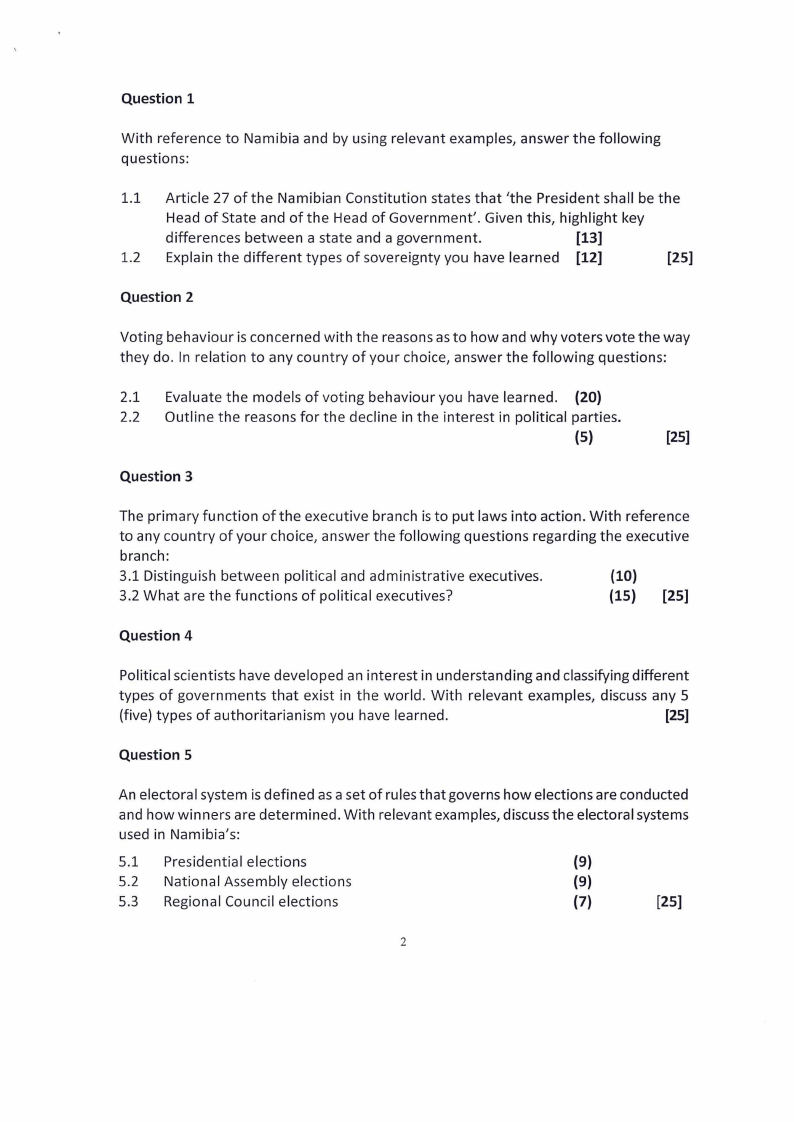
Question 1
With reference to Namibia and by using relevant examples, answer the following
questions:
1.1 Article 27 of the Namibian Constitution states that 'the President shall be the
Head of State and of the Head of Government'. Given this, highlight key
differences between a state and a government.
[13]
1.2 Explain the different types of sovereignty you have learned [12]
[25]
Question 2
Voting behaviour is concerned with the reasons as to how and why voters vote the way
they do. In relation to any country of your choice, answer the following questions:
2.1 Evaluate the models of voting behaviour you have learned. {20)
2.2 Outline the reasons for the decline in the interest in political parties.
(5)
[25]
Question 3
The primary function of the executive branch is to put laws into action. With reference
to any country of your choice, answer the following questions regarding the executive
branch:
3.1 Distinguish between political and administrative executives.
{10)
3.2 What are the functions of political executives?
{15) [25]
Question 4
Political scientists have developed an interest in understanding and classifying different
types of governments that exist in the world . With relevant examples, discuss any 5
(five) types of authoritarianism you have learned.
[25]
Question 5
An electoral system is defined as a set of rules that governs how elections are conducted
and how winners are determined. With relevant examples, discuss the electoral systems
used in Namibia's:
5.1 Presidential elections
5.2 National Assembly elections
5.3 Regional Council elections
{9)
{9)
{7)
[25]
2
|
|
3 Page 3 |
▲back to top |

Question 6
According to Electoral Commission of Namibia (2025), there are 25 registered political
parties in Namibia. These political parties perform vital functions in democracy. With
reference to any country of your choice, discuss any 5 functions of political parties. In
addition, analyse whether political parties in your chosen country perform their
functions.
[25]
END OF PAPER
3