


 |
BMI511S - INTRODUCTION TO BUSINESS MANAGEMENT - 2ND OPP - JUNE 2025 |
|
|
1 Page 1 |
▲back to top |
nAmI BI AunIVER s ITY
FACULTY OF
OF SCIEnCE Ano TECHn OLOGY COMMERCE, HUMAN
SCIENCES AND EDUCATION
DEPARTMENT OF GOVERNANCE AND MANAGEMENT SCIENCES
QUALIFICATION: BACHELOR OF MANAGEMENT
QUALIFICATION CODE:
07BBMA
COURSE CODE: BMI511 S
SESSION: JULY 2025
LEVEL: 6
COURSE NAME: INTRODUCTION TO BUSINESS
MANAGEMENT
PAPER: SECOND OPPORTUNITY
DURATION: 3 HOURS
MARKS: 100
SECOND OPPORTUNITY EXAMINATION - QUESTION PAPER
EXAMINER(S) Mr B. Zealand
Ms S. Sakarias
Mr K. Uirab
Distance Tutors
MODERATOR: Dr V. Sibanda
THIS QUESTION PAPER CONSISTS OF 6 PAGES (Including this front page)
INSTRUCTIONS
I. Answer all questions in the booklet provided.
2. Read all the questions carefully before answering.
3. Marks for each question are indicated at the end of each question.
4. Please ensure that your writing is legible, neat and presentable and start each Section
on a new page.
PERMISSIBLE MATERIALS
1. Examination question paper
2. Examination answer sheet
3. Calculator
|
|
2 Page 2 |
▲back to top |
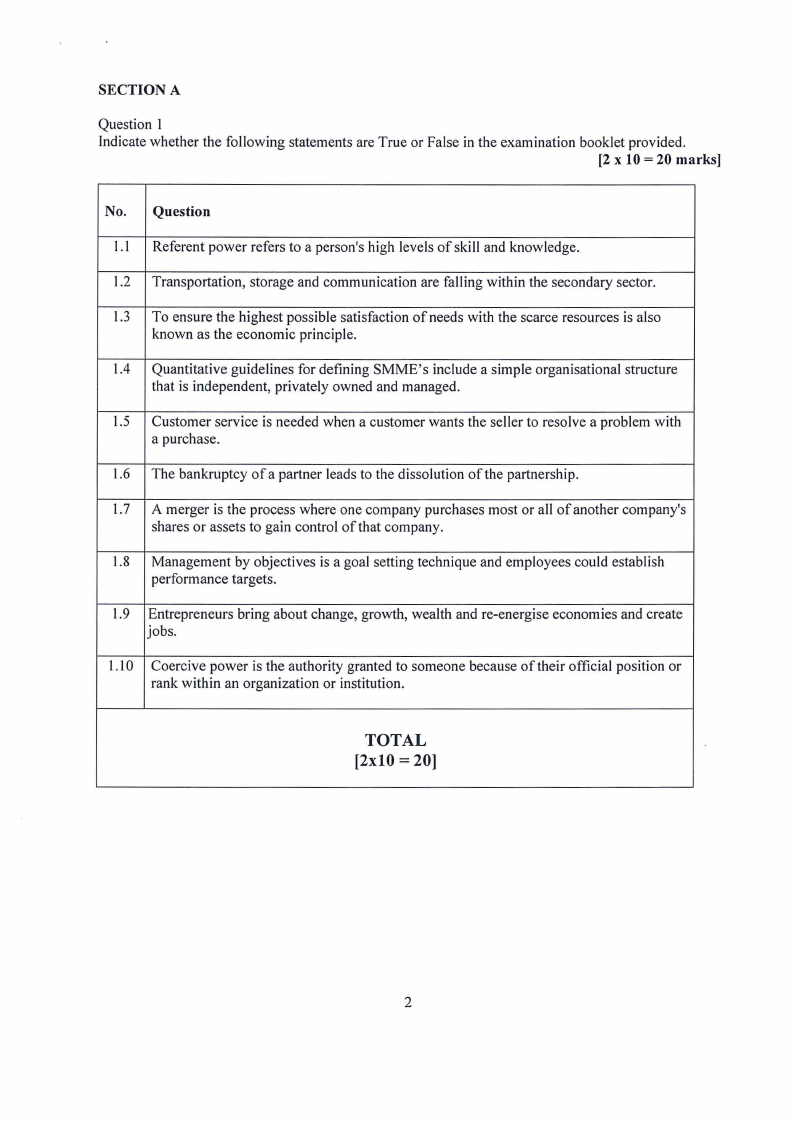
SECTION A
Question 1
Indicate whether the following statements are True or False in the examination booklet provided.
[2 x 10 = 20 marks]
No. Question
I. I Referent power refers to a person's high levels of skill and knowledge.
1.2 Transportation, storage and communication are falling within the secondary sector.
1.3 To ensure the highest possible satisfaction of needs with the scarce resources is also
known as the economic principle.
1.4 Quantitative guidelines for defining SMME's include a simple organisational structure
that is independent, privately owned and managed.
1.5 Customer service is needed when a customer wants the seller to resolve a problem with
a purchase.
1.6 The bankruptcy of a partner leads to the dissolution of the partnership.
1.7 A merger is the process where one company purchases most or all of another company's
shares or assets to gain control of that company.
1.8 Management by objectives is a goal setting technique and employees could establish
performance targets.
1.9 Entrepreneurs bring about change, growth, wealth and re-energise economies and create
jobs.
1.10 Coercive power is the authority granted to someone because of their official position or
rank within an organization or institution.
TOTAL
[2x10 = 20]
2
|
|
3 Page 3 |
▲back to top |
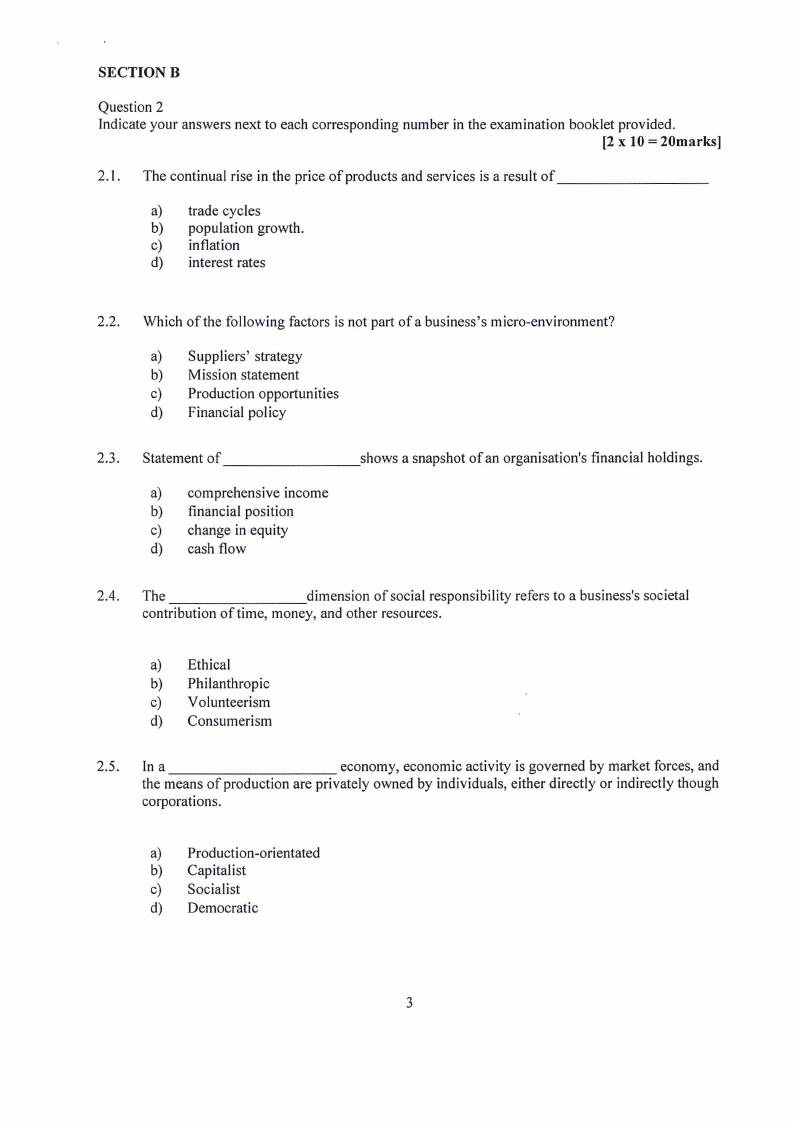
SECTIONB
Question 2
Indicate your answers next to each corresponding number in the examination booklet provided.
[2 x 10 = 20marks]
2.1. The continual rise in the price of products and services is a result of ________
_
a) trade cycles
b) population growth.
c) inflation
d) interest rates
2.2. Which of the following factors is not part of a business's micro-environment?
a) Suppliers' strategy
b) Mission statement
c) Production opportunities
d) Financial policy
2.3. Statement of ________
a) comprehensive income
b) financial position
c) change in equity
d) cash flow
shows a snapshot of an organisation's financial holdings.
2.4. The ________
dimension of social responsibility refers to a business's societal
contribution of time, money, and other resources.
a) Ethical
b) Philanthropic
c) Volunteerism
d) Consumerism
2.5. In a __________
economy, economic activity is governed by market forces, and
the means of production are privately owned by individuals, either directly or indirectly though
corporations.
a) Production-orientated
b) Capitalist
c) Socialist
d) Democratic
3
|
|
4 Page 4 |
▲back to top |
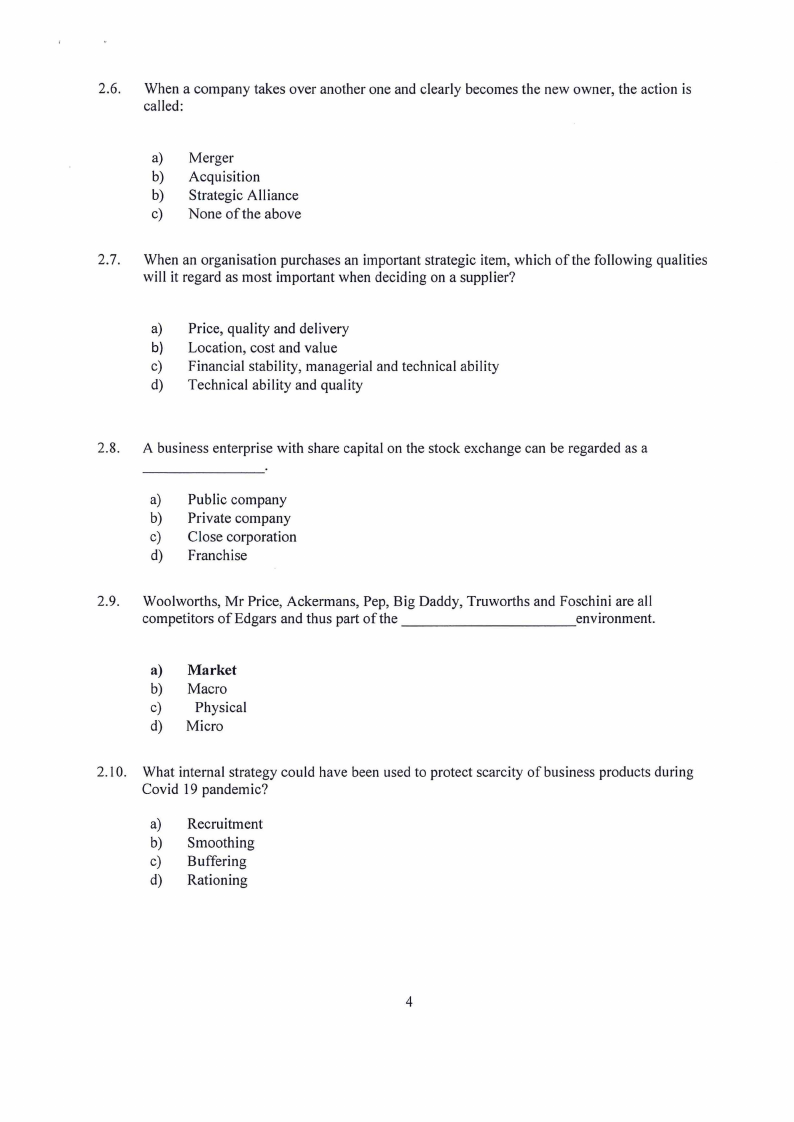
2.6. When a company takes over another one and clearly becomes the new owner, the action is
called:
a) Merger
b) Acquisition
b) Strategic Alliance
c) None of the above
2.7. When an organisation purchases an important strategic item, which of the following qualities
will it regard as most important when deciding on a supplier?
a) Price, quality and delivery
b} Location, cost and value
c) Financial stability, managerial and technical ability
d) Technical ability and quality
2.8. A business enterprise with share capital on the stock exchange can be regarded as a
a) Public company
b) Private company
c) Close corporation
d) Franchise
2.9. Woolworths, Mr Price, Ackermans, Pep, Big Daddy, Truworths and Foschini are all
competitors of Edgars and thus part of the ___________
environment.
a) Market
b) Macro
c) Physical
d) Micro
2.10. What internal strategy could have been used to protect scarcity of business products during
Covid 19 pandemic?
a) Recruitment
b) Smoothing
c) Buffering
d) Rationing
4
|
|
5 Page 5 |
▲back to top |
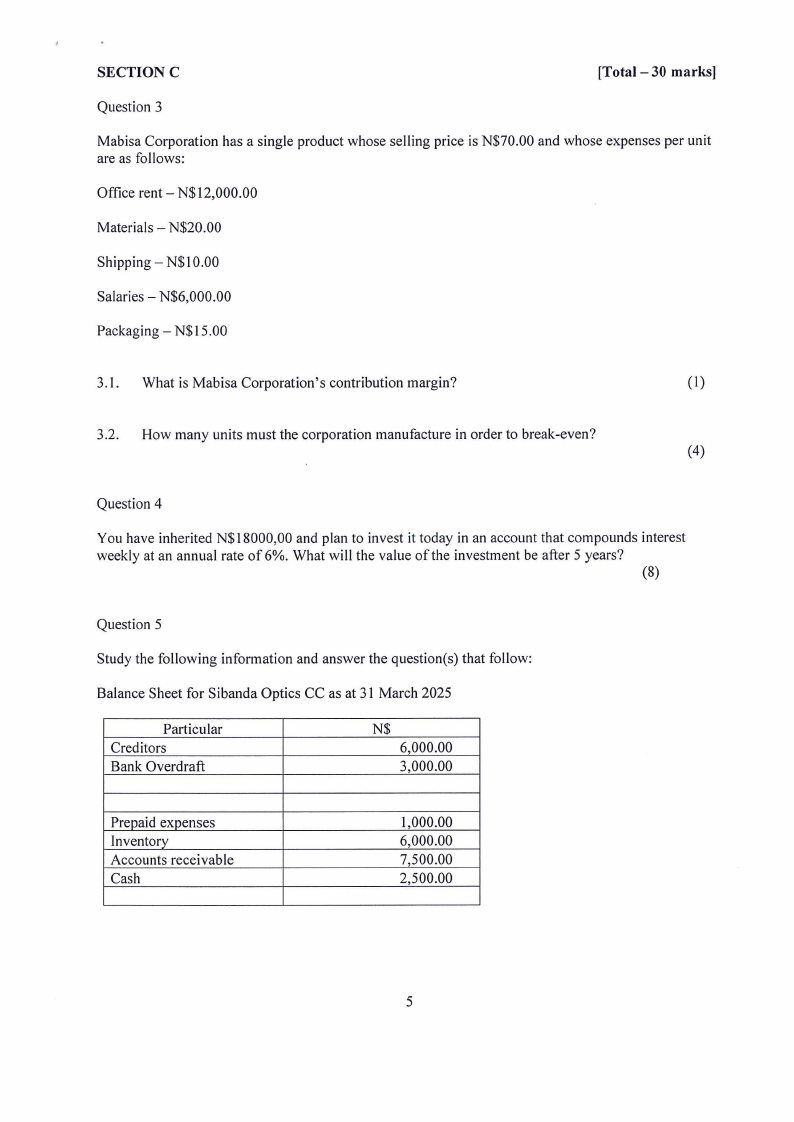
SECTIONC
[Total - 30 marks]
Question 3
Mabisa Corporation has a single product whose selling price is N$70.00 and whose expenses per unit
are as follows:
Office rent - N$12,000.00
Materials - N$20.00
Shipping-N$10.00
Salaries - N$6,000.00
Packaging - N$ l 5.00
3.1. What is Mabisa Corporation's contribution margin?
(1)
3.2. How many units must the corporation manufacture in order to break-even?
(4)
Question 4
You have inherited N$ l 8000,00 and plan to invest it today in an account that compounds interest
weekly at an annual rate of 6%. What will the value of the investment be after 5 years?
(8)
Question 5
Study the following information and answer the question(s) that follow:
Balance Sheet for Sibanda Optics CC as at 31 March 2025
Particular
Creditors
Bank Overdraft
N$
6,000.00
3,000.00
Prepaid expenses
Inventory
Accounts receivable
Cash
1,000.00
6,000.00
7,500.00
2,500.00
5
|
|
6 Page 6 |
▲back to top |
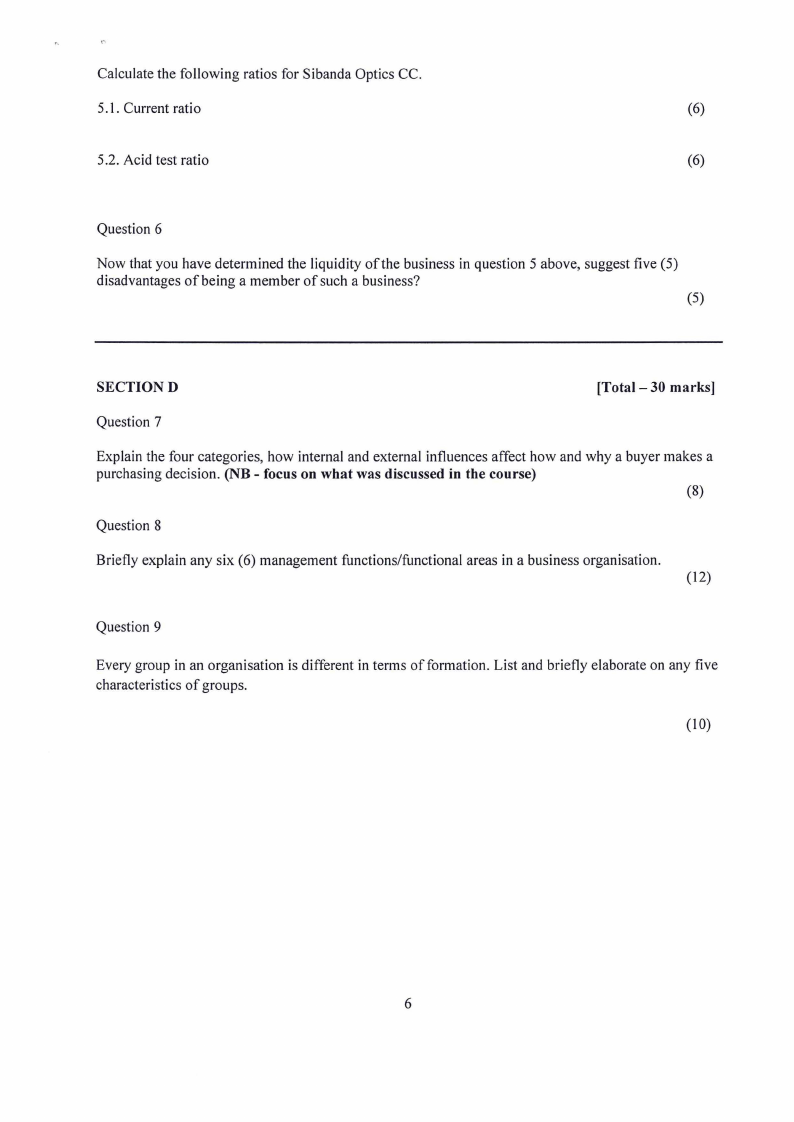
Calculate the following ratios for Sibanda Optics CC.
5.1. Current ratio
(6)
5.2. Acid test ratio
(6)
Question 6
Now that you have determined the liquidity of the business in question 5 above, suggest five (5)
disadvantages of being a member of such a business?
(5)
SECTIOND
[Total -30 marks]
Question 7
Explain the four categories, how internal and external influences affect how and why a buyer makes a
purchasing decision. (NB - focus on what was discussed in the course)
(8)
Question 8
Briefly explain any six (6) management functions/functional areas in a business organisation.
(12)
Question 9
Every group in an organisation is different in terms of formation. List and briefly elaborate on any five
characteristics of groups.
(10)
6