


 |
CMD812S - CAREER MANAGEMENT AND DEVELOPMENT - 1ST OPP - NOV 2025 |
|
|
1 Page 1 |
▲back to top |
nAm I BI A un IVE RS ITV
OF SCIEnCE Ano TECHnOLOGY
FACULTY OF COMMERCE, HUMAN SCIENCES AND EDUCATION
DEPARTMENT OF GOVERNANCE
QUALIFICATION: BACHELOR OF HUMAN RESOURCES MANAGEMENT HONOURS
QUALIFICATION CODE: 0SBHRH
COURSE CODE: CMD 812S
LEVEL: 8
COURSE NAME: CAREER MANAGEMENT AND
DEVELOPMENT
SESSION: NOVEMBER 2025
PAPER: THEORY
DURATION: 3 HOURS
MARKS: 100
FIRST OPPORTUNITY QUESTION PAPER
EXAMINER(S) Ms. Fiina Shimaneni
MODERATOR: Prof Wesley Pieters
INSTRUCTIONS
1. Write clearly and neatly.
2. ALL questions are compulsory
THIS PAPER CONSISTS OF 7 PAGES (Including this front page)
1
|
|
2 Page 2 |
▲back to top |
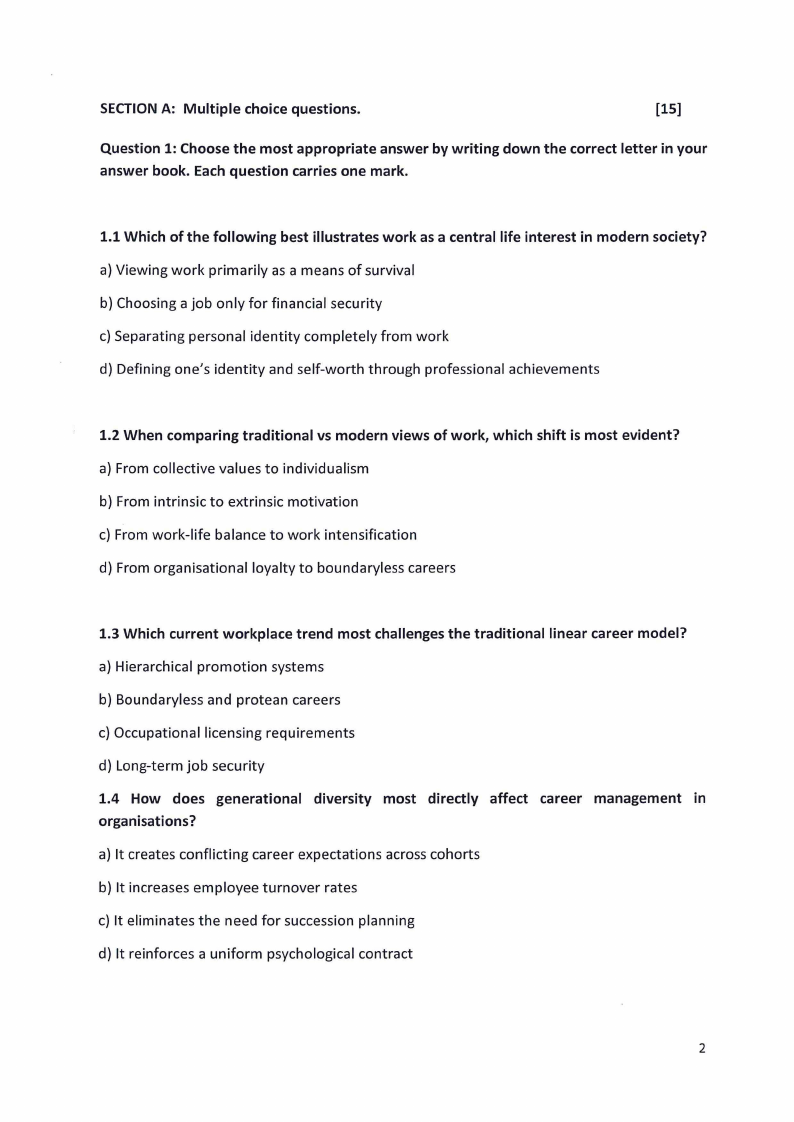
SECTION A: Multiple choice questions.
[15)
Question 1: Choose the most appropriate answer by writing down the correct letter in your
answer book. Each question carries one mark.
1.1 Which of the following best illustrates work as a central life interest in modern society?
a} Viewing work primarily as a means of survival
b} Choosing a job only for financial security
c) Separating personal identity completely from work
d) Defining one's identity and self-worth through professional achievements
1.2 When comparing traditional vs modern views of work, which shift is most evident?
a} From collective values to individualism
b) From intrinsic to extrinsic motivation
c} From work-life balance to work intensification
d} From organisational loyalty to boundaryless careers
1.3 Which current workplace trend most challenges the traditional linear career model?
a) Hierarchical promotion systems
b) Boundaryless and protean careers
c) Occupational licensing requirements
d) Long-term job security
1.4 How does generational diversity most directly affect career management in
organisations?
a) It creates conflicting career expectations across cohorts
b) It increases employee turnover rates
c) It eliminates the need for succession planning
d) It reinforces a uniform psychological contract
2
|
|
3 Page 3 |
▲back to top |
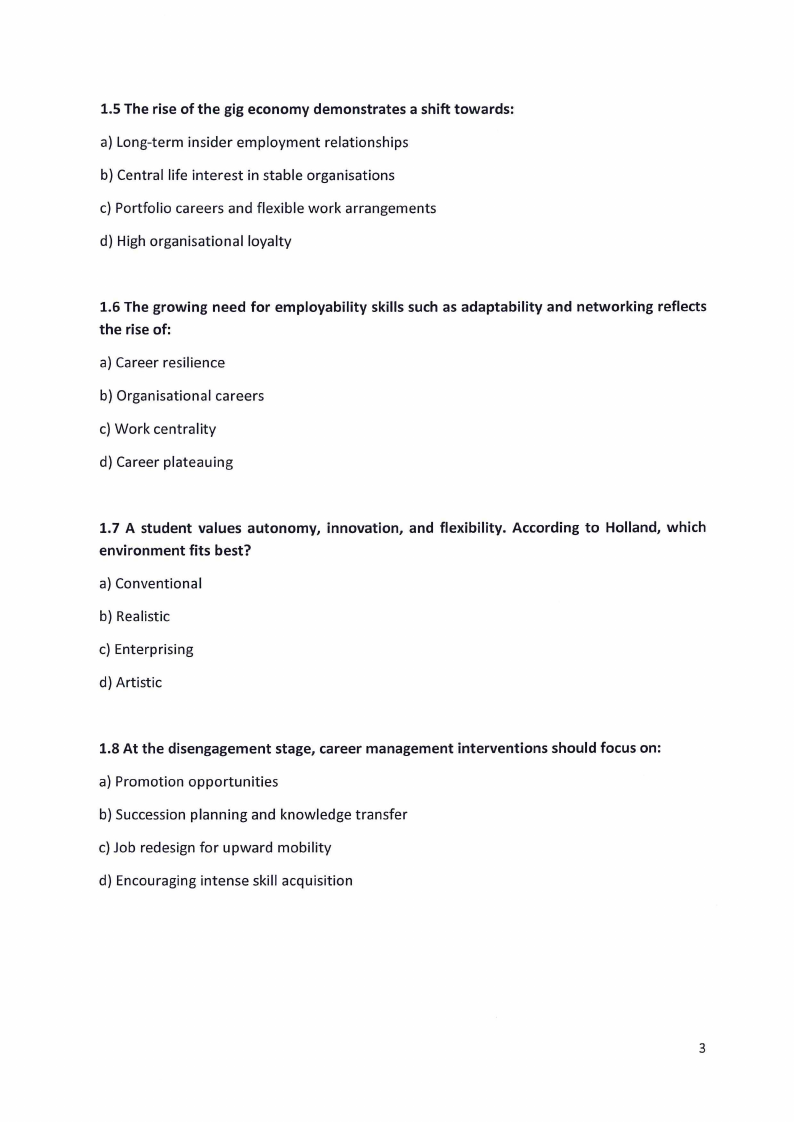
1.5 The rise of the gig economy demonstrates a shift towards:
a) Long-term insider employment relationships
b) Central life interest in stable organisations
c) Portfolio careers and flexible work arrangements
d) High organisational loyalty
1.6 The growing need for employability skills such as adaptability and networking reflects
the rise of:
a) Career resilience
b) Organisational careers
c) Work centrality
d) Career plateauing
1.7 A student values autonomy, innovation, and flexibility. According to Holland, which
environment fits best?
a) Conventional
b) Realistic
c) Enterprising
d) Artistic
1.8 At the disengagement stage, career management interventions should focus on:
a) Promotion opportunities
b) Succession planning and knowledge transfer
c) Job redesign for upward mobility
d) Encouraging intense skill acquisition
3
|
|
4 Page 4 |
▲back to top |
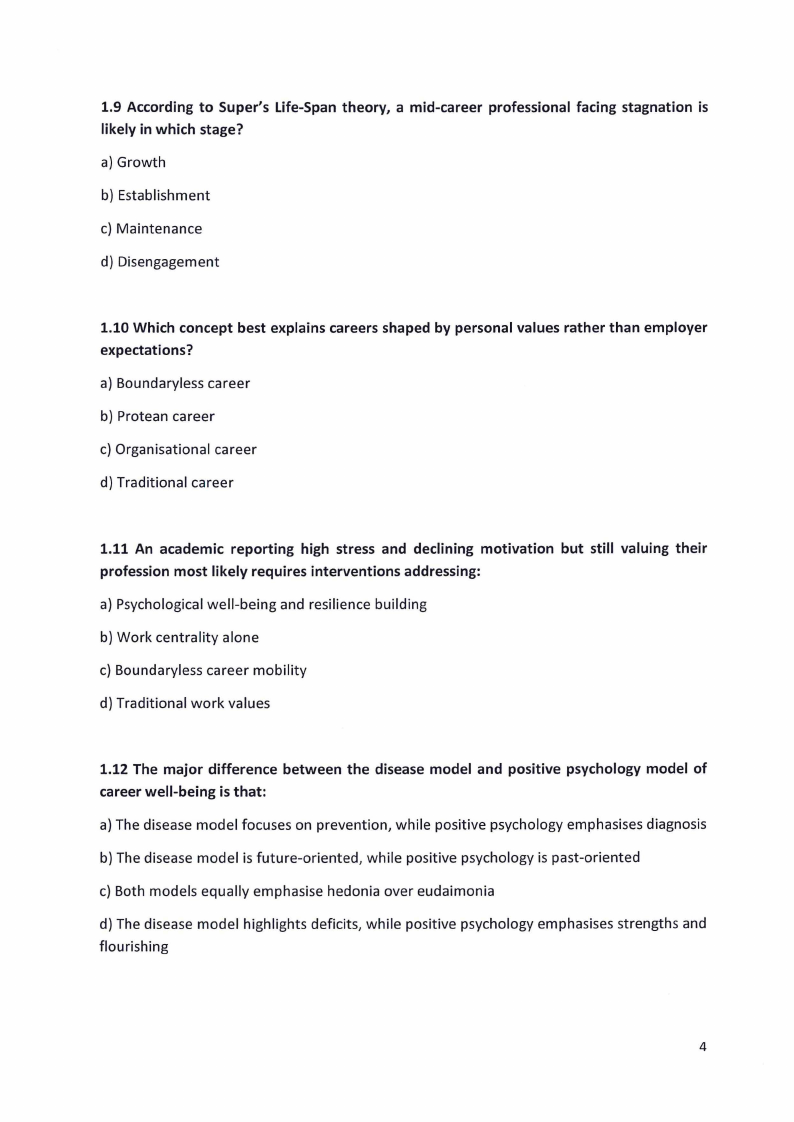
1.9 According to Super's Life-Span theory, a mid-career professional facing stagnation is
likely in which stage?
a) Growth
b) Establishment
c) Maintenance
d) Disengagement
1.10 Which concept best explains careers shaped by personal values rather than employer
expectations?
a) Boundaryless career
b) Protean career
c) Organisational career
d) Traditional career
1.11 An academic reporting high stress and declining motivation but still valuing their
profession most likely requires interventions addressing:
a) Psychological well-being and resilience building
b) Work centrality alone
c) Boundaryless career mobility
d) Traditional work values
1.12 The major difference between the disease model and positive psychology model of
career well-being is that:
a) The disease model focuses on prevention, while positive psychology emphasises diagnosis
b) The disease model is future-oriented, while positive psychology is past-oriented
c) Both models equally emphasise hedonia over eudaimonia
d) The disease model highlights deficits, while positive psychology emphasises strengths and
flourishing
4
|
|
5 Page 5 |
▲back to top |
1.13 A lecturer feels energised by teaching, has strong departmental friendships and derives
purpose from shaping students' futures. According to Seligman's PERMA, which elements
are evident?
a) Engagement, Relationships, Meaning
b) Hedonia, Accomplishment, Resilience
c) Exploration, Maintenance, Adaptab ility
d) Disengagement, Flourishing, Meaning
1.14 Which statement best represents hedonic well-being in a career context?
a) "I enjoy the salary and flexible working hours."
b) "My work allows me to fulfil my potential as a scholar."
c) "I am proud to contribute to community development through my research ."
d) "I find deep purpose in mentoring students."
1.15 A mid-career professional who feels trapped, disengaged, and unmotivated but is not
clinically depressed would be placed on the mental health continuum as:
a) Flourishing
b) Moderate mental health
c) Languishing
d) Acute disorder
5
|
|
6 Page 6 |
▲back to top |
SECTION B: Case Study
Question 2
[20]
Read the following scenario and answer the questions that follow.
Selma's Career Journey
Selma, a 32-year-old HR professional, has worked for seven years in an insurance company.
She completed her degree at a public university but struggled to get internships during her
studies because of limited networks. Despite her dedication, she often feels she must work
harder than her peers to be noticed.
Her personality is reserved, and she finds networking events uncomfortable. Although she
values stability and family time, she is highly ambitious and wants to grow into a senior
management role. Lately, she feels demotivated because promotions seem to go to
employees with stronger social connections.
Selma also recognises she lacks some advanced HR analytics and digital skills, which are
increasingly valued in her organisation. The company itself has a rigid hierarchy with few
senior positions available, making upward mobility difficult. Although Selma regards her
current salary growth as insufficient, she feels that her work is meaningful and provides her
with a family life balance.
2.1 identify the background-related hurdle that influenced Selma's career?
(1)
2.2 State the trait-like hurdle that Selma face and briefly explain how this affects her career.(2)
2.3 Identify one motivation hurdle from Selma's situation.
(4)
2.4 What skill-related hurdle is holding back Selma's career advancement?
(2)
2.5 What organisational/job hurdles are evident in Selma's company?
(2)
2.6 Distinguish between Selma's subjective and objective career success.
(6)
2.7 If Selma was to overcome one hurdle first, which would be the most strategic and why?
(3)
6
|
|
7 Page 7 |
▲back to top |
SECTION C: Structured questions
(65)
Question 3
3.1 The meaning of work has evolved significantly from ancient times to the contemporary
era. Discuss the evolution of meanings associated with work across different historical
periods.
(20)
3.2 In the contemporary protean career environment, employability capital has become
central to sustaining long-term career success. Critically discuss the concept of employability
capital, explaining its key dimensions.
(20)
3.3 Trait-and-Factor and Person-Environment Fit (PE-fit) theories remain foundational in
understanding career choice and counselling. Critically discuss these theories by explaining
their main assumptions, strengths, and limitations.
(10)
3.4 Career well-being has moved beyond the absence of illness towards the promotion of
flourishing at work. Critically discuss individual-level interventions that employees can adopt
to enhance career well-being and flourish at work.
(15)
End of examination paper!
7