SMM811S - STRATEGIC MANAGEMENT - 1ST OPP - NOV 2025


SMM811S - STRATEGIC MANAGEMENT - 1ST OPP - NOV 2025


1 Pages 1-10

▲back to top


1.1 Page 1

▲back to top


nAmlBIA unlVERSITY
OF SCIEnCE Ano TECHnOLOGY
FACULTY OF COMMERCE, HUMAN SCIENCES AND EDUCATION
DEPARTMENT OF GOVERNANCE AND MANAGEMENT SCIENCES
MANAGEMENT SECTION
QUALIFICATION: BACHELOR OF BUSINESS MANAGEMENT HONOURS
QUALIFICATION CODE: 08BMAR
LEVEL: 8
COURSE CODE: SMM811S
COURSE NAME: STRATEGIC MANAGEMENT
SESSION: November 2025
DURATION: 3 HOURS
PAPER: THEORY
MARKS: 100
EXAMINER(S)
FIRST OPPORTUNITY EXAMINATION QUESTION PAPER
DR KARIKARI AMOA-GYARTENG
MODERATOR:
Ms Ayesha Tjiueza
INSTRUCTIONS
This exam has two sections: A and B. Total marks are 100 (Section A= 60, Section B = 40).
Section A: 60 multiple-choice questions, 1 mark each . Answer all questions and choose the single best
option from A to E.
Section B: Answer all questions for a total of 40 marks. Show workings where needed.
1. Answer ALL the questions in the answer book provided.
2. Write clearly and neatly.
3. Number the answers clearly.
4. Indicate your lecturer's name on your answer sheet.
THIS EXAM PAPER CONSISTS OF 18 PAGES (Including this front page)

1.2 Page 2

▲back to top


SECTION A-ANSWER ALL QUESTIONS (60 Marks)
Mini-Case A: Namibia Fast-Food Sector
Several quick-service outlets operate in Windhoek malls and other areas in the city. Customers can
switch easily among brands, vendors sell ready-to-eat options nearby, and delivery platforms make
comparisons simple. Franchise fees and setup costs are moderate, recipes are widely known, and
some imported items face currency swings.
l. Within this sector, buyer power is most likely
A. Low because customers are locked in by contracts
B. High because switch ing is easy and options are many
C. Zero because prices are regulated
D. Moderate because switching requires approvals
E. High only during public holidays
2. Which is the clearest substitute pressure in this context
A. Government training grants
B. Home-cooked meals and vendors
C. Bank interest rates
D. Interior decor costs
E. Corporate tax changes
3. A sensible competitive move given these forces would be
A. Compete only on price and ignore operations
B. Develop speed, consistency, and a signature value item
C. Eliminate delivery options to reduce complexity
D. Increase fixed decor spend ing in low-traffic sites
E. Standardise premium pricing across all neighbourhoods
4. If imported inputs are volatile, a matching action is to
A. Ignore it and keep prices fixed indefinitely
2

1.3 Page 3

▲back to top


B. Hedge exposure and re-engineer the menu mix
C. Increase credit terms to customers
D. Cut training to offset volatility
E. Freeze supplier relationships permanently
Mini-Case B: DRN Brand Misalignment
DRN advertises value to lower-income segments. In store, managers push premium imported lines
and give space to high-margin decor products. Sales fall and customers migrate to rivals that match
the advertised promise. Staff are unsure which segment to serve.
5. The core strategic problem at DRN is best described as
A. Effective functional alignment
B. Cross-level misalignment between marketing and in-store offers
C. Successful focus on premium differentiation
D. Correct execution of corporate diversification
E. Excess regulation in the sector
6. A first corrective step that fits the target segment is to
A. Increase emphasis on premium decor SKUs
B. Align assortment and price points with the advertised promise
C. Remove promotions to avoid confusion
D. Shift entirely to on line sales only
E. Close stores in low-income areas
7. Which KPI would most directly signal improved alignment
A. Interior design spend as percent of sales
B. Average basket size for the targeted segment
C. Time to restock decor items
D. Head-office travel costs
E. Store rental per square metre
3

1.4 Page 4

▲back to top


Mini-Case C: Retailer Considering Zambia
A South African retailer evaluates entry into Zambia. The policy climate is broadly pro-business with
incentives in certain zones. Currency fluctuations and inflation complicate pricing and sourcing. Urban
middle-income segments are growing in Lusaka.
8. Which PESTLE factors are most salient to the entry decision
A. Political support and economic stability challenges
B. Technological patents and ecological fines only
C. Legal ban on foreign retailers
D. Ethical concerns about advertising
E. Demographic decline in urban areas
9. Given currency volatility, a suitable strategic response is
A. Uniform annual price reductions across all categories
B. Local sourcing where feasible and adaptive pricing
C. Exclusive reliance on imported SKUs
D. Removal of performance-based pay
E. Ignoring exchange-rate trends
Mini-Case D: Everyday-Value Grocer
A national grocer pursues cost leadership: large-format stores, strong distribution, mostly cash sales.
Margins are thin, turnover is high, supplier terms are long, and stores are plain but efficient.
10. Which financial architecture most closely matches this strategy
A. High net margins and low turnover
B. Thin margins, high asset turnover, tight operating expenses
C. High receivables and generous customer credit
D. Heavy decor investment to drive premium pricing
E. Minimal logistics investment
11. Which working-capital pattern is consistent with the model
4

1.5 Page 5

▲back to top


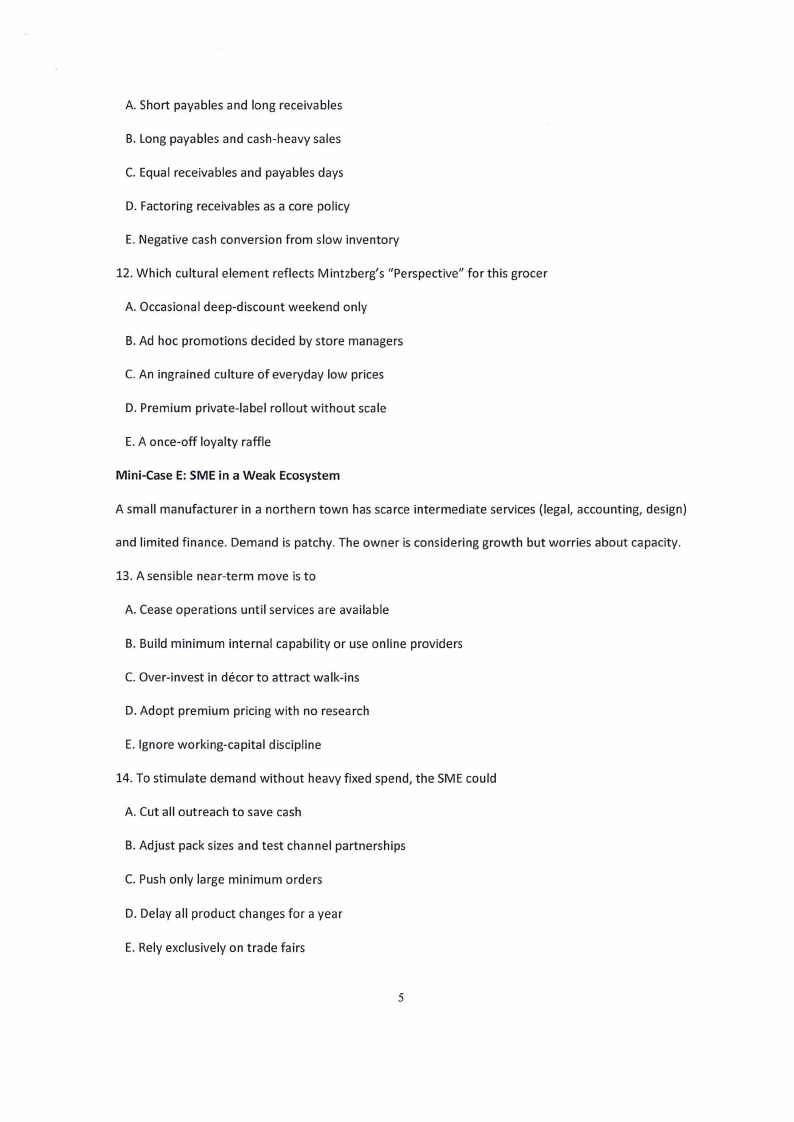
A. Short payables and long receivables
B. Long payables and cash-heavy sales
C. Equal receivables and payables days
D. Factoring receivables as a core policy
E. Negative cash conversion from slow inventory
12. Which cultural element reflects Mintzberg' s "Perspective" for this grocer
A. Occasional deep-discount weekend only
B. Ad hoc promotions decided by store managers
C. An ingrained culture of everyday low prices
D. Premium private-label rollout without scale
E. A once-off loyalty raffle
Mini-Case E: SME in a Weak Ecosystem
A small manufacturer in a northern town has scarce intermediate services (legal, accounting, design)
and limited finance. Demand is patchy. The owner is considering growth but worries about capacity.
13 . A sensible near-term move is to
A. Cease operations until services are available
B. Build minimum internal capability or use online providers
C. Over-invest in decor to attract walk-ins
D. Adopt premium pricing with no resea rch
E. Ignore working-capital discipline
14. To stimulate demand without heavy fixed spend, the SME could
A. Cut all outreach to save cash
B. Adjust pack sizes and test channel partnerships
C. Push only large minimum orders
D. Delay all product changes for a year
E. Rely exclusively on trade fairs
5

1.6 Page 6

▲back to top


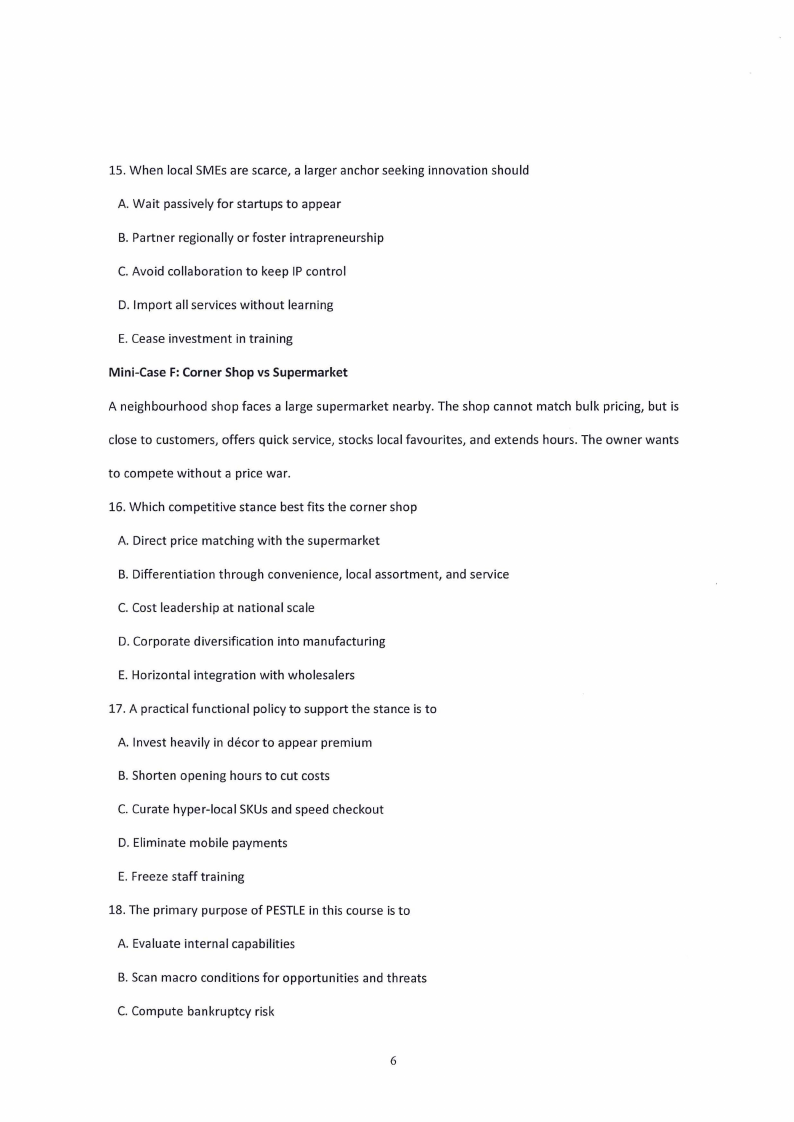
15. When local SM Es are scarce, a larger anchor seeking innovation should
A. Wait passively for startups to appear
B. Partner regionally or foster intrapreneurship
C. Avoid collaboration to keep IP control
D. Import all services without learning
E. Cease investment in training
Mini-Case F: Corner Shop vs Supermarket
A neighbourhood shop faces a large supermarket nearby. The shop cannot match bulk pricing, but is
close to customers, offers quick service, stocks local favourites, and extends hours. The owner wants
to compete without a price war.
16. Which competitive stance best fits the corner shop
A. Direct price matching with the supermarket
B. Differentiation through convenience, local assortment, and service
C. Cost leadership at national scale
D. Corporate diversification into manufacturing
E. Horizontal integration with wholesalers
17. A practical functional policy to support the stance is to
A. Invest heavily in decor to appear premium
B. Shorten opening hours to cut costs
C. Curate hyper-local SKUs and speed checkout
D. Eliminate mobile payments
E. Freeze staff training
18. The primary purpose of PESTLE in this course is to
A. Evaluate internal capabilities
B. Scan macro conditions for opportunities and threats
C. Compute bankruptcy risk
6

1.7 Page 7

▲back to top


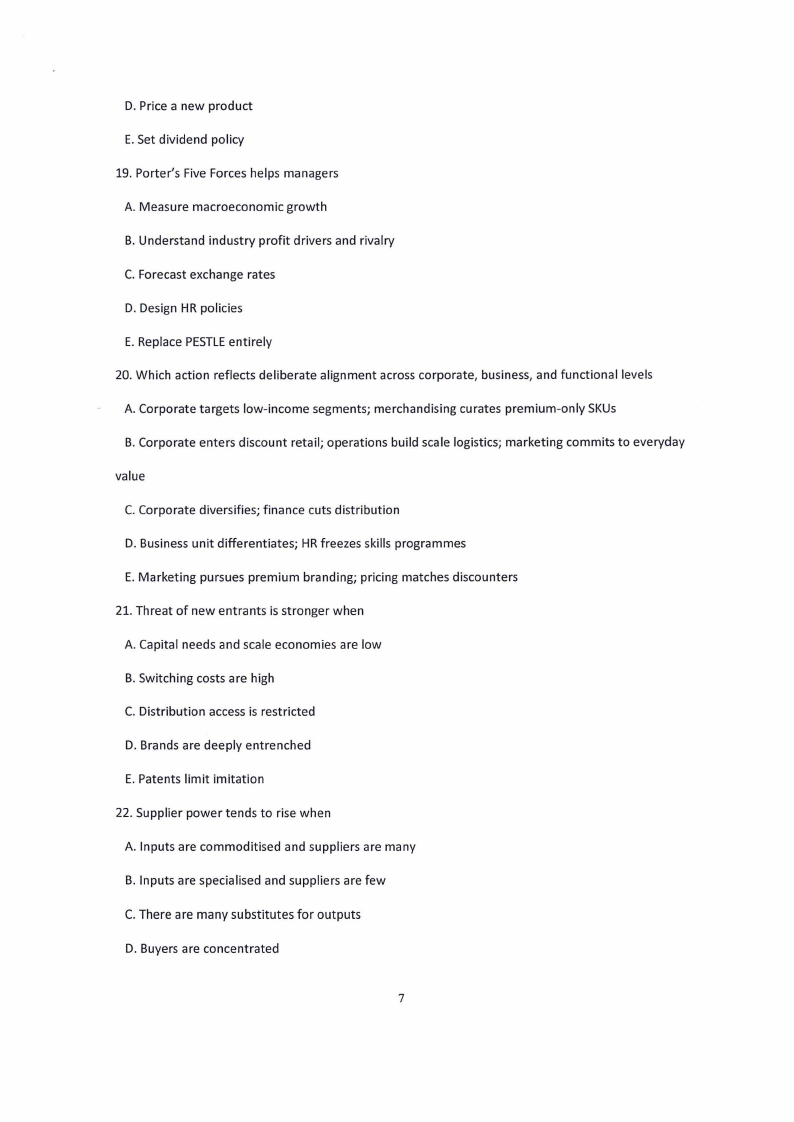
D. Price a new product
E. Set dividend policy
19. Porter's Five Forces helps managers
A. Measure macroeconomic growth
B. Understand industry profit drivers and rivalry
C. Forecast exchange rates
D. Design HR policies
E. Replace PESTLE entirely
20. Which action reflects deliberate alignment across corporate, business, and functional levels
A. Corporate targets low-income segments; merchandising curates premium-only SKUs
B. Corporate enters discount retail; operations build scale logistics; marketing commits to everyday
value
C. Corporate diversifies; finance cuts distribution
D. Business unit differentiates; HR freezes skills programmes
E. Marketing pursues premium branding; pricing matches discounters
21. Threat of new entrants is stronger when
A. Capital needs and scale economies are low
B. Switching costs are high
C. Distribution access is restricted
D. Brands are deeply entrenched
E. Patents limit imitation
22. Supplier power tends to rise when
A. Inputs are commoditised and suppliers are many
B. Inputs are specialised and suppliers are few
C. There are many substitutes for outputs
D. Buyers are concentrated
7

1.8 Page 8

▲back to top


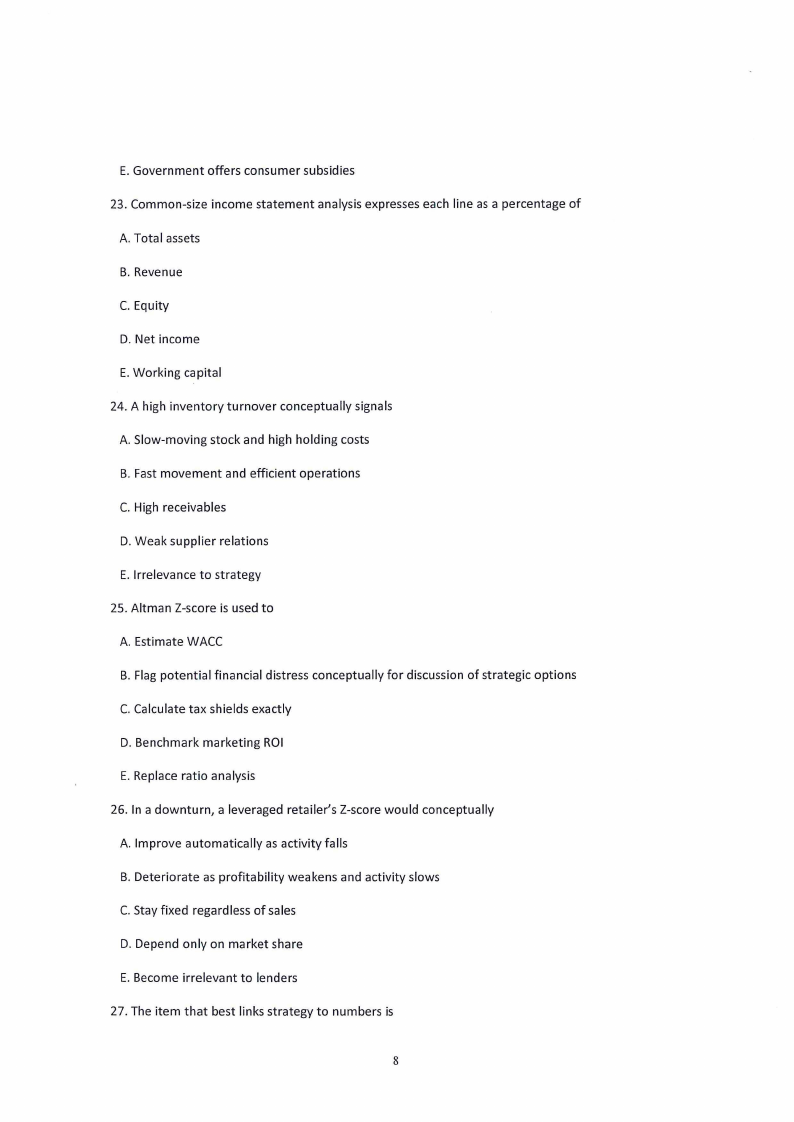
E. Government offers consumer subsidies
23 . Common-size income statement analysis expresses each line as a percentage of
A. Total assets
B. Revenue
C. Equity
D. Net income
E. Working capital
24. A high inventory turnover conceptually signals
A. Slow-moving stock and high holding costs
B. Fast movement and efficient operations
C. High receivables
D. Weak supplier relations
E. Irrelevance to strategy
25 . Altman Z-score is used to
A. Estimate WACC
B. Flag potential financial distress conceptually for discussion of strategic options
C. Calculate ta x shields exactly
D. Benchmark marketing ROI
E. Replace ratio analysis
26. In a downturn, a leveraged retailer's Z-score would conceptually
A. Improve automatically as activity falls
B. Deteriorate as profitability weakens and activity slows
C. Stay fixed regardless of sales
D. Depend only on market share
E. Become irrelevant to lenders
27 . The item that best links strategy to numbers is
8

1.9 Page 9

▲back to top


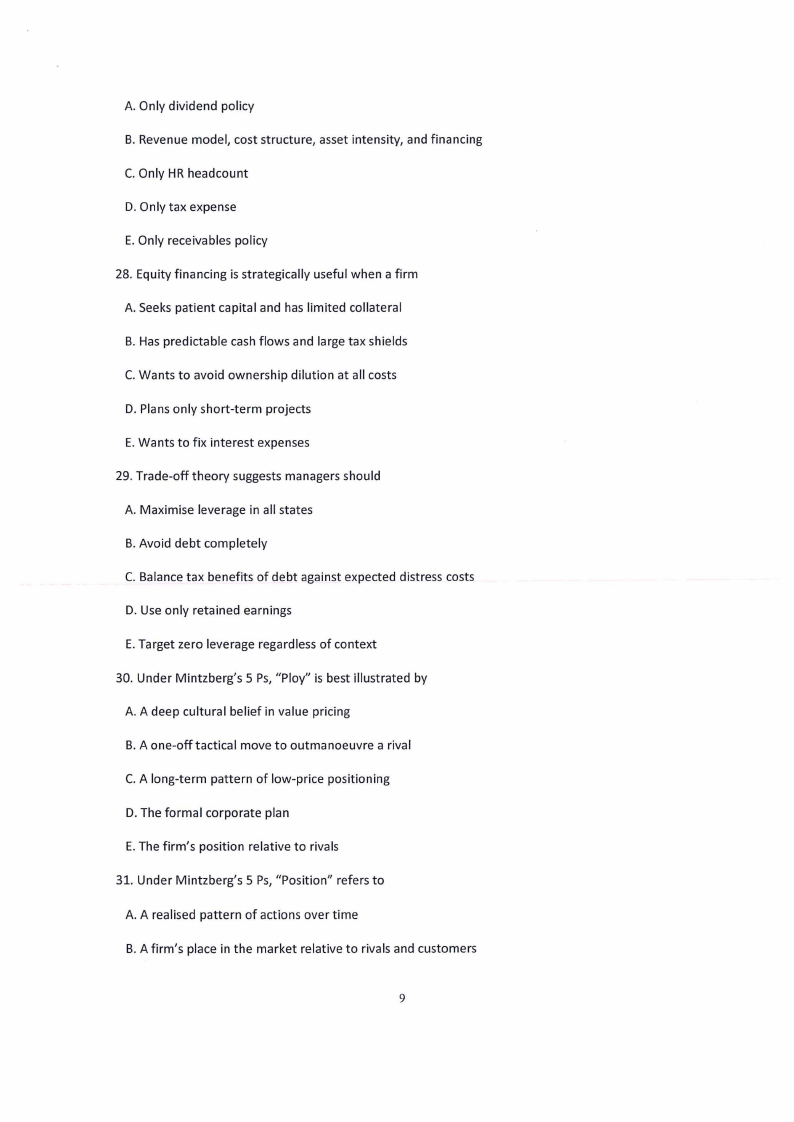
A. Only dividend policy
B. Revenue model, cost structure, asset intensity, and financing
C. Only HR headcount
D. Only tax expense
E. Only receivables policy
28. Equity financing is strategically useful when a firm
A. Seeks patient capital and has limited collateral
B. Has predictable cash flows and large tax shields
C. Wants to avoid ownership dilution at all costs
D. Plans only short-term projects
E. Wants to fix interest expenses
29. Trade-off theory suggests managers should
A. Maximise leverage in all states
B. Avoid debt completely
C. Balance tax benefits of debt against expected distress costs
D. Use only retained earnings
E. Target zero leverage regardless of context
30. Under Mintzberg's 5 Ps, "Ploy" is best illustrated by
A. A deep cultural belief in value pricing
B. A one-off tactical move to outmanoeuvre a rival
C. A long-term pattern of low-price positioning
D. The formal corporate plan
E. The firm's position relative to rivals
31. Under Mintzberg's 5 Ps, "Position" refers to
A. A realised pattern of actions over time
B. A firm's place in the market relative to rivals and customers
9

1.10 Page 10

▲back to top


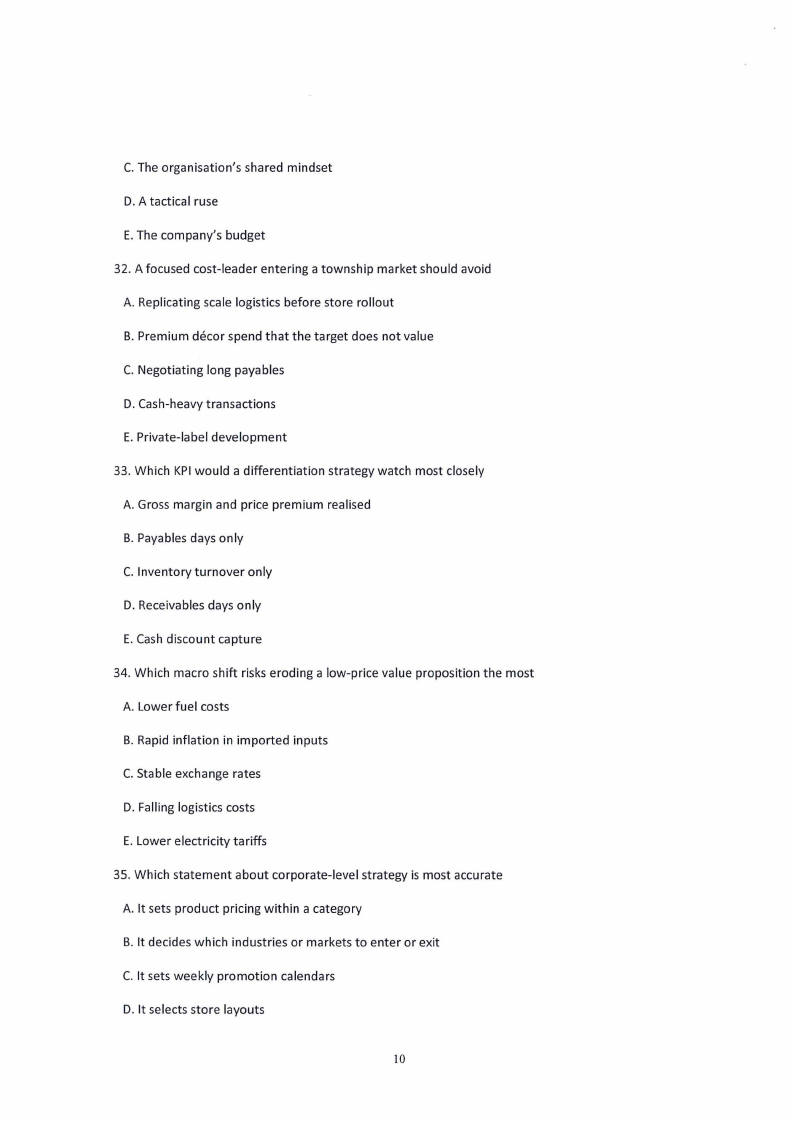
C. The organisation's shared mindset
D. A tactical ruse
E. The company's budget
32. A focused cost-leader entering a township market should avoid
A. Replicating scale logistics before store rollout
B. Premium decor spend that the target does not value
C. Negotiating long payables
D. Cash-heavy transactions
E. Private-label development
33 . Which KPI would a differentiation strategy watch most closely
A. Gross margin and price premium realised
B. Payables days only
C. Inventory turnover only
D. Receivables days only
E. Cash discount capture
34. Which macro shift risks eroding a low-price value proposition the most
A. Lower fuel costs
B. Rapid inflation in imported inputs
C. Stable exchange rates
D. Falling logistics costs
E. Lower electricity tariffs
35. Which statement about corporate-level strategy is most accurate
A. It sets product pricing within a category
B. It decides which industries or markets to enter or exit
C. It sets weekly promotion calendars
D. It selects store layouts
10

2 Pages 11-20

▲back to top


2.1 Page 11

▲back to top


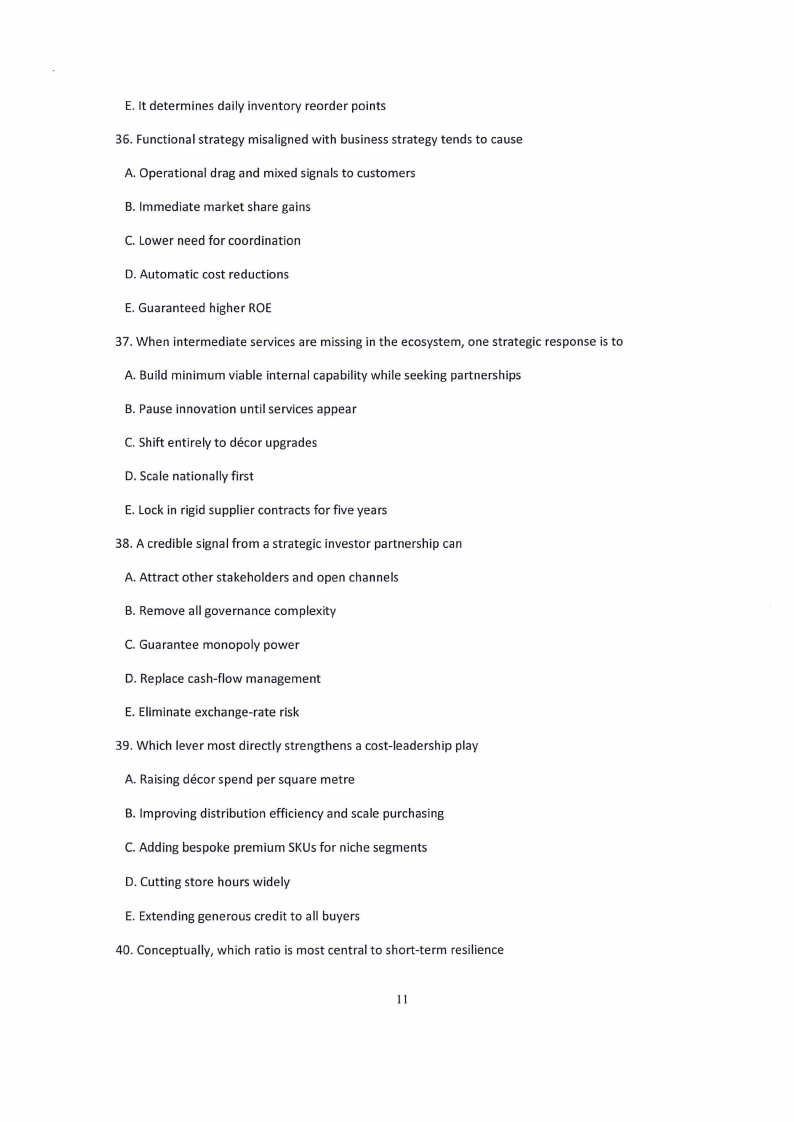
E. It determines daily inventory reorder points
36. Functional strategy misaligned with business strategy tends to cause
A. Operational drag and mixed signals to customers
B. Immediate market share gains
C. Lower need for coordination
D. Automatic cost reductions
E. Guaranteed higher ROE
37. When intermediate services are missing in the ecosystem, one strategic response is to
A. Build minimum viable internal capability while seeking partnerships
B. Pause innovation until services appear
C. Shift entirely to decor upgrades
D. Scale nationally first
E. Lock in rigid supplier contracts for five years
38. A credible signal from a strategic investor partnership can
A. Attract other stakeholders and open channels
B. Remove all governance complexity
C. Guarantee monopoly power
D. Replace cash-flow management
E. Eliminate exchange-rate risk
39 . Which lever most directly strengthens a cost-leadership play
A. Raising decor spend per square metre
B. Improving distribution efficiency and scale purchasing
C. Adding bespoke premium SKUs for niche segments
D. Cutting store hours widely
E. Extending generous credit to all buyers
40. Conceptually, which ratio is most central to short-term resilience
11

2.2 Page 12

▲back to top


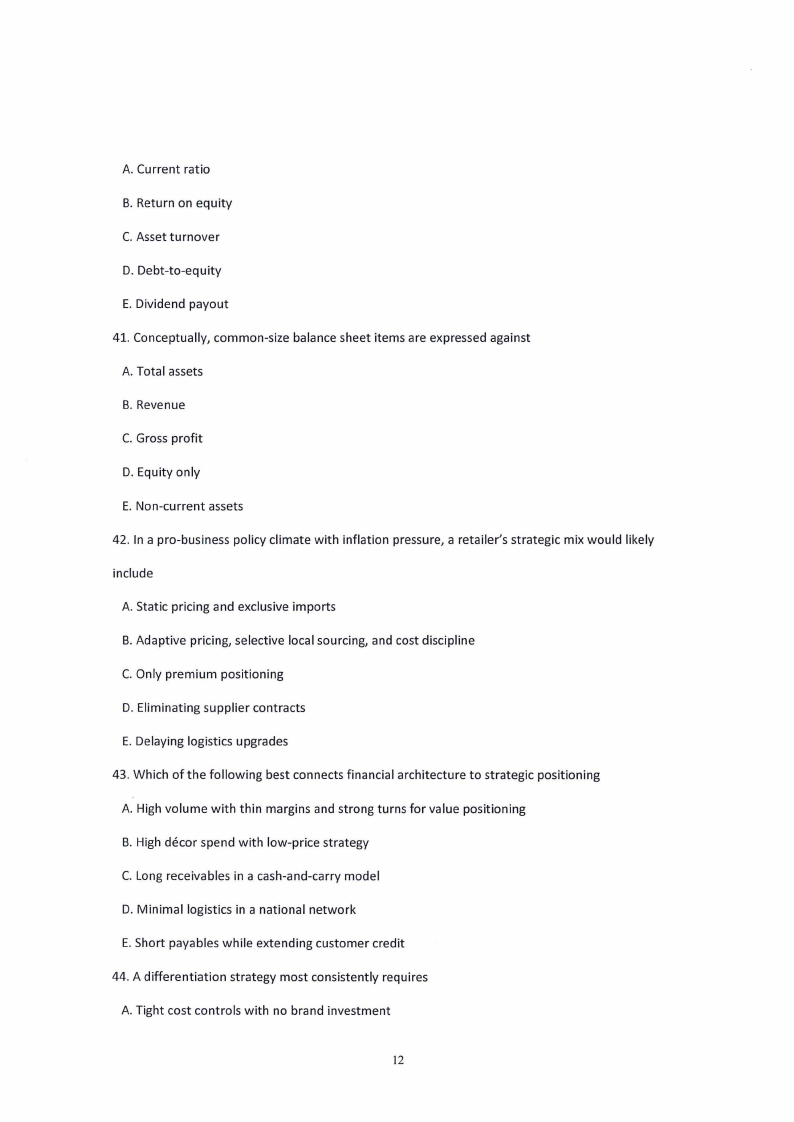
A. Current ratio
B. Return on equ ity
C. Asset turnover
D. Debt-to-equity
E. Dividend payout
41. Conceptually, common-size balance sheet items are expressed against
A. Total assets
B. Revenue
C. Gross profit
D. Equity only
E. Non-current assets
42 . In a pro-business policy climate with inflation pressure, a retailer's strategic mix would likely
include
A. Static pricing and exclusive imports
B. Adaptive pricing, selective local sourcing, and cost discipline
C. Only premium positioning
D. Eliminating supplier contracts
E. Delaying logistics upgrades
43 . Which of the following best connects financial architecture to strategic positioning
A. High volume with thin margins and strong turns for value positioning
B. High decor spend with low-price strategy
C. Long receivables in a cash-and-carry model
D. Minimal logistics in a national network
E. Short payables while extending customer credit
44. A differentiation strategy most consistently requires
A. Tight cost controls with no brand investment
12

2.3 Page 13

▲back to top


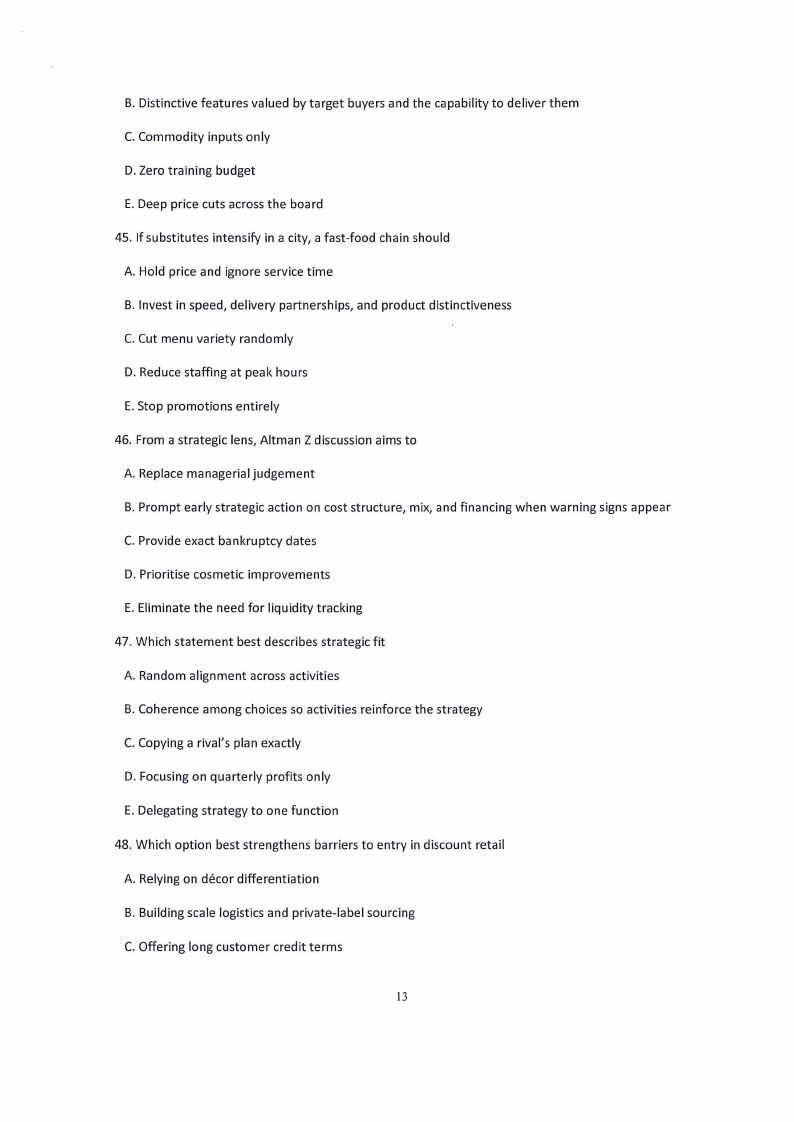
B. Distinctive features valued by target buyers and the capability to deliver them
C. Commodity inputs only
D. Zero training budget
E. Deep price cuts across the board
45. If substitutes intensify in a city, a fast-food chain should
A. Hold price and ignore service time
B. Invest in speed, delivery partnerships, and product distinctiveness
C. Cut menu variety randomly
D. Reduce staffing at peak hours
E. Stop promotions entirely
46. From a strategic lens, Altman Z discussion aims to
A. Replace managerial judgement
B. Prompt early strategic action on cost structure, mix, and financing when warning signs appear
C. Provide exact bankruptcy dates
D. Prioritise cosmetic improvements
E. Eliminate the need for liquidity tracking
47. Which statement best describes strategic fit
A. Random alignment across activities
B. Coherence among choices so activities reinforce the strategy
C. Copying a rival's plan exactly
D. Focusing on quarterly profit s only
E. Delegating strategy to one function
48. Which option best strengthens barriers to entry in discount retail
A. Relying on decor differentiation
B. Building scale logistics and private-label sourcing
C. Offering long customer credit terms
13

2.4 Page 14

▲back to top


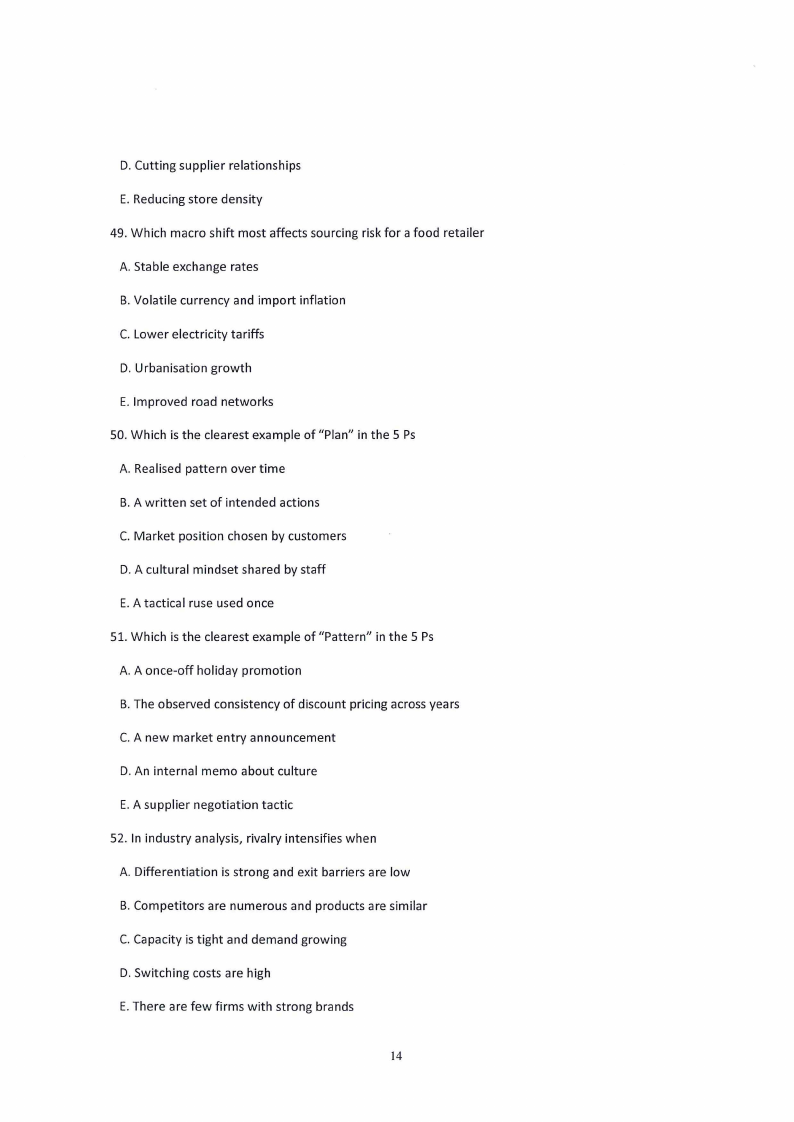
D. Cutting supplier relationships
E. Reducing store density
49. Which macro shift most affects sourcing risk for a food retailer
A. Stable exchange rates
B. Volatile currency and import inflation
C. Lower electricity tariffs
D. Urbanisation growth
E. Improved road networks
50. Which is the clearest example of "Plan" in the 5 Ps
A. Realised pattern over time
B. A written set of intended actions
C. Market position chosen by customers
D. A cultural mindset shared by staff
E. A tactical ruse used once
51. Which is the clearest example of "Pattern" in the 5 Ps
A. A once-off holiday promotion
B. The observed consistency of discount pricing across years
C. A new market entry announcement
D. An internal memo about culture
E. A supplier negotiation tactic
52. In industry analysis, rivalry intensifies when
A. Differentiation is strong and exit barriers are low
B. Competitors are numerous and products are similar
C. Capacity is tight and demand growing
D. Switching costs are high
E. There are few firms with strong brands
14

2.5 Page 15

▲back to top


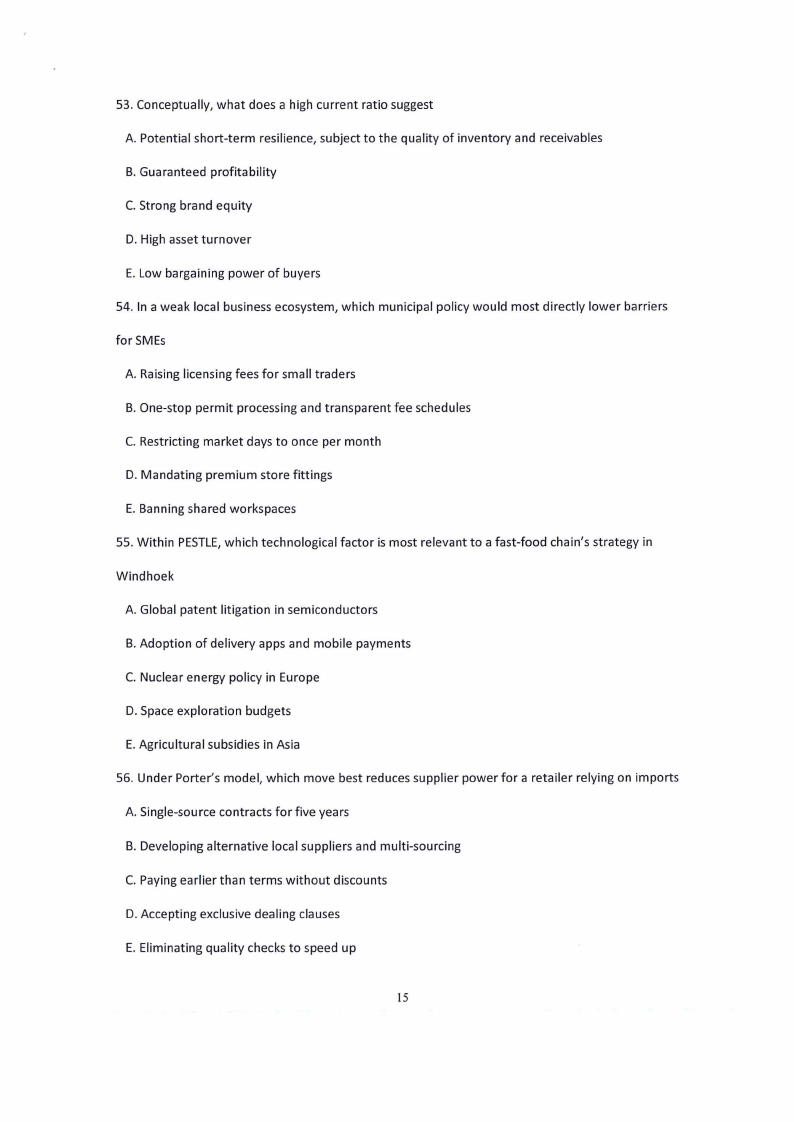
53 . Conceptually, what does a high current ratio suggest
A. Potential short-term resilience, subject to the quality of inventory and receivables
B. Guaranteed profitability
C. Strong brand equity
D. High asset turnover
E. Low bargaining power of buyers
54. In a weak local business ecosystem, which municipal policy would most directly lower barriers
for SM Es
A. Raising licensing fees for small traders
B. One-stop permit processing and transparent fee schedules
C. Restricting market days to once per month
D. Mandating premium store fittings
E. Banning shared workspaces
55 . Within PESTLE, which technological factor is most relevant to a fast-food chain's strategy in
Windhoek
A. Global patent litigation in semiconductors
B. Adoption of delivery apps and mobile payments
C. Nuclear energy policy in Europe
D. Space exploration budgets
E. Agricultural subsidies in Asia
56. Under Porter's model, which move best reduces supplier power for a retailer relying on imports
A. Single-source contracts for five years
B. Developing alternative local suppliers and multi-sourcing
C. Paying earlier than terms without discounts
D. Accepting exclusive dealing clauses
E. Eliminating quality checks to speed up
15

2.6 Page 16

▲back to top


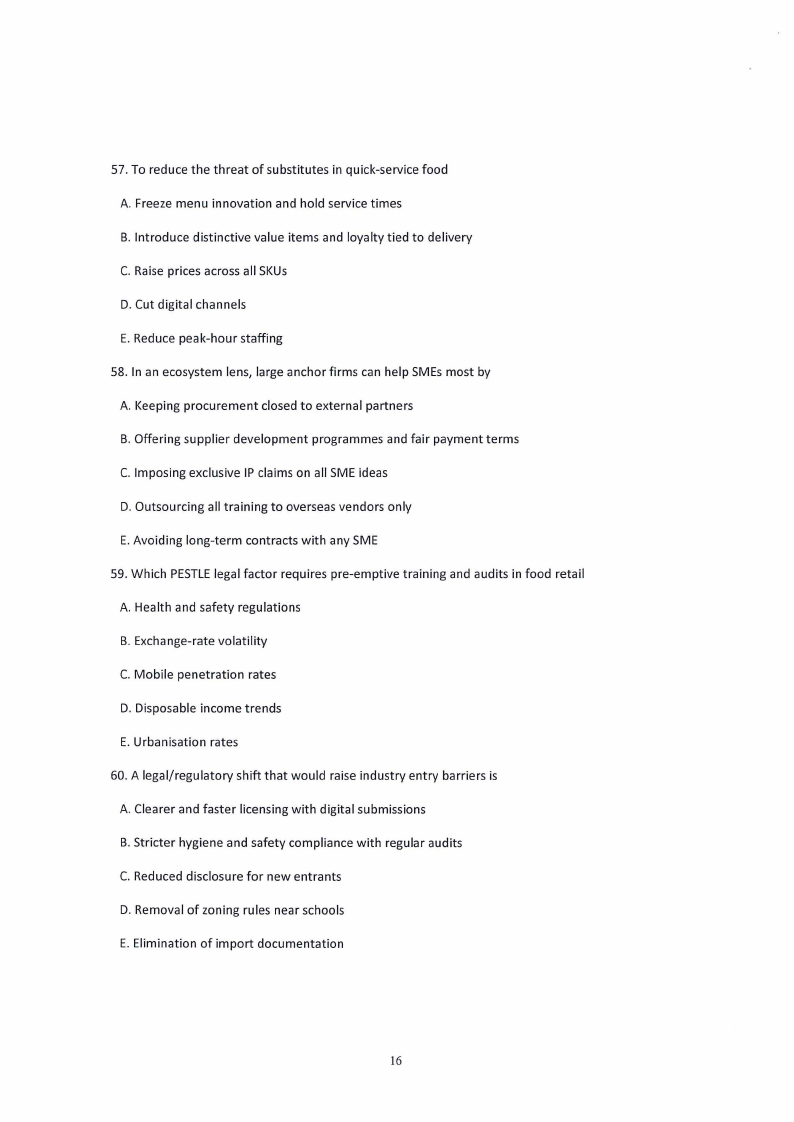
57. To reduce the threat of substitutes in quick-service food
A. Freeze menu innovation and hold service times
B. Introduce distinctive value items and loyalty tied to delivery
C. Raise prices across all SKUs
D. Cut digital channels
E. Reduce peak-hour staffing
58. In an ecosystem lens, large anchor firms can help SM Es most by
A. Keeping procurement closed to external partners
B. Offering supplier development programmes and fair payment terms
C. Imposing exclusive IP claims on all SME ideas
D. Outsourcing all training to overseas vendors only
E. Avoiding long-term contracts with any SME
59. Which PESTLE legal factor requires pre-emptive training and audits in food retail
A. Health and safety regulations
B. Exchange-rate volatility
C. Mobile penetration rates
D. Disposable income trends
E. Urbanisation rates
60. A legal/regulatory shift that would raise industry entry barriers is
A. Clearer and faster licensing with digital submissions
B. Stricter hygiene and safety compliance with regular audits
C. Reduced disclosure for new entrants
D. Removal of zoning rules near schools
E. Elimination of import documentation
16

2.7 Page 17

▲back to top


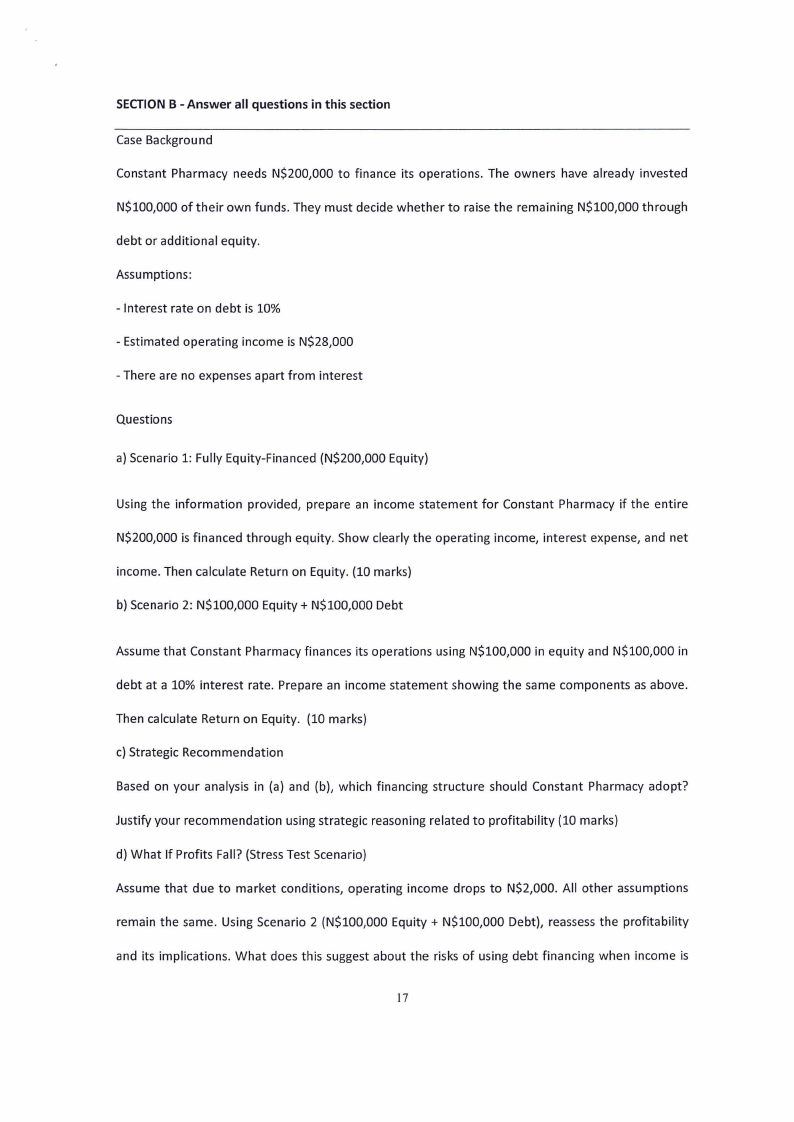
SECTION B - Answer all questions in this section
Case Background
Constant Pharmacy needs N$200,000 to finance its operations. The owners have already invested
N$100,000 of their own funds. They must decide whether to raise the remaining N$100,000 through
debt or additional equity.
Assumptions:
- Interest rate on debt is 10%
- Estimated operating income is N$28,000
- There are no expenses apart from interest
Questions
a) Scenario 1: Fully Equity-Financed (N$200,000 Equity)
Using the information provided, prepare an income statement for Constant Pharmacy if the entire
N$200,000 is financed through equity. Show clearly the operating income, interest expense, and net
income. Then calculate Return on Equity. {10 marks)
b) Scenario 2: N$100,000 Equity+ N$100,000 Debt
Assume that Constant Pharmacy finances its operations using N$100,000 in equity and N$100,000 in
debt at a 10% interest rate. Prepare an income statement showing the same components as above.
Then calculate Return on Equity. (10 marks)
c) Strategic Recommendation
Based on your analysis in (a) and (b), which financing structure should Constant Pharmacy adopt?
Justify your recommendation using strategic reasoning related to profitability (10 marks)
d) What If Profits Fall? (Stress Test Scenario)
Assume that due to market conditions, operating income drops to N$2,000. All other assumptions
remain the same. Using Scenario 2 (N$100,000 Equity + N$100,000 Debt), reassess the profitability
and its implications. What does this suggest about the risks of using debt financing when income is
17

2.8 Page 18

▲back to top


low? (10 marks)
END OF QUESTION PAPER
18