SMM811S - STRATEGIC MANAGEMENT - 2ND OPP - NOV 2025


SMM811S - STRATEGIC MANAGEMENT - 2ND OPP - NOV 2025


1 Pages 1-10

▲back to top


1.1 Page 1

▲back to top


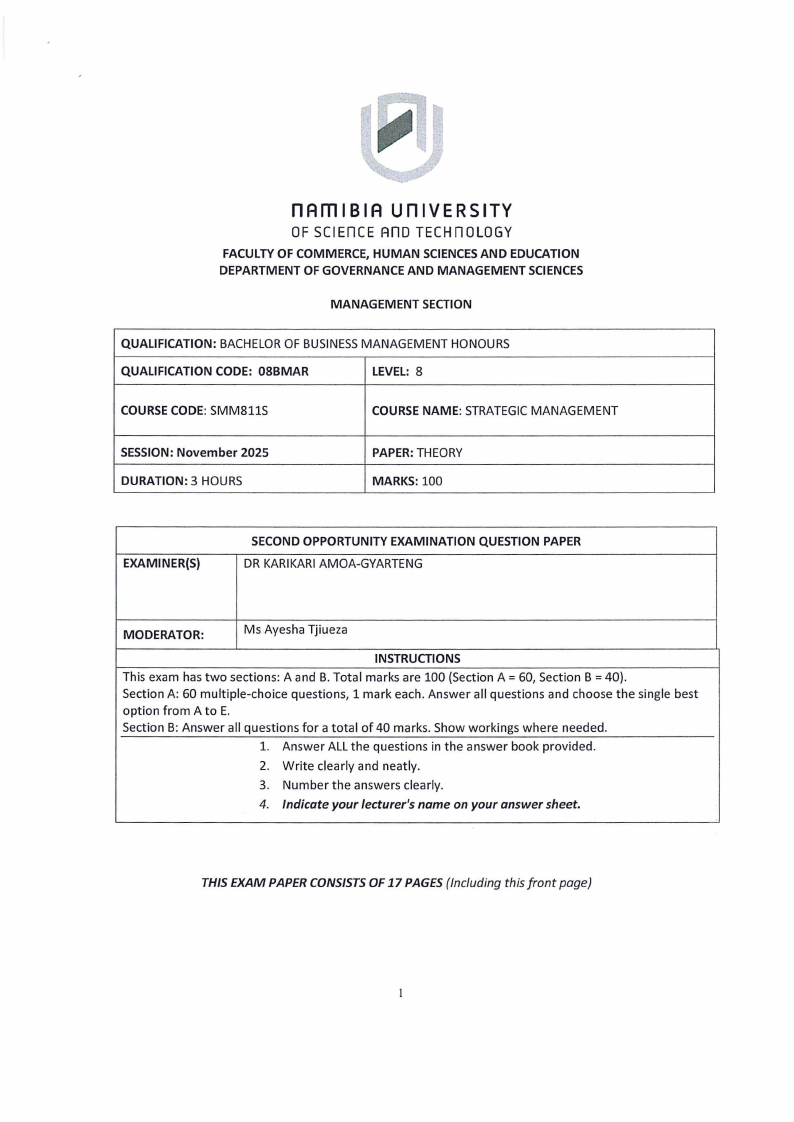
nAmlBIA unlVERSITY
OF SCIEnCE Ano TECHnOLOGY
FACULTY OF COMMERCE, HUMAN SCIENCES AND EDUCATION
DEPARTMENT OF GOVERNANCE AND MANAGEMENT SCIENCES
MANAGEMENT SECTION
QUALIFICATION: BACHELOR OF BUSINESS MANAGEMENT HONOURS
QUALIFICATION CODE: 08BMAR
LEVEL: 8
COURSE CODE: SMM811S
COURSE NAME: STRATEGIC MANAGEMENT
SESSION: November 2025
DURATION: 3 HOURS
PAPER: THEORY
MARKS: 100
EXAMINER(S)
SECOND OPPORTUNITY EXAMINATION QUESTION PAPER
DR KARIKARI AMOA-GYARTENG
MODERATOR:
Ms Ayesha Tjiueza
INSTRUCTIONS
This exam has two sections: A and B. Total marks are 100 (Section A= 60, Section B = 40).
Section A: 60 multiple-choice questions, 1 mark each. Answer all questions and choose the single best
option from A to E.
Section B: Answer all questions for a total of 40 marks. Show workings where needed.
1. Answer ALL the questions in the answer book provided.
2. Write clearly and neatly.
3. Number the answers clearly.
4. Indicate your lecturer's name on your answer sheet.
THIS EXAM PAPER CONSISTS OF 17 PAGES {Including this front page)

1.2 Page 2

▲back to top


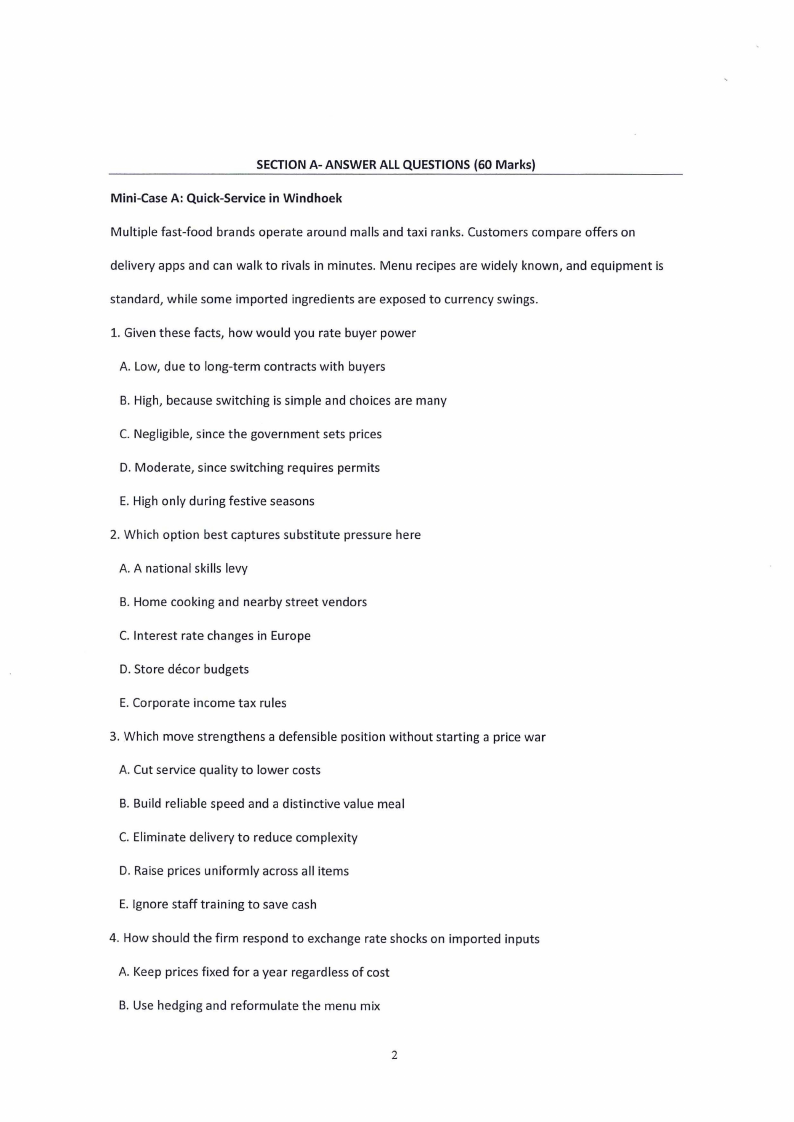
SECTION A- ANSWER ALL QUESTIONS {60 Marks)
Mini-Case A: Quick-Service in Windhoek
Multiple fast-food brands operate around malls and taxi ranks . Customers compare offers on
delivery apps and can walk to rivals in minutes. Menu recipes are widely known, and equipment is
standard, while some imported ingredients are exposed to currency swings.
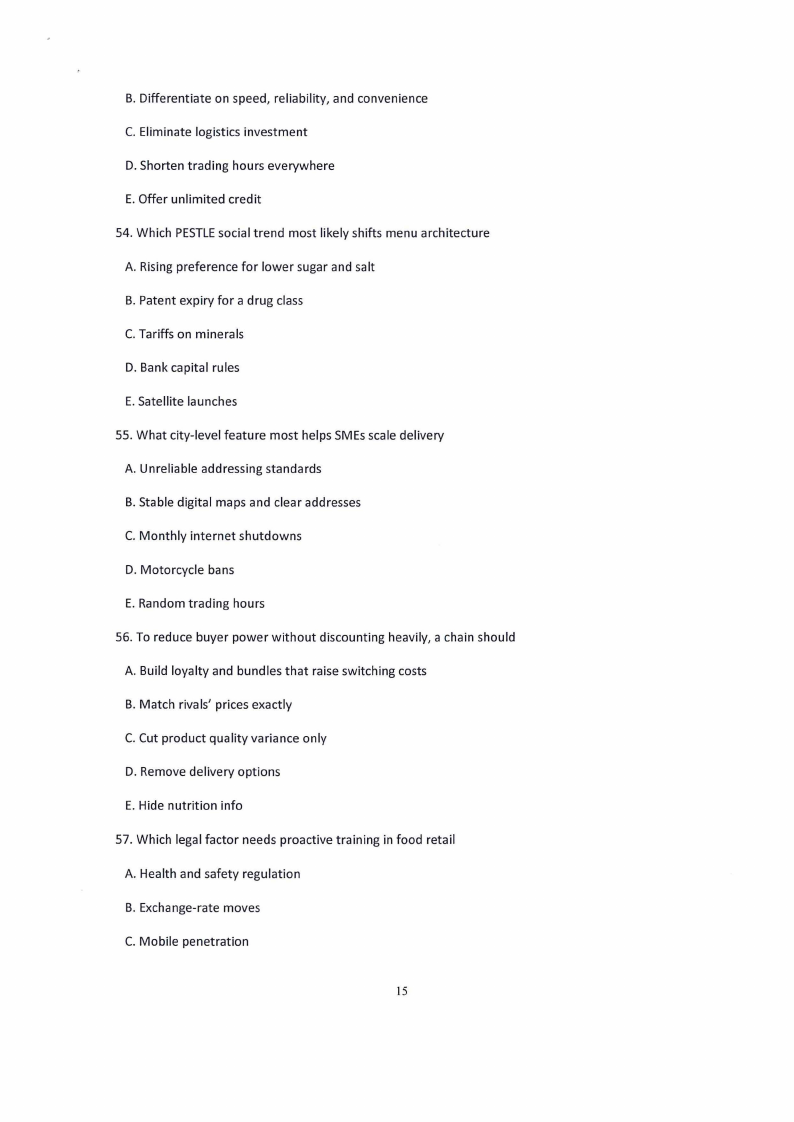
1. Given these facts, how would you rate buyer power
A. Low, due to long-term contracts with buyers
B. High, because switching is simple and choices are many
C. Negligible, since the government sets prices
D. Moderate, since switching requires permits
E. High only during festive seasons
2. Which option best captures substitute pressure here
A. A national skills levy
B. Home cooking and nearby street vendors
C. Interest rate changes in Europe
D. Store decor budgets
E. Corporate income tax rules
3. Which move strengthens a defensible position without starting a price war
A. Cut service quality to lower costs
B. Build reliable speed and a distinctive value meal
C. Eliminate delivery to reduce complexity
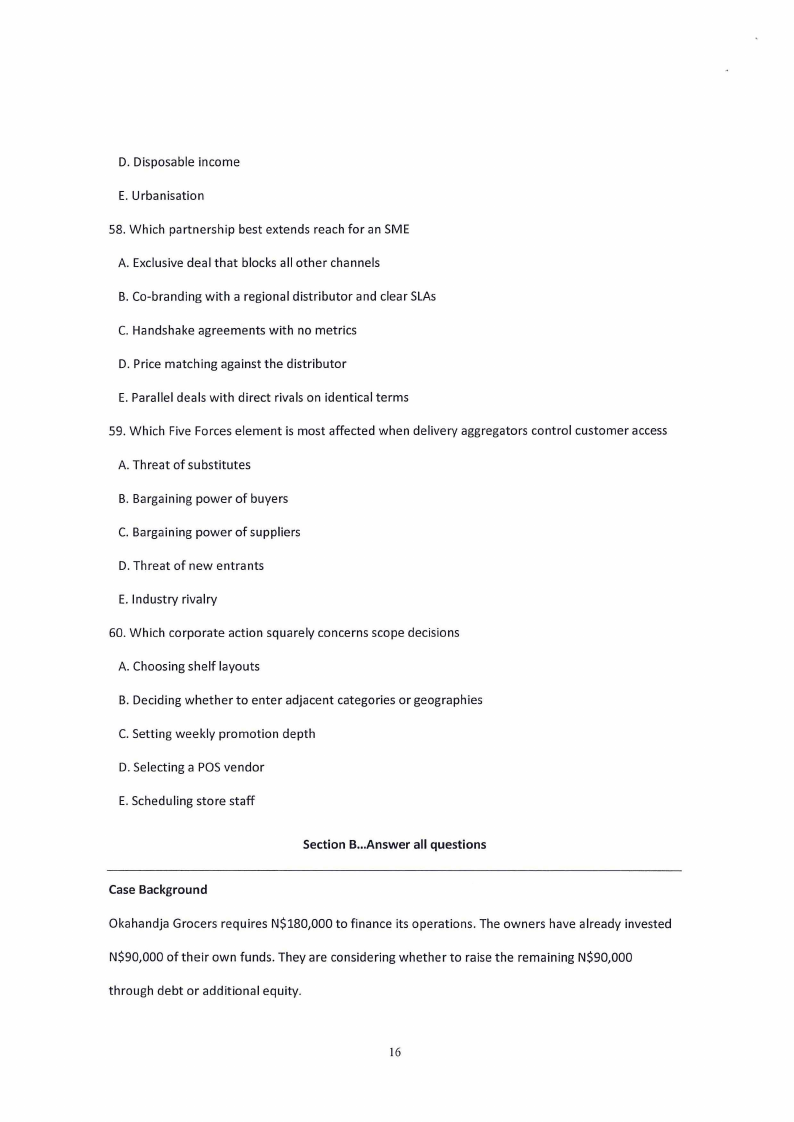
D. Raise prices uniformly across all items
E. Ignore staff training to save cash
4. How should the firm respond to exchange rate shocks on imported inputs
A. Keep prices fixed for a year regardless of cost
B. Use hedging and reformulate the menu mix
2

1.3 Page 3

▲back to top


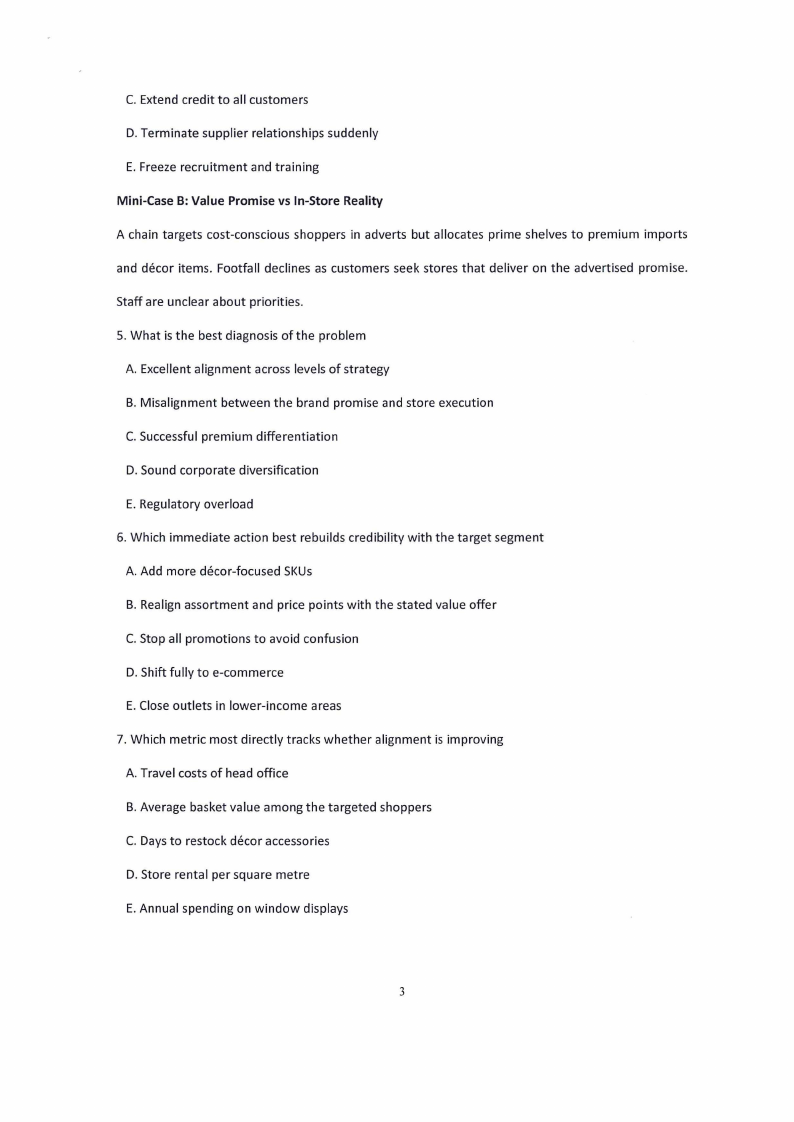
C. Extend credit to all customers
D. Terminate supplier relationships suddenly
E. Freeze recruitment and training
Mini-Case B: Value Promise vs In-Store Reality
A chain targets cost-conscious shoppers in adverts but allocates prime shelves to premium imports
and decor items. Footfall declines as customers seek stores that deliver on the advertised promise.
Staff are unclear about priorities.
5. What is the best diagnosis of the problem
A. Excellent alignment across levels of strategy
B. Misalignment between the brand promise and store execution
C. Successful premium diffe rentiation
D. Sound corporate diversification
E. Regulatory overload
6. Which immediate action best rebuilds credibility with the target segment
A. Add more decor-focused SKUs
B. Realign assortment and price points with the stated value offer
C. Stop all promotions to avoid confusion
D. Shift fully to e-commerce
E. Close outlets in lower-income areas
7. Which metric most directly tracks whether alignment is improving
A. Travel costs of head office
B. Average basket value among the targeted shoppers
C. Days to restock decor accessories
D. Store rental per square metre
E. Annual spending on window displays
3

1.4 Page 4

▲back to top


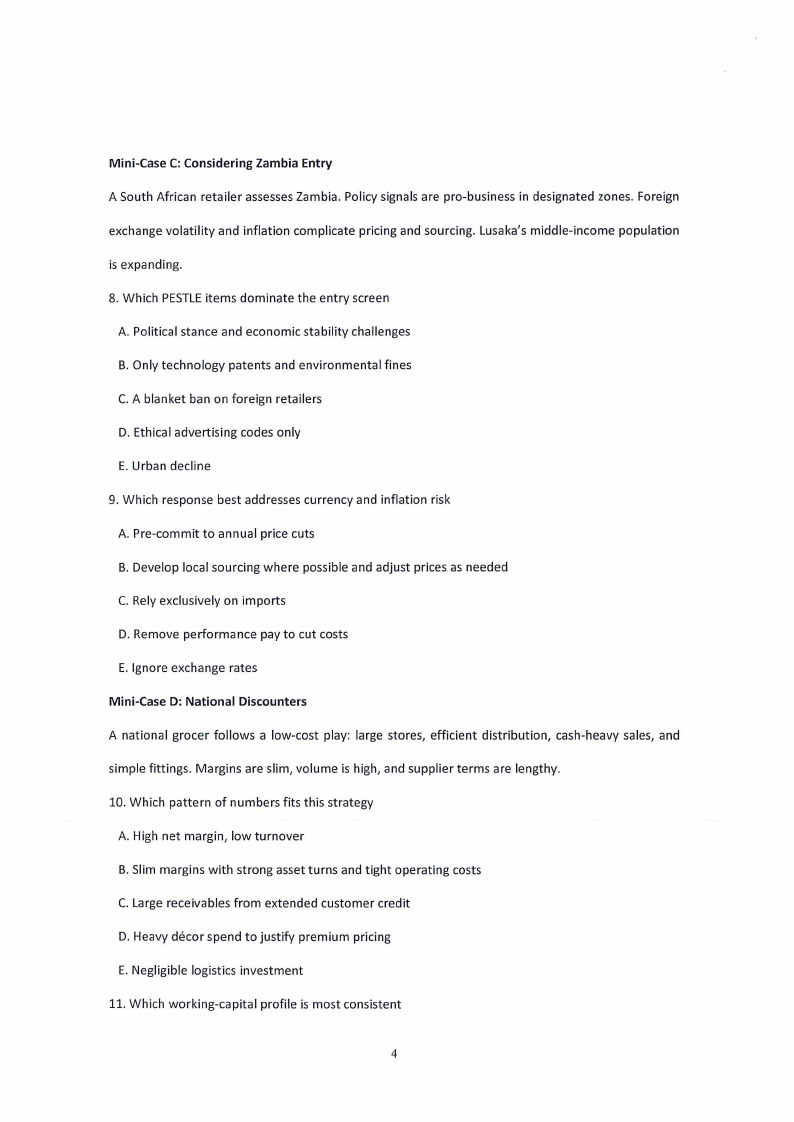
Mini-Case C: Considering Zambia Entry
A South African retailer assesses Zambia. Policy signals are pro-business in designated zones. Foreign
exchange volatility and inflation complicate pricing and sourcing. Lusaka's middle-income population
is expanding.
8. Which PESTLE items dominate the entry screen
A. Political stance and economic stability challenges
B. Only technology patents and environmental fines
C. A blanket ban on foreign retailers
D. Ethical advertising codes only
E. Urban decline
9. Which response best addresses currency and inflation risk
A. Pre-commit to annual price cuts
B. Develop local sourcing where possible and adjust prices as needed
C. Rely exclusively on imports
D. Remove performance pay to cut costs
E. Ignore exchange rates
Mini-Case D: National Discounters
A national grocer follows a low-cost play: large stores, efficient distribution, cash-heavy sales, and
simple fittings. Margins are slim, volume is high, and supplier terms are lengthy.
10. Which pattern of numbers fits this strategy
A. High net margin, low turnover
B. Slim margins with strong asset turns and tight operating costs
C. Large receivables from extended customer credit
D. Heavy decor spend to justify premium pricing
E. Negligible logistics investment
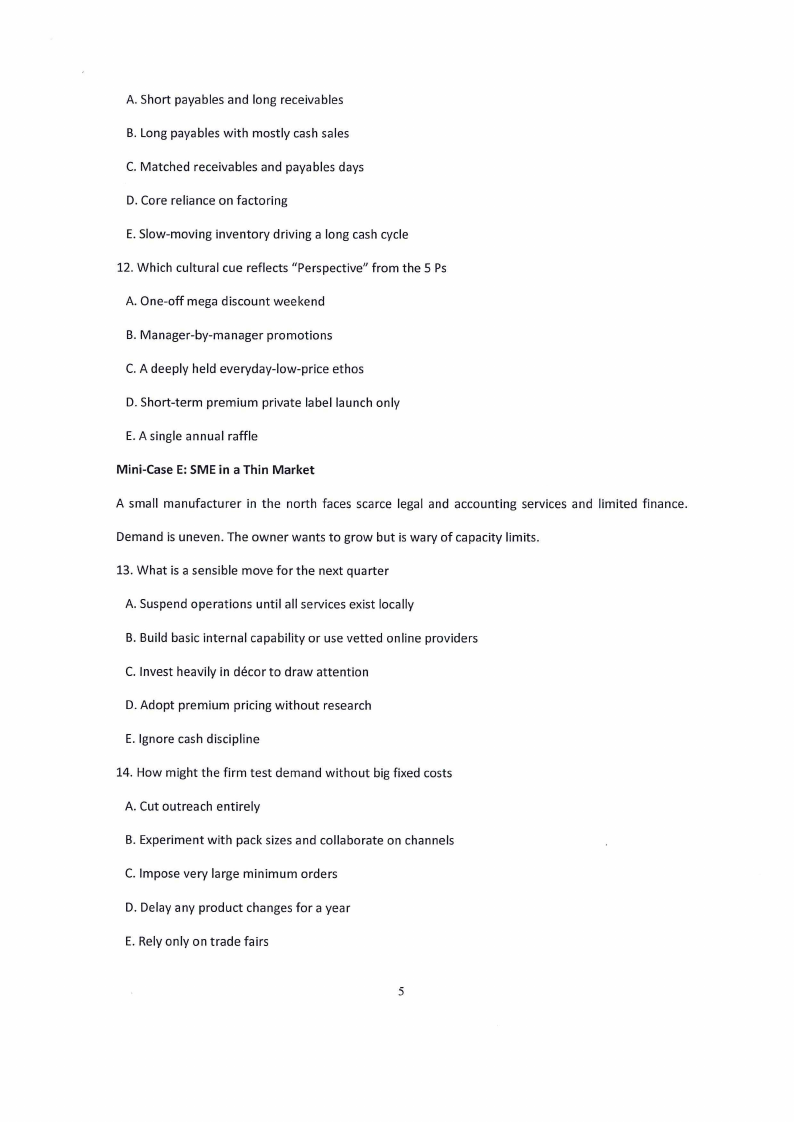
11. Which working-capital profile is most consistent
4

1.5 Page 5

▲back to top


A. Short payables and long receivables
B. Long payables with mostly cash sales
C. Matched receivables and payables days
D. Core reliance on factoring
E. Slow-moving inventory driving a long cash cycle
12. Which cultural cue reflects "Perspective" from the 5 Ps
A. One-off mega discount weekend
B. Manager-by-manager promotions
C. A deeply held everyday-low-price ethos
D. Short-term premium private label launch only
E. A single annual raffle
Mini-Case E: SME in a Thin Market
A small manufacturer in the north faces scarce legal and accounting services and limited finance .
Demand is uneven. The owner wants to grow but is wary of capacity limits.
13. What is a sensible move for the next quarter
A. Suspend operations until all services exist locally
B. Build basic internal capability or use vetted online providers
C. Invest heavily in decor to draw attention
D. Adopt premium pricing without research
E. Ignore cash discipline
14. How might the firm test demand without big fixed costs
A. Cut outreach entirely
B. Experiment with pack sizes and collaborate on channels
C. Impose very large minimum orders
D. Delay any product changes for a year
E. Rely only on trade fairs
5

1.6 Page 6

▲back to top


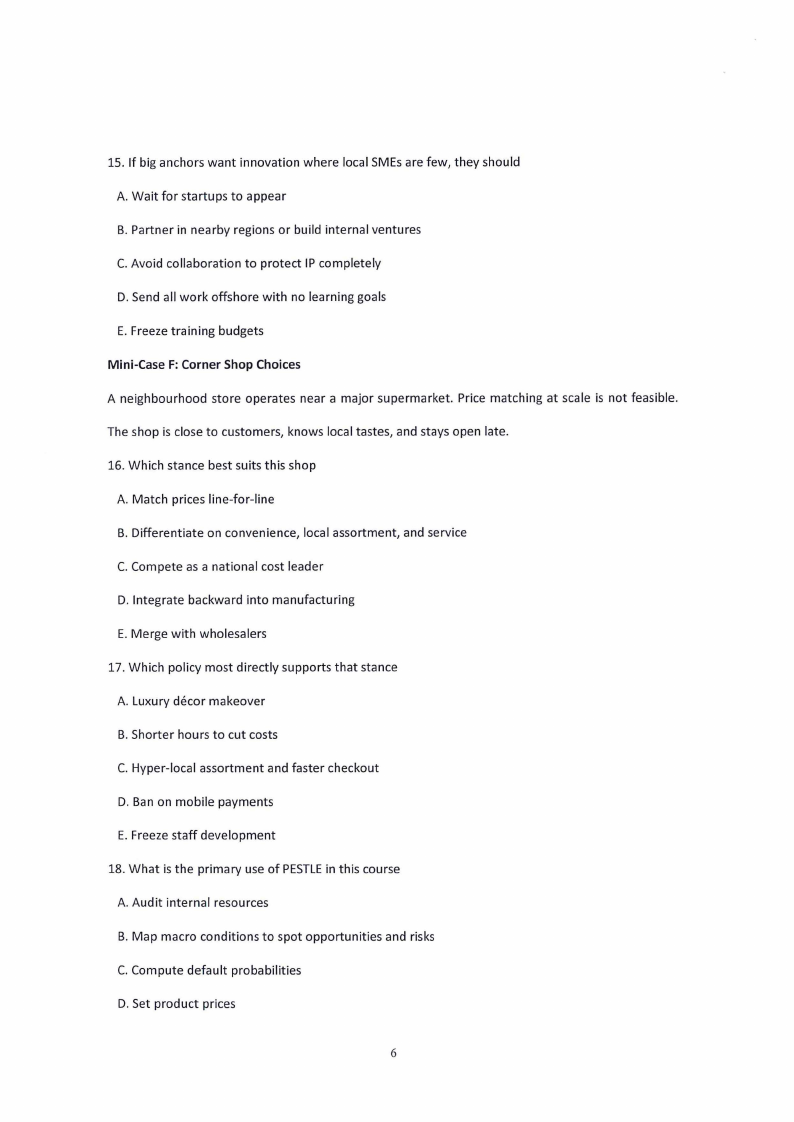
15. If big anchors want innovation where local SMEs are few, they should
A. Wait for startups to appear
B. Partner in nearby regions or build internal ventures
C. Avoid collaboration to protect IP completely
D. Send all work offshore with no learning goals
E. Freeze training budgets
Mini-Case F: Corner Shop Choices
A neighbourhood store operates near a major supermarket. Price matching at scale is not feasible.
The shop is close to customers, knows local tastes, and stays open late.
16. Which stance best suits this shop
A. Match prices line-for-line
B. Differentiate on convenience, local assortment, and service
C. Compete as a national cost leader
D. Integrate backward into manufacturing
E. Merge with wholesalers
17. Which policy most directly supports that stance
A. Luxury decor makeover
B. Shorter hours to cut costs
C. Hyper-local assortment and faster checkout
D. Ban on mobile payments
E. Freeze staff development
18. What is the primary use of PESTLE in this course
A. Audit internal resources
B. Map macro conditions to spot opportunities and risks
C. Compute default probabilities
D. Set product prices
6

1.7 Page 7

▲back to top


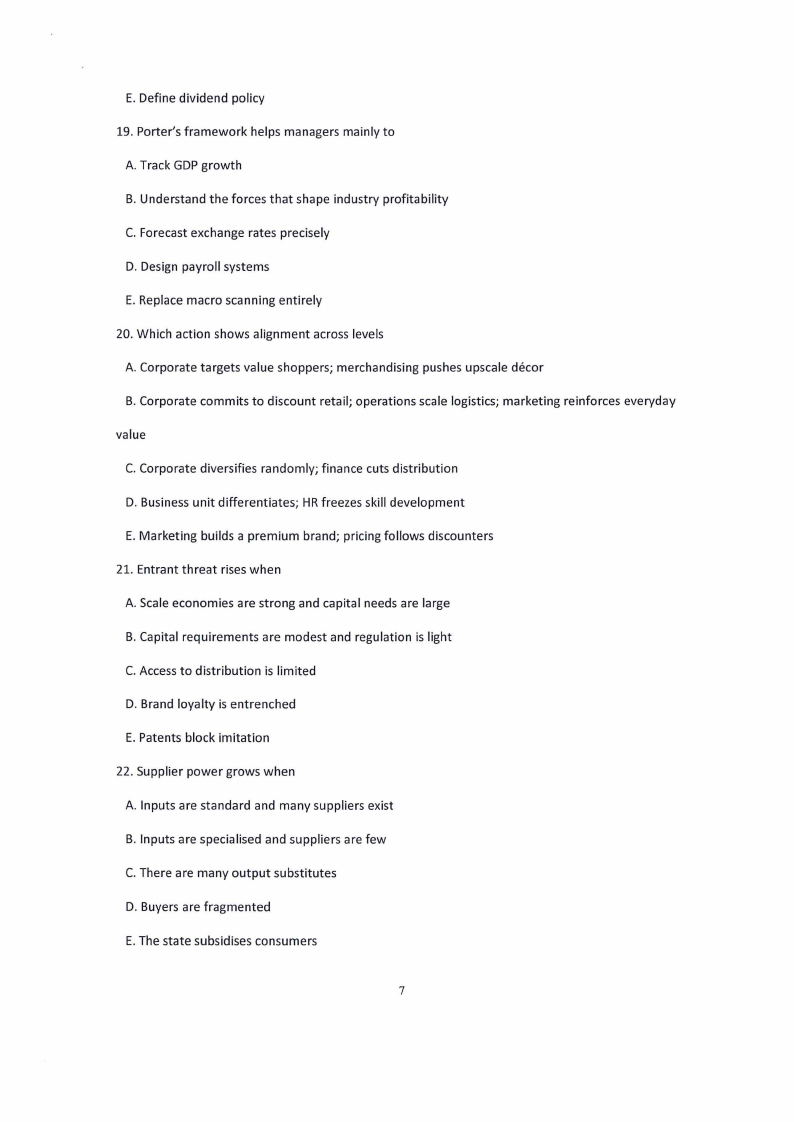
E. Define dividend policy
19. Porter's framework helps managers mainly to
A. Track GDP growth
B. Understand the forces that shape industry profitability
C. Forecast exchange rates precisely
D. Design payroll systems
E. Replace macro scanning entirely
20. Which action shows alignment across levels
A. Corporate targets value shoppers; merchandising pushes upscale decor
B. Corporate commits to discount retail; operations scale logistics; marketing reinforces everyday
value
C. Corporate diversifies randomly; finance cuts distribution
D. Business unit differentiates; HR freezes skill development
E. Marketing builds a premium brand; pricing follows discounters
21. Entrant threat rises when
A. Scale economies are strong and capital needs are large
B. Capital requirements are modest and regulation is light
C. Access to distribution is limited
D. Brand loyalty is entrenched
E. Patents block imitation
22. Supplier power grows when
A. Inputs are standard and many suppliers exist
B. Inputs are specialised and suppliers are few
C. There are many output substitutes
D. Buyers are fragmented
E. The state subsidises consumers
7

1.8 Page 8

▲back to top


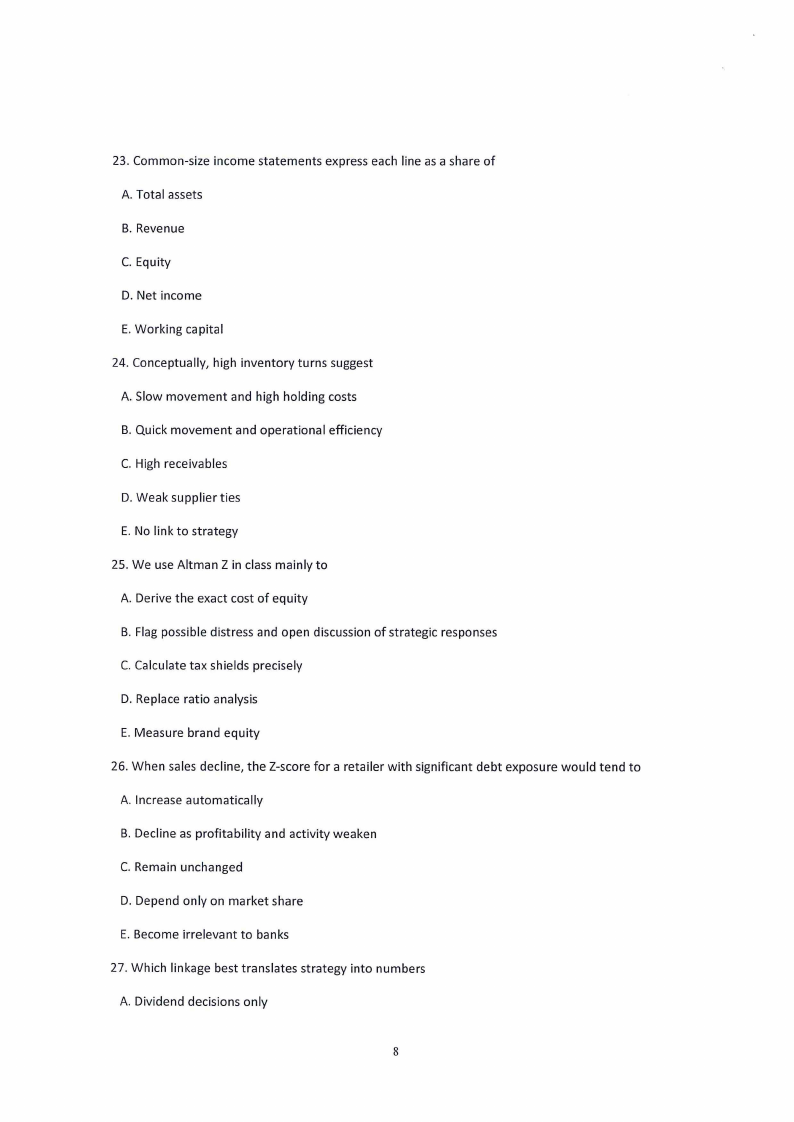
23 . Common-size income statements express each line as a share of
A. Total assets
B. Revenue
C. Equity
D. Net income
E. Working capital
24. Conceptually, high inventory turns suggest
A. Slow movement and high holding costs
B. Quick movement and operational efficiency
C. High receivables
D. Weak supplier ties
E. No link to strategy
25. We use Altman Zin class mainly to
A. Derive the exact cost of equity
B. Flag possible distress and open discussion of strategic responses
C. Calculate tax shields precisely
D. Replace ratio analysis
E. Measure brand equity
26. When sales decline, the Z-score for a retailer with significant debt exposure would tend to
A. Increase automatically
B. Decline as profitability and activity weaken
C. Remain unchanged
D. Depend only on market share
E. Become irrelevant to banks
27. Wh ich linkage best translates strategy into numbers
A. Dividend decisions only
8

1.9 Page 9

▲back to top


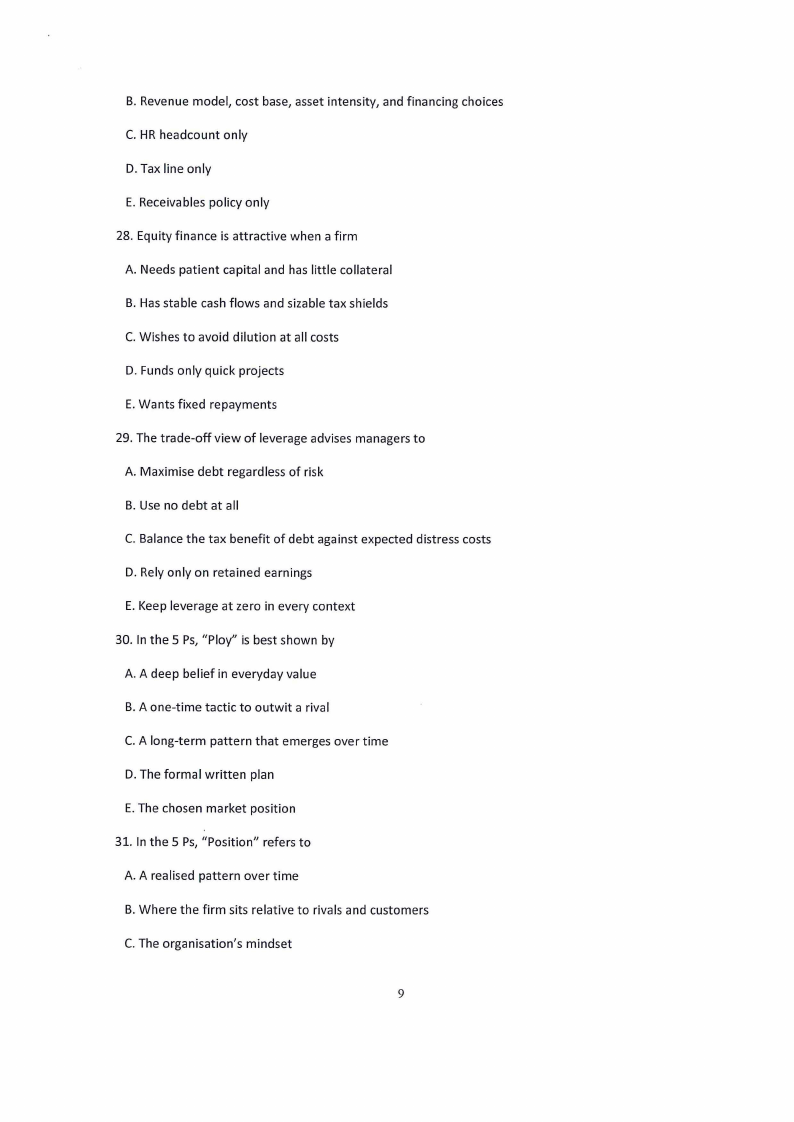
B. Revenue model, cost base, asset intensity, and financing choices
C. HR headcount only
D. Tax line only
E. Receivables policy only
28. Equity finance is attractive when a firm
A. Needs patient capital and has little collateral
B. Has stable cash flows and sizable tax shields
C. Wishes to avoid dilution at all costs
D. Funds only quick projects
E. Wants fixed repayments
29. The trade-off view of leverage advises managers to
A. Maximise debt regardless of risk
B. Use no debt at all
C. Ba lance the tax benefit of debt against expected distress costs
D. Rely only on retained earnings
E. Keep leverage at zero in every context
30. In the 5 Ps, "Ploy" is best shown by
A. A deep belief in everyday value
B. A one-time tactic to outwit a rival
C. A long-term pattern that emerges over time
D. The formal written plan
E. The chosen market position
31. In the 5 Ps, "Position" refers to
A. A realised pattern over time
B. Where the firm sits relative to rivals and customers
C. The organisation's mindset
9

1.10 Page 10

▲back to top


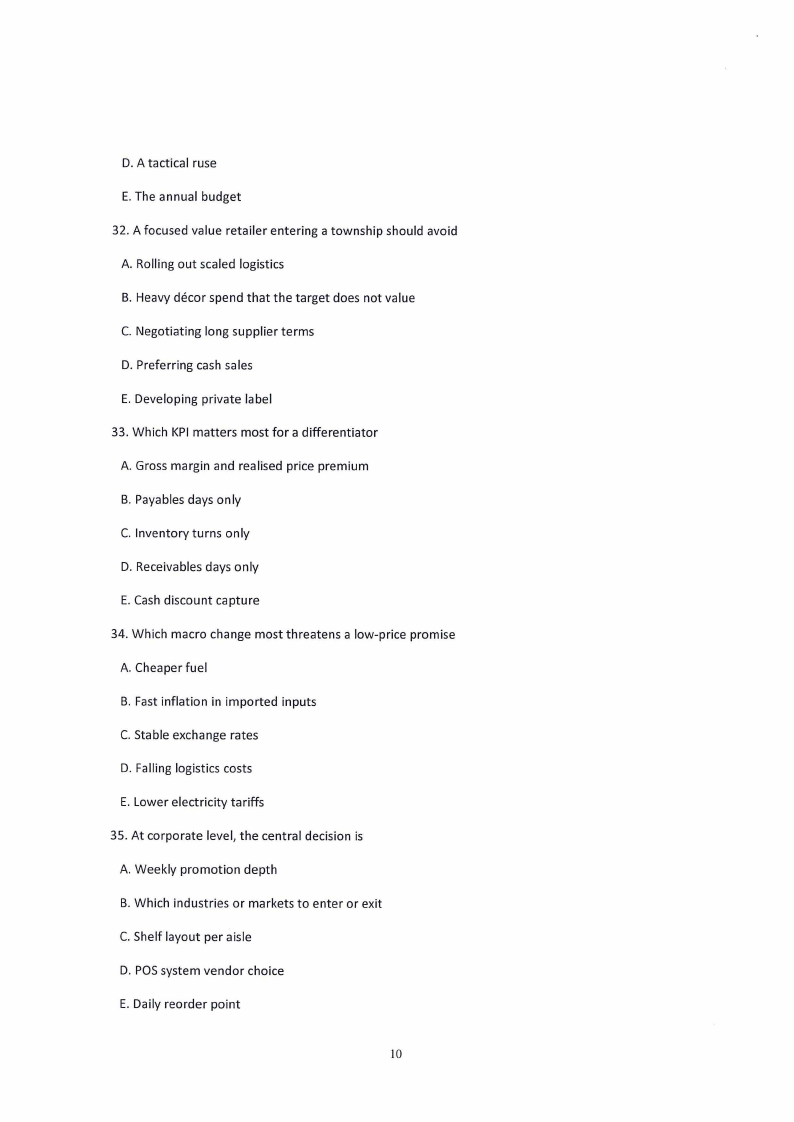
D. A tactical ruse
E. The annual budget
32. A focused value retailer entering a township should avoid
A. Rolling out scaled logistics
B. Heavy decor spend that the target does not value
C. Negotiating long supplier terms
D. Preferring cash sales
E. Developing private label
33. Which KPI matters most for a differentiator
A. Gross margin and realised price premium
B. Payables days only
C. Inventory turns only
D. Receivables days only
E. Cash discount capture
34. Which macro change most threatens a low-price promise
A. Cheaper fuel
B. Fast inflation in imported inputs
C. Stable exchange rates
D. Falling logistics costs
E. Lower electricity tariffs
35 . At corporate level, the central decision is
A. Weekly promotion depth
B. Which industries or markets to enter or exit
C. Shelf layout per aisle
D. POS system vendor choice
E. Daily reorder point
10

2 Pages 11-20

▲back to top


2.1 Page 11

▲back to top


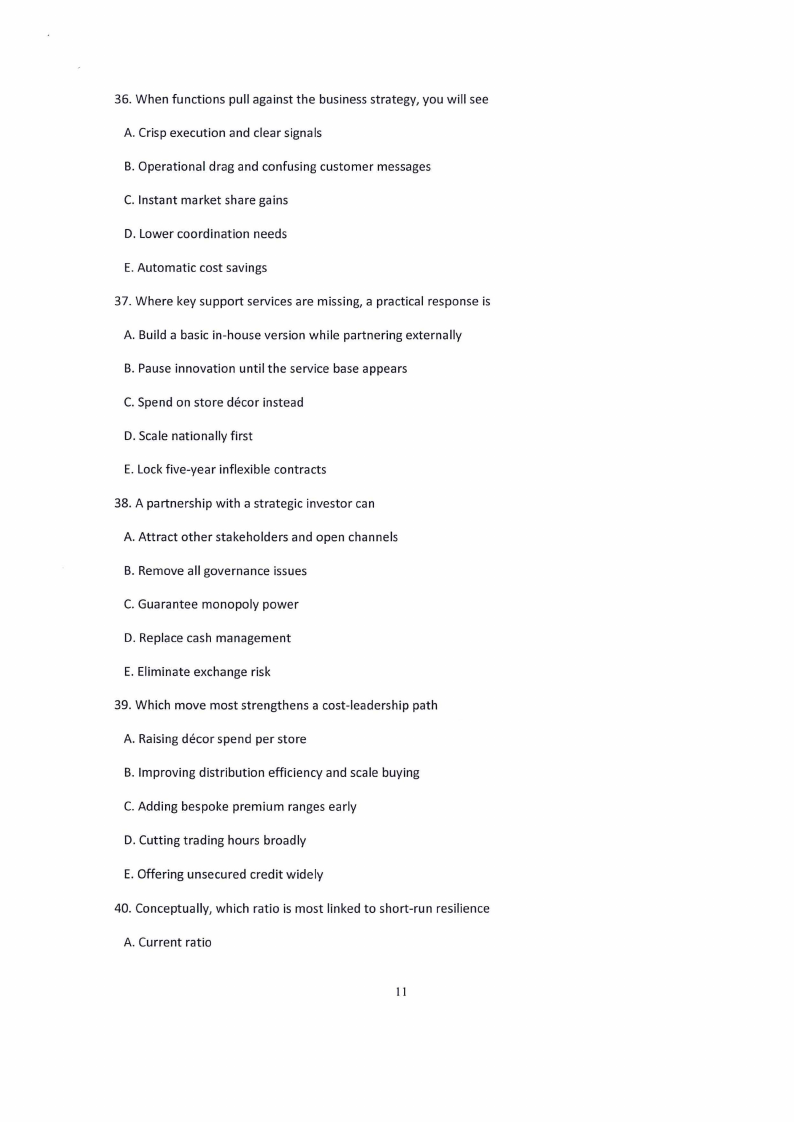
36. When functions pull against the business strategy, you will see
A. Crisp execution and clear signals
B. Operational drag and confusing customer messages
C. Instant market share gains
D. Lower coordination needs
E. Automatic cost savings
37. Where key support services are missing, a practical response is
A. Build a basic in-house version while partnering externally
B. Pause innovation until the service base appears
C. Spend on store decor instead
D. Scale nationally first
E. Lock five-year inflexible contracts
38. A partnership with a strategic investor can
A. Attract other stakeholders and open channels
B. Remove all governance issues
C. Guarantee monopoly power
D. Replace cash management
E. Eliminate exchange risk
39. Which move most strengthens a cost-leadership path
A. Raising decor spend per store
B. Improving distribution efficiency and scale buying
C. Adding bespoke premium ranges early
D. Cutting trading hours broadly
E. Offering unsecured credit widely
40. Conceptually, which ratio is most linked to short-run resilience
A. Current ratio
11

2.2 Page 12

▲back to top


B. Return on equity
C. Asset turnover
D. Debt to equity
E. Dividend payout
41. On a common-size balance sheet, assets are usually shown as a share of
A. Total assets
B. Revenue
C. Gross profit
D. Equity only
E. Non-current assets
42. Facing inflation with pro-business policy, a retailer's playbook likely includes
A. Static pricing and rel iance on imports
B. Flexible pricing, selective local sourcing, and tight cost control
C. Premium-only positioning
D. Dropping supplier contracts
E. Delaying logistics upgrades
43. Which numeric pattern fits a value strategy
A. High volume, slim margins, and strong turns
B. High decor spend with a low-price claim
C. Long receivables in a cash-and-carry model
D. Minimal logistics in a nationwide network
E. Short payables while granting wide customer credit
44. A differentiator usually depends on
A. No brand investment
B. Distinctive features that matter to the target and the capability to deliver
C. Commodity inputs alone
12

2.3 Page 13

▲back to top


D. Zero training
E. Across-the-board price cuts
45. If delivery-only kitchens proliferate in a city, a chain should
A. Keep prices fixed and ignore service time
B. Pursue faster service, delivery partnerships, and distinctive items
C. Cut variety randomly
D. Reduce peak staffing
E. Stop promotions
46. The use of Z-score aims to
A. Replace managerial judgement
B. Prompt early strategic action on cost, mix, and financing when warning lights appear
C. Provide exact failure dates
D. Prioritise cosmetic upgrades
E. Make liquidity tracking unnecessary
47. Which local policy most lowers barriers for town-based SM Es
A. Raise licensing fees sharply
B. One-stop permitting with clear fee schedules
C. Restrict market days to once a month
D. Mandate premium fixtures for all stores
E. Ban co-working spaces
48. Within PESTLE, which technology factor is most relevant to quick-service strategy
A. Semiconductor patent disputes
B. Adoption of mobile payments and delivery apps
C. Nuclear policy in Europe
D. Space budgets
E. Farm subsidies in Asia
13

2.4 Page 14

▲back to top


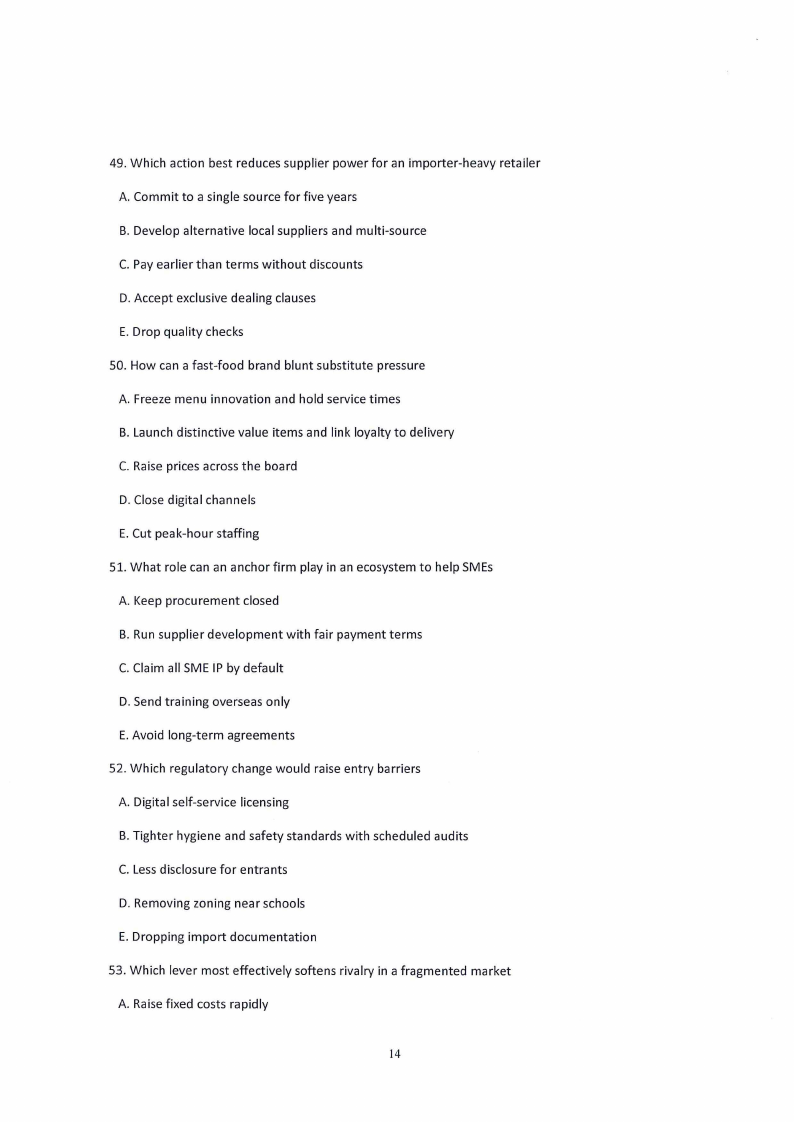
49. Which action best reduces supp lier powe r for an importer-heavy retailer
A. Commit to a single source for five years
B. Develop alternative local suppliers and multi-source
C. Pay earlier than terms without discounts
D. Accept exclusive dealing clauses
E. Drop quality checks
50. How can a fast-food brand blunt substitute pressure
A. Freeze menu innovation and hold service times
B. Launch distinctive value items and link loyalty to delivery
C. Ra ise prices across the board
D. Close digital channels
E. Cut peak-hour staffing
51. What role can an anchor firm play in an ecosystem to help SM Es
A. Keep procurement closed
B. Run supplier development with fa ir payment terms
C. Claim all SME IP by default
D. Send tra ining overseas only
E. Avoid long-term agreements
52. Wh ich regulatory change would raise entry barriers
A. Digital self-service licensing
B. Tighter hygiene and safety standards with scheduled audits
C. Less disclosure for entrants
D. Removing zon ing near schools
E. Dropping import documentation
53. Wh ich lever most effectively softens rivalry in a fragmented market
A. Raise fixed costs rapidly
14

2.5 Page 15

▲back to top


B. Differentiate on speed, reliability, and conven ience
C. Eliminate logistics investment
D. Shorten trading hours everywhere
E. Offer unlimited credit
54. Which PESTLE social trend most likely shifts menu architecture
A. Rising preference for lower sugar and salt
B. Patent expiry for a drug class
C. Tariffs on minerals
D. Bank capital rules
E. Satellite launches
55. What city-level feature most helps SM Es scale delivery
A. Unreliable addressing standards
B. Stable digital maps and clear addresses
C. Monthly internet shutdowns
D. Motorcycle bans
E. Random trading hours
56. To reduce buyer power without discounting heavily, a chain should
A. Build loyalty and bundles that raise switching costs
B. Match rivals' prices exactly
C. Cut product quality variance only
D. Remove delivery options
E. Hide nutrition info
57. Which legal factor needs proactive training in food retail
A. Health and safety regulation
B. Exchange-rate moves
C. Mobile penetration
15

2.6 Page 16

▲back to top


D. Disposable income
E. Urbanisation
58 . Which partnership best extends reach for an SME
A. Exclusive deal that blocks all other channels
B. Co-branding with a regional distributor and clear SLAs
C. Handshake agreements with no metrics
D. Price matching against the distributor
E. Parallel deals with direct rivals on identical terms
59 . Which Five Forces element is most affected when delivery aggregators control customer access
A. Threat of substitutes
B. Bargaining power of buyers
C. Bargaining power of suppliers
D. Threat of new entrants
E. Industry rivalry
60. Which corporate action squarely concerns scope decisions
A. Choosing shelf layouts
B. Deciding whether to enter adjacent categories or geographies
C. Setting weekly promotion depth
D. Selecting a POS vendor
E. Scheduling store staff
Section B...Answer all questions
Case Background
Okahandja Grocers requires N$180,000 to finance its operations. The owners have already invested
N$90,000 of their own funds. They are considering whether to raise the remaining N$90,000
through debt or add itional equity.
16

2.7 Page 17

▲back to top


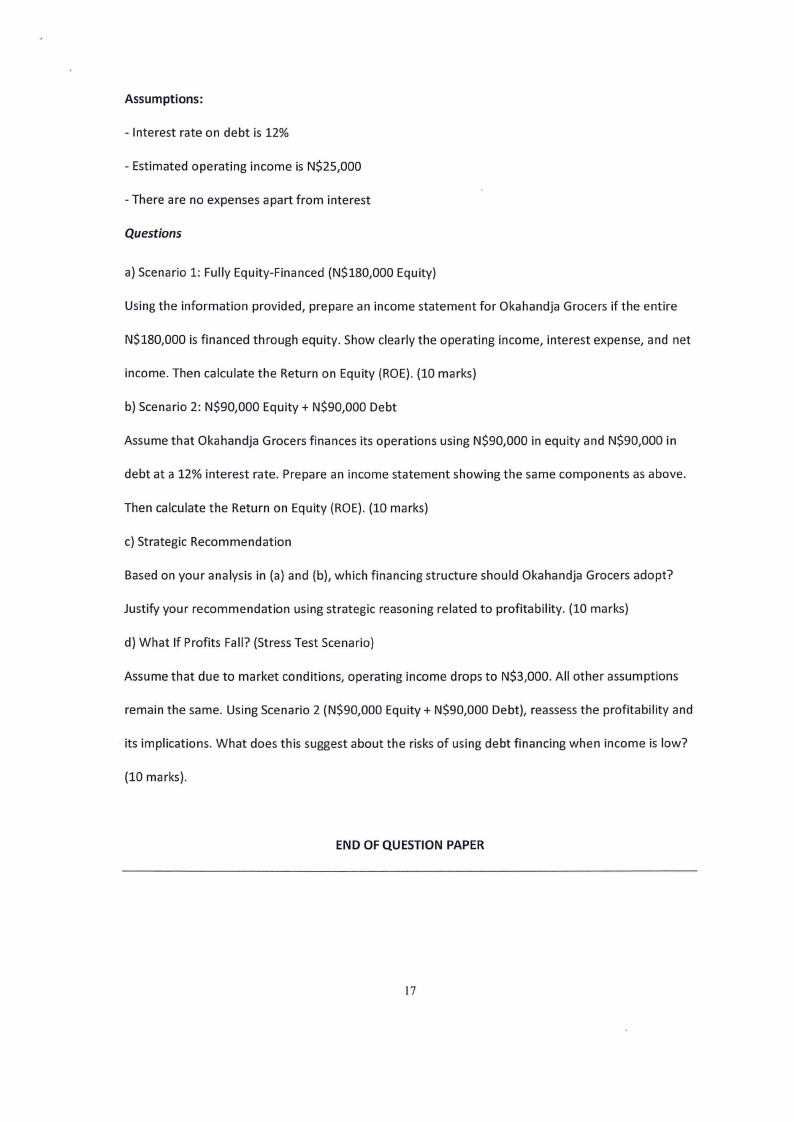
Assumptions:
- Interest rate on debt is 12%
- Estimated operating income is N$25,000
- There are no expenses apart from interest
Questions
a) Scenario 1: Fully Equity-Financed (N$180,000 Equity)
Using the information provided, prepare an income statement for Okahandja Grocers if the entire
N$180,000 is financed through equity. Show clearly the operating income, interest expense, and net
income. Then calculate the Return on Equity (ROE). (10 marks)
b) Scenario 2: N$90,000 Equity+ N$90,000 Debt
Assume that Okahandja Grocers finances its operations using N$90,000 in equity and N$90,000 in
debt at a 12% interest rate. Prepare an income statement showing the same components as above.
Then calculate the Return on Equity (ROE). (10 marks)
c) Strategic Recommendation
Based on your analysis in (a) and (b), which financing structure should Okahandja Grocers adopt?
Justify your recommendation using strategic reasoning related to profitability. (10 marks)
d) What If Profits Fall? (Stress Test Scenario)
Assume that due to market conditions, operating income drops to N$3,000. All other assumptions
remain the same. Using Scenario 2 (N$90,000 Equity+ N$90,000 Debt), reassess the profitability and
its implications. What does this suggest about the risks of using debt financing when income is low?
(10 marks).
END OF QUESTION PAPER
17

2.8 Page 18

▲back to top


2.9 Page 19

▲back to top


nAml BIA unlVERSITY
OF SCI En CE AnD TECH n OLOGY
Office of the Registrar
Examinations and Assessment Administration
13 Jackson Kaujeua Street
Private Bag 13388
Windhoek
NAMIBIA
T: +264 612072412
F: +264 61207 9412
E: exams@nust.na
W: www.nust.na
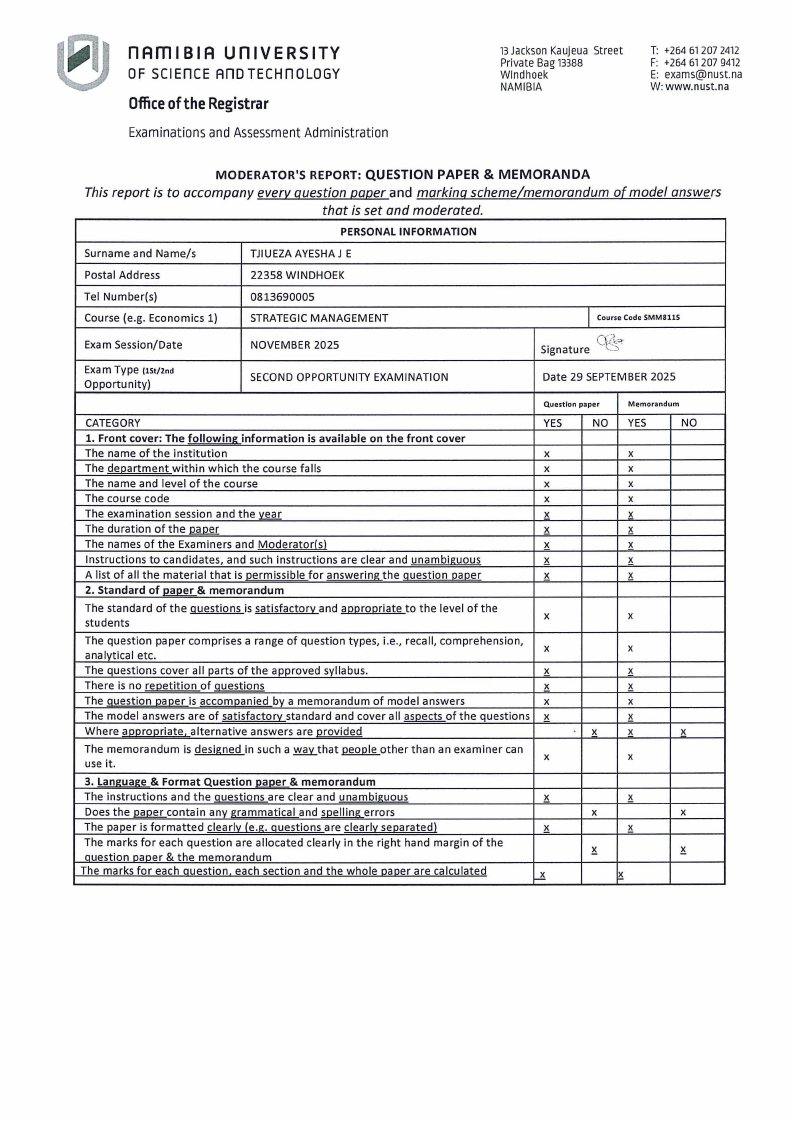
MODERATOR'S REPORT: QUESTION PAPER & MEMORANDA
This report is to accompany every question paper and marking scheme/memorandum of model answers
that is set and moderated.
PERSONAL INFORMATION
Surname and Name/s
TJIUEZA AYESHA J E
Postal Address
22358 WINDHOEK
Tel Number(s)
Course (e.g. Economics 1)
Exam Session/Date
0813690005
STRATEGIC MANAGEMENT
NOVEMBER 2025
I Course Code SMMSllS
Signature C~/ ] ·
Exam Type 11st/2nd
Opportunity)
SECOND OPPORTUNITY EXAMINATION
Date 29 SEPTEMBER 2025
Question paper
Memorandum
CATEGORY
1. Front cover: The followine: information is available on the front cover
The name of the institution
The degartment within which the course falls
The name and level of the course
The course code
The examination session and the year
The duration of the Qg_QgJ:
The names of the Examiners and Moderator{sl
Instructions to candidates, and such instructions are clear and unambiguous
A list of all the material that is germissible for answering the guestion gager
2. Standard o f ~ & memorandum
YES
NO YES
NO
X
X
X
X
X
X
X
X
X
X
X
X
X
X
X
X
X
X
The standard of the guestions is satisfactory and aggrogriate to the level of the
students
X
X
The question paper comprises a range of question types, i.e., recall, comprehension,
analytical etc.
X
X
The questions cover all parts of the approved syllabus.
X
X
There is no regetition of guestions
X
X
The auestion oaoer is accomoanied by a memorandum of model answers
X
X
The model answers are of satisfactory standard and cover all asgects of the questions X
X
Where aggrogriate, alternative answers are orovided
X
X
l
The memorandum is designed in such a way that ~other than an examiner can
use it.
X
X
3. Language & Format Question oaoer & memorandum
The instructions and the guestions are clear and unambiguous
X
X
Does the ~contain any e:rammatical and soelline: errors
X
X
The paper is formatted clearly {e.g. guestions are clearly segaratedl
X
X
The marks for each question are allocated clearly in the right hand margin of the
ouestion oaoer & the memorandum
l
l
The marks for each auestion each section and the whole oaoer are calculated
~
l

2.10 Page 20

▲back to top


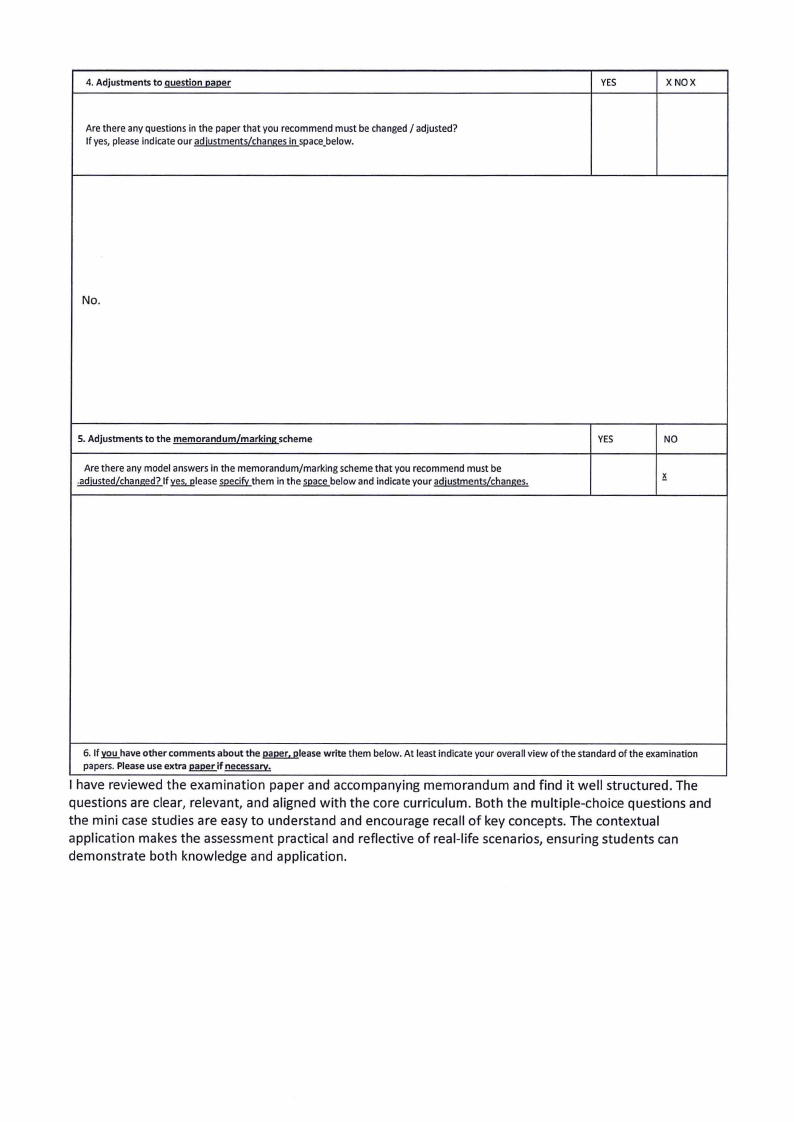
4. Adjustments to guestion l!al!er
Are there any questions in the paper that you recommend must be changed/ adjusted?
If yes, please indicate our adjustmentsLchanges in space_below.
YES
X NOX
No.
5. Adjustments to the memorandumLmarking scheme
Are there any model answers in the memorandum/marking scheme that you recommend must be
.adjustedLchanged? If ~lease ~them in the Sl!ace below and indicate your adjustmentsLchanges.
YES
NO
~
6. If YQ.!!._have other comments about the ~lease write them below. At least indicate your overall view of the standard of the examination
papers. Please use extra ~ i f necessart,
I have reviewed the examination paper and accompanying memorandum and find it well structured. The
questions are clear, relevant, and aligned with the core curriculum. Both the multiple-choice questions and
the mini case studies are easy to understand and encourage recall of key concepts. The contextual
application makes the assessment practical and reflective of real-life scenarios, ensuring students can
demonstrate both knowledge and application.