


 |
RES511S - REMOTE SENSING 1 - 2ND OPP - JULY 2025 |
|
|
1 Page 1 |
▲back to top |
nAmlBIA unlVERSITY
OF SCIEnCE Ano TECHnOLOGY
FACULTYOF ENGINEERINGAND THE BUILTENVIRONMENT
DEPARTMENTOF LANDAND SPATIALSCIENCES
QUALIFICATIONS:
DIPLOMA IN GEOMATICS, BACHELOR OF GEOMATICS, BACHELOR OF GEOINFORMATION
TECHNOLOGY
QUALIFICATIONCODES:
LEVEL:
06DGEO, 07BGEO, 07BGEI
Level 6 - 06DGEO
Level 7 - 07BGEO, 07BGEI
COURSECODE:RES511S
SESSION:JULY 2025
COURSENAME: REMOTE SENSING1
PAPER:THEORY
DURATION:3 HOURS
MARKS: 100
SECOND OPPORTUNITY/SUPPLEMENTARY EXAMINATION QUESTION PAPER
EXAMINER:
Ms Roxanne Murangi
MODERATOR: Ms Celeste Espach
INSTRUCTIONS
1. Write your student number and programme code (e.g.07BGEI ) on the answer sheet.
2. Answer ALL the questions.
3. Read each question carefully before attempting to answer.
4. Write clearly and neatly.
PERMISSIBLEMATERIALS
1. Pen
2. Pencil
3. Eraser
4. Ruler
5. Non-programming calculator
Thisquestion paper consistsof seven (7) pages,includingthis cover page.
|
|
2 Page 2 |
▲back to top |
H.emotcSensin131
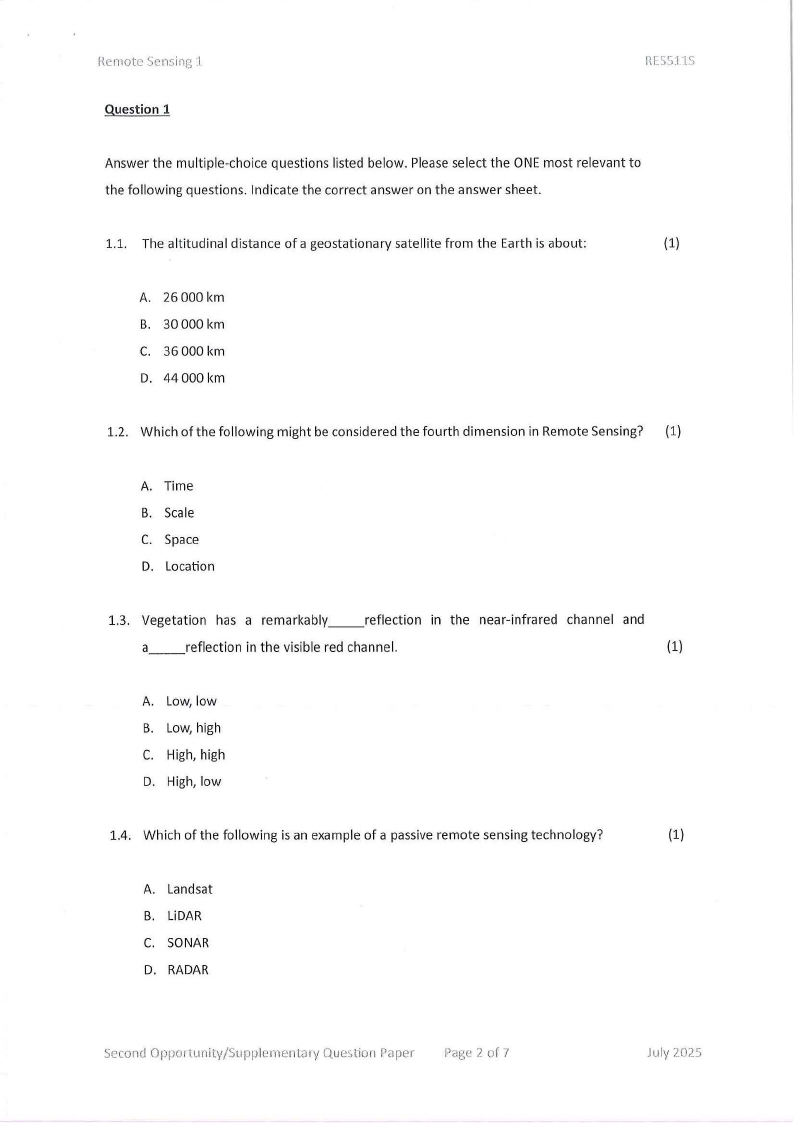
Question 1
Answer the multiple-choice questions listed below. Please select the ONE most relevant to
the following questions. Indicate the correct answer on the answer sheet.
1.1. The altitudinal distance of a geostationary satellite from the Earth is about:
(1)
A. 26 000 km
B. 30 000 km
C. 36 000 km
D. 44 000 km
1.2. Which of the following might be considered the fourth dimension in Remote Sensing? (1)
A. Time
B. Scale
C. Space
D. Location
1.3. Vegetation has a remarkably __ reflection in the near-infrared channel and
a__ reflection in the visible red channel.
(1)
A. Low, low
B. Low, high
C. High, high
D. High, low
1.4. Which of the following is an example of a passive remote sensing technology?
(1)
A. Landsat
B. LiDAR
C. SONAR
D. RADAR
Second Opportunity/Supplementary Question Paper
Page 2 orI
July 2025
|
|
3 Page 3 |
▲back to top |
Remote Sensing 1
Rl:5~1 l!·,
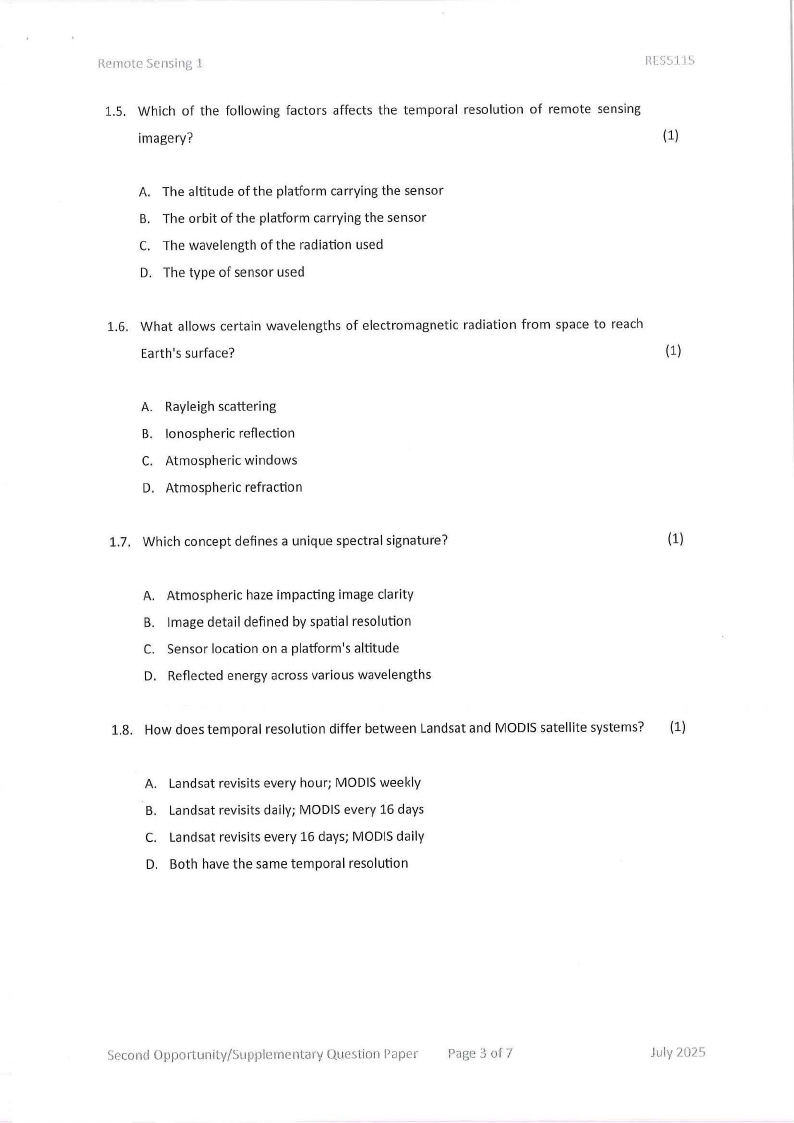
1.5. Which of the following factors affects the temporal resolution of remote sensing
imagery?
(1)
A. The altitude of the platform carrying the sensor
B. The orbit of the platform carrying the sensor
C. The wavelength of the radiation used
D. The type of sensor used
1.6. What allows certain wavelengths of electromagnetic radiation from space to reach
Earth's surface?
(1)
A. Rayleigh scattering
B. Ionospheric reflection
C. Atmospheric windows
D. Atmospheric refraction
1.7. Which concept defines a unique spectral signature?
(1)
A. Atmospheric haze impacting image clarity
B. Image detail defined by spatial resolution
C. Sensor location on a platform's altitude
D. Reflected energy across various wavelengths
1.8. How does temporal resolution differ between Landsat and MODIS satellite systems? (1)
A. Landsat revisits every hour; MODIS weekly
B. Landsat revisits daily; MODIS every 16 days
C. Landsat revisits every 16 days; MODIS daily
D. Both have the same temporal resolution
Second Oµportunity/Supplementary Question raper
Page3of7
July 2025
|
|
4 Page 4 |
▲back to top |
f~ernote Sensing 1
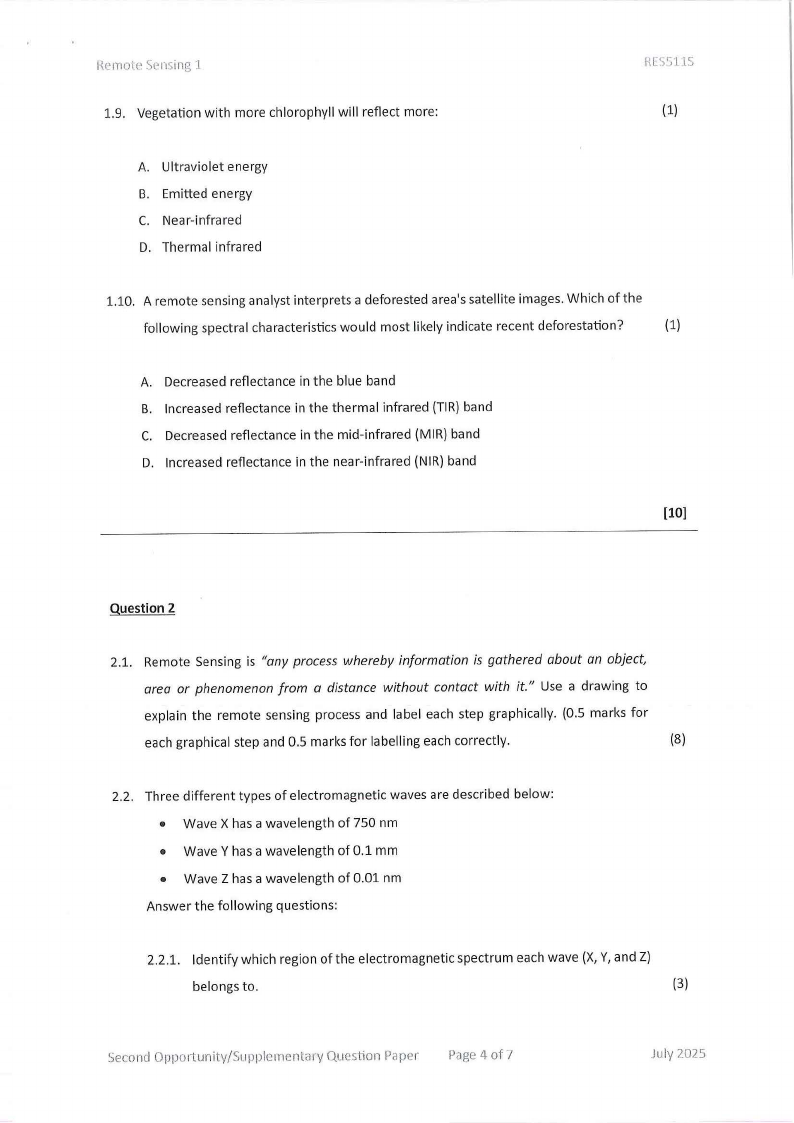
1.9. Vegetation with more chlorophyll will reflect more:
(1)
A. Ultraviolet energy
B. Emitted energy
C. Near-infrared
D. Thermal infrared
1.10. A remote sensing analyst interprets a deforested area's satellite images. Which of the
following spectral characteristics would most likely indicate recent deforestation?
(1)
A. Decreased reflectance in the blue band
B. Increased reflectance in the thermal infrared (TIR) band
C. Decreased reflectance in the mid-infrared (MIR) band
D. Increased reflectance in the near-infrared (NIR) band
[10]
Question 2
2.1. Remote Sensing is "any process whereby information is gathered about an object,
area or phenomenon from a distance without contact with it." Use a drawing to
explain the remote sensing process and label each step graphically. (0.5 marks for
each graphical step and 0.5 marks for labelling each correctly.
(8)
2.2. Three different types of electromagnetic waves are described below:
• Wave X has a wavelength of 750 nm
• Wave Y has a wavelength of 0.1 mm
• Wave Z has a wavelength of 0.01 nm
Answer the following questions:
2.2.1. Identify which region of the electromagnetic spectrum each wave (X,Y, and Z)
belongs to.
(3)
Second Opportunity/Suµpl<~rnentary Question Paper Page 4 of 7
July 2025
|
|
5 Page 5 |
▲back to top |
Hemote Sensing 1
RFS';1"JS
2.2.2. Which of these waves would penetrate Earth's atmosphere most effectively?
Explain why.
(3)
2.2.3. Give one safety concern when working with each of these electromagnetic
waves.
(3)
2.2.4. Describe one (1) practical application for each type of wave.
(3)
2.2.5. Justify why remote sensing is more effective than traditional ground surveys
in this scenario.
(3)
2.3. How is remote sensing applied in agriculture? Describe two (2) specific applications
and their two (2) benefits to farmers.
(6)
2.4. You are working for the Namibian Ministry of Environment and Tourism to monitor
wildlife populations in Etosha National Park, where poaching of endangered rhinos
has increased in recent years. The ministry is considering implementing a new
monitoring system and has asked you to evaluate the advantages and limitations of
drone-based remote sensing compared to traditional satellite imagery for this specific
application.
Explain the advantages and limitations of using drone-based remote sensing
compared to traditional satellite imagery for environmental monitoring. Provide two
(2) advantages and two (2) limitations of drone-based systems.
(4)
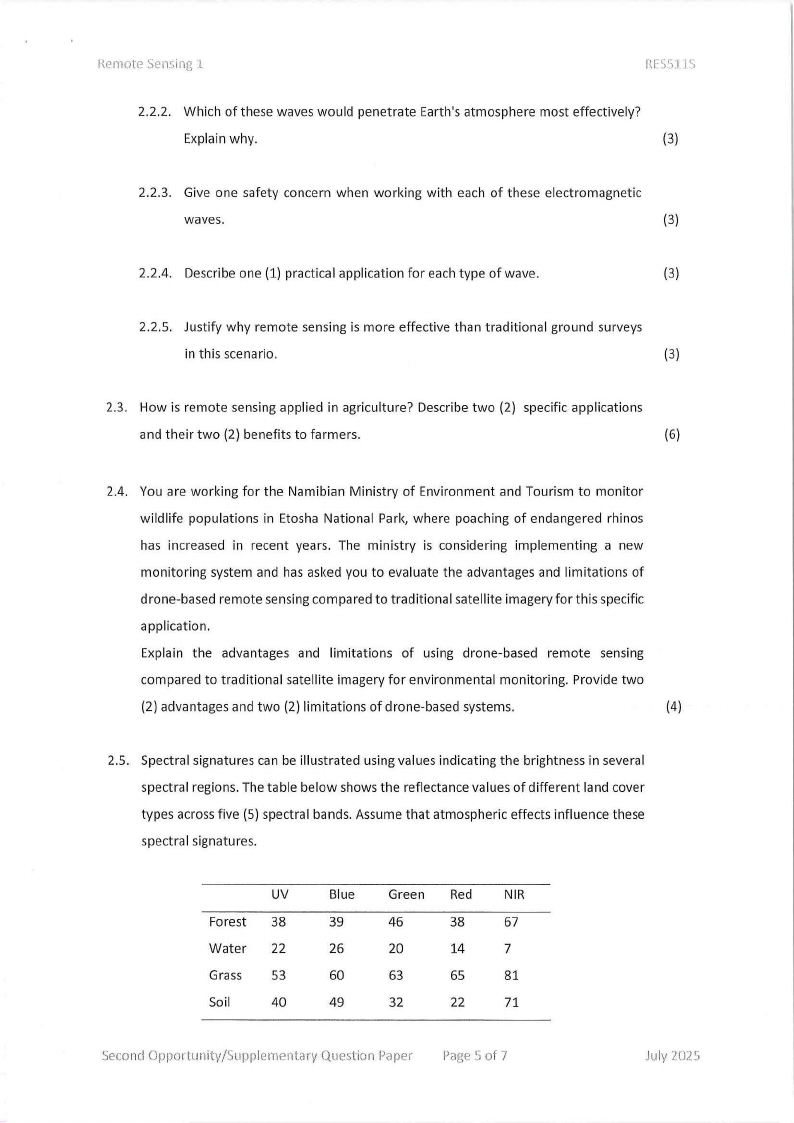
2.5. Spectral signatures can be illustrated using values indicating the brightness in several
spectral regions. The table below shows the reflectance values of different land cover
types across five (5) spectral bands. Assume that atmospheric effects influence these
spectra I signatures.
UV
Blue
Green Red NIR
Forest 38
39
46
38
67
Water 22
26
20
14
7
Grass 53
60
63
65
81
Soil
40
49
32
22
71
Second Opportunity/Supplernenlary Question Paper Page 5 of 7
July 2025
|
|
6 Page 6 |
▲back to top |
RPmote Sensing l
Kl:S511S
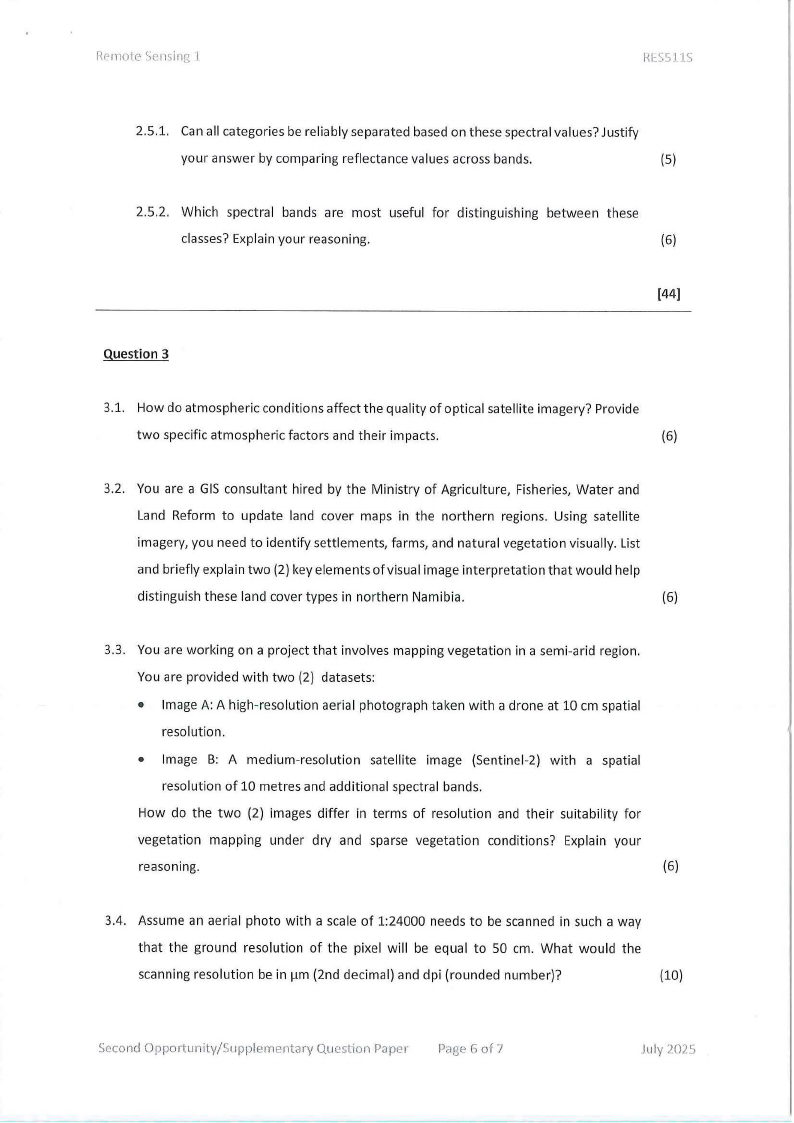
2.5.1. Can all categories be reliably separated based on these spectral values? Justify
your answer by comparing reflectance values across bands.
(5)
2.5.2. Which spectral bands are most useful for distinguishing between these
classes? Explain your reasoning.
(6)
(44)
Question 3
3.1. How do atmospheric conditions affect the quality of optical satellite imagery? Provide
two specific atmospheric factors and their impacts.
(6)
3.2. You are a GIS consultant hired by the Ministry of Agriculture, Fisheries, Water and
Land Reform to update land cover maps in the northern regions. Using satellite
imagery, you need to identify settlements, farms, and natural vegetation visually. List
and briefly explain two (2) key elements of visual image interpretation that would help
distinguish these land cover types in northern Namibia.
(6)
3.3. You are working on a project that involves mapping vegetation in a semi-arid region.
You are provided with two (2) datasets:
• Image A: A high-resolution aerial photograph taken with a drone at 10 cm spatial
resolution.
• Image B: A medium-resolution satellite image {Sentinel-2) with a spatial
resolution of 10 metres and additional spectral bands.
How do the two (2) images differ in terms of resolution and their suitability for
vegetation mapping under dry and sparse vegetation conditions? Explain your
reasoning.
(6)
3.4. Assume an aerial photo with a scale of 1:24000 needs to be scanned in such a way
that the ground resolution of the pixel will be equal to 50 cm. What would the
scanning resolution be in µm (2nd decimal) and dpi (rounded number)?
(10)
Second Oppo1tunity/Supplernentary Question Paper
Page 6 of 7
July 2025
|
|
7 Page 7 |
▲back to top |
Remote SPnsinc 1
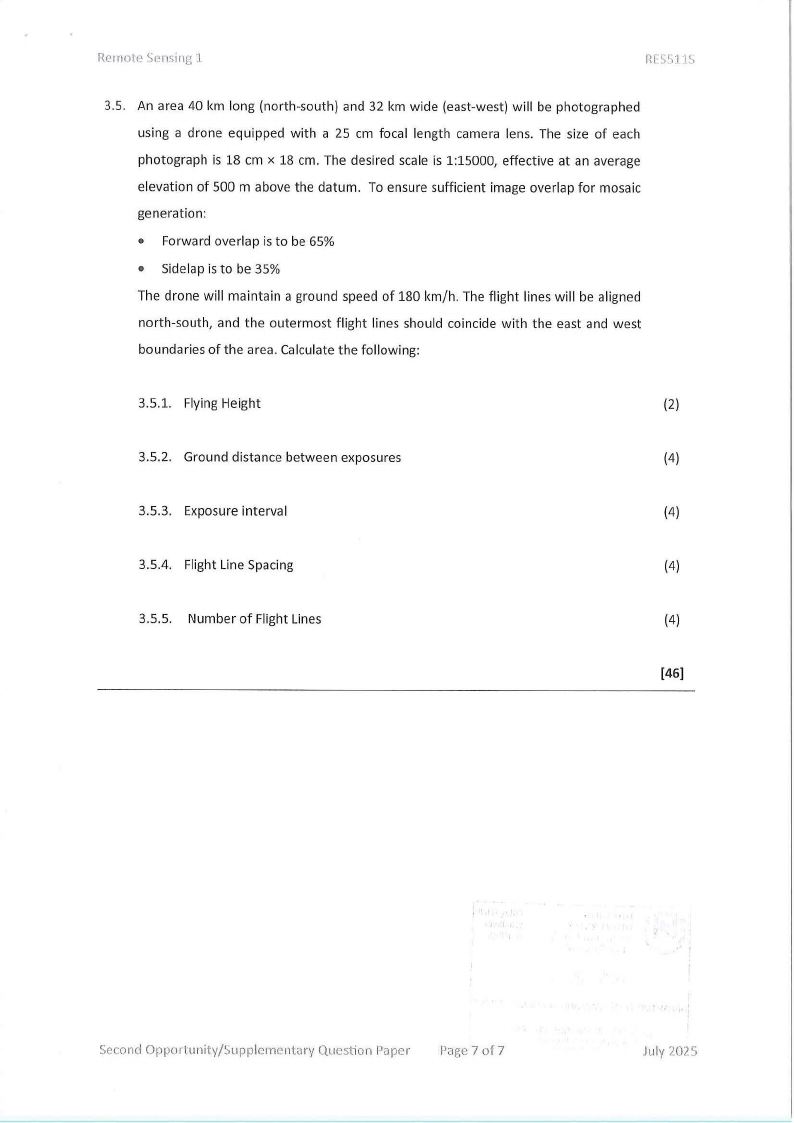
3.5. An area 40 km long (north-south) and 32 km wide (east-west) will be photographed
using a drone equipped with a 25 cm focal length camera lens. The size of each
photograph is 18 cm x 18 cm. The desired scale is 1:15000, effective at an average
elevation of 500 m above the datum. To ensure sufficient image overlap for mosaic
generation:
• Forward overlap is to be 65%
• Sidelap is to be 35%
The drone will maintain a ground speed of 180 km/h. The flight lines will be aligned
north-south, and the outermost flight lines should coincide with the east and west
boundaries of the area. Calculate the following:
3.5.1. Flying Height
(2)
3.5.2. Ground distance between exposures
(4)
3.5.3. Exposure interval
(4)
3.5.4. Flight Line Spacing
(4)
3.5.5. Number of Flight Lines
(4)
(46)
Second Opportunity/Supplement:?1ry Question Paper
Page 7 of7
July 2025