


 |
SVT710S - SYSTEM VIRTUALISATION - 2ND OPP - JULY 2025 |
|
|
1 Page 1 |
▲back to top |
n Am I BI A u n IVE Rs ITY
OF SCIEnCEAno TECHnOLOGY
FACULTY OF COMPUTING AND INFORMATICS
DEPARTMENTOF COMPUTERSCIENCE
QUALIFICATION: BACHELOROF COMPUTER SCIENCE
QUALIFICATIONCODE: 07BACS07BCMS
LEVEL: 7
COURSE: SYSTEMVIRTUALISATION
COURSECODE: SVT710S
DATE: JULY 2025
DURATION: 3 HOURS
PAPER:THEORY
MARICS: 85
SECONDOPPORTUNITY/SUPPLEMENTARYEXAMINATION QUESTION PAPER
EXAMINER(S)
MR. SHOOPALANAMBAHU
MODERATOR:
MR. ANTON LIMBO
THIS QUESTION PAPERCONSISTSOF 5 PAGES
(Excluding this front page)
INSTRUCTIONS
1. Answer ALLthe questions on the answer scripts.
2. Write clearly and neatly.
3. Number the answers clearly.
PERMISSIBLEMATERIALS
1. Calculator.
|
|
2 Page 2 |
▲back to top |
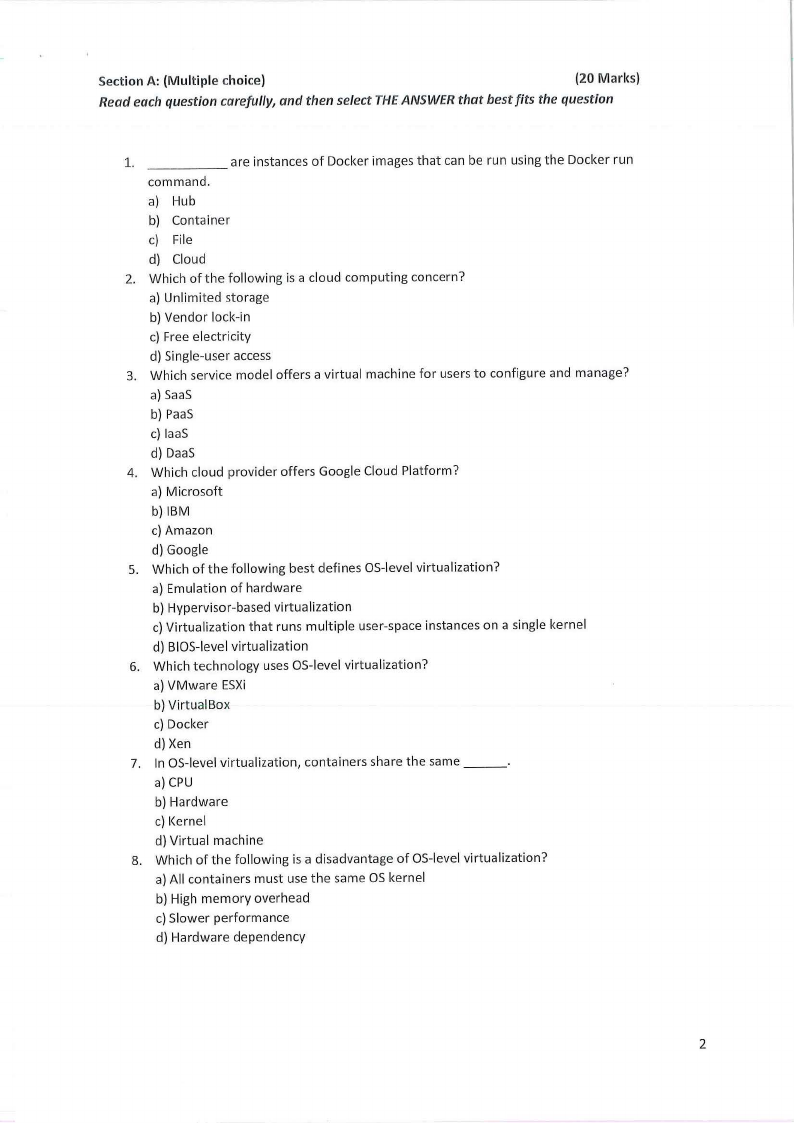
Section A: (Multiple choice)
(20 Marks)
Read each question carefully, and then select THEANSWERthat best fits the question
1. _____
are instances of Docker images that can be run using the Docker run
command.
a) Hub
b) Container
c) File
d) Cloud
2. Which of the following is a cloud computing concern?
a) Unlimited storage
b) Vendor lock-in
c) Free electricity
d) Single-user access
3. Which service model offers a virtual machine for users to configure and manage?
a)SaaS
b) PaaS
c) laaS
d) DaaS
4. Which cloud provider offers Google Cloud Platform?
a) Microsoft
b) IBM
c) Amazon
d) Google
5. Which of the following best defines OS-level virtualization?
a) Emulation of hardware
b) Hypervisor-based virtualization
c) Virtualization that runs multiple user-space instances on a single kernel
d) BIOS-level virtualization
6. Which technology uses OS-level virtualization?
a) VMware ESXi
b) Virtual Box
c) Docker
d)Xen
7. In OS-level virtualization, containers share the same __ _
a)CPU
b) Hardware
c) Kernel
d) Virtual machine
8. Which of the following is a disadvantage of OS-level virtualization?
a) All containers must use the same OS kernel
b) High memory overhead
c) Slower performance
d) Hardware dependency
2
|
|
3 Page 3 |
▲back to top |
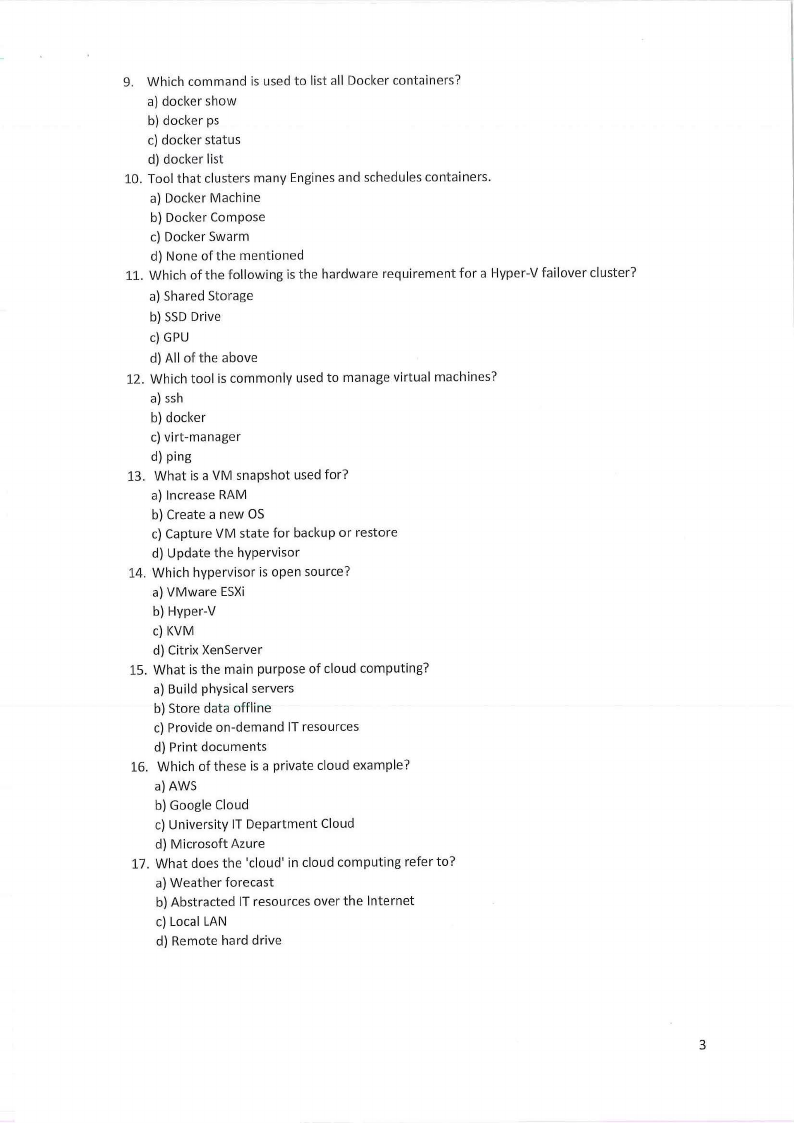
9. Which command is used to list all Docker containers?
a) docker show
b) docker ps
c) docker status
d) docker list
10. Tool that clusters many Engines and schedules containers.
a) Docker Machine
b) Docker Compose
c) Docker Swarm
d) None of the mentioned
11. Which of the following is the hardware requirement for a Hyper-V failover cluster?
a) Shared Storage
b) SSDDrive
c) GPU
d) All of the above
12. Which tool is commonly used to manage virtual machines?
a) ssh
b) docker
c) virt-manager
d) ping
13. What is a VM snapshot used for?
a) Increase RAM
b) Create a new OS
c) Capture VM state for backup or restore
d) Update the hypervisor
14. Which hypervisor is open source?
a) VMware ESXi
b) Hyper-V
c) l<VM
d) Citrix XenServer
15. What is the main purpose of cloud computing?
a) Build physical servers
b) Store data offline
c) Provide on-demand IT resources
d) Print documents
16. Which of these is a private cloud example?
a) AWS
b) Google Cloud
c) University IT Department Cloud
d) Microsoft Azure
17. What does the 'cloud' in cloud computing refer to?
a) Weather forecast
b) Abstracted IT resources over the Internet
c) Local LAN
d) Remote hard drive
3
|
|
4 Page 4 |
▲back to top |
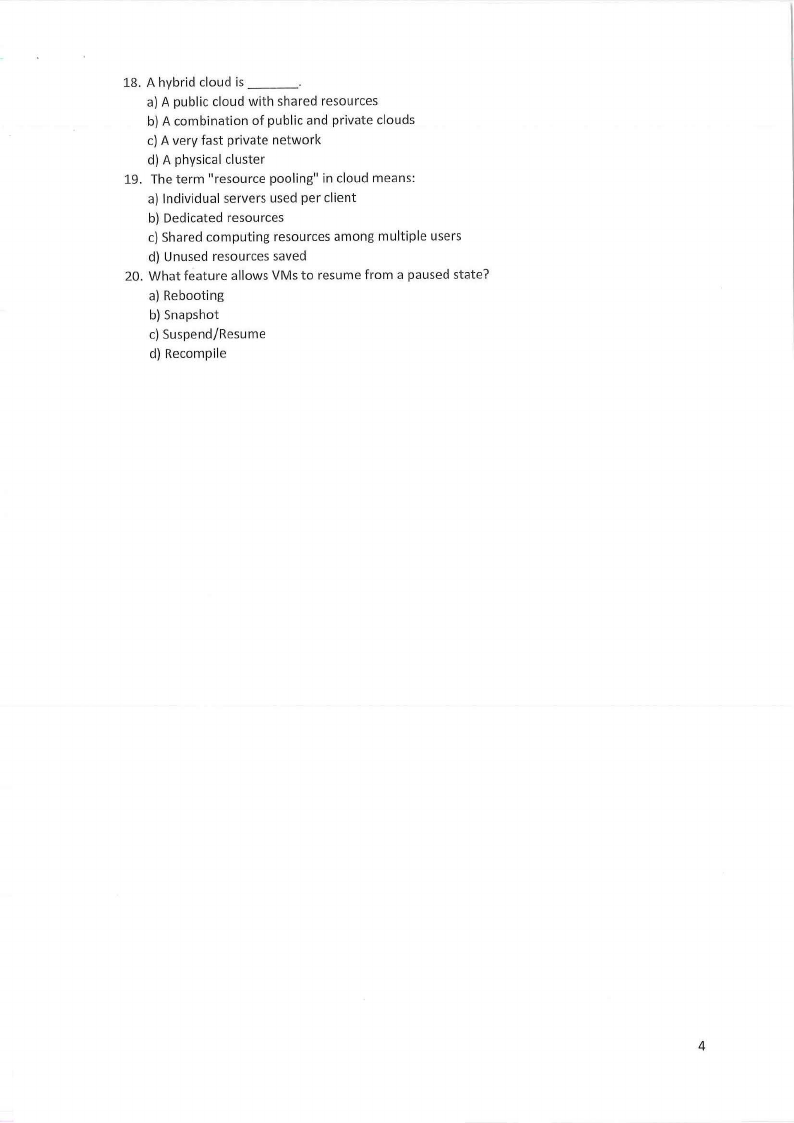
18. A hybrid cloud is __ _
a) A public cloud with shared resources
b) A combination of public and private clouds
c) A very fast private network
d) A physical cluster
19. The term "resource pooling" in cloud means:
a) Individual servers used per client
b) Dedicated resources
c) Shared computing resources among multiple users
d) Unused resources saved
20. What feature allows VMs to resume from a paused state?
a) Rebooting
b)Snapshot
c) Suspend/Resume
d) Recompile
4
|
|
5 Page 5 |
▲back to top |
Section B: True or False_
Read each statement below carefully and state whether false or true.
(10 Marks)
1. With Docker you can combine your applications from your infrastructure AND treat
your infrastructure like a managed application.
2. In cloud computing data should be stored and processed only in specific jurisdictions
as define by user.
3. LUN is a storage technology that deals with how data is spread across multiple disks
for both increased availability and improved performance.
4. The security issue has played the most important role in affecting Cloud computing
acceptance.
5. The static binary translation takes the whole program code and target instruction set
at once and translates it to the target architecture.
6. Hypervisors allow multiple virtual servers to run on a single host.
7. A virtual machine connects from the virtual NIC to a Virtual Switch.
8. One of the community cloud deployment model's disadvantages is cost reduction.
9. In virtualization at Operating System Level, we keep the base O.S. same and install
only the differences in each single Virtual machine.
10. The cloud computing creates the abstraction of VMs by interrupting a virtualization
layer at various levels of a computer system.
5
|
|
6 Page 6 |
▲back to top |
Section B
Answer all the questions in this section.
[55 marks]
1. Name any four levels of virtualization implementation.
[4]
2. Why does the performance become poor in (ISA)?
[2]
3. Name and explain two types of hypervisors, give also twa examples of each type. [6]
4. What does hardware independence in virtualisation mean?
[2]
5. A company is considering moving its entire IT infrastructure to the cloud. What
factors should they consider when choosing between public, private, or hybrid cloud
deployment models?
[4]
6. Name ways how the VMM share resources between VMs.
[2]
7. A multinational corporation is looking to streamline its email and collaboration tools
for employees across different geographic locations. Which cloud service model
(laaS, PaaS,Saas) would you recommend for their email and collaboration needs?
[4]
8. A company needs high performance and has a limited budget for storage. Which RAID
level would you recommend, and why?
[2]
9. Name any four advantages of containers over virtual machines (VMs).
[4]
10. What is the difference between deployment model and service model in cloud
computing?
[4]
11. How does hypervisor eliminate the need to overprovision virtual disks.
[2]
12. Name three layers where storage virtualization can be performed?
[3]
13. What is storage virtualization?
[2]
14. Name and explain any two economic reasons for virtualization.
(4]
15. Name two union file systems used for Docker images.
[2]
16. What do you understand by the term data sanitization?
[2]
17. Based on the classification of CPU modes, instructions are divided into three types.
Name them.
[4]
18. Name two design challenges and issues that are faced during emulation
implementations.
[2]
6