EAP511S - ENGLISH FOR ACADEMIC PURPOSES - 2ND OPP - JULY 2025


EAP511S - ENGLISH FOR ACADEMIC PURPOSES - 2ND OPP - JULY 2025


1 Page 1

▲back to top


n Am I BI A u n IVER s I TY
OF SCI En CE
TECH n OLOGY
FACULTY OF COMMERCE, HUMAN SCIENCES AND EDUCATION
DEPARTMENT OF COMMUNICATION AND LANGUAGES
COURSE CODE: EAP511S
COURSE NAME: ENGLISH FOR ACADEMIC PURPOSES
DATE:
JULY 2025
MODE:
FM, PM, DI
DURATION: 3 HOURS
MARKS:
100
SECOND OPPORTUNITY EXAMINATION QUESTION PAPER
EXAMINER(S):
Ms T. Kanime
Mr C. Gwasira
Ms Y. Lyamine
Dr T. Mushaandja
Mr E. Shilemba
Ms M. Hashoongo
Ms M. Simon
Dr P. Midzi
Ms E. Lymwena
Ms R. Ndengu
Mr V. Endjala
MODERATOR: Prof N. Mlambo
INSTRUCTIONS
1. Answer all questions.
2. Write clearly and neatly.
3. Number the answers clearly.
4. Follow instructions for each question carefully.
THIS EXAMINATION QUESTION PAPER CONSISTS OF 10 PAGES (including this front page).
1

2 Page 2

▲back to top


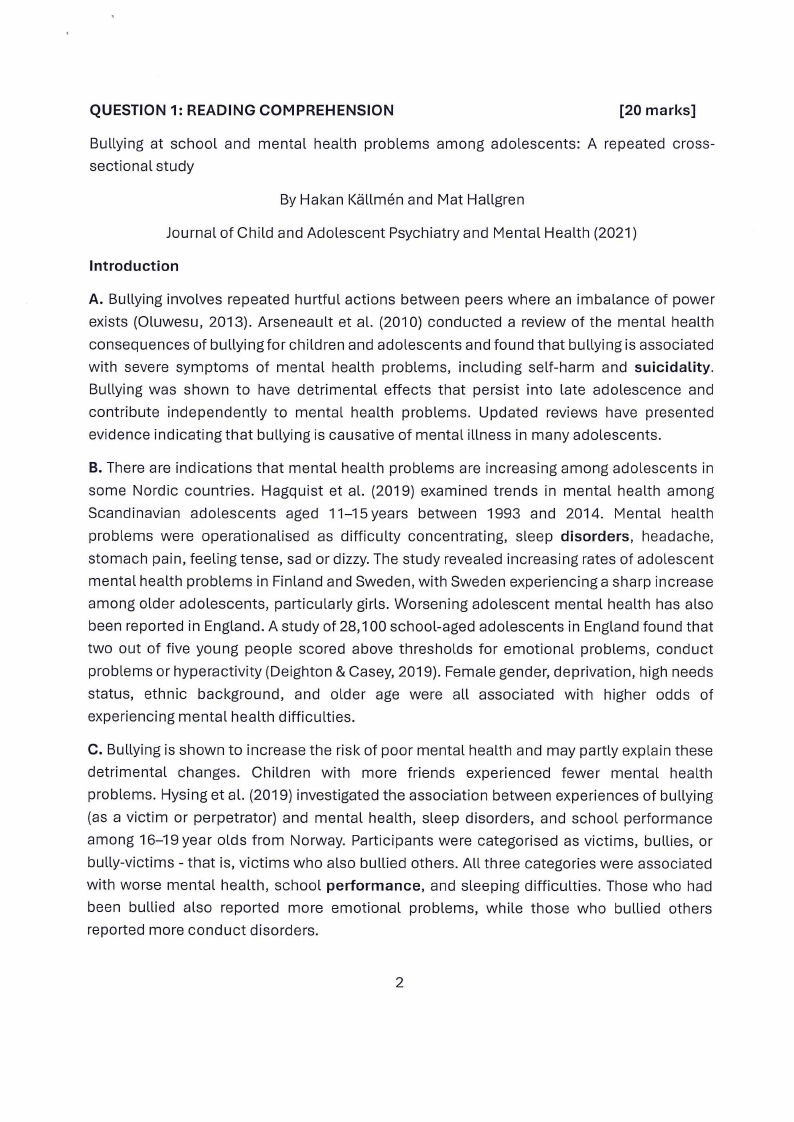
QUESTION 1: READING COMPREHENSION
[20 marks]
Bullying at school and mental health problems among adolescents: A repeated cross-
sectional study
By Hakan Kallmen and Mat Hallgren
Journal of Child and Adolescent Psychiatry and Mental Health (2021)
Introduction
A. Bullying involves repeated hurtful actions between peers where an imbalance of power
exists (Oluwesu, 2013). Arseneault et al. (2010) conducted a review of the mental health
consequences of bullying for children and adolescents and found that bullying is associated
with severe symptoms of mental health problems, including self-harm and suicidality.
Bullying was shown to have detrimental effects that persist into late adolescence and
contribute independently to mental health problems. Updated reviews have presented
evidence indicating that bullying is causative of mental illness in many adolescents.
B. There are indications that mental health problems are increasing among adolescents in
some Nordic countries. Hagquist et al. (2019) examined trends in mental health among
Scandinavian adolescents aged 11-15 years between 1993 and 2014. Mental health
problems were operationalised as difficulty concentrating, sleep disorders, headache,
stomach pain, feeling tense, sad or dizzy. The study revealed increasing rates of adolescent
mental health problems in Finland and Sweden, with Sweden experiencing a sharp increase
among older adolescents, particularly girls. Worsening adolescent mental health has also
been reported in England. A study of 28,100 school-aged adolescents in England found that
two out of five young people scored above thresholds for emotional problems, conduct
problems or hyperactivity (Deighton & Casey, 2019). Female gender, deprivation, high needs
status, ethnic background, and older age were all associated with higher odds of
experiencing mental health difficulties.
C. Bullying is shown to increase the risk of poor mental health and may partly explain these
detrimental changes. Children with more friends experienced fewer mental health
problems. Hysing et al. (2019) investigated the association between experiences of bullying
(as a victim or perpetrator) and mental health, sleep disorders, and school performance
among 16-19 year olds from Norway. Participants were categorised as victims, bullies, or
bully-victims - that is, victims who also bullied others. All three categories were associated
with worse mental health, school performance, and sleeping difficulties. Those who had
been bullied also reported more emotional problems, while those who bullied others
reported more conduct disorders.
2

3 Page 3

▲back to top


D. As most adolescents spend a considerable amount of time at school, the school
environment has been a major focus of mental health research. In a recent review,
Saminathen et al. (2020) concluded that school is a potential protective factor against
mental health problems, as it provides a socially supportive context and prepares students
for higher education and employment. However, it may also be the primary setting for
protracted bullying and stress. Another factor associated with adolescent mental health is
parental socio-economic status. A systematic review indicated that lower parental socio-
economic status is associated with poorer adolescent mental health. It remains unclear
whether school related factors, such as school grades and the school environment,
influence the relationship between bullying and mental health. This information could help
to identify those adolescents most at risk of harm from bullying.
Method
Participants
E. The Stockholm school survey in Sweden is completed every other year by students in
lower secondary school and upper secondary school. The survey is mandatory for public
schools, but voluntary for private schools. The purpose of the survey is to help inform
decision making by local authorities that will ultimately improve students' wellbeing. The
questions relate to life circumstances, including schoolwork, bullying, drug use, health, and
crime. As the data are completely anonymous, the study was exempt from ethical approval
according to an earlier decision from the Ethical Review Board in Stockholm. Details of the
survey are available via a website.
Procedure
F. Students completed the questionnaire during a school lesson, placed it in a sealed
envelope and handed it to their teacher. Students were permitted the entire lesson to
complete the questionnaire and were informed that participation was voluntary and that
they were free to cancel their participation at any time without consequences.
Primary exposure
G. Experiences of bullying were measured by the following two questions: Have you felt
bullied or harassed during the past school year? Have you been involved in bullying or
harassing other students during this school year? Alternatives for the first question were: yes
or no. Alternatives indicating emotional bullying were feelings of being mocked, ridiculed,
socially excluded, or teased. Alternatives indicating physical bullying were being beaten,
kicked, forced to do something against their will, robbed, or locked away somewhere. The
response alternatives for the second question gave an estimation of how often the
respondent had participated in bullying others. Combining the answers to these two
3

4 Page 4

▲back to top


questions, five different categories of bullying were identified: never been bullied and never
bully others; victims of emotional bullying who have never bullied others; victims of physical
bullying who have never bullied others; victims of bullying who have also bullied others; and
perpetrators of bullying, but not victims. As the number of positive cases in the last three
categories was low bully categories were combined into one primary exposure variable:
bullied at school.
Results
Prevalence of bullying at school and mental health problems
H. Our findings indicate that mental health problems increased among Swedish
adolescents between 2014 and 2020, while the prevalence of bullying at school remained
stable, except among girls, where the prevalence increased by 2.5%. As previously reported,
mental health problems were more common among girls and older adolescents. These
findings align with previous studies showing that adolescents who are bullied at school are
more likely to experience mental health problems compared to those who are not bullied.
This detrimental relationship was observed after adjustment for school-related factors
shown to be associated with adolescent mental health.
I. One novel finding was that boys who had been bullied at school reported a four-times
higher prevalence of mental health problems compared to non-bullied boys. The
corresponding figure for girls was 2.5 times higher for those who were bullied compared to
non-bullied girls, which could indicate that boys are more vulnerable to the deleterious
effects of bullying than girls. Alternatively, it may indicate that boys are on average bullied
more frequently or more intensely than girls, leading to worse mental health. Social support
could also play a role; adolescent girls often have stronger social networks than boys and
could be more inclined to voice concerns about bullying to significant others, who in turn
may offer supports which are protective. Related studies partly confirm this speculative
explanation.
J. Other studies suggest that heritable traits, such as the tendency to internalize problems
and having low self-esteem are associated with being a bully-victim (Tsous, 2016). Genetics
are understood to explain a large proportion of bullying-related behaviors among
adolescents. A study from the Netherlands involving 8215 primary school children found
that genetics explained approximately 65% of the risk of being a bully-victim. This proportion
was similar for boys and girls.
K. The relative stability of bullying at school between 2014 and 2020 suggests that other
factors may better explain the increase in mental health problems seen here. Many factors
could be contributing to these changes, including the increasingly competitive labour
4

5 Page 5

▲back to top


market, higher demands for education, and the rapid expansion of social media (Janssen,
2004). Research is needed in examining possible gender differences in perceived school
stress and how these differences moderate associations between bullying and mental
health.
Strengths and limitations
L. Strengths of the current study include the large participant sample from diverse schools;
public and private, theoretical and practical orientations. The survey included items
measuring diverse aspects of the school environment; factors previously linked to
adolescent mental health but rarely included as covariates in studies of bullying and mental
health. Some limitations are also acknowledged. Previous studies indicate that students
tend to under-report bullying and mental health problems; thus, our results may
underestimate the prevalence of these behaviors.
M. In conclusion, consistent with our stated hypotheses, we observed an increase in self-
reported mental health problems among Swedish adolescents, and a detrimental
association between bullying at school and mental health problems. Bullying at school does
not appear to be the primary explanation for these changes, bullying was detrimentally
associated with mental health after adjustment for relevant demographic, socio-economic,
and school-related factors, confirming our third hypothesis. The finding that boys are
potentially more vulnerable than girls to the deleterious effects of bullying should be
replicated in future studies. Future studies should examine the association between bullying
.2,,() > and mental health, including which factors moderate this relationship.
n -1~/(;
i:: N-D
4....-f'--cc..
1/Y'
_.?'
COMPREHENSION QUESTIONS
/\\
1. Identify the researchers who carried out this research study.
(2)
2. From which source was this article taken?
(2)
3. Define 'bullying' as presented in the passage.
(2)
4. Give any two characteristics associated with a person who is experiencing
mental health challenges.
(2)
5. Vocabulary: Provide the meanings of the following words as used in the text.
8.1 'suicidality' (paragraph A)
8.2 'mandatory' (paragraph E)
(4)
6. Pronoun reference: What do the following pronouns refer to as presented in the
text?
9.1 'it' (paragraph D)
5

6 Page 6

▲back to top


9.2 'we' (paragraph M)
(2)
7. Cohesive devices: Identify one cohesive device in
7.1 paragraph D
7.2 paragraph M
(2)
8. State two important findings that were proven through this research study. (4)
QUESTION 2: LANGUAGE USAGE
[15 marks]
1. What is the meaning of the underlined morphemes in the following words as used in
the passage?
1.1 unclear (paragraph D)
(2)
1.2 students.'. (paragraph E)
(2)
2. Analyse (break down) the following words according to their morpheme structure
2.1 disorders (paragraph B)
(2)
2.2 performance (paragraph C)
(2)
3. What part of speech are the words below as used in paragraph G?
3.1 'and'
(1)
3.2 'physical'
(1)
3.3 'the'
(1)
4. State whether the following words are derivational or inflectional
4.1 'reported'
(2)
4.2 'adjustment'
(2)
QUESTION 3: RESEARCH ANALYSIS
[15 marks]
1. Identify one method of data collection used in this research study.
(2)
2. State one main advantage of using the method you identified in question 1. (2)
3. Observe the two questions in italics in paragraph G. Are these two questions
A. Close ended questions or B. Open ended questions? Choose one answer. (2)
4. True or False:
4.1 A study of this nature had never been done before. This was the first time it was
done.
(2)
4.2 Support your answer to 4.1
(2)
5. Explain the meaning of 'ethical approval' as stated in paragraph E.
(2)
6. In paragraph H, the researchers identify a 'gap' in their research; that is, a specific
area that remains uncovered by previous studies. Explain what the gap they have
identified is.
(3)
6

7 Page 7

▲back to top


QUESTION 4: ACADEMIC WRITING
[20 marks]
1. When editing for correctness in academic writing, the writer focuses on grammar
correctness, subject verb agreement, spelling, punctuation and word omissions.
Read the article below and edit it for correctness. The article has ten errors. Copy
the error and write its correct form. Do not rewrite the whole text.
(10)
Climate change
Climate change is a mayor global challenge today. The world is becoming more
vulnerable to this change. Climate change refer to the changes in earths climate
condition. It describes the changes in the atmosphere which has taken place over a
period ranging from decades to millions of years. A recent report from the united
nations predicted that the average global temprature could increase significantly
before the end of the century. Climate change have an adverse affect on the
environment and ecosystem. With the help of this essay, students will get to know the
causes of climate change and possible solutions. Also, they will be able to
write essays on similar topics and can boost there writing skills
2. In academic writing, a writer incorporates information from other scholars through
quoting, paraphrasing, summarizing and synthesising. Which of these methods is
defined below? Write the number and the correct answer. Do not copy the
definition.
2.1 ________
using your own words to state the information that you read
in a source while keeping the original meaning.
(2)
2.2 ________
shorteningthe original text, writing in your own words as well
as presenting the main points only.
(2)
2.3 ________
getting information from more than one source and
combining the ideas in your own work.
(2)
3. Which of the following shows the correct stages of the writing process?
(2)
3.1 Preparation - Planning Drafting-Writing Revising- Editing- Proof reading
3.2 Preparation - Planning Drafting- Editing - Writing Revising- Proof reading
3.3 Preparation - Planning Drafting-Writing Revising- Proof reading- Editing
4. Indicate whether the following statement is True or False:
Objectivity refers to relying on the opinions of other writers and acknowledging them
using standard conventions.
(2)
7

8 Page 8

▲back to top


QUESTION 5: TEXT STRUCTURE
[15 marks]
Choose one of the prompts below.
1. The positive influence of social media on the youth
2. The causes of student stress
3. How to overcome the high student drop-out rate at university
4. Successful entrepreneurship
Write one paragraph of about 100 words on the topic that you have chosen.
(10)
Underline the topic sentence of the paragraph.
(2)
Underline the concluding sentence of the paragraph.
(1)
Underline any two cohesive devices or linking words that you have used in the paragraph.
(2)
QUESTION 6: CITATION AND REFERENCING
[15 marks]
Some of the reference entries below are not aligned to the APA style of referencing. Select
one option in each case that best represents the APA 7th edition style. Write the letter of the
correct answer (a, b, c). Do not copy the whole entry.
1. Article from a journal
(3)
(a) Allport, G. W., & Cantrida H. (1934). Judging personality from voice. Journal of
Social Psychology, 5, 37-55. https://doi.org/10.1080/00224545.1934
(b) Allport, G. W., Cantrida H. Judging personality from voice. Journal of Social
Psychology, 5, 37-55. https://doi.org/10.1080/00224545.1934
(c) Allport, G. W., Cantrida H. (1934). Judging personality from voice. Journal of
Social Psychology, 5. https:/ /doi.org/10.108J)JQ0224545.1934
2. Article from a journal
(2)
(a) Blair, I. V., Judd C. M., Sadler M. S., & Jenkins C. (2002). The role of
Afrocentric features in person perception: Judging by features and
categories. Journal of Personality and Social Psychology, 83(1 ), 5-25
(b) Blair, I. V., Judd C. M., Sadler M. S., Jenkins C. (2002). The role of Afrocentric
features in person perception: Judging by features and categories. Journal of
Personality and Social Psychology, 5-25
8

9 Page 9

▲back to top


(c) Blair, I. V., Judd C. M., Sadler M. S., & Jenkins C. (2002). The role of Afrocentric
features in person perception: Judging by features and categories. Journal of
Personality and Social Psychology, 83(1 ), 5-25.
3. Article from a newspaper
(2)
(a) Davidson, J. (2018, January 9). Samsung vows to add artificial intelligence to
everything it does. The Windhoek Observer, p. 13
(b) Davidson, J. (2018). Samsung vows to add artificial intelligence to everything it
does. The Windhoek Observer, p. 13
(c) Davidson, Jack. (2018, January 9). Samsung vows to add artificial intelligence to
everything it does. The Windhoek Observer, p. 13
4. Article from a newspaper
(2)
(a) Tillett A (2025, March 12). Rivers flow, vehicles swept away. The Southern Times,
p.5
(b) Tillett, A. (2025, March 12). Rivers flow, vehicles swept away. The Southern
Times, p. 5
(c) Tillett, A. (March 12). Rivers flow, vehicles swept away. The Southern Times, p. 5
5. Printed book chapter
(2)
(a) martino, P. (2018). Inclusive practices. In A. Ashman (Ed.), Education for
inclusion and diversity (6th ed., pp. 235-267). Pearson
(b) Martino, P. (2018). Inclusive practices. In A. Ashman (Ed.), Education for
inclusion and diversity (6th ed., pp. 235-267). Pearson
(c) Martino, P. (2018). Inclusive practices. In A. Ashman (Ed.), Education for
inclusion and diversity (6th ed., pp. 235-267). Pearson
6. Magazine article
(2)
(a) Schuman, M. (2011, October 3). Empowering youth through horticulture.
Farmers' Weekly, 24-27
(b) Schuman, M. (2011 ). Empowering youth through horticulture. Farmers' Weekly,
24-27
(c) Schuman. (2011, October 3). Empowering youth through horticulture. Farmers'
Weekly, 24-27
9

10 Page 10

▲back to top


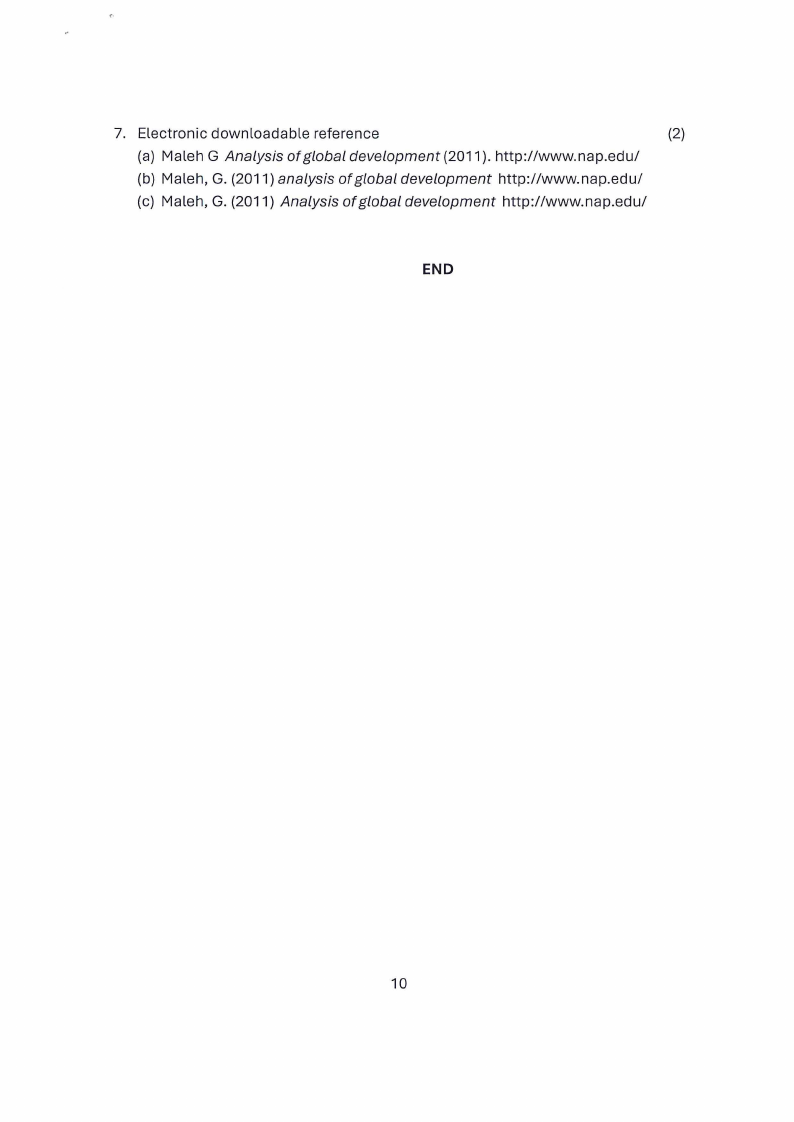
7. Electronic downloadable reference
(2)
(a) Maleh G Analysis of global development (2011 ). http://www.nap.edu/
(b) Maleh, G. (2011) analysis of global development http://www.nap.edu/
(c) Maleh, G. (2011) Analysis of global development http://www.nap.edu/
END
10