


 |
BBE612S - BUSINESS ETHICS - 1ST OPP - NOV 2025 |
|
|
1 Page 1 |
▲back to top |
n Am I BI A u n IVER s ITY
OF SCIEnCE Ano TECHnOLOGY
FACULTY OF COMMERCE, HUMAN SCIENCES AND EDUCATION
DEPARTMENT OF GOVERNANCE AND MANAGEMENT SCIENCES
QUALIFICATION: BACHELOR OF MANAGEMENT
QUALIFICATION CODE: 07BBMA
LEVEL: 6
COURSE CODE : BBE612S
SESSION: NOVEMBER 2025
DURATION: 3 HOURS
COURSE NAME: BUSINESS ETHICS
PAPER: 1
MARKS: 100
EXAMINER(S)
MODERATOR:
FIRST OPPORTUNITY EXAMINATION QUESTION PAPER
Mr N. Neema
Mr B. Zealand
Mr K. Uirab Dr M. Waigandjo
Prof. Asa Romeo Asa
THIS MEMORANDUM CONSISTS OF 6 PAGES {Including this front page)
INSTRUCTIONS
1.
Answer all questions.
2.
Read all the questions carefully before answering.
3.
Marks for each question are indicated at the end of each question.
4.
Please ensure that your writing is legible, neat and presentable and start each
Section on a new page.
|
|
2 Page 2 |
▲back to top |
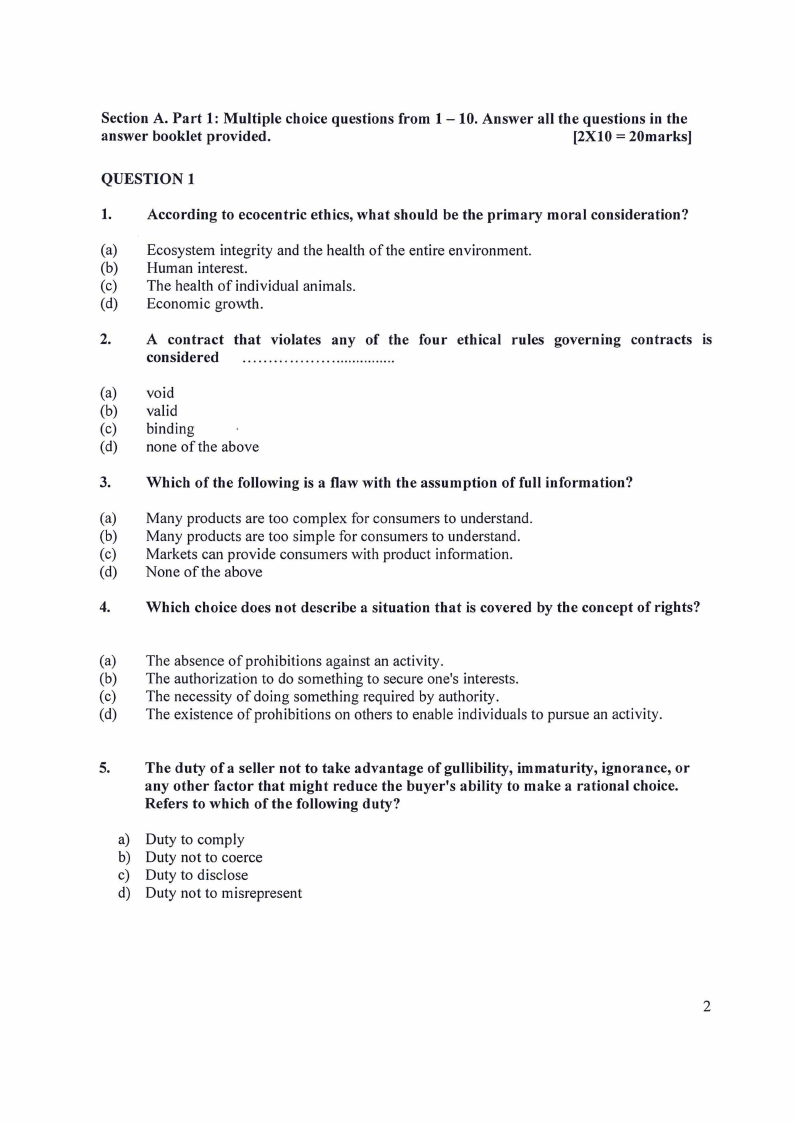
Section A. Part 1: Multiple choice questions from 1 - 10. Answer all the questions in the
answer booklet provided.
[2X10 = 20marks]
QUESTION 1
1. According to ecocentric ethics, what should be the primary moral consideration?
(a) Ecosystem integrity and the health of the entire environment.
(b) Human interest.
(c) The health of individual animals.
(d) Economic growth.
2. A contract that violates any of the four ethical rules governing contracts is
considered
(a) void
(b) valid
(c) binding
(d) none of the above
3. Which of the following is a flaw with the assumption of full information?
(a) Many products are too complex for consumers to understand.
(b) Many products are too simple for consumers to understand.
(c) Markets can provide consumers with product information.
(d) None of the above
4. Which choice does not describe a situation that is covered by the concept of rights?
(a) The absence of prohibitions against an activity.
(b) The authorization to do something to secure one's interests.
(c) The necessity of doing something required by authority.
(d) The existence of prohibitions on others to enable individuals to pursue an activity.
5. The duty of a seller not to take advantage of gullibility, immaturity, ignorance, or
any other factor that might reduce the buyer's ability to make a rational choice.
Refers to which of the following duty?
a) Duty to comply
b) Duty not to coerce
c) Duty to disclose
d) Duty not to misrepresent
2
|
|
3 Page 3 |
▲back to top |
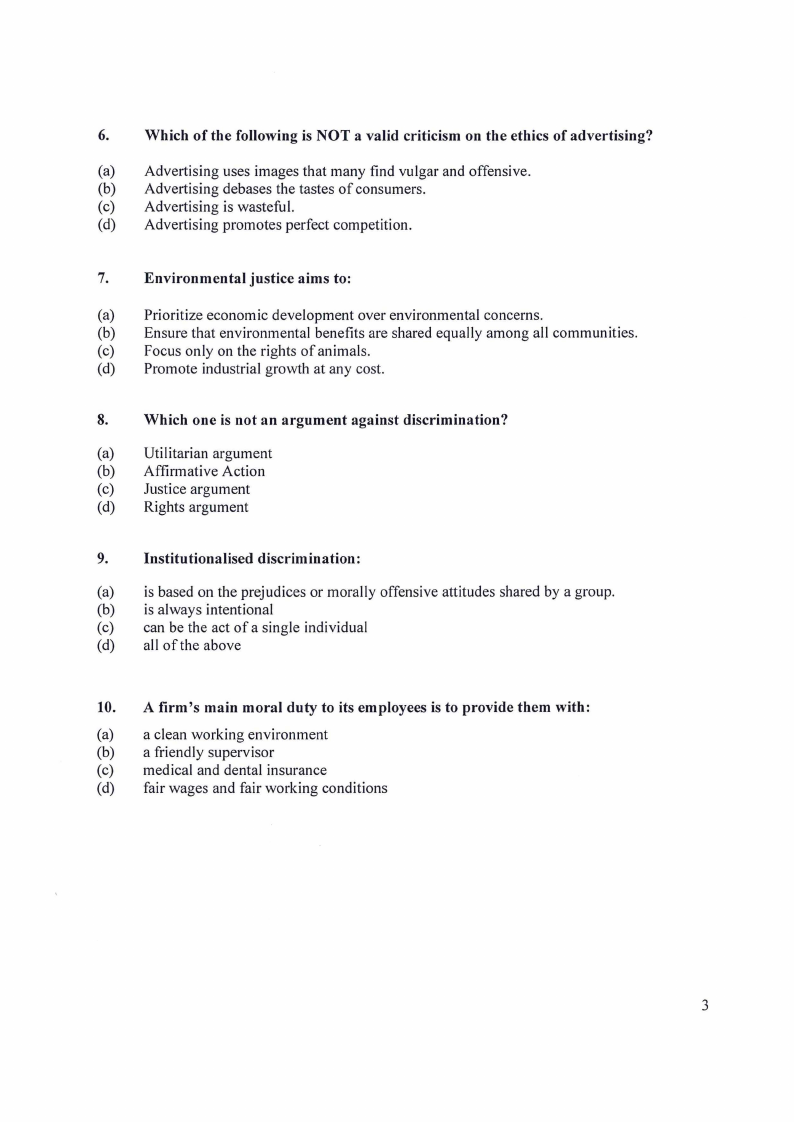
6. Which of the following is NOT a valid criticism on the ethics of advertising?
(a) Advertising uses images that many find vulgar and offensive.
(b) Advertising debases the tastes of consumers.
(c) Advertising is wasteful.
(d) Advertising promotes perfect competition.
7. Environmental justice aims to:
(a) Prioritize economic development over environmental concerns.
(b) Ensure that environmental benefits are shared equally among all communities.
(c) Focus only on the rights of animals.
(d) Promote industrial growth at any cost.
8. Which one is not an argument against discrimination?
(a) Utilitarian argument
(b) Affirmative Action
(c) Justice argument
(d) Rights argument
9. Institutionalised discrimination:
(a) is based on the prejudices or morally offensive attitudes shared by a group.
(b) is always intentional
(c) can be the act of a single individual
(d) all of the above
10. A firm's main moral duty to its employees is to provide them with:
(a) a clean working environment
(b) a friendly supervisor
(c) medical and dental insurance
(d) fair wages and fair working conditions
3
|
|
4 Page 4 |
▲back to top |
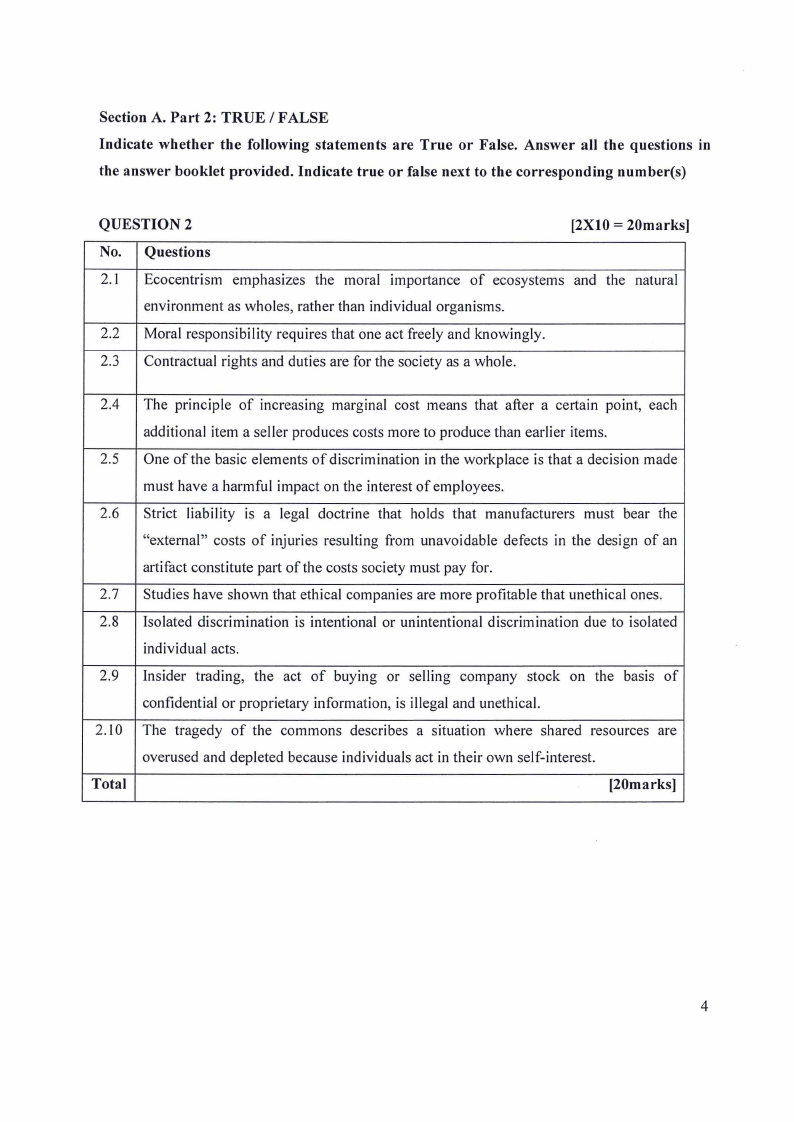
Section A. Part 2: TRUE/ FALSE
Indicate whether the following statements are True or False. Answer all the questions in
the answer booklet provided. Indicate true or false next to the corresponding number(s)
QUESTION2
[2X10 = 20marks]
No. Questions
2.1 Ecocentrism emphasizes the moral importance of ecosystems and the natural
environment as wholes, rather than individual organisms.
2.2 Moral responsibility requires that one act freely and knowingly.
2.3 Contractual rights and duties are for the society as a whole.
2.4 The principle of increasing marginal cost means that after a certain point, each
additional item a seller produces costs more to produce than earlier items.
2.5 One of the basic elements of discrimination in the workplace is that a decision made
must have a harmful impact on the interest of employees.
2.6 Strict liability is a legal doctrine that holds that manufacturers must bear the
"external" costs of injuries resulting from unavoidable defects in the design of an
artifact constitute part of the costs society must pay for.
2.7 Studies have shown that ethical companies are more profitable that unethical ones.
2.8 Isolated discrimination is intentional or unintentional discrimination due to isolated
individual acts.
2.9 Insider trading, the act of buying or selling company stock on the basis of
confidential or proprietary information, is illegal and unethical.
2.10 The tragedy of the commons describes a situation where shared resources are
overused and depleted because individuals act in their own self-interest.
Total
[20marks]
4
|
|
5 Page 5 |
▲back to top |
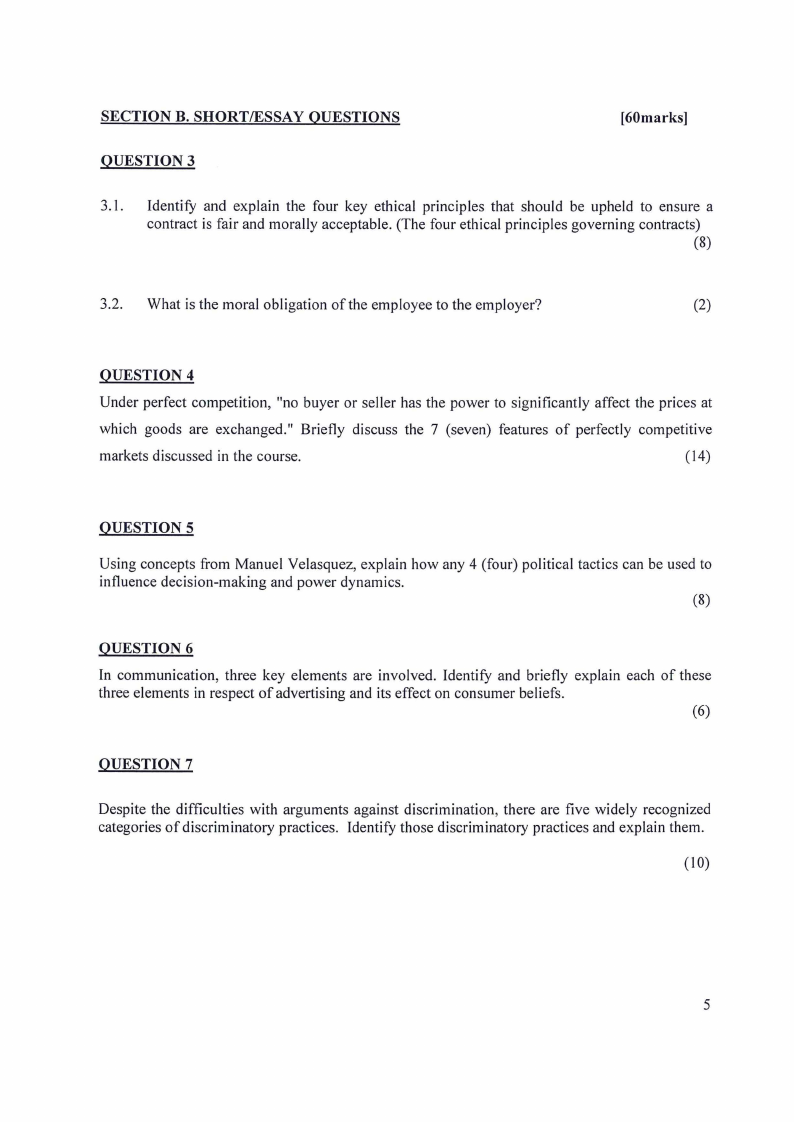
SECTION B. SHORT/ESSAY QUESTIONS
[60marks]
QUESTION3
3.1. Identify and explain the four key ethical principles that should be upheld to ensure a
contract is fair and morally acceptable. (The four ethical principles governing contracts)
(8)
3.2. What is the moral obligation of the employee to the employer?
(2)
QUESTION 4
Under perfect competition, "no buyer or seller has the power to significantly affect the prices at
which goods are exchanged." Briefly discuss the 7 (seven) features of perfectly competitive
markets discussed in the course.
(14)
QUESTION 5
Using concepts from Manuel Velasquez, explain how any 4 (four) political tactics can be used to
influence decision-making and power dynamics.
(8)
QUESTION 6
In communication, three key elements are involved. Identify and briefly explain each of these
three elements in respect of advertising and its effect on consumer beliefs.
(6)
QUESTION 7
Despite the difficulties with arguments against discrimination, there are five widely recognized
categories of discriminatory practices. Identify those discriminatory practices and explain them.
5
|
|
6 Page 6 |
▲back to top |

QUESTION 8
Case Scenario: The Ethical Responsibilities in the Sale of a Used Car
Shikongo is selling his used car to Emma. They meet to finalize the sale, Shikongo agrees to sell
the car for N$55,000.00. Shikongo is aware that the car has a minor engine issue that causes
occasional stalling, but he chooses not to disclose this defect. He believes that Emma will buy
the car regardless and does not want to risk losing the sale by mentioning the problem. Emma,
eager to purchase a vehicle quickly, proceeds with the transaction .
Analyse Shikongo's actions in light of the four main moral duties of the contractual theory.
(12)
6