


 |
DMA711S - DEVELOPMENT MANAGEMENT - 1ST OPP - JUNE 2025 |
|
|
1 Page 1 |
▲back to top |
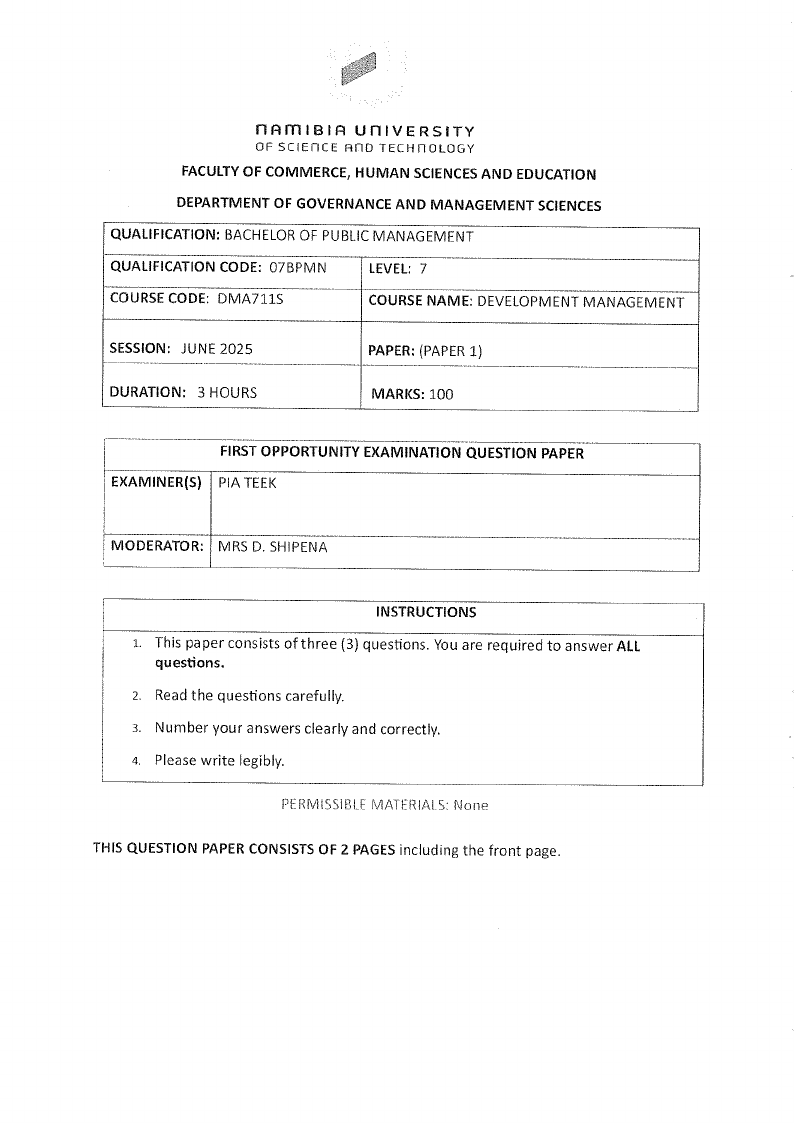
nAmlBIA
UnlVERSITY
OF SCIEnCE Ano TECHnOLOGY
FACULTYOF COMMERCE, HUMAN SCIENCES AND EDUCATION
DEPARTMENT OF GOVERNANCE AND MANAGEMENT SCIENCES
QUALIFICATION: BACHELOROF PUBLICMANAGEMENT
QUALIFICATION CODE: 07BPMN
LEVEL: 7
COURSE CODE: DMA711S
COURSE NAME: DEVELOPMENTMANAGEMENT
SESSION: JUNE 2025
DURATION: 3 HOURS
PAPER: (PAPER1)
MARKS: 100
--- .. ··"--·-
EXAMINER($)
FIRST OPPORTUNITY EXAMINATION QUESTION PAPER
PIA TEEK
MODERATOR: MRS D. SHIPENA
INSTRUCTIONS
1. This paper consists of three (3) questions. You are required to answer ALL
questions.
2. Read the questions carefully.
3. Number your answers clearly and correctly.
4. Please write legibly.
PrnrvliSSIBLE lv1ATFl,li\\LS:None
THIS QUESTION PAPER CONSISTS OF 2 PAGES including the front page.
|
|
2 Page 2 |
▲back to top |
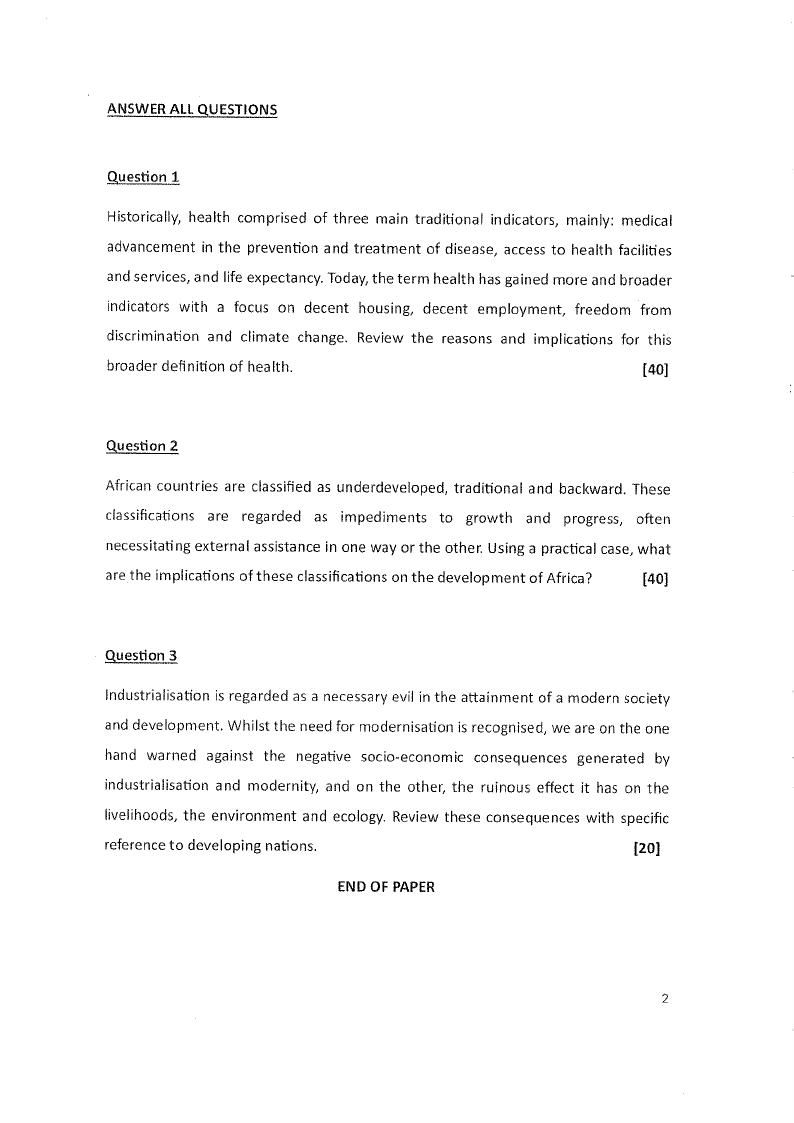
ANSWER ALL QUESTIONS
Question 1
Historically, health comprised of three main traditional indicators, mainly: medical
advancement in the prevention and treatment of disease, access to health facilities
and services, and life expectancy. Today, the term health has gained more and broader
indicators with a focus on decent housing, decent employment, freedom from
discrimination and climate change. Review the reasons and implications for this
broader definition of health.
[40)
Question 2
African countries are classified as underdeveloped, traditional and backward. These
classifications are regarded as impediments to growth and progress, often
necessitating external assistance in one way or the other. Using a practical case, what
are the implications of these classifications on the development of Africa?
[40)
Question 3
Industrialisation is regarded as a necessary evil in the attainment of a modern society
and development. Whilst the need for modernisation is recognised, we are on the one
hand warned against the negative socio-economic consequences generated by
industrialisation and modernity, and on the other, the ruinous effect it has on the
livelihoods, the environment and ecology. Review these consequences with specific
reference to developing nations.
[20]
END OF PAPER
2