


 |
AME820S-ADVANCED MACROECONOMICS-1ST OPP-NOV 2025 |
|
|
1 Page 1 |
▲back to top |

nAm I BIA un IVE RSITY
OF SCIEnCE Ano TECHn0L0GY
FACULTY OF COMMERCE, HUMAN SCIENCES AND EDUCATION
DEPARTMENT OF ECONOMICS, ACCOUNTING AND FINANCE
QUALIFICATION: BACHELOR OF ECONOMICS HONOURS
QUALIFICATION CODE: 08HECO
LEVEL: 8
COURSE CODE: AME80205
COURSE NAME: ADVANCED MACROECONOMICS
SESSION: NOVEMBER 2025
DURATION: 3 HOURS
PAPER:THEORY
MARKS: 100
FIRST OPPORTUNITY EXAMINATION QUESTION PAPER
EXAMINER(S) DR P. OKWOCHE
MODERATOR DR ANTHONY ADEYANJU
INSTRUCTIONS
1. Answer ALL the questions.
2. Write clearly and neatly.
3. Number the answers clearly.
PERMISSIBLE MATERIALS
1. PEN,
2. PENCIL
3. CALCULATOR
THIS QUESTION PAPER CONSISTS OF 4 PAGES (Including this front page)
|
|
2 Page 2 |
▲back to top |
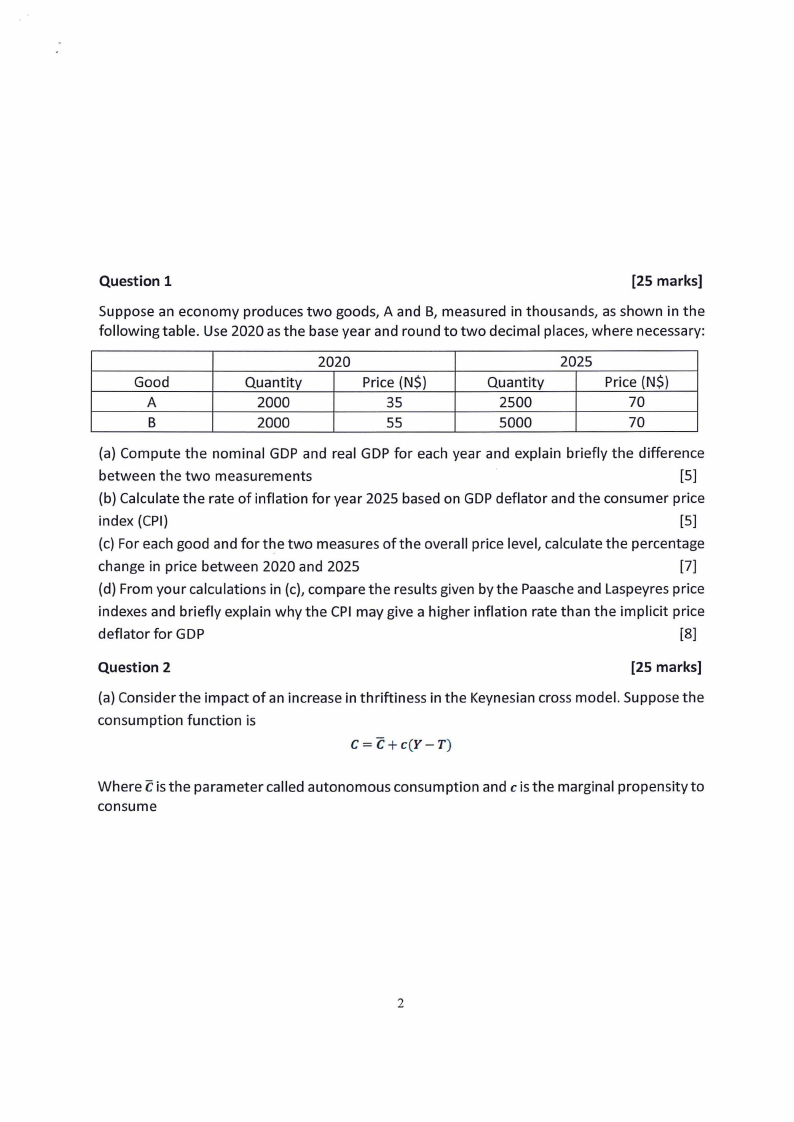
Question 1
[25 marks]
Suppose an economy produces two goods, A and B, measured in thousands, as shown in the
following table. Use 2020 as the base year and round to two decimal places, where necessary:
Good
A
B
Quantity
2000
2000
2020
Price (N$)
35
55
Quantity
2500
5000
2025
Price (N$)
70
70
(a) Compute the nominal GDP and real GDP for each year and explain briefly the difference
between the two measurements
[5]
(b) Calculate the rate of inflation for year 2025 based on GDP deflator and the consumer price
index (CPI)
[5]
(c) For each good and for the two measures of the overall price level, calculate the percentage
change in price between 2020 and 2025
[7]
(d) From your calculations in (c), compare the results given by the Paasche and Laspeyres price
indexes and briefly explain why the CPI may give a higher inflation rate than the implicit price
deflator for GDP
[8]
Question 2
[25 marks]
(a) Consider the impact of an increase in thriftiness in the Keynesian cross model. Suppose the
consumption function is
C = C+c (Y-T)
Where cis the parameter called autonomous consumption and c is the marginal propensity to
consume
2
|
|
3 Page 3 |
▲back to top |
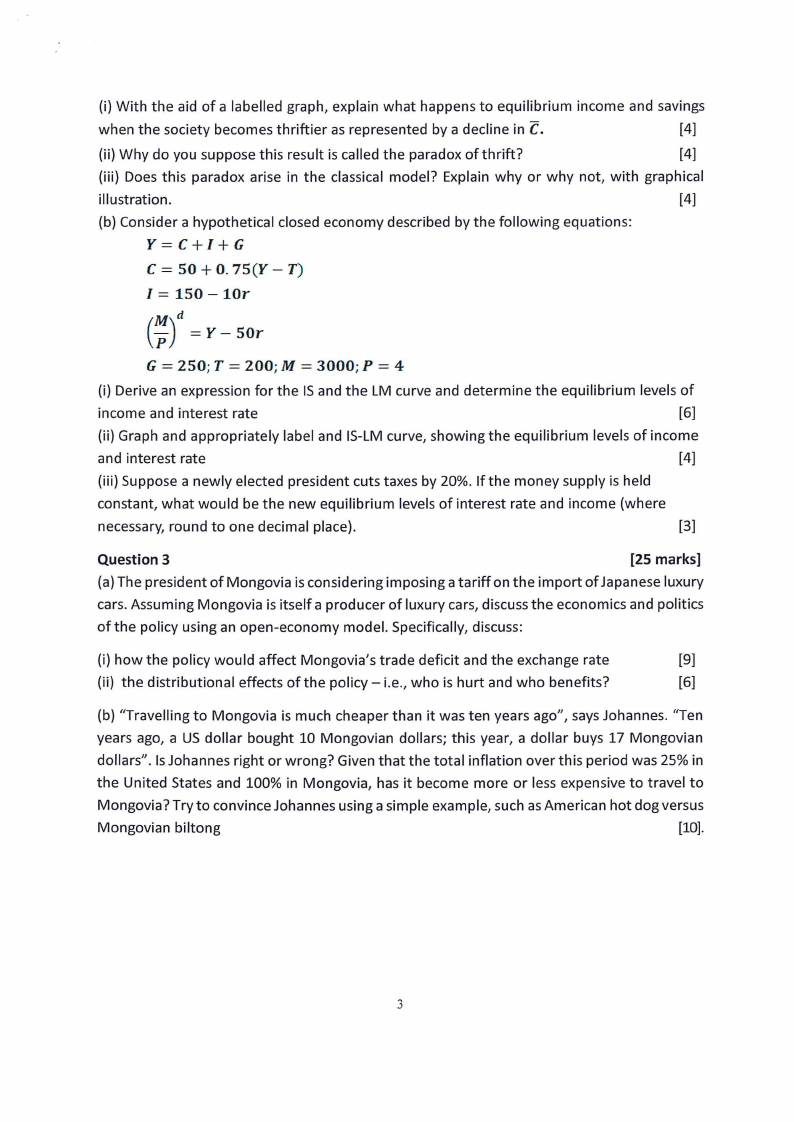
(i) With the aid of a labelled graph, explain what happens to equilibrium income and savings
when the society becomes thriftier as represented by a decline in C.
[4]
(ii) Why do you suppose this result is called the paradox of thrift?
[4]
(iii) Does this paradox arise in the classical model? Explain why or why not, with graphical
illustration.
[4]
(b) Consider a hypothetical closed economy described by the following equations:
Y=C+I+G
C = 50 + 0. 75(Y - T)
I= 150- lOr
(;f = Y- Sor
G = 250; T = 200; M = 3000; P = 4
(i) Derive an expression for the IS and the LM curve and determine the equilibrium levels of
income and interest rate
[6]
(ii) Graph and appropriately label and IS-LM curve, showing the equilibrium levels of income
and interest rate
[4]
(iii) Suppose a newly elected president cuts taxes by 20%. If the money supply is held
constant, what would be the new equilibrium levels of interest rate and income (where
necessary, round to one decimal place).
[3]
Question 3
[25 marks]
(a) The president of Mongovia is considering imposing a tariff on the import of Japanese luxury
cars. Assuming Mongovia is itself a producer of luxury cars, discuss the economics and politics
of the policy using an open-economy model. Specifically, discuss:
(i) how the policy would affect Mongovia's trade deficit and the exchange rate
[9]
(ii) the distributional effects of the policy-Le., who is hurt and who benefits?
[6]
(b) "Travelling to Mongovia is much cheaper than it was ten years ago", says Johannes. "Ten
years ago, a US dollar bought 10 Mongovian dollars; this year, a dollar buys 17 Mongovian
dollars". Is Johannes right or wrong? Given that the total inflation over this period was 25% in
the United States and 100% in Mongovia, has it become more or less expensive to travel to
Mongovia? Try to convince Johannes using a simple example, such as American hot dog versus
Mongovian biltong
[10].
3
|
|
4 Page 4 |
▲back to top |
Question 4
[25 marks]
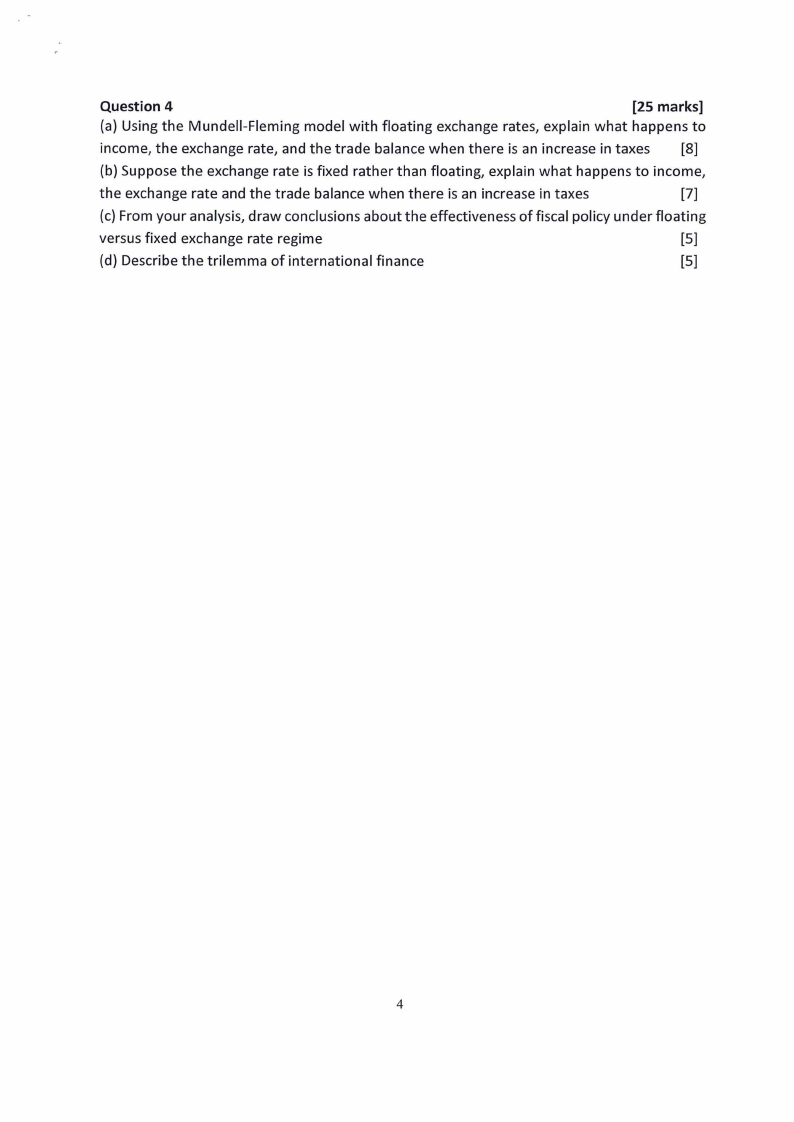
(a) Using the Mundell-Fleming model with floating exchange rates, explain what happens to
income, the exchange rate, and the trade balance when there is an increase in taxes [8]
(b) Suppose the exchange rate is fixed rather than floating, explain what happens to income,
the exchange rate and the trade balance when there is an increase in taxes
[7]
(c) From your analysis, draw conclusions about the effectiveness of fiscal policy under floating
versus fixed exchange rate regime
[S]
(d) Describe the trilemma of international finance
[5]
4