


 |
CIH811S - CONTEMPORARY ISSUES IN HRM - 1ST OPP - JUNE 2025 |
|
|
1 Page 1 |
▲back to top |
nAmlBIA unlVERSITY
OF SCIEnCE Ano TECHnOLOGY
FACULTY OF COMMERCE, HUMAN SCIENCES AND EDUCATION
DEPARTMENT OF GOVERNANCE AND MANAGEMENT SCIENCES
QUALIFICATION: BACHELOR OF EMPLOYMENT AND INDUSTRIAL RELATIONS
HONOURS
QUALi FiCA TION CODE: 08BERH LEVEL: 8
COURSE CODE: CIH811S
COURSE NAME: CONTEMPORARY ISSUES IN
HRM
DATE: JUNE 2025
DURATION: 3 HOURS
PAPER: 1
MARKS: 100
EXAMINER(S)
FIRST OPPORTUNITY QUESTION PAPER
Ms. Fiina Shimaneni
MODERATOR:
Ms. lleni- Mutale Ndahafa Haiduwa
INSTRUCTIONS
1. Answer ALL questions.
2. Write clearly and neatly.
3. Number your answers clearly.
THIS QUESTION PAPER CONSISTS OF 5 PAGES (Including this front page)
|
|
2 Page 2 |
▲back to top |
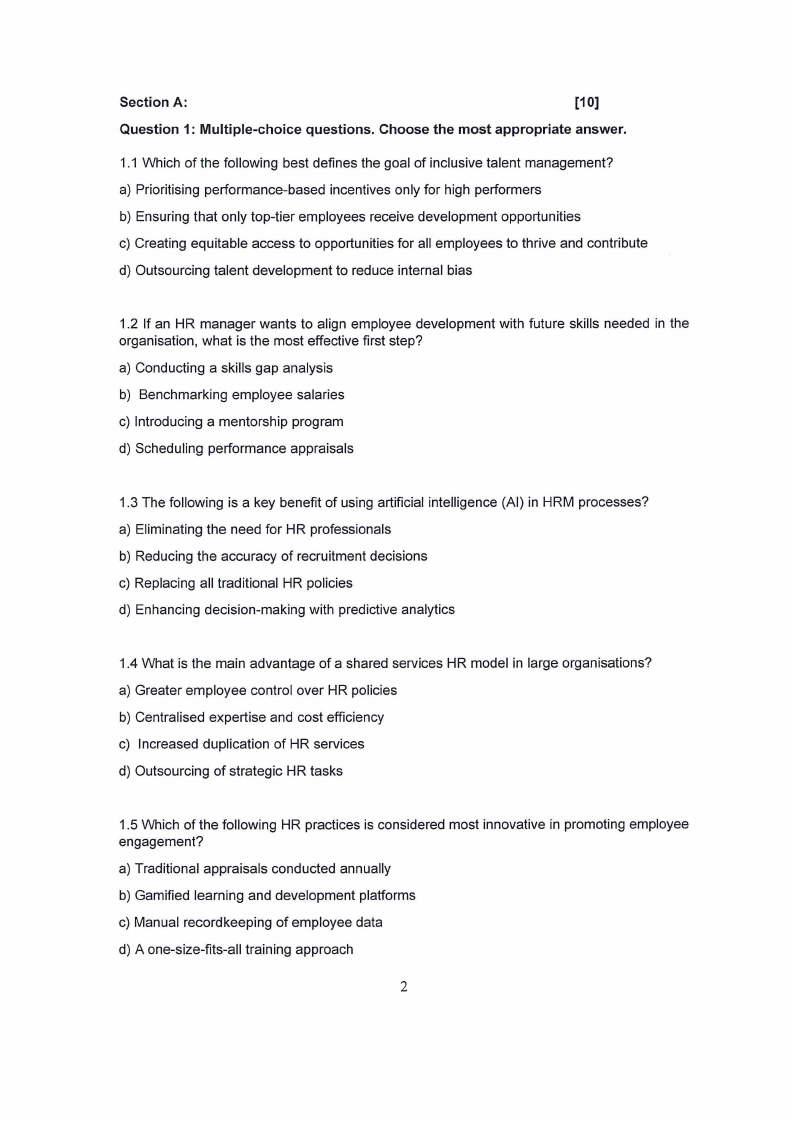
Section A:
[10]
Question 1: Multiple-choice questions. Choose the most appropriate answer.
1.1 Which of the following best defines the goal of inclusive talent management?
a) Prioritising performance-based incentives only for high performers
b) Ensuring that only top-tier employees receive development opportunities
c) Creating equitable access to opportunities for all employees to thrive and contribute
d) Outsourcing talent development to reduce internal bias
1.2 If an HR manager wants to align employee development with future skills needed in the
organisation, what is the most effective first step?
a) Conducting a skills gap analysis
b) Benchmarking employee salaries
c) Introducing a mentorship program
d) Scheduling performance appraisals
1.3 The following is a key benefit of using artificial intelligence (Al) in HRM processes?
a) Eliminating the need for HR professionals
b) Reducing the accuracy of recruitment decisions
c) Replacing all traditional HR policies
d) Enhancing decision-making with predictive analytics
1.4 What is the main advantage of a shared services HR model in large organisations?
a) Greater employee control over HR policies
b) Centralised expertise and cost efficiency
c) Increased duplication of HR services
d) Outsourcing of strategic HR tasks
1.5 Which of the following HR practices is considered most innovative in promoting employee
engagement?
a) Traditional appraisals conducted annually
b) Gamified learning and development platforms
c) Manual recordkeeping of employee data
d) A one-size-fits-all training approach
2
|
|
3 Page 3 |
▲back to top |
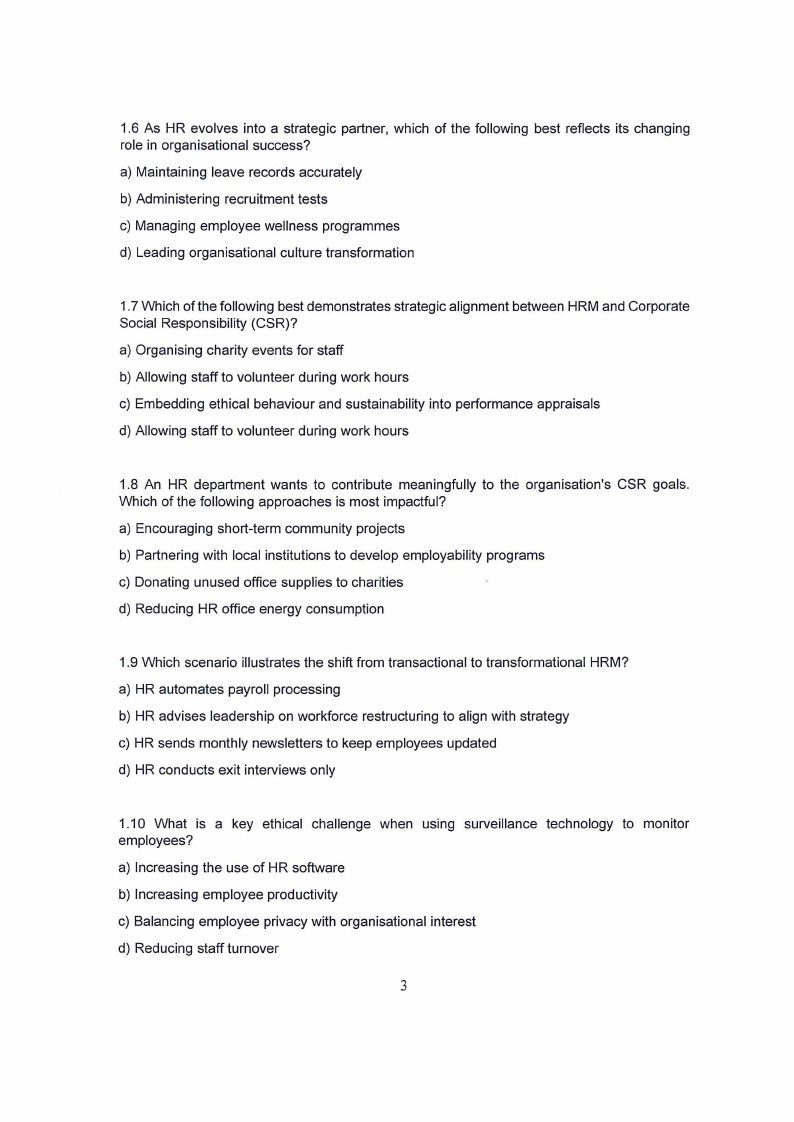
1.6 As HR evolves into a strategic partner, which of the following best reflects its changing
role in organisational success?
a) Maintaining leave records accurately
b) Administering recruitment tests
c) Managing employee wellness programmes
d) Leading organisational culture transformation
1.7 Which of the following best demonstrates strategic alignment between HRM and Corporate
Social Responsibility (CSR)?
a) Organising charity events for staff
b) Allowing staff to volunteer during work hours
c) Embedding ethical behaviour and sustainability into performance appraisals
d) Allowing staff to volunteer during work hours
1.8 An HR department wants to contribute meaningfully to the organisation's CSR goals.
Which of the following approaches is most impactful?
a) Encouraging short-term community projects
b) Partnering with local institutions to develop employability programs
c) Donating unused office supplies to charities
d) Reducing HR office energy consumption
1.9 Which scenario illustrates the shift from transactional to transformational HRM?
a) HR automates payroll processing
b) HR advises leadership on workforce restructuring to align with strategy
c) HR sends monthly newsletters to keep employees updated
d) HR conducts exit interviews only
1.10 What is a key ethical challenge when using surveillance technology to monitor
employees?
a) Increasing the use of HR software
b) Increasing employee productivity
c) Balancing employee privacy with organisational interest
d) Reducing staff turnover
3
|
|
4 Page 4 |
▲back to top |
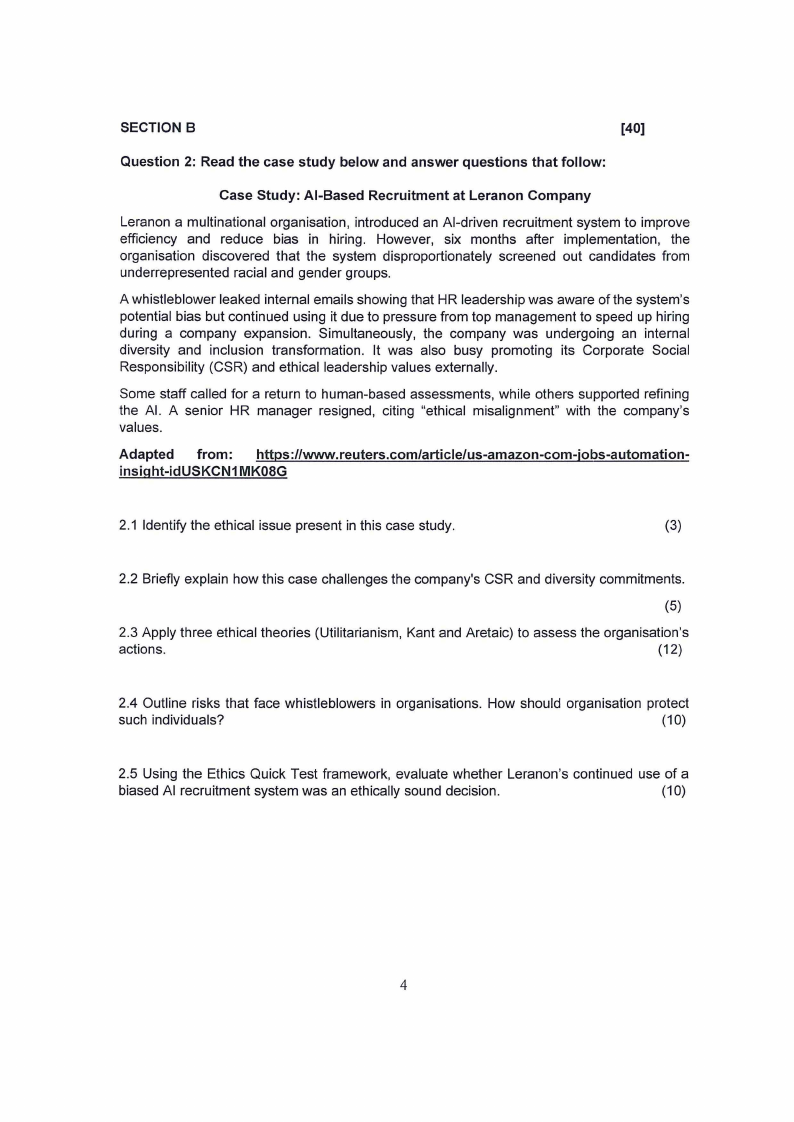
SECTION B
[40]
Question 2: Read the case study below and answer questions that follow:
Case Study: Al-Based Recruitment at Leranon Company
Leranon a multinational organisation, introduced an Al-driven recruitment system to improve
efficiency and reduce bias in hiring. However, six months after implementation, the
organisation discovered that the system disproportionately screened out candidates from
underrepresented racial and gender groups.
A whistleblower leaked internal emails showing that HR leadership was aware of the system's
potential bias but continued using it due to pressure from top management to speed up hiring
during a company expansion. Simultaneously, the company was undergoing an internal
diversity and inclusion transformation. It was also busy promoting its Corporate Social
Responsibility (CSR) and ethical leadership values externally.
Some staff called for a return to human-based assessments, while others supported refining
the Al. A senior HR manager resigned, citing "ethical misalignment" with the company's
values.
Adapted from: https://www.reuters.com/article/us-amazon-com-jobs-automation-
insight-idUSKCN1 MK08G
2.1 Identify the ethical issue present in this case study.
(3)
2.2 Briefly explain how this case challenges the company's CSR and diversity commitments.
(5)
2.3 Apply three ethical theories (Utilitarianism, Kant and Aretaic) to assess the organisation's
actions.
(12)
2.4 Outline risks that face whistleblowers in organisations. How should organisation protect
such individuals?
(10)
2.5 Using the Ethics Quick Test framework, evaluate whether Leranon's continued use of a
biased Al recruitment system was an ethically sound decision.
(10)
4
|
|
5 Page 5 |
▲back to top |
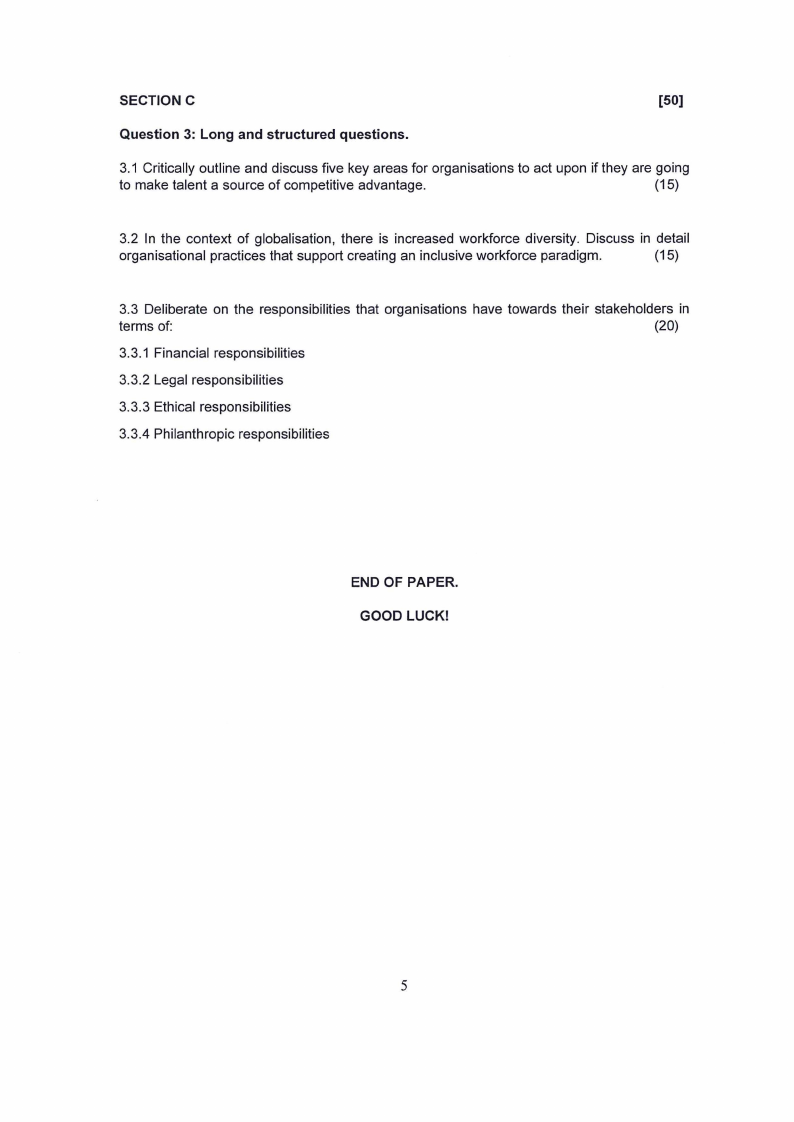
SECTION C
[50)
Question 3: Long and structured questions.
3.1 Critically outline and discuss five key areas for organisations to act upon if they are going
to make talent a source of competitive advantage.
(15)
3.2 In the context of globalisation, there is increased workforce diversity. Discuss in detail
organisational practices that support creating an inclusive workforce paradigm.
(15)
3.3 Deliberate on the responsibilities that organisations have towards their stakeholders in
~ms~
3.3.1 Financial responsibilities
3.3.2 Legal responsibilities
3.3.3 Ethical responsibilities
3.3.4 Philanthropic responsibilities
END OF PAPER.
GOOD LUCK!
5