


 |
CIH811S - CONTEMPORARY ISSUES IN HRM - 2ND OPP - JUNE 2025 |
|
|
1 Page 1 |
▲back to top |
nAmlBIA UnlVERSITY
OF SCIEnCE Ano TECHnOLOGY
FACULTY OF COMMERCE, HUMAN SCIENCES AND EDUCATION
DEPARTMENT OF GOVERNANCE AND MANAGEMENT SCIENCES
QUALIFICATION: BACHELOR OF EMPLOYMENT AND INDUSTRIAL RELATIONS
HONOURS
QUALi FiCA TION CODE: 08BERH LEVEL: 8
COURSE CODE: CIH811 S
COURSE NAME: CONTEMPORARY ISSUES IN
HRM
DATE: JULY 2025
DURATION: 3 HOURS
PAPER: 1
MARKS: 100
EXAMINER(S)
SECOND OPPORTUNITY QUESTION PAPER
Ms. Fiina Shimaneni
MODERATOR:
Ms. lleni- Mutale Ndahafa Haiduwa
INSTRUCTIONS
1. Answer ALL questions.
2. Write clearly and neatly.
3. Number your answers clearly.
THIS QUESTION PAPER CONSISTS OF 5 PAGES (Including this front page)
|
|
2 Page 2 |
▲back to top |
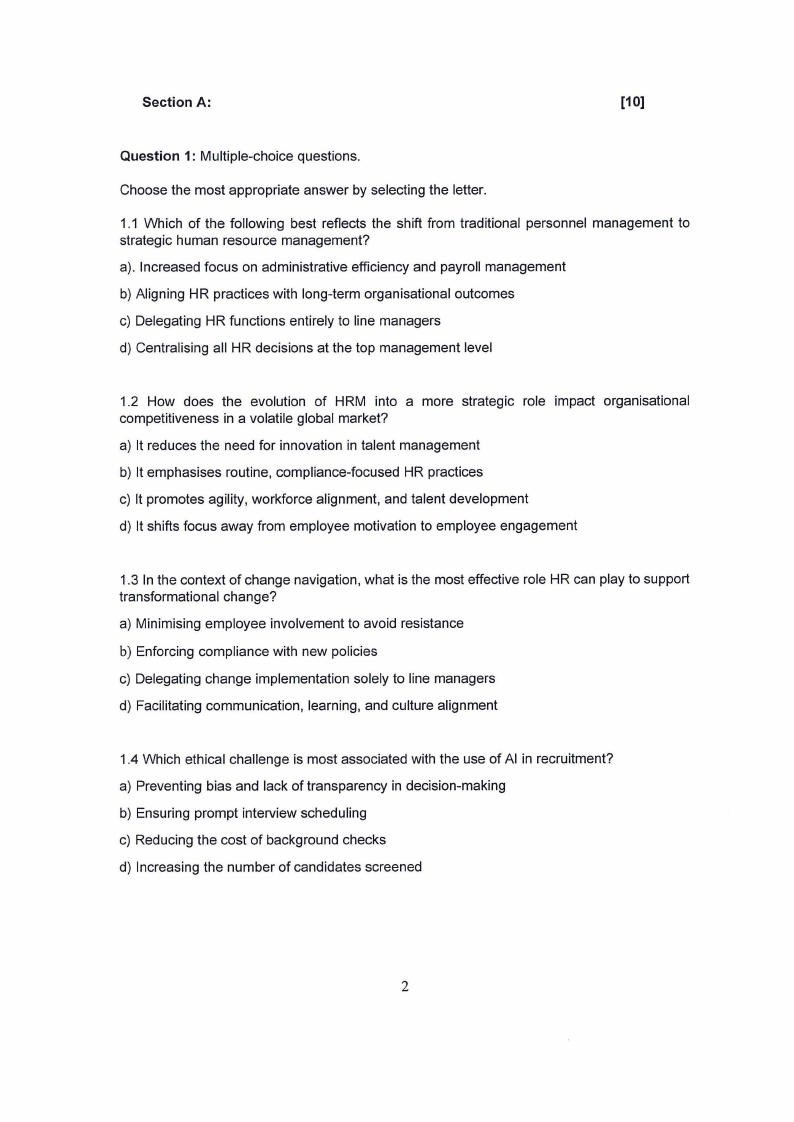
Section A:
[10]
Question 1: Multiple-choice questions.
Choose the most appropriate answer by selecting the letter.
1.1 Which of the following best reflects the shift from traditional personnel management to
strategic human resource management?
a). Increased focus on administrative efficiency and payroll management
b) Aligning HR practices with long-term organisational outcomes
c) Delegating HR functions entirely to line managers
d) Centralising all HR decisions at the top management level
1.2 How does the evolution of HRM into a more strategic role impact organisational
competitiveness in a volatile global market?
a) It reduces the need for innovation in talent management
b) It emphasises routine, compliance-focused HR practices
c) It promotes agility, workforce alignment, and talent development
d) It shifts focus away from employee motivation to employee engagement
1.3 In the context of change navigation, what is the most effective role HR can play to support
transformational change?
a) Minimising employee involvement to avoid resistance
b) Enforcing compliance with new policies
c) Delegating change implementation solely to line managers
d) Facilitating communication, learning, and culture alignment
1.4 Which ethical challenge is most associated with the use of Al in recruitment?
a) Preventing bias and lack of transparency in decision-making
b) Ensuring prompt interview scheduling
c) Reducing the cost of background checks
d) Increasing the number of candidates screened
2
|
|
3 Page 3 |
▲back to top |
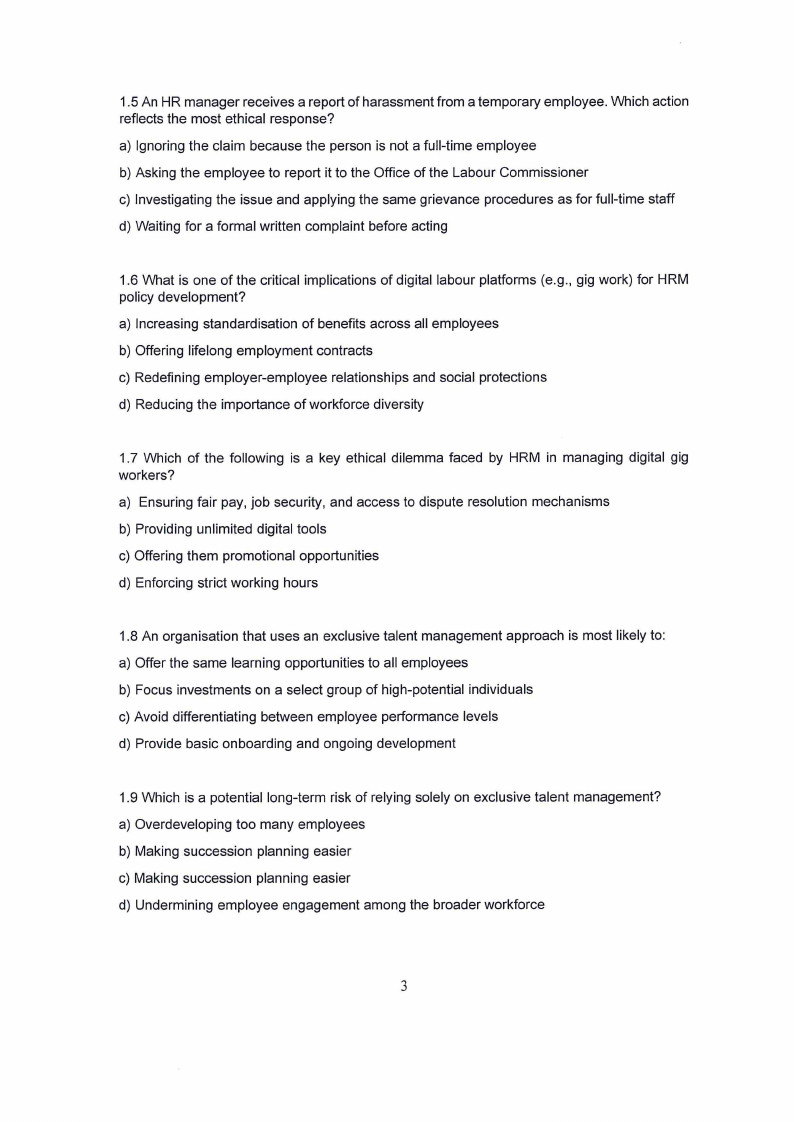
1.5 An HR manager receives a report of harassment from a temporary employee. Which action
reflects the most ethical response?
a) Ignoring the claim because the person is not a full-time employee
b) Asking the employee to report it to the Office of the Labour Commissioner
c) Investigating the issue and applying the same grievance procedures as for full-time staff
d) Waiting for a formal written complaint before acting
1.6 What is one of the critical implications of digital labour platforms (e.g., gig work) for HRM
policy development?
a) Increasing standardisation of benefits across all employees
b) Offering lifelong employment contracts
c) Redefining employer-employee relationships and social protections
d) Reducing the importance of workforce diversity
1.7 Which of the following is a key ethical dilemma faced by HRM in managing digital gig
workers?
a) Ensuring fair pay, job security, and access to dispute resolution mechanisms
b) Providing unlimited digital tools
c) Offering them promotional opportunities
d) Enforcing strict working hours
1.8 An organisation that uses an exclusive talent management approach is most likely to:
a) Offer the same learning opportunities to all employees
b) Focus investments on a select group of high-potential individuals
c) Avoid differentiating between employee performance levels
d) Provide basic onboarding and ongoing development
1.9 Which is a potential long-term risk of relying solely on exclusive talent management?
a) Overdeveloping too many employees
b) Making succession planning easier
c) Making succession planning easier
d) Undermining employee engagement among the broader workforce
3
|
|
4 Page 4 |
▲back to top |
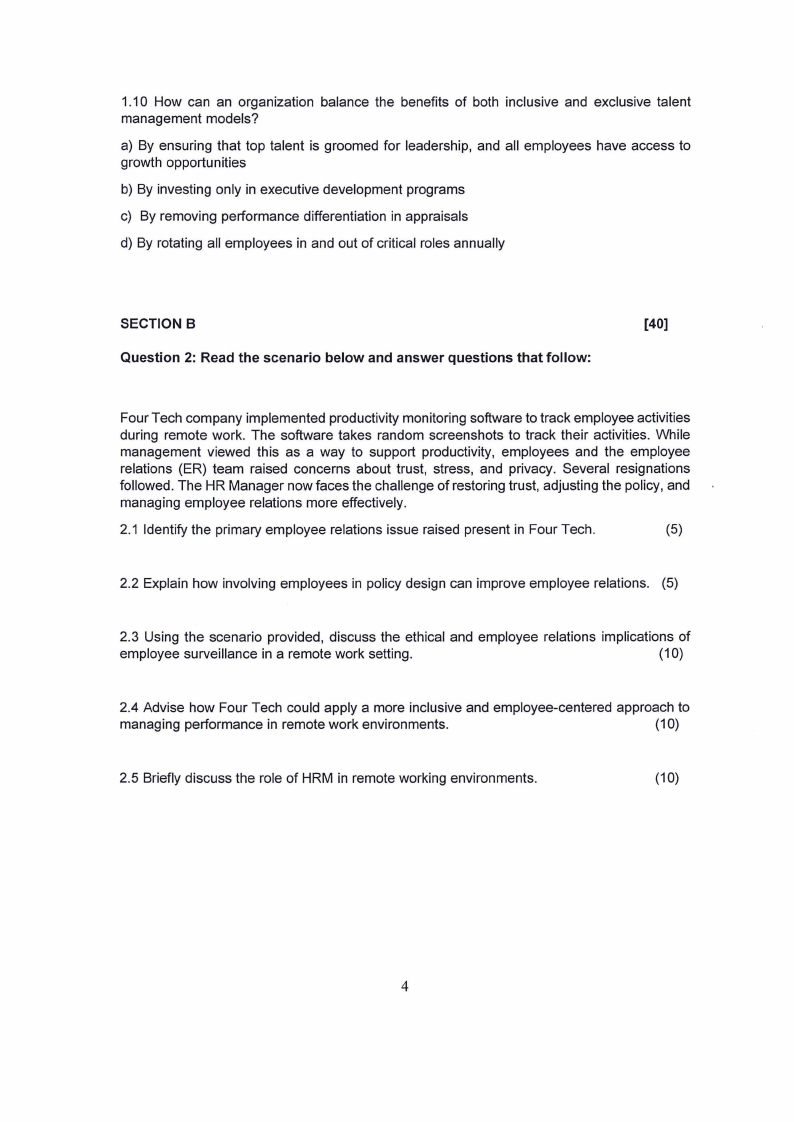
1.10 How can an organization balance the benefits of both inclusive and exclusive talent
management models?
a) By ensuring that top talent is groomed for leadership, and all employees have access to
growth opportunities
b) By investing only in executive development programs
c) By removing performance differentiation in appraisals
d) By rotating all employees in and out of critical roles annually
SECTION B
[40]
Question 2: Read the scenario below and answer questions that follow:
Four Tech company implemented productivity monitoring software to track employee activities
during remote work. The software takes random screenshots to track their activities. While
management viewed this as a way to support productivity, employees and the employee
relations (ER) team raised concerns about trust, stress, and privacy. Several resignations
followed. The HR Manager now faces the challenge of restoring trust, adjusting the policy, and
managing employee relations more effectively.
2.1 Identify the primary employee relations issue raised present in Four Tech.
(5)
2.2 Explain how involving employees in policy design can improve employee relations. (5)
2.3 Using the scenario provided, discuss the ethical and employee relations implications of
employee surveillance in a remote work setting.
(10)
2.4 Advise how Four Tech could apply a more inclusive and employee-centered approach to
managing performance in remote work environments.
(10)
2.5 Briefly discuss the role of HRM in remote working environments.
(10)
4
|
|
5 Page 5 |
▲back to top |

SECTION C
[50]
Question 3: Long and structured questions.
3.1 Discuss the concept of humane capital, highlighting its benefits and how it differs from
traditional views of human capital.
(15)
3.2 Change is inevitable in today's organisations. Explain how HRM can make value
contributions to ensure people agility in organisations.
(20)
3.3 Distinguish between performance management and performance appraisal.
(15)
END OF PAPER.
GOOD LUCK!
5