EUR612S - ELEMENTS OF URBAN AND RURAL ECONOMICS - 1ST OPP - NOV 2025


EUR612S - ELEMENTS OF URBAN AND RURAL ECONOMICS - 1ST OPP - NOV 2025


1 Page 1

▲back to top


nAmlBIA unlVERSITY
OF SCI En CE Ano TECH n OLOGY
FACULTY OF ENGINEERING AND THE BUILT ENVIRONMENT
DEPARTMENT OF LAND AND SPATIAL SCIENCES
QUALIFICATION(S): BACHELOR OF PROPERTY STUDIES
DIPLOMA IN PROPERTY STUDIES
QUALIFICATION(S) CODE: 08BOPS
06DIPS
NQF LEVEL: 6
COURSE CODE: EUR612S
COURSE NAME: ELEMENTS OF URBAN AND RURAL
ECONOMICS
EXAMS SESSION: NOVEMBER 2025
PAPER:
THEORY
DURATION: 3 HOURS
MARKS:
100
EXAMINER(S)
FIRST OPPORTUNITY EXAMINATION QUESTION PAPER
MR SAMUELATO K. HAYFORD
MODERATOR: MS ELINA TEODOL
INSTRUCTIONS
1. Read the entire question paper before answering the Questions.
2. Please write clearly and legibly!
3. Please START EACH QUESTION ON A FRESH PAGE.
4. The question paper contains a total of 5 questions.
5. You must answer ALL QUESTIONS.
6. Make sure your Student Number is on the EXAMINATION BOOK(S).
PERMISSIBLE MATERIALS
1. Non-programmable Scientific Calculator
THIS QUESTION PAPER CONSISTS OF 9 PAGES (Including this front page)

2 Page 2

▲back to top


Elements of Urban and Rural Economics
EUR612S
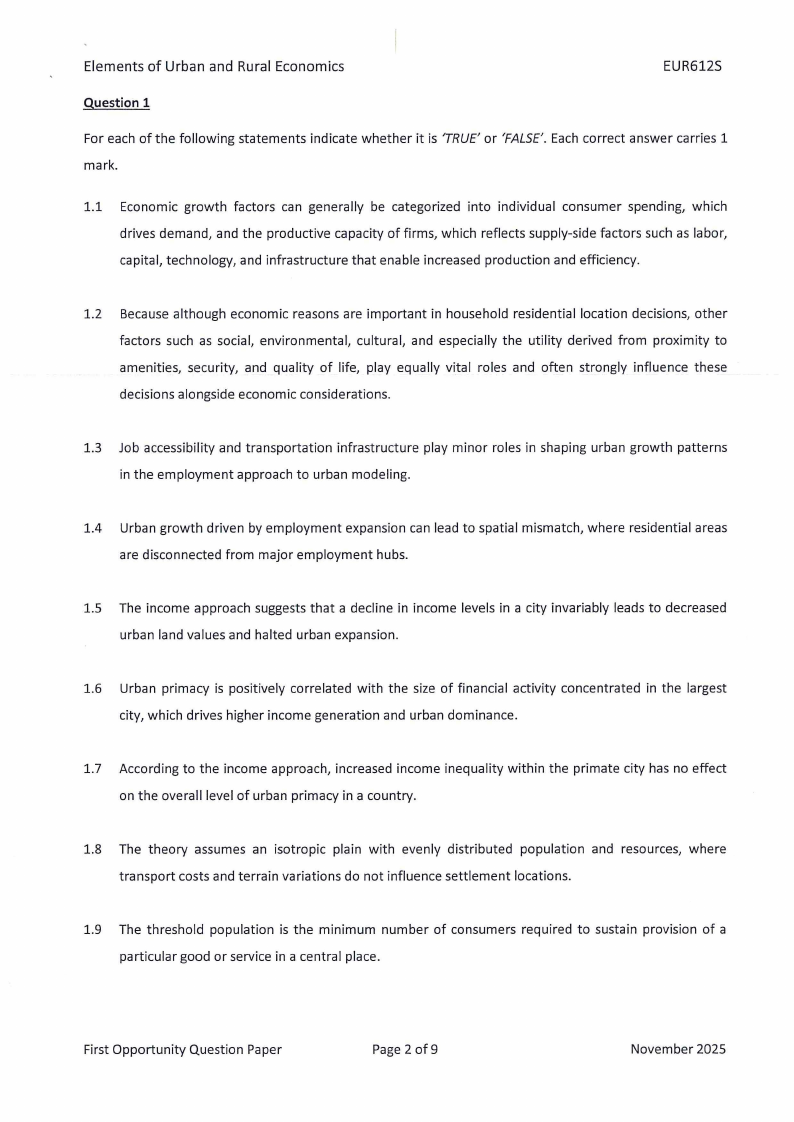
Question 1
For each of the following statements indicate whether it is 'TRUE' or 'FALSE'. Each correct answer carries 1
mark.
1.1 Economic growth factors can generally be categorized into individual consumer spending, which
drives demand, and the productive capacity of firms, which reflects supply-side factors such as labo r,
capital, technology, and infrastructure that enable increased production and efficiency.
1.2 Because although economic reasons are important in household residential location decisions, other
factors such as social, environmental, cultural, and especially the utility derived from proximity to
amenities, security, and quality of life, play equally vital roles and often strongly influence these
decisions alongside economic considerations.
1.3 Job accessibility and transportation infrastructure play minor roles in shaping urban growth patterns
in the employment approach to urban modeling.
1.4 Urban growth driven by employment expansion can lead to spatial mismatch, where residential areas
are disconnected from major employment hubs.
1.5 The income approach suggests that a decline in income levels in a city invariably leads to decreased
urban land values and halted urban expansion.
1.6 Urban primacy is positively correlated with the size of financial activity concentrated in the largest
city, which drives higher income generation and urban dominance.
1.7 According to the income approach, increased income inequality within the primate city has no effect
on the overall level of urban primacy in a country.
1.8 The theory assumes an isotropic plain with evenly distributed population and resources, where
transport costs and terrain variations do not influence settlement locations.
1.9 The threshold population is the min imum number of consumers required to sustain provision of a
particular good or service in a central place .
First Opportunity Question Paper
Page 2 of 9
November 2025

3 Page 3

▲back to top


Elements of Urban and Rural Economics
EUR612S
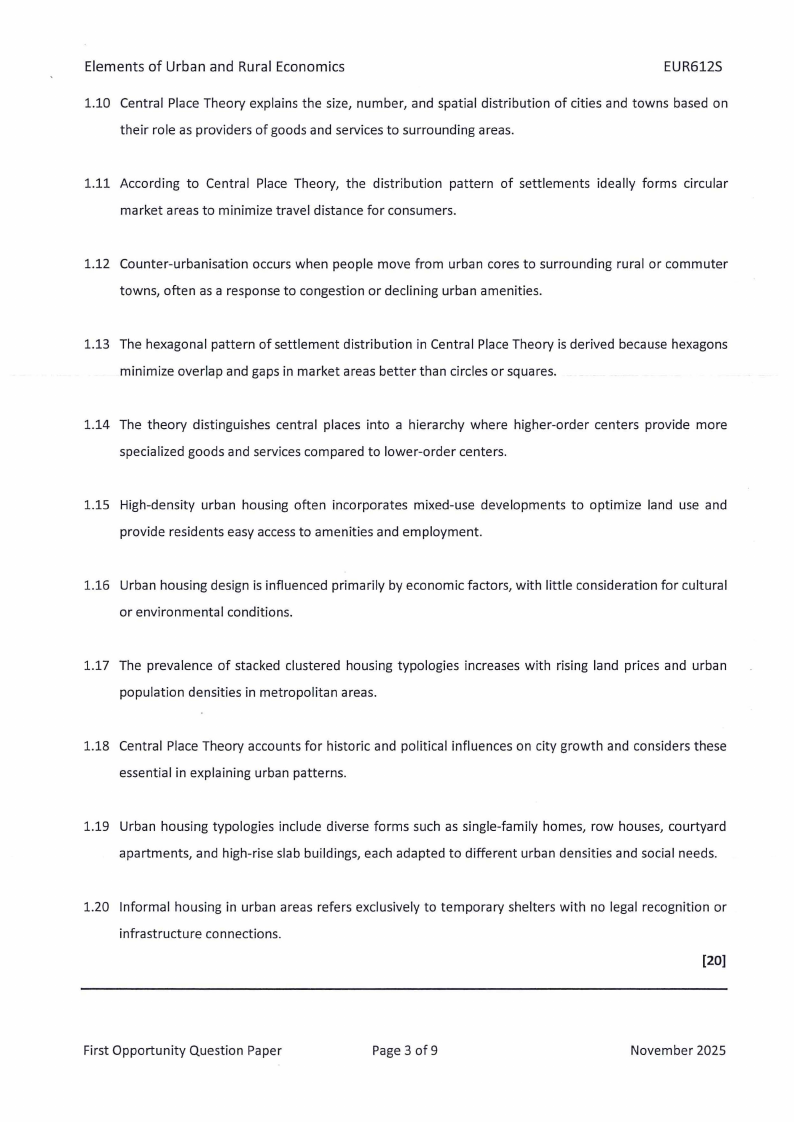
1.10 Central Place Theory explains the size, number, and spatial distribution of cities and towns based on
their role as providers of goods and services to surrounding areas.
1.11 According to Central Place Theory, the distribution pattern of settlements ideally forms circular
market areas to minimize travel distance for consumers.
1.12 Counter-urbanisation occurs when people move from urban cores to surrounding rural or commuter
towns, often as a response to congestion or declining urban amenities.
1.13 The hexagonal pattern of settlement distribution in Central Place Theory is derived because hexagons
minimize overlap and gaps in market areas better than circles or squares.
1.14 The theory distinguishes central places into a hierarchy where higher-order centers provide more
specialized goods and services compared to lower-order centers.
1.15 High-density urban housing often incorporates mixed-use developments to optimize land use and
provide residents easy access to amenities and employment.
1.16 Urban housing design is influenced primarily by economic factors, with little consideration for cultural
or environmental conditions.
1.17 The prevalence of stacked clustered housing typologies increases with rising land prices and urban
population densities in metropolitan areas.
1.18 Central Place Theory accounts for historic and political influences on city growth and considers these
essential in explaining urban patterns.
1.19 Urban housing typologies include diverse forms such as single-family homes, row houses, courtyard
apartments, and high-rise slab buildings, each adapted to different urban densities and social needs.
1.20 Informal housing in urban areas refers exclusively to temporary shelters with no legal recognition or
infrastructure connections.
[20]
First Opportunity Question Paper
Page 3 of 9
November 2025

4 Page 4

▲back to top


Elements of Urban and Rural Economics
EUR612S
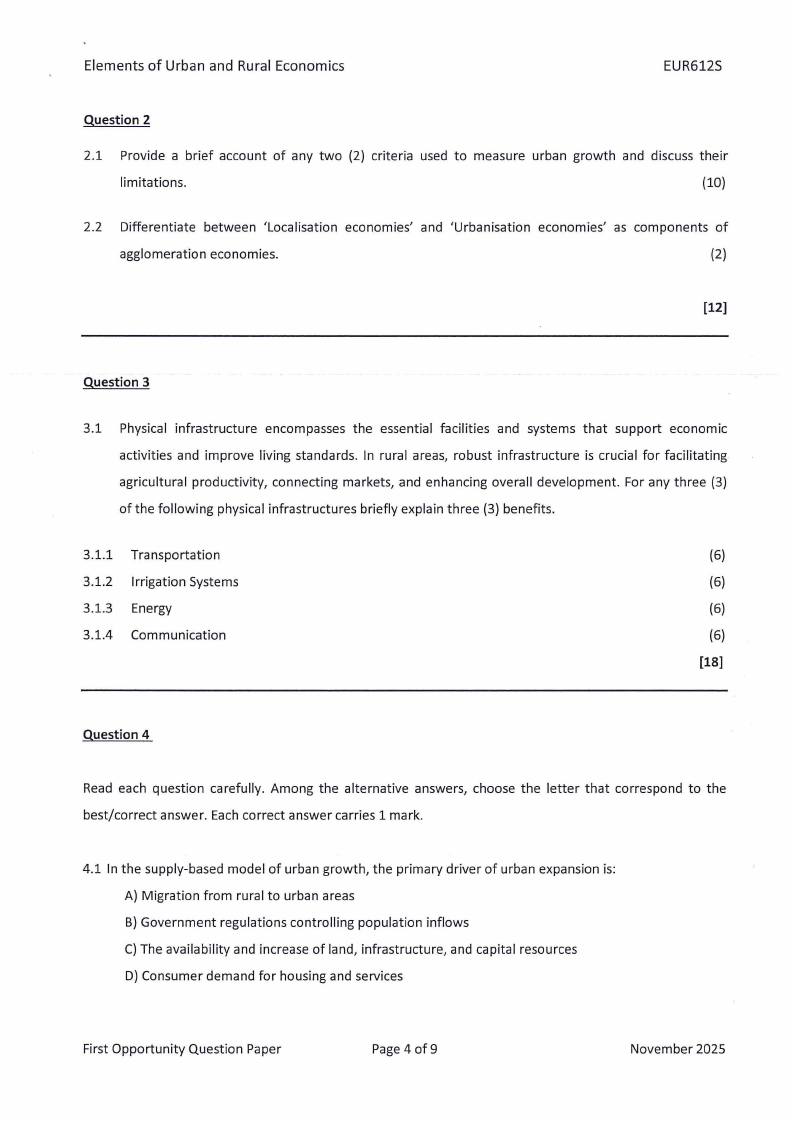
Question 2
2.1 Provide a brief account of any two (2) criteria used to measure urban growth and discuss their
limitations.
(10)
2.2 Differentiate between 'Localisation economies' and 'Urbanisation economies' as components of
agglomeration economies.
(2)
[12]
Question 3
3.1 Physical infrastructure encompasses the essential facilities and systems that support economic
activities and improve living standards. In rural areas, robust infrastructure is crucial for facilitating
agricultural productivity, connecting markets, and enhancing overall development. For any three (3)
of the following physical infrastructures briefly explain three (3) benefits.
3.1.1 Transportation
(6)
3.1.2 Irrigation Systems
(6)
3.1.3 Energy
(6)
3.1.4 Communication
(6)
[18]
Question 4
Read each question carefully. Among the alternative answers, choose the letter that correspond to the
best/correct answer. Each correct answer carries 1 mark.
4.1 In the supply-based model of urban growth, the primary driver of urban expansion is:
A) Migration from rural to urban areas
B) Government regulations controlling population inflows
C) The availability and increase of land, infrastructure, and capital resources
D) Consumer demand for housing and services
First Opportunity Question Paper
Page 4 of 9
November 2025

5 Page 5

▲back to top


Elements of Urban and Rural Economics
EUR612S
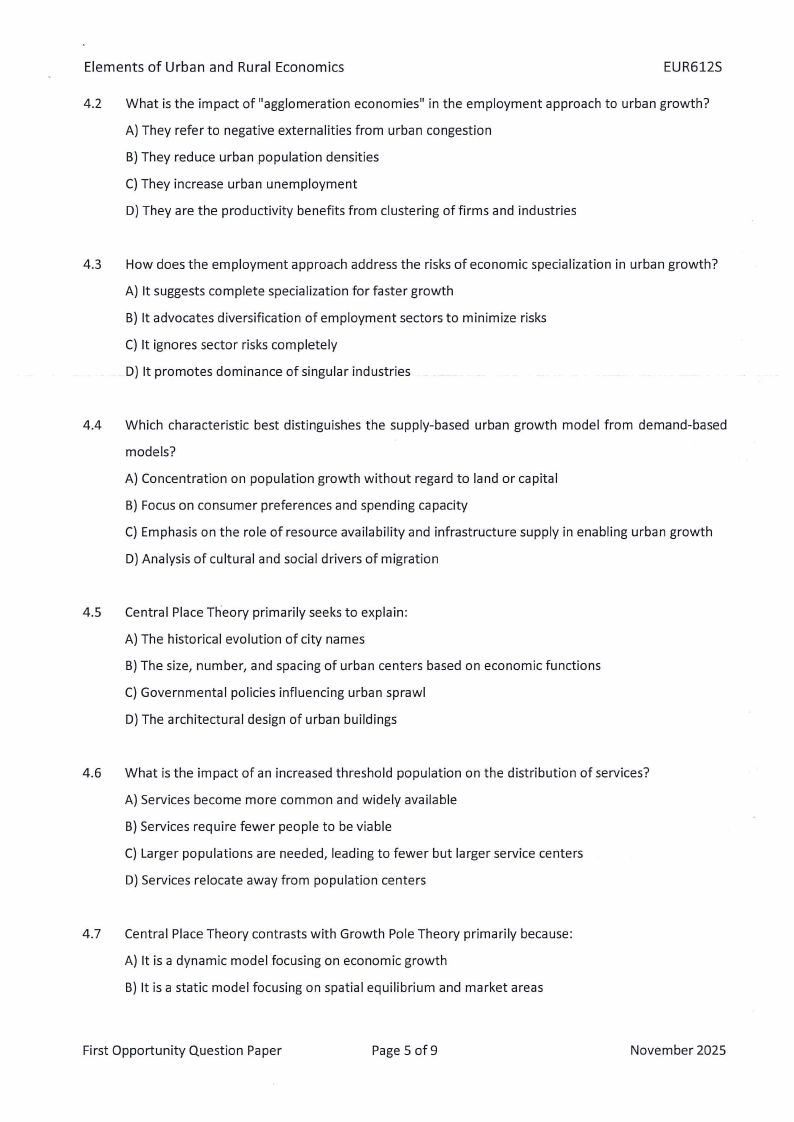
4.2 What is the impact of "agglomeration economies" in the employment approach to urban growth?
A) They refer to negative externalities from urban congestion
B) They reduce urban population densities
C} They increase urban unemployment
D) They are the productivity benefits from clustering of firms and industries
4.3 How does the employment approach address the risks of economic specialization in urban growth?
A) It suggests complete specialization for faster growth
B) It advocates diversification of employment sectors to minimize risks
C} It ignores sector risks completely
D) It promotes dominance of singular industries
4.4 Which characteristic best distinguishes the supply-based urban growth model from demand-based
models?
A) Concentration on population growth without regard to land or capital
B) Focus on consume r preferences and spending capacity
C} Emphasis on the role of resource availabi lity and infrastructure supply in enabling urban growth
D) Analysis of cultural and social drivers of migration
4.5 Central Place Theory primarily seeks to explain:
A) The historical evolution of city names
B) The size, number, and spacing of urban centers based on economic functions
C} Governmental policies influencing urban sprawl
D) The architectural design of urban buildings
4.6 What is the impact of an increased threshold population on the distribution of services?
A) Services become more common and widely available
B) Services require fewer people to be viable
C} Larger populations are needed, leading to fewer but larger service centers
D) Services relocate away from popu lation centers
4.7 Central Place Theory contrasts with Growth Pole Theory primarily because :
A) It is a dynamic model focusing on econom ic growth
B) It is a static model focusing on spatial equilibrium and market areas
First Opportunity Question Paper
Page 5 of 9
November 2025

6 Page 6

▲back to top


Elements of Urban and Rural Economics
C) It emphasizes governmental intervention in urban development
D) It centers on population migration rates
EUR612S
4.8 What urban policy focus would align best with insights from supply-based growth models?
A) Expanding infrastructure and utilities to support urban expansion
B) Increasing taxes to reduce consumer demand
C) Restricting movement from rural to urban areas
D) Privatising urban land markets without public investment
4.9 What distinguishes the income approach from other urban growth models?
A) Its focus on economic base theory
B) Its exclusive focus on transportation networks
C) Its emphasis on income and investment flows driving urban expansion
D) Its disregard for economic variables
4.10 How does income inequality impact urban growth patterns in the income approach?
A) It has no impact on urban spatial structure
B) Higher income inequality can lead to more pronounced spatial segregation and varied growth
rates
C) Income inequality automatically leads to urban decline
D) Income inequality increases uniform urban growth
4.11 What is a key limitation of the income approach when applied to urban growth prediction?
A) It ignores all economic factors
B) It relies heavily on accurate income and investment data which may be difficult to obtain
C) It assumes uniform population distribution
D) It primarily models rural development
4.12 Which of the following statements about the urbanisation process in developing countries is
generally true?
A) They follow exactly the same urbanisation stages observed in developed countries
B) Suburbanisation occurs before initial urbanisation
C) Urban populations decrease due to rural migration trends
D) They often exhibit unique patterns and may not conform to established models fully
First Opportunity Question Paper
Page 6 of 9
November 2025

7 Page 7

▲back to top


Elements of Urban and Rural Economics
EUR612S
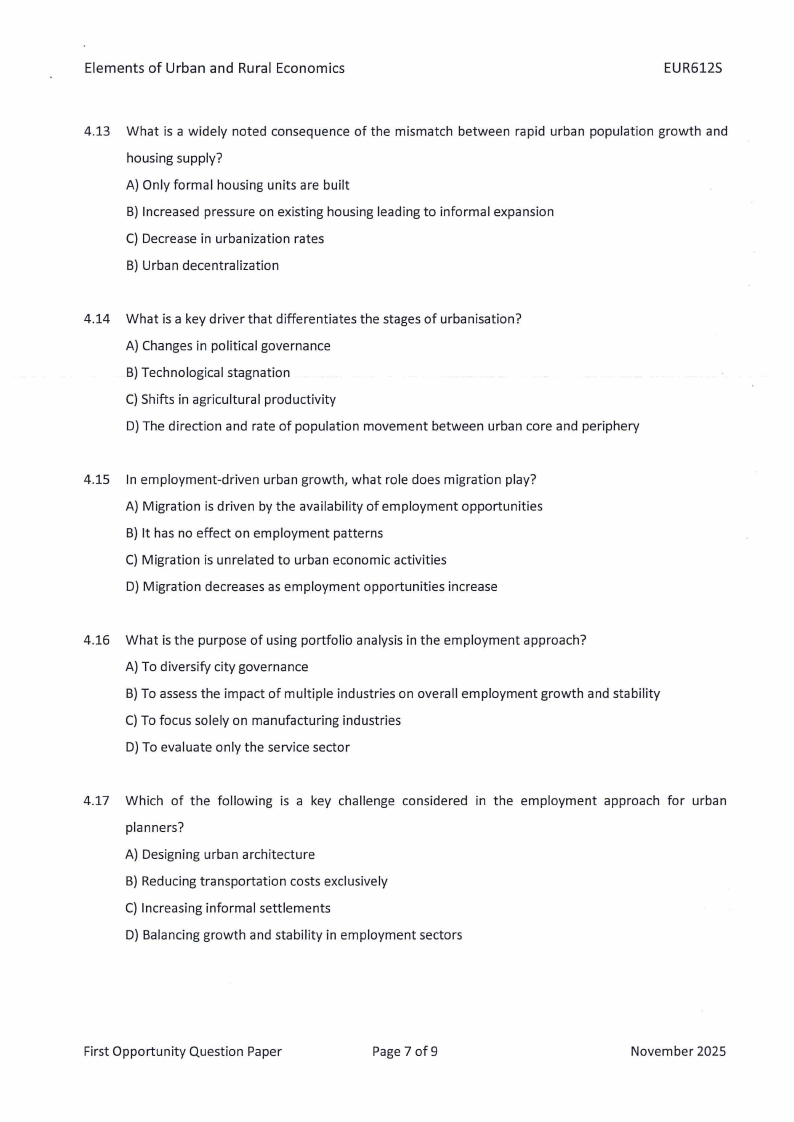
4.13 What is a widely noted consequence of the mismatch between rapid urban popu lation growth and
housing supply?
A) Only formal housing units are built
B) Increased pressure on existing housing leading to informal expansion
C} Decrease in urbanization rates
B) Urban decentralization
4.14 What is a key driver that differentiates the stages of urbanisation?
A) Changes in political governance
B) Technological stagnation
C} Shifts in agricultural productivity
D} The direction and rate of population movement between urban core and periphery
4.15 In employment-driven urban growth, what role does migration play?
A) Migration is driven by the availability of employment opportunities
B) It has no effect on employment patterns
C} Migration is unrelated to urban economic activities
D) Migration decreases as employment opportunities increase
4.16 What is the purpose of using portfolio analysis in the employment approach?
A) To diversify city governance
B) To assess the impact of multiple industries on overall employment growth and stability
C} To focus solely on manufacturing industries
D) To evaluate only the service sector
4.17 Which of the following is a key challenge considered in the employment approach for urban
planners?
A) Designing urban architecture
B) Reducing transportation costs exclusively
C} Increasing informal settlements
D) Balancing growth and stability in employment sectors
First Opportunity Question Paper
Page 7 of 9
November 2025

8 Page 8

▲back to top


Elements of Urban and Rural Economics
EUR612S
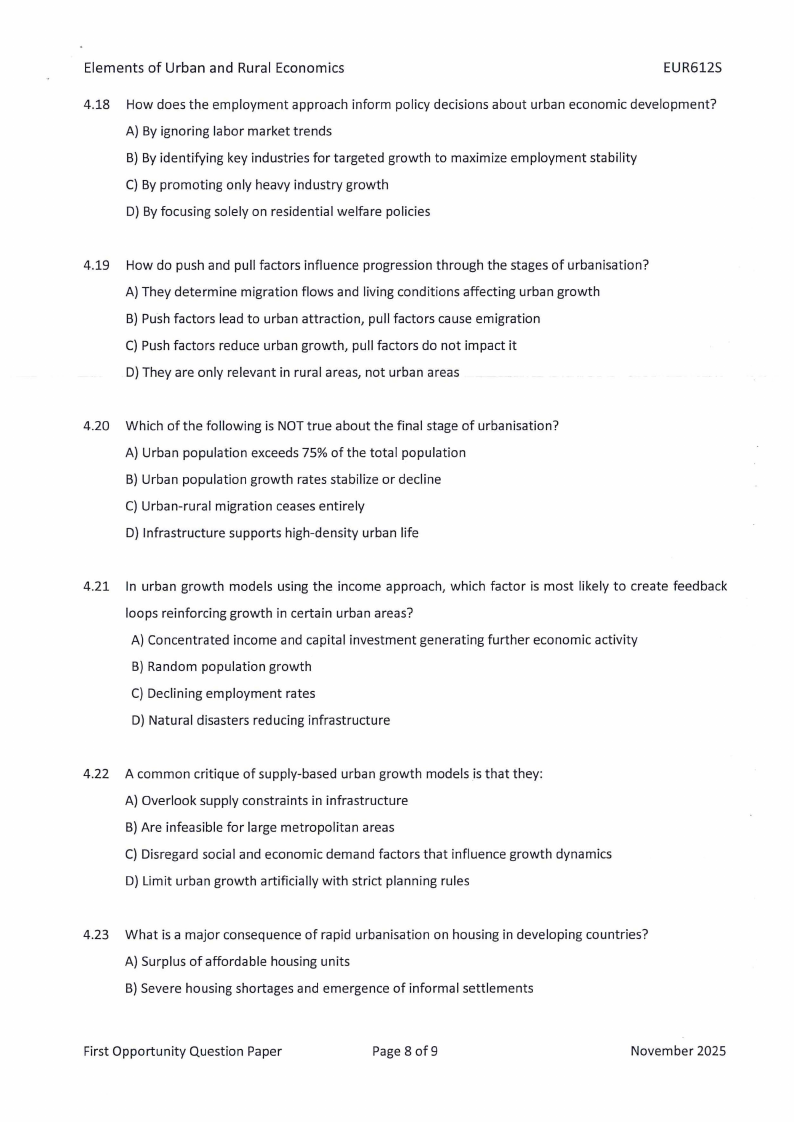
4.18 How does the employment approach inform policy decisions about urban economic development?
A) By ignoring labor market trends
B) By identifying key industries for targeted growth to maximize employment stability
C) By promoting only heavy industry growth
D) By focusing solely on residential welfare policies
4.19 How do push and pull factors influence progression through the stages of urbanisation?
A) They determine migration flows and living conditions affecting urban growth
B) Push factors lead to urban attraction, pull factors cause emigration
C) Push factors reduce urban growth, pull factors do not impact it
D) They are only relevant in rural areas, not urban areas
4.20 Which of the following is NOT true about the final stage of urbanisation?
A) Urban population exceeds 75% of the total population
B) Urban population growth rates stabilize or decline
C) Urban-rural migration ceases entirely
D) Infrastructure supports high-density urban life
4.21 In urban growth models using the income approach, which factor is most likely to create feedback
loops reinforcing growth in certain urban areas?
A) Concentrated income and capital investment generating further economic activity
B) Random population growth
C) Declining employment rates
D) Natural disasters reducing infrastructure
4.22 A common critique of supply-based urban growth models is that they:
A) Overlook supply constraints in infrastructure
B) Are infeasible for large metropolitan areas
C) Disregard social and economic demand factors that influence growth dynamics
D) Limit urban growth artificially with strict planning rules
4.23 What is a major consequence of rapid urbanisation on housing in developing countries?
A) Surplus of affordable housing units
B) Severe housing shortages and emergence of informal settlements
First Opportunity Question Paper
Page 8 of 9
November 2025

9 Page 9

▲back to top


Elements of Urban and Rural Economics
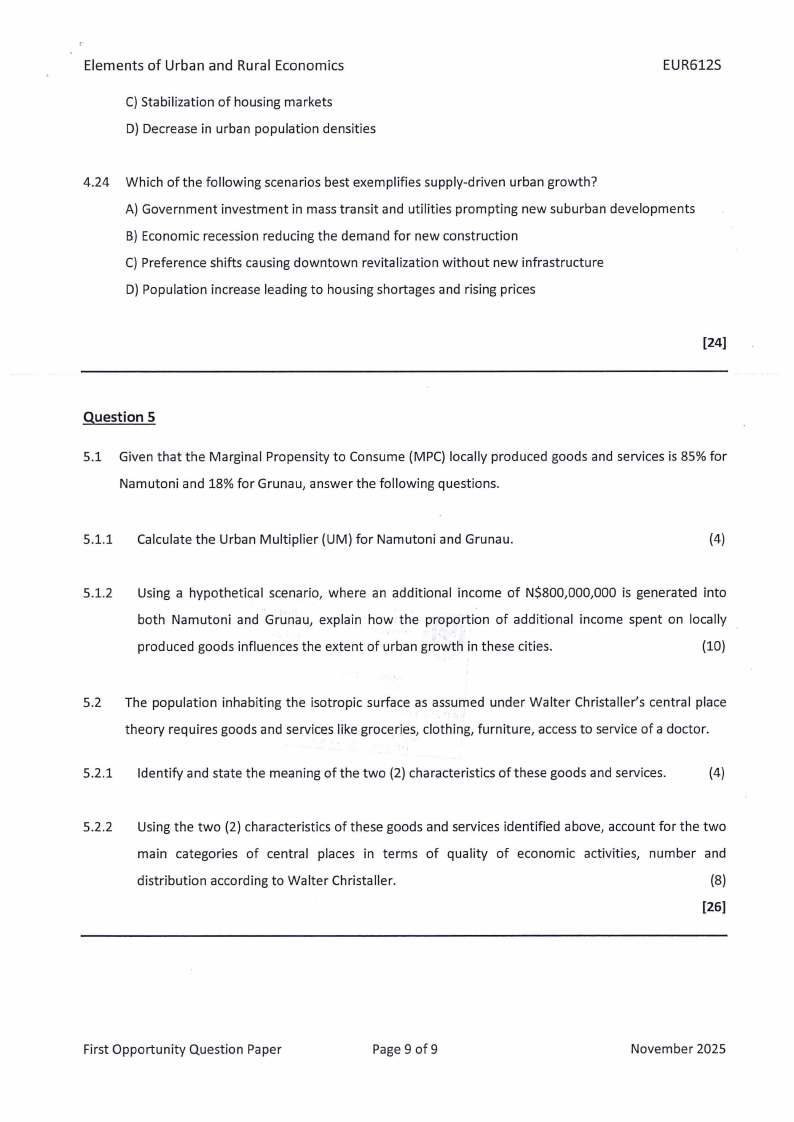
C) Stabilization of housing markets
D) Decrease in urban population densities
EUR612S
4.24 Which of the following scenarios best exempl ifies supply-driven urban growth?
A) Government investment in mass transit and utilities prompting new suburban developments
B) Economic recession reducing the demand for new construction
C) Preference shifts causing downtown revitalization without new infrastructure
D) Population increase leading to housing shortages and rising prices
[24]
Question 5
5.1 Given that the Ma rginal Propensity to Consume (MPC) locally produced goods and services is 85% for
Namutoni and 18% for Grunau, answer the following questions.
5.1.1 Calculate the Urban Multiplier (UM) for Namutoni and Grunau.
(4)
5.1.2
Using a hypothetical scenario, where an additional income of N$800,000,000 is generated into
both Namutoni and Grunau, explain how the proportion of additional income spent on locally
produced goods influences the extent of urban growth in these cities.
(10)
5.2 The population inhabiting the isotropic surface as assumed under Walter Christaller's central place
theory requ ires goods and services like groceries, clothing, furniture, access to service of a doctor.
5.2.1 Identify and state the meaning of the two (2) characteristics ofthese goods and services.
(4)
5.2.2
Using the two (2) characteristics of these goods and services identified above, account for the two
main categories of central places in terms of quality of economic activities, number and
distribution according to Walter Christa lier.
(8)
[26]
First Opportunity Question Paper
Page 9 of 9
November 2025