


 |
AUT621S-AUDITING 202-1ST OPP-NOV 2025 |
|
|
1 Page 1 |
▲back to top |
nAmlBIA unlVERSITY
OF SCIEnCE Ano TECHnOLOGY
FACULTY OF COMMERCE, HUMAN SCIENCES & EDUCATION
DEPARTMENT OF ECONOMICS, ACCOUNTING AND FINANCE
QUALIFICATION: BACHELOR OF ACCOUNTING
QUALIFICATION CODE: 07 BOAC
LEVEL: 7
COURSE CODE: AUT 621S
COURSE NAME: AUDITING 202
SESSION: OCT/NOV 2025
DURATION: 3 HOURS
PAPER: THEORY
MARKS: 100
FIRST OPPORTUNITY QUESTION PAPER
EXAMINER(S) P. ERKIE, F. SHIKOYENI AND E.N. SAKEUS
MODERATOR: DR. D. MUZIRA
INSTRUCTIONS
1. This test paper is made up of five (5) questions.
2. Answer ALL Question in blue or black ink
3. Start each question on a new page in your answer sheet
4. Questions relating to this paper may be raised in the initial 30 minutes after the
start of the paper. Thereafter, candidates must use their initiative to deal with any
perceived error or ambiguities & any assumption made by the candidate should be
clearly stated.
This question paper consists of 7 pages (including the cover page)
1
|
|
2 Page 2 |
▲back to top |
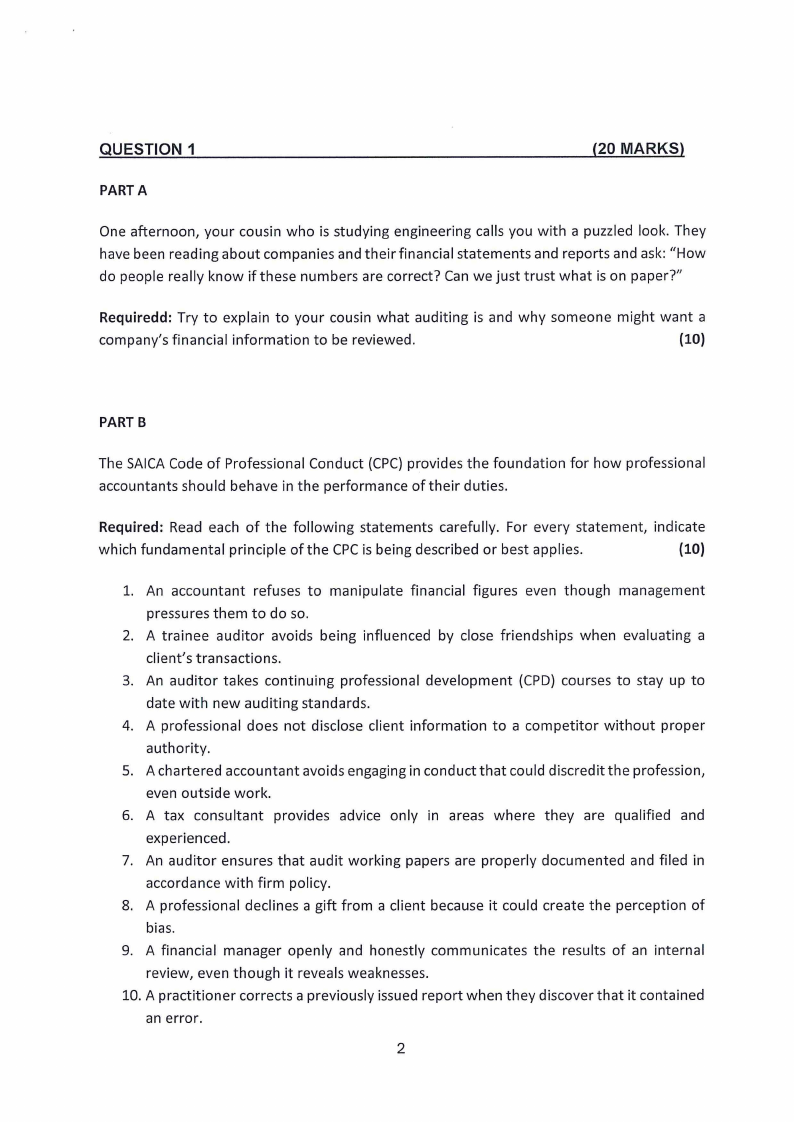
QUESTION 1
(20 MARKS)
PART A
One afternoon, your cousin who is studying engineering calls you with a puzzled look. They
have been reading about companies and their financial statements and reports and ask: "How
do people really know if these numbers are correct? Can we just trust what is on paper?"
Requiredd: Try to explain to your cousin what auditing is and why someone might want a
company's financial information to be reviewed .
(10)
PARTB
The SAICA Code of Professional Conduct (CPC) provides the foundation for how professional
accountants should behave in the performance of their duties.
Required: Read each of the following statements carefully. For every statement, indicate
which fundamental principle of the CPC is being described or best applies.
(10)
1. An accountant refuses to manipulate financial figures even though management
pressures them to do so.
2. A trainee auditor avoids being influenced by close friendships when evaluating a
client's transactions.
3. An auditor takes continuing professional development (CPD) courses to stay up to
date with new auditing standards.
4. A professional does not disclose client information to a competitor without proper
authority.
5. A chartered accountant avoids engaging in conduct that could discredit the profession,
even outside work.
6. A tax consultant provides advice only in areas where they are qualified and
experienced.
7. An auditor ensures that audit working papers are properly documented and filed in
accordance with firm pol icy.
8. A professional declines a gift from a cl ient because it could create the perception of
bias.
9. A financial manager openly and honestly communicates the results of an internal
review, even though it reveals weaknesses.
10. A practitioner corrects a previously issued report when they discover that it contained
an error.
2
|
|
3 Page 3 |
▲back to top |
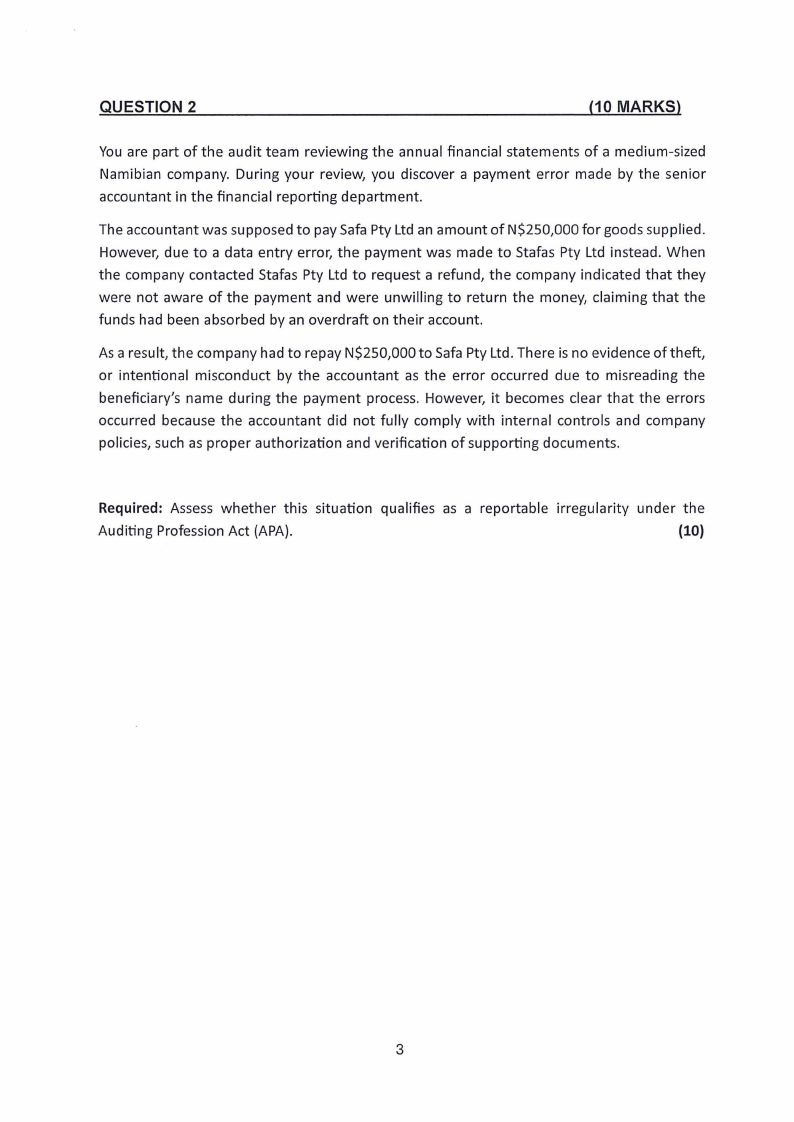
QUESTION 2
(10 MARKS)
You are part of the audit team reviewing the annual financial statements of a medium-sized
Namibian company. During your review, you discover a payment error made by the senior
accountant in the financial reporting department.
The accountant was supposed to pay Safa Pty Ltd an amount of N$250,000 for goods supplied.
However, due to a data entry error, the payment was made to Stafas Pty Ltd instead. When
the company contacted Stafas Pty Ltd to request a refund, the company indicated that they
were not aware of the payment and were unwilling to return the money, claiming that the
funds had been absorbed by an overdraft on their account.
As a result, the company had to repay N$250,000to Safa Pty Ltd. There is no evidence of theft,
or intentional misconduct by the accountant as the error occurred due to misreading the
beneficiary's name during the payment process. However, it becomes clear that the errors
occurred because the accountant did not fully comply with internal controls and company
policies, such as proper authorization and verification of supporting documents.
Required: Assess whether this situation qualifies as a reportable irregularity under the
Auditing Profession Act (APA}.
{10)
3
|
|
4 Page 4 |
▲back to top |
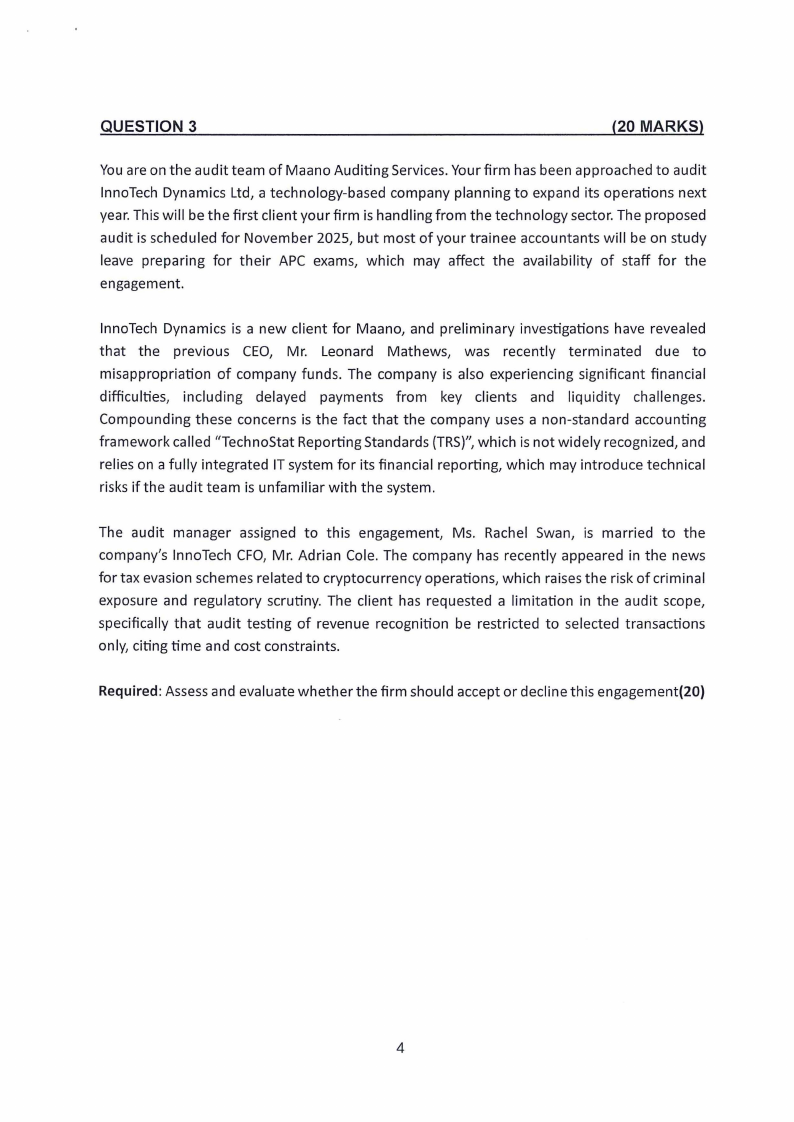
QUESTION 3
(20 MARKS)
You are on the audit team of Maano Auditing Services. Your firm has been approached to audit
lnnoTech Dynamics Ltd, a technology-based company planning to expand its operations next
year. This will be the first client your firm is handling from the technology sector. The proposed
audit is scheduled for November 2025, but most of your trainee accountants will be on study
leave preparing for their APC exams, which may affect the availability of staff for the
engagement.
lnnoTech Dynamics is a new client for Maano, and preliminary investigations have revealed
that the previous CEO, Mr. Leonard Mathews, was recently terminated due to
misappropriation of company funds. The company is also experiencing significant financial
difficulties, including delayed payments from key clients and liquidity challenges.
Compounding these concerns is the fact that the company uses a non-standard accounting
framework called "TechnoStat Reporting Standards (TRS}", which is not widely recognized, and
relies on a fully integrated IT system for its financial reporting, which may introduce technical
risks if the audit team is unfamiliar with the system.
The audit manager assigned to this engagement, Ms. Rachel Swan, is married to the
company's lnnoTech CFO, Mr. Adrian Cole. The company has recently appeared in the news
for tax evasion schemes related to cryptocurrency operations, which raises the risk of criminal
exposure and regulatory scrutiny. The client has requested a limitation in the audit scope,
specifically that audit testing of revenue recognition be restricted to selected transactions
only, citing time and cost constraints.
Required: Assess and evaluate whether the firm should accept or decline this engagement(20}
4
|
|
5 Page 5 |
▲back to top |

QUESTION 4
(10 MARKS)
SCENARIO: BOARD COMPOSITION AT MANPOWER RESOURCES LTD
ManPower Resources Ltd is a listed Namibian energy company operating primarily in the
Erongo and Kunene regions. The company recently underwent a restructuring process and is
aiming to align with the principles of the King IV Report on Corporate Governance and the
requirements of the Namibian Stock Exchange (NSX).
As part of this process, attention has been placed on the composition of the Governing body
committee. Below is the current structure of the governing body:
Name
Paulus Amutenya
Johan van Wyk
Thomas lilonga
Michael Beukes
Simon Nghitila
Peter de Villiers
Elias Haufiku
Willem Botha
Anna Shilongo
Helena Swart
Role on the Governing Body
Chair (Independent Non-Executive)
Independent Non-Executive
Independent Non-Executive
Independent Non-Executive
Independent Non-Executive
Non-Executive
Non-Executive
Non-Executive
Non-Executive
Executive - CFO
Race
Black
White
Black
White
Black
White
Black
White
Black
White
Gender
Male
Male
Male
Male
Male
Male
Male
Male
Female
Female
Required: Critically comment on the composition of the governing body of NamPower
Resources Ltd.
(10)
5
|
|
6 Page 6 |
▲back to top |
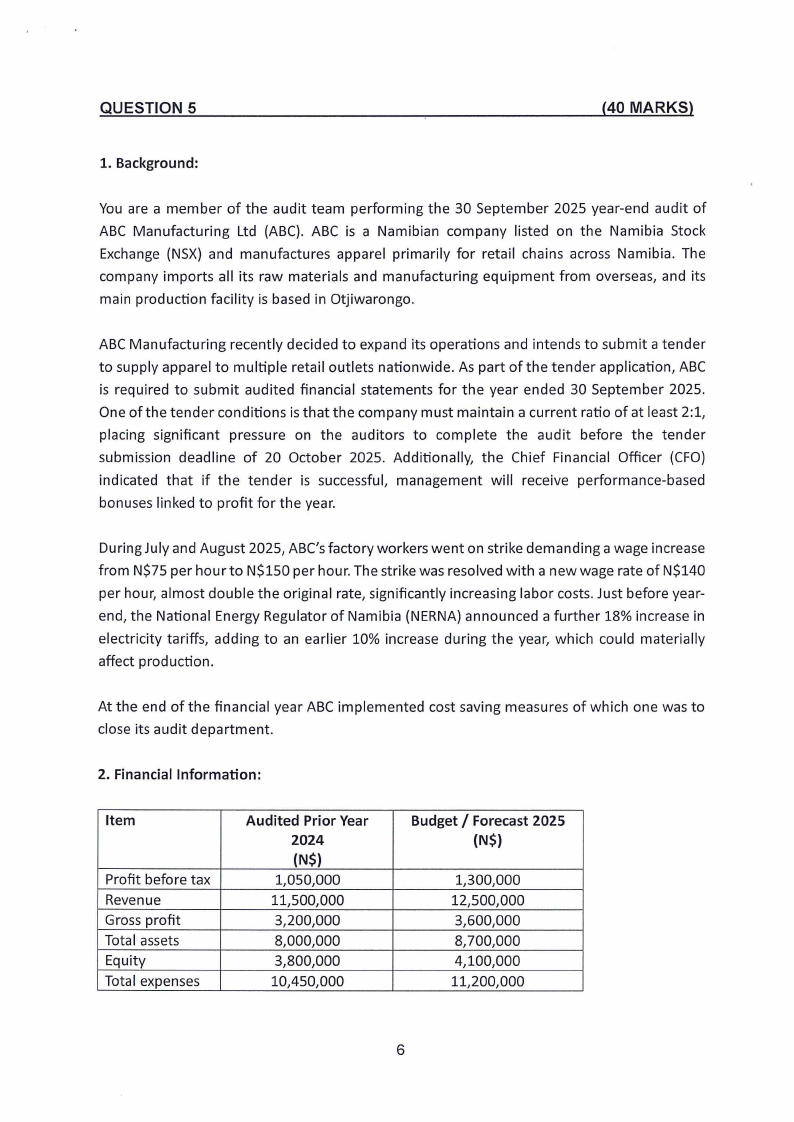
QUESTION 5
(40 MARKS)
1. Background:
You are a member of the audit team performing the 30 September 2025 year-end audit of
ABC Manufacturing Ltd {ABC). ABC is a Namibian company listed on the Namibia Stock
Exchange {NSX) and manufactures apparel primarily for retail chains across Namibia. The
company imports all its raw materials and manufacturing equipment from overseas, and its
main production facility is based in Otjiwarongo.
ABC Manufacturing recently decided to expand its operations and intends to submit a tender
to supply apparel to multiple retail outlets nationwide. As part of the tender application, ABC
is required to submit audited financial statements for the year ended 30 September 2025.
One of the tender conditions is that the company must maintain a current ratio of at least 2:1,
placing significant pressure on the auditors to complete the audit before the tender
submission deadline of 20 October 2025. Additionally, the Chief Financial Officer {CFO)
indicated that if the tender is successful, management will receive performance-based
bonuses linked to profit for the year.
During July and August 2025, ABC's factory workers went on strike demanding a wage increase
from N$75 per hour to N$150 per hour. The strike was resolved with a new wage rate of N$140
per hour, almost double the original rate, significantly increasing labor costs. Just before year-
end, the National Energy Regulator of Namibia {NERNA) announced a further 18% increase in
electricity tariffs, adding to an earlier 10% increase during the year, which could materially
affect production.
At the end of the financial year ABC implemented cost saving measures of which one was to
close its audit department.
2. Financial Information:
Item
Profit before tax
Revenue
Gross profit
Total assets
Equity
Total expenses
Audited Prior Year
2024
(N$)
1,050,000
11,500,000
3,200,000
8,000,000
3,800,000
10,450,000
Budget/ Forecast 2025
(N$)
1,300,000
12,500,000
3,600,000
8,700,000
4,100,000
11,200,000
6
|
|
7 Page 7 |
▲back to top |
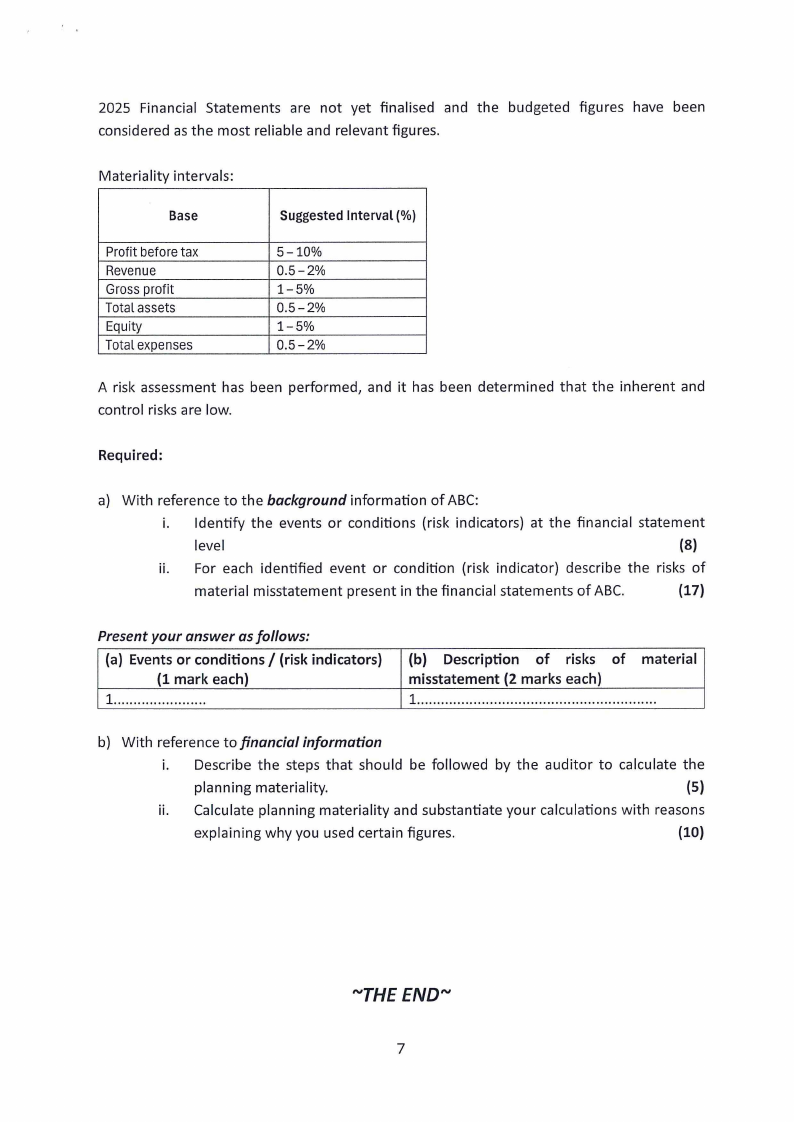
2025 Financial Statements are not yet finalised and the budgeted figures have been
considered as the most reliable and relevant figures.
Materiality intervals:
Base
Profit before tax
Revenue
Gross profit
Total assets
Equity
Total expenses
Suggested Interval(%)
5-10%
0.5-2%
1-5%
0.5-2%
1-5%
0.5-2%
A risk assessment has been performed, and it has been determined that the inherent and
control risks are low.
Required:
a) With reference to the background information of ABC:
i. Identify the events or conditions {risk indicators) at the financial statement
level
(8)
ii. For each identified event or condition {risk indicator) describe the risks of
material misstatement present in the financial statements of ABC.
(17}
Present your answer as follows:
(a) Events or conditions/ (risk indicators)
(1 mark each)
1 .......................
(b) Description of risks of material
misstatement (2 marks each)
1..................... ... .. ... ............................. .
b) With reference to financial information
i. Describe the steps that should be followed by the auditor to calculate the
planning materiality.
(5)
ii. Calculate planning materiality and substantiate your calculations with reasons
explaining why you used certain figures.
(10}
~rHE END~
7