


 |
DPS610S - DEMOGRAPHY AND POPULATION STUDIES - 2ND OPP - JULY 2025 |
|
|
1 Page 1 |
▲back to top |

nAmlBIA UnlVERSITY
OF SCIEnCE Ano TECHnOLOGY
FACULTYOF ENGINEERINGAND THE BUILTENVIRONMENT
DEPARTMENT OF ARCHITECTURE, PLANNING AND CONSTRUCTION
QUALIFICATION: BACHELOR OF TOWN AND REGIONAL PLANNING
QUALIFICATION CODE: 07BTAR
NQF LEVEL: 6
COURSE CODE: DPS610S
COURSE NAME: DEMOGRAPHY AND
POPULATION STUDIES
DATE: JULY 2025
PAPER: THEORY
DURATION: 3 HOURS
MARl<S: 100
SECOND OPPORTUNITY/ SUPPLEMENTARY EXAMINATION QUESTION PAPER
EXAMINER
Dr J. Kohima
MODERATOR
Prof E. Yankson
NOTES:
1. Read the entire question paper before answering the questions.
2. You must answer all questions.
3. Please number your answers correctly in an orderly manner.
4. Please write clearly and legibly.
5. Ensure your Student Number is on the Examination Book(s).
THIS QUESTION PAPER CONSISTS OF 4 PAGES (Including this front page)
|
|
2 Page 2 |
▲back to top |
Demography and Population Studies
DPS610S
Question 1
(a) A way of looking at changes in population composition is through population pyramids.
Differentiate between constrictive and expansive population pyramids by providing
pyramid sketches.
(10)
(b) Census and surveys are two sources of demographic data. Formulate a table comparing
census to surveys.
(10)
[20]
Question 2
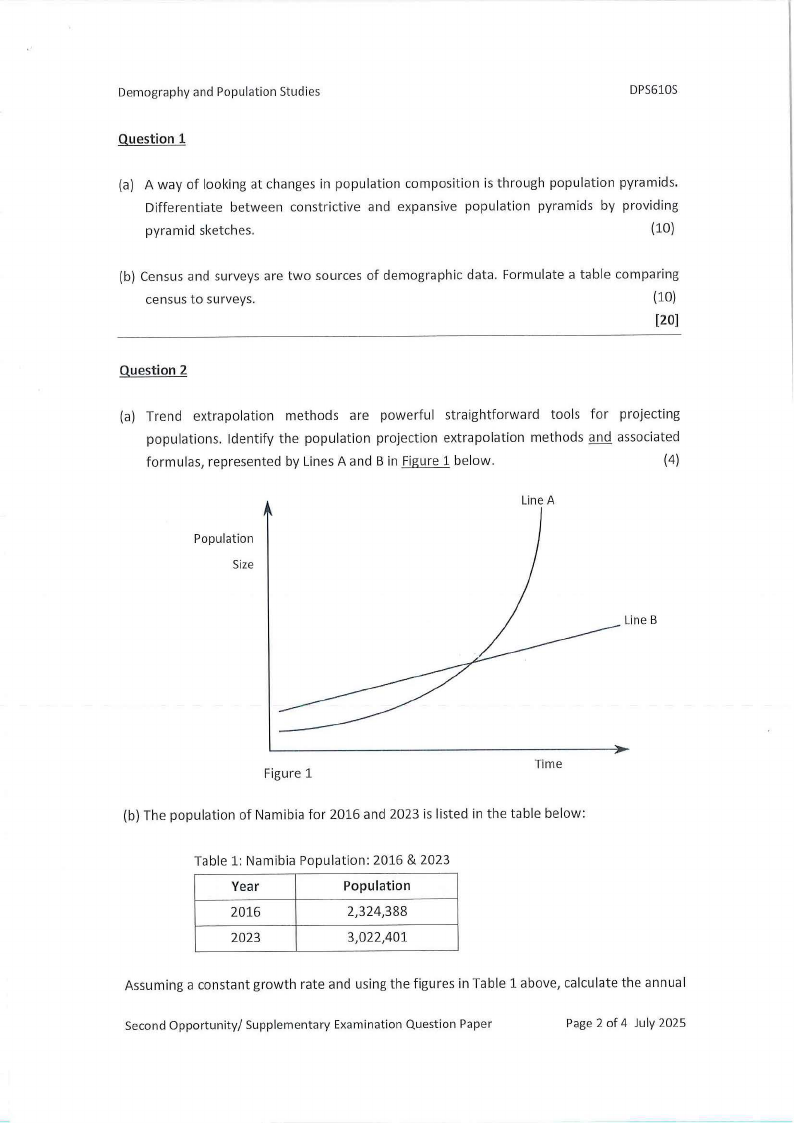
(a) Trend extrapolation methods are powerful straightforward tools for projecting
populations. Identify the population projection extrapolation methods and associated
formulas, represented by Lines A and Bin Figure 1 below.
(4)
Line A
Population
Size
Line B
Figure 1
Time
(b) The population of Namibia for 2016 and 2023 is listed in the table below:
Table 1: Namibia Population: 2016 & 2023
Year
Population
2016
2,324,388
2023
3,022,401
Assuming a constant growth rate and using the figures in Table 1 above, calculate the annual
Second Opportunity/ Supplementary Examination Question Paper
Page 2 of 4 July 2025
|
|
3 Page 3 |
▲back to top |
Demography and Population Studies
DPS610S
growth rate in percentage using the most preferred method of trend extrapolation. Please
show the formula and all calculation steps and round of your answers to two decimal points.
(S}
(c} Using the most preferred trend extrapolation projection method and the data in Table 1
above, find out what Namibia's population will be in 2030. Round off to the nearest whole
number.
(5)
(d} Population projection can be classified into two classes.
(i} Identify the projection class that urban planners are advised not to rely on.
(1)
(ii) Explain briefly, in two sentences, why urban planners are not encouraged to use the
projection class you identified in Question 2(c}(i).
(2}
(e} The central government is offering grants for one public bus for each growing settlement,
with an estimated population of 10,000 or more by 2030. You have been instructed by
your mayor to estimate the number of people who will be in your settlement in 2030, in
order to enable your settlement to apply for that grant. Based on your estimation, the
population of your settlement will decrease from 2,500 to 1,500 in 2030.
The mayor was not happy with your projections, and subsequently informed you that you
should change the population projections to reflect that your settlement will have over
10,000 people by 2030; in order to secure the central government grant for the public
bus. The mayor further threatened that he will bring you down through your Chief
Executive Officer if you did not change the population projections.
(i) From an ethical approach, indicate if you will decide to change or not change the
population projection figures.
(1}
(ii) Motivate the decision you provided in Question 2(d}(i}, in seven brief statements. (7)
(f} A town planner wishes to project the population of a town for the next decade, and is
not sure of what projection method to use. Outline seven factors that can affect the town
planner's choice of population projection methods.
(7}
[32)
Second Opportunity/ Supplementary Examination Question Paper
Page 3 of 4 July 2025
|
|
4 Page 4 |
▲back to top |
Demography and Population Studies
DPS610S
Question 3
(a) It is important to analyse the population or demographic profile of an area during the
planning process. In seven brief statements, explain why it is essential for urban planners
in the public sector to consider population analyses.
(7)
(b) Businesses use population and demographic data to identify profitable locations for
goods and services. Pinpoint three ways through which the private sector can identify
profitable locations for goods and services.
(3)
(c) You have been appointed as a Public Health Planner at the Ministry of Health and Social
Services. Discuss the steps that you will follow to ensure that health facilities are
equitably allocated in Region X.
(10}
(d) Data forecasts, including population projections, are used in the planning process and in
the location of various public facilities. Explain briefly why it is difficult to investigate
professional ethics in planning data forecasts.
(4)
[24]
Question 4
(a) According to a certain population theory, as technology advances in various fields, birth
and death rates shift, directly impacting the population numbers and growth rates.
Demonstrate this theory in a graphic format.
(13)
(b) One theorist analysed the prevailing situation in different countries, as part of his essay
titled "An Essayon the Principle of Populations as it affects the Future Improvement of
Society." Critique, in seven (7) statements, the theorist's perspectives on population. (7)
(c) International migration can be explained through various theories. Identify four (4)
theories that explain international migration.
(4)
[24]
TOTAL MARKS= 100
Second Opportunity/ Supplementary Examination Question Paper
Page 4 of 4 July 2025